

The liveliest game for adults isn’t always the loudest one. Games for group interaction adults enjoy most match the group’s mood: a few new faces may appreciate easy conversation starters, while close friends might be ready for playful competition or vocal silliness. If a game feels childish, complicated, or too personal, even a good gathering can lose its spark.
You’re right to look beyond party size. The kind of interaction matters just as much, especially when guests have different comfort levels and social energy. A useful way to choose is to picture the first few minutes of play: Will guests talk through a prompt, laugh over a word challenge, or work toward a shared goal? The right activity gives people a natural way to join in without a long setup or putting anyone on the spot.
This guide compares light icebreakers, conversation games, party challenges, cooperative play, and active options, with tips for matching each style to your occasion. You’ll also find ways to make the choice welcoming for quieter guests and high-energy players. Conversation-starting games such as Really Fun Games’ Really?! Think You Know Me? Guess Again! and vocal-play favorites like Triple Tongue Twisters offer different ways to bring adults together through play.
Key Takeaways
- Choose a game by the interaction you want, such as easy conversation, playful word challenges, teamwork, or movement.
- For Games for group interaction adults will enjoy, weigh the gathering’s purpose, guests’ comfort levels, and overall energy.
- Make participation welcoming with a simple introduction, clear instructions, and an easy first step.
- Use conversation prompts to encourage sharing, or try vocal play when the group is ready for a more energetic laugh.
- Explore Really Fun Games’ conversation and wordplay options to find an activity that fits your group.
Why Group Interaction Games Matter for Adults
A room full of adults can still feel surprisingly quiet. Friends may arrive with different stories, coworkers may stick to familiar circles, and relatives who haven’t seen each other in a while may default to the same small-talk questions. Games give everyone a shared focus, so conversation has somewhere to begin besides a round of introductions. Players can react to the same prompt, idea, or challenge, then let laughter and follow-up questions happen naturally.
An adult group interaction game is a shared activity that gives people an enjoyable reason to communicate, collaborate, or laugh together. The format matters, but so does the gathering’s purpose. At a casual get-together, play can make it easier to mingle. A structured team-building activity may instead give coworkers a chance to listen, compare ideas, or work toward a common goal. A game doesn’t guarantee instant closeness or better teamwork; it creates an opportunity for people to interact in a different way.
That opportunity makes sense through the lens of understanding group dynamics: people respond not only to an activity, but also to the relationships and expectations already present. A shared focus can shift attention away from “What should I say?” and toward what everyone is doing together. The best games for group interaction adults can enjoy leave room for different personalities instead of demanding that everyone perform in the same way.
What makes a group activity feel welcoming rather than awkward?
Low-pressure participation starts with clear expectations. Explain the activity simply, let people know they can pass or listen, and avoid requiring personal disclosures. Imagine a gathering where some guests know each other and others are new. A light prompt or playful challenge gives everyone the same starting point. Someone can answer briefly, listen, or build on another person’s response. That shared moment can ease conversation without forcing instant familiarity.
Which adult groups can benefit from playing together?
Friends might choose a lively activity that adds a new twist to a familiar night. Relatives may enjoy prompts that bring out stories across generations, while coworkers might prefer a collaborative format with a clear shared task. Clubs and community groups can use play to help newcomers join an existing circle. The less familiar the group, the more useful it is to choose a simple activity that doesn’t depend on inside jokes or personal stories. Close friends may be ready for more playful or revealing prompts, if that suits them.
Before choosing, consider what would feel like a good outcome for this gathering:
- Friends or relatives: Look for a relaxed spark for conversation and shared laughter.
- Colleagues: Decide whether the aim is informal connection or a more structured team activity.
- Clubs or community groups: Choose a format that lets newcomers take part without needing inside knowledge.
For adults who want conversation with a playful focus, Really?! Think You Know Me? Guess Again! is one option from Really Fun Games. Explore the card and conversation games to find an activity suited to your gathering.
Compare Conversation, Wordplay, and Team Games for Adults
The best format depends on how you want people to interact, not simply how many guests are in the room. A small group can feel lively or reserved; a larger one can be comfortable with conversation if people have clear ways to join. Consider whether your guests would rather share perspectives, play with language, solve something together, or get moving.
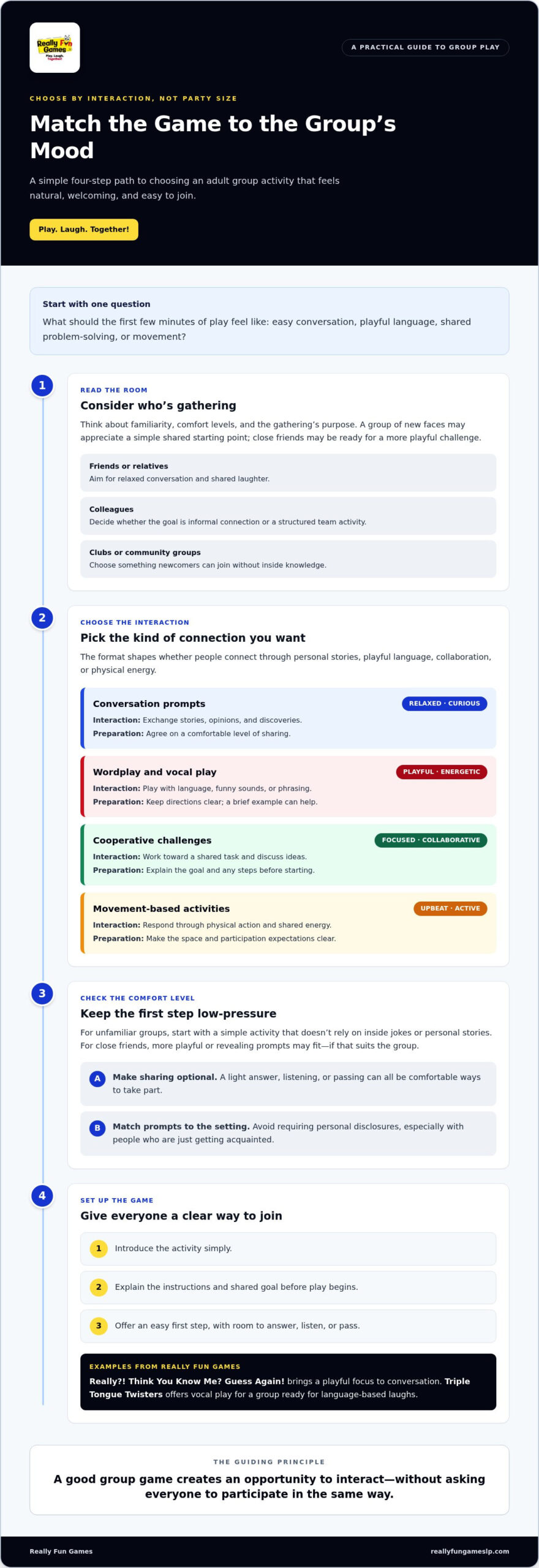
A game’s format shapes whether a group connects through personal stories, playful language, shared problem-solving, or movement. Use this comparison to match the activity to the mood, then adjust for the people in the room.
| Format | Interaction style | Preparation | Suitable group mood |
|---|---|---|---|
| Conversation prompts | Exchanging stories, opinions, and discoveries | Usually light; agree on a comfortable level of sharing | Relaxed, curious, or getting acquainted |
| Wordplay and vocal play | Playing with language and enjoying funny sounds or phrasing | Keep directions clear; a brief example can help | Playful, energetic, or ready to laugh |
| Cooperative challenges | Working toward a shared task and discussing ideas | Explain the goal and any steps before starting | Focused, collaborative, or eager to solve a problem |
| Movement-based activities | Responding through physical action and shared energy | Make the space and participation expectations clear | Upbeat, active, and comfortable with movement |
When do conversation games suit an adult gathering?
Choose conversation-based formats when guests are in the mood to trade stories, offer opinions, or discover something unexpected about one another. A good prompt invites discussion without demanding a private confession. Players should be able to answer lightly, pass, or simply listen. For unfamiliar groups, icebreaker games can offer a gentle first step into conversation. Before playing, consider whether prompts feel appropriate for the setting and the people attending.
When is wordplay or a collaborative challenge a better fit?
Wordplay shifts attention from personal perspectives to language itself, making it a lively choice for groups that want shared amusement without a deep conversation. Really Fun Games’ Triple Tongue Twisters is a vocal-play option. A cooperative challenge suits guests who enjoy having a common task to focus on; discussion grows from comparing ideas and working together, rather than answering personal prompts.
Before choosing, ask what participation will feel like for the least familiar or most reserved guest. A larger group doesn’t automatically need an active game, and a small group doesn’t automatically want personal questions. Look for a format that makes joining feel natural, whether that means talking, listening, laughing, or contributing to a shared task. For conversation and wordplay options, explore Really Fun Games’ card games and choose a style that fits your gathering.
How to Choose Games for Group Interaction Adults Will Enjoy
Start with the experience you want, not the label on the box. A connection-focused evening calls for a different feel than a lively celebration or a shared problem-solving session. Choosing Games for group interaction adults will enjoy becomes simpler when you consider four things: purpose, social comfort, energy, and preferred interaction.
What should you consider before choosing an adult group game?
First, name the mood: relaxed conversation, lively laughter, or a chance to work through a challenge together. Then think about how well guests know one another. If people are still getting comfortable, avoid formats that put individuals on the spot or depend on private stories. Finally, consider how the activity is explained and how guests take part. Clear directions and flexible participation can make joining feel easier.
Separate the choices you can make as host from the details you can learn by reading the game instructions. You can assess the group’s purpose, comfort, and energy in advance. Then review how to begin and what participation involves, so you can choose a format that suits the occasion and explain it clearly.
How can you match a game to the occasion?
Let the group’s preference lead. A vocal-play option such as Triple Tongue Twisters may suit adults looking for language-based laughs, while connection-focused guests may prefer a conversation game such as Really?! Think You Know Me? Guess Again!. Explore Really Fun Games to find a playful option that fits the mood you’re hoping to create.
How to Set Up an Inclusive, Low-Pressure Group Game
A welcoming game night doesn’t need a big speech or a perfect host. A little structure helps guests understand what’s happening, while a relaxed tone gives them room to join at their own pace. Use this simple sequence to get play underway:
- Introduce the purpose. Say whether the activity is meant to spark conversation, share a laugh, or give everyone a common challenge.
- Explain participation. Make it clear how people can take part, including whether listening or passing is okay.
- Begin simply. Start with one easy turn or a quick example instead of explaining every possibility up front.
- Check the group’s energy. Notice whether people seem engaged, unsure, or ready for a change, then adjust without making anyone the focus.
Clear expectations help group play feel welcoming because people know what’s being asked of them and can choose how to join. That matters when a group includes people with different levels of familiarity or enthusiasm. The goal isn’t to get every person speaking at once. It’s to make participation available, not demanded.
How can a host help everyone feel comfortable joining in?
Offer a warm invitation, then let the activity do the work. Avoid calling on a quiet guest or asking anyone to share something personal to prove they’re participating. Model a lighthearted response and show that imperfect answers, laughter, and experimentation are all part of the fun. If attention begins to drift, pause naturally, switch activities, or return to conversation.
What makes game instructions easier to follow?
Lead with the aim, then explain only the steps people need to start. If the format might be unclear, demonstrate one sample turn before play begins. Save extra details for questions that come up rather than front-loading every possible variation. Short explanations and smooth transitions leave more room for the interaction everyone came to enjoy.
Avoid turning setup into a second activity. Keep game materials within easy reach, make sure everyone can hear the directions, and give people a moment to settle before beginning. If someone asks a question, answer briefly and return attention to the shared activity. For a conversation game, remind guests that a prompt is an invitation, not a requirement to reveal something private. For wordplay, a sample can show the tone without putting anyone on the spot.
Choosing Games for group interaction adults will enjoy is only part of hosting; the way you introduce the game also shapes how comfortable it feels. Watch for signs of energy: quick responses, laughter, and guests building on one another’s ideas suggest the format is working. Long pauses or people turning away may mean it’s time to simplify, take a break, or invite the group to choose what comes next. Keep the adjustment casual. A change of pace is a normal part of a gathering, not a sign that anyone has failed.
For a ready-to-play option that gives adults a shared focus, explore Really Fun Games’ conversation and wordplay games.
Bring Adults Together with Really Fun Games
A good group game gives guests something enjoyable to do together, whether they’re catching up with friends, gathering with relatives, or meeting new people. Really Fun Games offers award-winning card and conversation games designed to encourage communication and playful interaction. The collection includes conversation and wordplay options for hosts looking for an activity with a clear focus beyond generic party entertainment.
Which Really Fun Games examples fit an adult group?
For a gathering centered on conversation, Really?! Think You Know Me? Guess Again! is a conversation-game option. It can suit hosts looking for an activity that makes room for people to exchange thoughts and discover what others think, without turning the evening into a formal discussion.
If your group would rather play with language, Triple Tongue Twisters brings vocal-play fun to the table. It’s a different kind of shared experience: the focus is on wordplay rather than exchanging personal perspectives. Neither option depends on an adults-only theme. Really Fun Games’ titles are designed for ages 8 and up, so these examples can also fit mixed-age gatherings where adults and younger players are together.
Think about the people who’ll be there, not just the occasion on the invitation. A family get-together may call for an activity that welcomes different generations, while a group of friends might be eager for a lively, language-focused change of pace. For colleagues or community groups, consider whether guests would prefer conversation or vocal play, and choose the style that feels comfortable for the people in the room.
How can you choose a game for your next gathering?
Use three quick questions to narrow the options:
- What should the activity add? Choose a conversation game if guests want to share perspectives, or wordplay if the aim is lighthearted vocal fun.
- How familiar is the group? Consider whether people are already comfortable together or would appreciate an easy shared starting point.
- What kind of participation feels right? Think about whether your guests enjoy speaking, listening, experimenting with words, or a mix of styles.
Then look at the game description and instructions so you know what to expect before the gathering. A clear match between the group’s mood and the activity can make it easier to get started and help the game feel like a natural part of the occasion. Browse the card and conversation game collection to compare options for your group.
Whether you’re planning a relaxed evening or a gathering filled with playful energy, choose the experience your guests are most likely to enjoy. Explore games for your next gathering and find a Really Fun Games option that brings conversation, wordplay, and shared laughter to the table.
Make Your Next Gathering a Little More Connected
The right game doesn’t need to transform a room all at once. It can give guests a fresh way to join the conversation, share a laugh, or discover a new side of someone they already know. For your next gathering, choose the kind of moment you’d like to create, then pick an activity that feels natural for the people coming together. That’s the heart of finding Games for group interaction adults will genuinely want to play.
Keep the invitation light, make space for different ways to participate, and let the group’s energy guide what happens next. A relaxed prompt may open the door to an unexpected story; playful wordplay may spark laughter that carries into the rest of the evening. Small shared moments can give a gathering its own memorable rhythm.
Ready to choose an activity for your group? Explore the Really Fun Games collection and find a playful fit for your next get-together. Here’s to easy conversation, joyful surprises, and time well spent together.
Frequently Asked Questions
What are good games for group interaction among adults?
Good options are easy to bring into the room and don’t require guests to stop everything else to participate. For Games for group interaction adults can enjoy at an informal gathering, consider whether people can see the materials, hear the instructions, and take turns comfortably. Read the directions before guests arrive so you can explain the first step clearly and spot anything that may need extra explanation or a quieter setting.
How do you get adults to participate in a group game?
Make the first step small: invite guests to watch a sample turn, help read a prompt, or join a pair before taking part in front of the whole group. This gives people a chance to understand the activity before deciding how involved they want to be. If guests are arriving at different times, briefly explain the game again so newcomers can join without interrupting the flow.
Are conversation games suitable for adults who do not know each other?
They can be, especially if the group has a shared setting to draw from. At a volunteer gathering, for example, guests might discuss what brought them to the event or what they’re looking forward to doing. Shared context gives people an easy starting point without assuming they know one another’s background. As host, preview the prompts and skip any that feel too specific for the group.
What games work for adults who dislike icebreakers?
Make the activity part of the gathering rather than presenting it as a formal exercise. You might leave a game available during a relaxed break, with no announcement that everyone needs to take a turn. Guests can join when they’re curious or keep chatting nearby. That casual setup can suit people who dislike being singled out or asked to introduce themselves on demand.
Can card games help adults connect at a party?
They can create a natural gathering point, particularly during a lull between planned activities. Place the game where guests can comfortably see and reach it, and keep the surrounding space open so people can come and go. If the party includes music or several conversations, choose a spot where players can hear one another. A host can welcome latecomers by briefly explaining what’s happening.
Are games for adults also suitable for mixed-age groups?
Really Fun Games’ titles are designed for ages 8 and up. For a mixed-age gathering, consider the needs of the youngest players and whether the activity feels comfortable for everyone. It can help to have an adult nearby to clarify unfamiliar words or read directions aloud. You can also let younger and older guests pair up if that suits the activity.
How do I choose between a conversation game and a party game?
Think about the shape of the event as well as its mood. If guests will be moving between dinner, music, and other activities, a format that can be picked up and paused may fit more smoothly. If you’ve set aside a quieter stretch for one shared activity, choose something that gives the group room to focus. A quick look at the instructions can help you plan where it fits.