The average American teen now spends 4.8 hours every single day scrolling through social media, a habit that often doubles the risk of poor mental health outcomes. It’s a staggering reality that leaves many parents and teachers wondering how to pull adolescents back into the vibrant world of face-to-face interaction. Finding the right educational card games for teens is the secret to breaking that digital trance. While many learning tools feel like a dull classroom lecture in a box, a truly great game sparks a level of laughter and spontaneity that no smartphone algorithm can ever replicate.
You likely know the frustration of trying to start a meaningful conversation only to receive a one-word answer or a distracted shrug. It’s tough to compete with a glowing screen, especially when so many activities for 15-year-olds feel either too childish or far too forced. This 2026 guide promises a better way. You’ll discover how the right card games can transform social skills, boost confidence, and create lasting family memories without a single device in sight. We’re diving into award-winning picks that bridge the communication gap, strengthen soft skills like articulation, and finally make game night something everyone actually wants to join.
Key Takeaways
- Learn how analog play bridges the digital divide, helping teens master essential social cues in a relaxed, high-energy environment.
- Discover how specific educational card games for teens build social-emotional intelligence by fostering empathy and deep connection beyond text-heavy communication.
- Identify the difference between academic and developmental games to find the perfect balance that matches your teen’s current energy levels and interests.
- Master the art of hosting a successful game night by creating a phone-free “play zone” and following the golden rule: never mention the word “educational” to an adolescent.
- Explore award-winning tools like “Really?! Think You Know Me? Guess Again!” that transform simple questions into vibrant bonds and hilarious memories for the whole family.
Why Educational Card Games Are Essential for Modern Teens
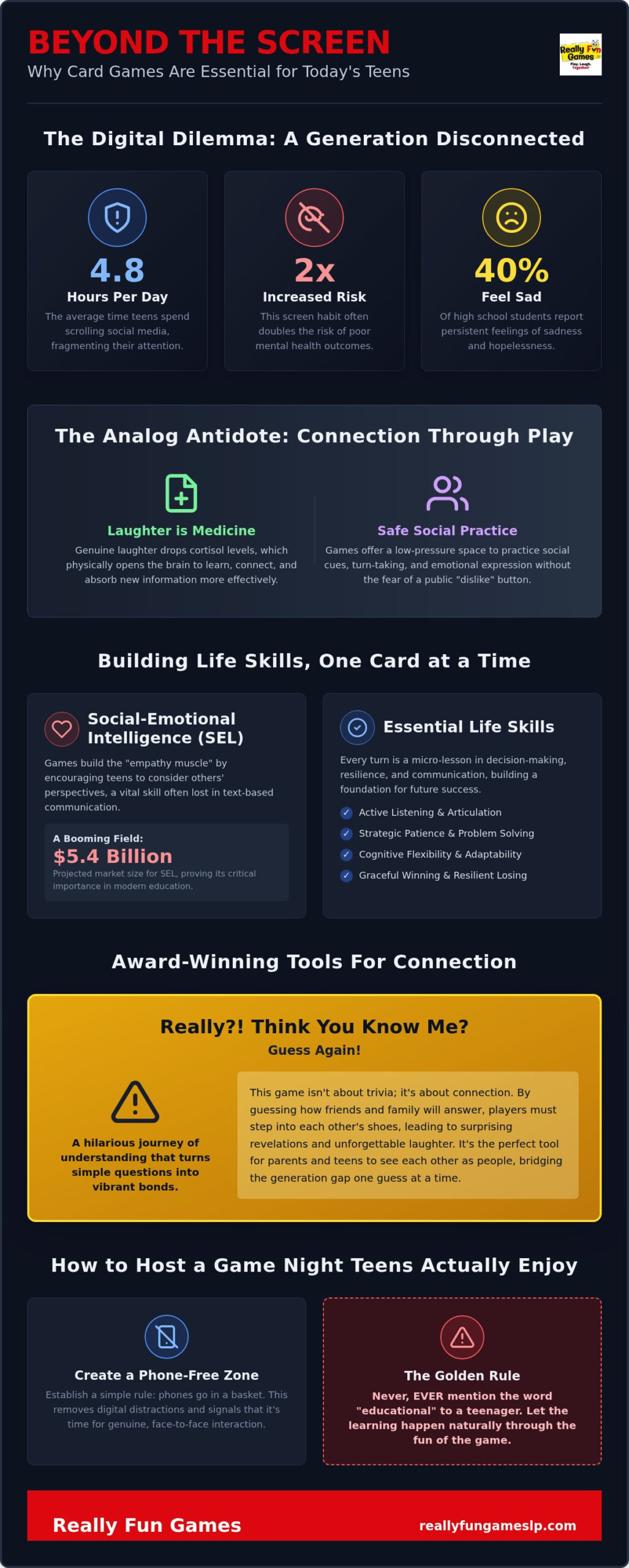
Modern adolescence is often defined by a glowing rectangle, but the real growth happens when the screens go dark. With 40% of high school students reporting persistent feelings of sadness according to South Denver Therapy, the need for genuine human connection has never been more urgent. This digital divide creates a gap in social development that only analog play can fill. Unlike the high-stakes world of social media, educational card games for teens offer a safe, low-pressure space to practice social cues and turn-taking without the fear of a public dislike button.
Laughter isn’t just fun; it’s biological medicine. When teens laugh, their cortisol levels drop, which physically opens their brains to learn and absorb new information. In 2026, the global focus has shifted toward Social-Emotional Learning (SEL). This market is projected to reach $5.4 billion this year by Grand View Research because we’ve realized that soft skills like empathy and articulation are just as vital as algebra. By moving beyond traditional math and science drills, we give adolescents the tools they need to handle the complexities of human interaction with grace and confidence.
Breaking the Screen Habit with Interactive Play
Teens get a dopamine hit from every “like,” yet these digital rewards often leave them feeling isolated. Analog play provides that same chemical reward through face-to-face victory and shared jokes. By setting aside protected time for a game, you’re helping them rebuild an attention span fragmented by short-form clips. Classic mechanics, like those found in Concentration (card game), prove that simple memory tasks are incredibly engaging when played with real people. This face-to-face engagement builds a level of focus that blue-light devices simply cannot match.
Developing Critical Life Skills Through Strategy
Every time a teen decides which card to play, they’re exercising cognitive flexibility. These quick-thinking moments mirror real-world problem solving, teaching them to pivot when a situation changes unexpectedly. Games from the Really Fun Games collection, such as “Really?! Think You Know Me? Guess Again!”, encourage players to think critically while practicing sportsmanship. This safe environment rewards:
- Active listening to understand opponents’ hidden clues.
- Articulation of complex thoughts under the pressure of a ticking clock.
- Strategic patience while waiting for the perfect moment to play a winning hand.
It’s about building a foundation of confidence that carries over into the classroom, the sports field, and their future professional lives. Learning to win with grace and lose with resilience is a lesson that sticks much longer than a memorized date in a history book.
The Core Pillar: Boosting Social-Emotional Intelligence (SEL)
Social-Emotional Intelligence (SEL) is the heartbeat of a thriving life. It’s the ability to recognize your own feelings and navigate relationships with empathy and skill. For teens living in a world of rapid-fire texts and curated feeds, this is often a struggle. Research from UNESCO MGIEP highlights the power of Using Games for Transformation and Social and Emotional Learning, showing how play creates a laboratory for emotional growth. Without the visual cues of a face-to-face chat, adolescents can lose the empathy muscle that makes human connection possible.
Educational card games for teens offer a brilliant way to bridge the generation gap. Instead of asking “How was your day?” and getting a grunt, these games create a structure for discovery. Our flagship game, Really?! Think You Know Me? Guess Again!, turns simple questions into a hilarious journey of understanding. It’s a tool that allows parents and teens to see each other as people, not just authority figures or children.
Empathy and Perspective-Taking
When a game asks you to guess how someone else would react, it forces you to step out of your own head. This perspective-taking is a critical developmental milestone. As players predict each other’s answers, they build trust through shared laughter and the occasional “Wait, you actually think that?!” moment. These surprising discoveries are the building blocks of social harmony. If you need more ways to spark these moments, check out our guide on Icebreaker Games for Groups and Social Gatherings.
Active Listening and Verbal Articulation
Confidence doesn’t just happen; it’s built through practice. Many educational card games for teens require players to listen intently to catch subtle clues or articulate their thoughts clearly to win a round. This is where “Triple Tongue Twisters” shines. It turns the often-stressful task of speech improvement into a joyful challenge. By tripping over silly phrases together, teens lose their fear of making mistakes in front of others. This play-based practice builds the vocal confidence they need to speak up in a crowded classroom or lead a group project. Finding the right conversation card games can turn a quiet evening into a night of connection.
Curriculum vs. Connection: Choosing the Right Educational Game
Selecting the right educational card games for teens requires understanding the vital shift between academic drills and developmental growth. While subject-based games tackle specific areas like math or history, developmental games focus on the “soft skills” that define success in 2026. If your teen is feeling the weight of a heavy school week, pushing another academic task can often backfire. Instead, a connection-first approach uses play to lower stress and build the social confidence they need to tackle those harder subjects later. High-quality games prioritize easy-to-learn mechanics so the focus stays on the people at the table, not the rulebook.
| Feature | Academic Games | Developmental Games |
|---|---|---|
| Primary Focus | Subjects (Math, History, Science) | Social Skills, Strategy, Articulation |
| Core Goal | Content Mastery & Fact Recall | Human Connection & Confidence |
| Best Time to Play | Homeschooling or Classroom Drills | Family Bonding or Stress Relief |
| Game Example | Vocabulary or Algebra Puzzles | Really?! Think You Know Me? Guess Again! |
When to Use Subject-Specific Games
Subject-specific games are fantastic tools for homeschoolers or classroom teachers who want to break the monotony of traditional lectures. The trick is to ensure the “fun” factor always outweighs the “test” factor. For a real-world win, try integrating a strategy-based math game during a Friday afternoon slump. Look for games that offer immediate feedback and high replayability. If a teen can see the direct result of a calculated move, they’re more likely to stay invested. These games shouldn’t feel like a graded assignment; they should feel like a puzzle waiting to be solved by a clever mind.
The Power of Conversation Starters
Conversation-based games are the ultimate educational tools for social development. They teach teens the “art of the question,” showing them how to engage others with genuine curiosity. This is a skill that translates directly to job interviews and healthy adult relationships. Using Really?! Think You Know Me? Guess Again! allows families to foster deep roots through hilarious, surprising discoveries. Imagine a family dinner where a simple card prompt turns a quiet room into a night of vibrant storytelling. Similarly, “Triple Tongue Twisters” builds vocal confidence through shared laughter. These experiences create a “play zone” where teens feel safe to express themselves and build the critical thinking skills needed to navigate a complex world.
How to Host a Teen Game Night They’ll Actually Enjoy
The secret to a successful evening with adolescents isn’t just the deck on the table; it’s the atmosphere you curate. If you want your kids to embrace educational card games for teens, you must follow the golden rule: never call it “educational” to their face. To a fifteen-year-old, that word sounds like a lecture in a box. Instead, pitch it as a “Really Fun” challenge or a simple way to hang out. When you focus on the joy of the experience, the learning happens naturally in the background.
Setting the stage is vital for creating a true “play zone.” Start by dimming the harsh overhead lights and bringing out the snacks they actually like. Most importantly, establish a “phone bucket” at the door. Removing the digital distraction is the only way to ensure face-to-face engagement. Once the screens are gone, kick things off with fast-paced icebreakers to lower social barriers. If you’re looking for ways to bring this energy on the road, check out The Best Travel Games for Kids: 2026 Guide for portable ideas that work perfectly in any setting.
The Facilitator’s Role: Warmth and Inclusion
You aren’t the boss; you’re the catalyst for harmony. Your role is to guide the flow without killing the vibe with too many rules. Encourage participation from quieter teens by using games that offer multiple ways to win. If someone is hesitant to speak up, model the high-energy, celebratory tone yourself. When they see you laughing and making mistakes, they’ll feel safe to do the same. It’s about building confidence through shared spontaneity and ensuring every player feels like a valued part of the group.
Variety and Replayability
Keep the momentum moving by mixing up the game types. Start with quick-fire rounds of “Triple Tongue Twisters” to get everyone laughing and practicing their articulation. These short, punchy games are perfect for building initial excitement. Once the group is warmed up, transition into deeper conversation rounds with Really?! Think You Know Me? Guess Again!. Knowing when to switch games is a skill in itself. If you notice eyes wandering or energy dipping, it’s time to pivot to a new deck. By keeping the rhythm fast and the content fresh, you’ll create a recurring tradition that your teens will actually look forward to every week. Ready to start your own tradition? Explore our full collection of conversation card games today.
Discover Really Fun Games: Award-Winning Tools for Teens
Real connection starts with a spark of curiosity. Really Fun Games exists to ignite that spark through award-winning designs that prioritize human bonding over technical complexity. We don’t just make games; we facilitate moments of discovery. Our collection of educational card games for teens bridges the gap between generations, turning quiet rooms into hubs of laughter and high-energy interaction. Every deck we create is a mission to build communication through joyful play, ensuring that the most important lessons are learned through shared experience.
Really?! Think You Know Me? Guess Again!
“Really?! Think You Know Me? Guess Again!” is our flagship experience for a reason. It’s a “get to know you” game where players navigate a series of thought-provoking questions, but there’s a twist: you have to guess what your friend or family member will say. This simple mechanic is a powerhouse for building trust in classrooms and family reunions alike. It forces players to step out of their own worldview and into someone else’s head. This process builds several key developmental pillars:
- Empathy: Stepping into another person’s shoes to predict their perspective.
- Critical Thinking: Analyzing past interactions to make an informed guess about a peer’s response.
- Social Harmony: Using humor to diffuse tension and strengthen interpersonal bonds.
It’s a favorite for building trust in teams because it reveals the person behind the role, making it an essential tool for any social setting.
Triple Tongue Twisters for Confidence
Articulation shouldn’t feel like a medical exercise or a boring classroom drill. “Triple Tongue Twisters” turns vocal play into a competitive, hilarious challenge that teens actually want to join. It supports Speech-Language Pathologist (SLP) goals by encouraging clear speech and rhythmic patterns in a way that feels like pure fun. By mastering tricky pronunciations together, adolescents learn to embrace the “tongue-tied” moments. They find joy in their own mistakes, which is the ultimate secret to building social resilience.
This play-based practice builds the vocal confidence needed for everything from high school presentations to job interviews. When teens aren’t afraid to trip over their words, they aren’t afraid to speak their minds. These tools are more than just entertainment; they’re the perfect gift for parents looking to reconnect, teachers wanting to boost engagement, and SLPs seeking vibrant therapy tools. You can find our entire award-winning collection at Really Fun Games. Every deck is a promise of laughter, learning, and a stronger bond with the people you care about most.
Ready to Spark a New Connection?
The journey from digital isolation to vibrant, face-to-face laughter starts with a single deck of cards. You’ve seen how the right educational card games for teens can transform a quiet room into a hub of discovery and social harmony. By prioritizing social-emotional intelligence and creating a phone-free “play zone,” you give your adolescents the space they need to build real-world confidence. Whether it’s mastering a tricky pronunciation or uncovering a surprising fact about a best friend, these moments are the building blocks of a resilient future.
Our award-winning designs for ages 8+ are trusted by educators and speech therapists because they focus 100% on human connection and laughter. It’s time to trade the blue light for the warmth of a shared joke and a meaningful conversation. We invite you to Explore the Award-Winning Really Fun Games Collection and find the perfect match for your family or classroom. Let’s make your next game night a memory that lasts long after the final card is played. Grab a deck, gather your group, and let the fun begin!
Frequently Asked Questions
What makes a card game ‘educational’ for a teenager?
An educational game for an adolescent is one that stretches their cognitive flexibility and social-emotional intelligence. While many think of math drills, the most effective educational card games for teens focus on soft skills like active listening, empathy, and articulation. These games provide a safe laboratory for testing social cues and critical thinking. By prioritizing connection over curriculum, you create an environment where learning feels like discovery rather than a chore.
How do I get my teen to play a card game without them rolling their eyes?
The best approach is to lead with the fun and leave the educational label at the door. Create a play zone by bringing out their favorite snacks and establishing a phone-free environment. Start with a high-energy icebreaker to build immediate momentum. If the mechanics are easy to learn and the pace is fast, they’ll stay engaged. Focus on the laughter and shared competition rather than the developmental benefits happening in the background.
Can educational card games help with social anxiety in teens?
Yes, they offer a structured, low-pressure environment that makes social interaction feel manageable. Games provide a clear set of rules and a specific focus, which helps reduce the anxiety of not knowing what to say next. By using conversation-based tools, teens can practice social cues and perspective-taking without the spotlight feeling too bright. Shared laughter acts as a natural stress reliever, helping to build interpersonal confidence over time.
Are these games suitable for classroom settings as well as home?
Absolutely. These educational card games for teens are designed for versatility and work beautifully in a classroom or homeschool setting. Teachers often use them to break up long lectures or to build team harmony during group projects. Because the mechanics are simple and the rounds are quick, they fit perfectly into a standard lesson block. They help students develop critical thinking and communication skills that are essential for academic success and future professional life.
How long does a typical round of ‘Really?! Think You Know Me? Guess Again!’ take?
A typical round is designed to be fast-paced and flexible, usually lasting between 15 and 30 minutes. This quick duration makes it easy to squeeze in a game after dinner or during a classroom break. You can play a single round for a quick connection or keep the cards moving for an hour of deep discovery. The goal is high replayability that keeps the energy levels up without overstaying its welcome.
Do I need any special skills to facilitate these games for a group of teens?
No special training is required to be a great facilitator. Your primary role is to act as a warm guide who encourages spontaneity and laughter. Simply read the easy-to-learn rules, set the tone with your own high energy, and let the game mechanics do the heavy lifting. The most successful facilitators are those who model joyful participation and know when to step back and let the teen group’s natural dynamic take over.
Are these games helpful for teens with speech or articulation challenges?
Yes, they are powerful tools for building vocal confidence. Our Triple Tongue Twisters collection is a favorite among speech-language pathologists because it turns articulation practice into a joyful challenge. Teens can master tricky pronunciations while laughing through the tongue-tied moments. This play-based approach removes the clinical pressure from speech therapy, making it easier for adolescents to embrace mistakes and find their voice in a supportive, fun-loving environment.
