What if the secret to a high-performing team or a legendary dinner party was hidden inside a simple deck of cards? We have all suffered through those agonizingly quiet mixers where the only thing flowing is the anxiety as you hunt for something, anything, to say. It is frustrating to watch a room full of brilliant people struggle to connect because they are stuck behind the stiff, professional masks we all wear. Pure social friction. Finding the right icebreaker card games for adults is about more than just filling time. It is about creating what Google’s Project Aristotle calls “psychological safety,” that magical environment where everyone feels safe to be their authentic selves.
You are about to discover how to transform those stiff, awkward moments into high-energy sessions of genuine joy and empathy. This 2026 guide will show you how to spark effortless conversation and build lasting trust in any setting, whether you are in a corporate boardroom or a cozy living room. From testing your assumptions with “Really?! Think You Know Me? Guess Again!” to the hilarious vocal play of “Triple Tongue Twisters,” we are diving into the best tools to make your next gathering truly unforgettable.
Key Takeaways
- Replace shallow small talk with “playful vulnerability” to bypass social anxiety and create instant rapport in any group.
- Identify the essential mechanics that make a game successful, focusing on simple rules that encourage active listening and genuine discovery.
- Master the art of selecting icebreaker card games for adults based on your specific environment, whether you’re leading a corporate workshop or hosting a festive holiday party.
- Boost your group’s empathy and critical thinking skills by using assumption-testing games that challenge how well you really know your peers.
- Explore award-winning tools designed to spark laughter and meaningful interaction through vocal play and thought-provoking conversation starters.
Why Icebreaker Card Games for Adults are the Secret to Effortless Connection
Connection isn’t just a luxury; it is the fuel for every thriving group. We often treat social gatherings like a chore, hoping the conversation will magically spark on its own. Understanding what an icebreaker is helps us see these games as social catalysts rather than just toys. They are specifically designed to bypass the surface-level chatter that keeps us at a distance. By using icebreaker card games for adults, you aren’t just playing a game. You are providing a structured path for people to leap over the hurdles of social anxiety and land directly into a space of genuine warmth.
The magic happens through a concept we call “Playful Vulnerability.” In adult settings, we are trained to be guarded and professional. Playful vulnerability allows us to lower those shields in a way that feels safe and lighthearted. As we move through 2026, this face-to-face connection has become more valuable than ever. After years of digital saturation, we are seeing a massive shift toward “feel-good” games that prioritize emotional resilience and combat loneliness. We crave the sensory experience of a physical card, the sound of a friend’s laughter, and the immediate feedback of a shared moment.
The Science of Laughter and Social Bonding
Laughter works fast. It is a biological shortcut to trust. When a group laughs together, their brains release a surge of dopamine, which makes the interaction feel rewarding and memorable. This is why “Vocal Play” is such a powerful tool for breaking the ice. When we use something like Triple Tongue Twisters, we aren’t just being silly. We are signaling to the group that it’s okay to be imperfect. Stumbling over a ridiculous phrase together creates an instant bond because everyone is in on the joke. It lowers adult defenses faster than any formal introduction ever could.
Moving Beyond the “What Do You Do?” Trap
Nothing kills the energy of a party faster than networking-style small talk. When we ask about jobs or the weather, we stay in our comfort zones, but we don’t actually connect. Card games provide a “structured excuse” to talk about the things that actually matter. Instead of reciting your resume, you might find yourself guessing a coworker’s favorite travel memory or a friend’s secret talent. Award-winning tools like Really?! Think You Know Me? Guess Again! create a “safe to play” environment where diverse groups can explore assumptions with curiosity instead of judgment. Check out the full Really Fun Games collection to see how these mechanics turn quiet rooms into vibrant hubs of conversation.
Understanding the Mechanics: What Makes an Icebreaker Game “Really Fun”?
A great game isn’t just a box of cards; it’s a high-energy social engine. To truly work, icebreaker card games for adults must follow the “Easy to Learn, Hard to Forget” rule. Friction is the enemy of fun. If you have to spend twenty minutes explaining complex rules, you’ve already lost the momentum of the room. The best mechanics strip away complexity to reveal the human connection underneath, making icebreaker card games for adults the perfect addition to any event where connection is the goal. These games prioritize active listening, ensuring that every player is tuned into the stories and quirks of their peers rather than just waiting for their turn to speak.
This sense of play is actually vital to our well-being. When we engage in structured play, we reduce stress and open up our creative pathways. Mechanics like guessing and vocal challenges aren’t just gimmicks. They are carefully crafted tools designed to trigger engagement and keep the energy high from the very first card drawn to the final round of laughter. To help you choose the right vibe for your group, here is a quick look at how different mechanics serve different social needs.
| Feature | Really?! Think You Know Me? | Triple Tongue Twisters |
|---|---|---|
| Core Mechanic | Guessing & Assumption-Testing | Vocal Play & Articulation |
| Social Outcome | Empathy & Deep Connection | High-Energy Laughter |
| Ideal Group Size | 2 to 10+ (Scales with dials) | Small to Large Groups |
| Game Pace | Thoughtful & Surprising | Fast-Paced & Hilarious |
The “Guess Again” Dynamic: Building Empathy Through Play
Guessing games are the ultimate empathy builders. When you play Really?! Think You Know Me? Guess Again!, you aren’t just earning points. You are actively testing your assumptions about the people around you. The “Really?!” moment occurs when a player’s answer completely surprises the group, shattering a stereotype or revealing a hidden passion. By using interactive elements like number dials, the game keeps everyone physically engaged. It transforms a simple question into a shared discovery, making it one of the most effective ways to build rapport quickly and authentically.
Vocal Play and Articulation Challenges
Vocal challenges add a layer of delightful chaos to any gathering. While some think tongue twisters are for the classroom, Triple Tongue Twisters proves they are a powerhouse for adult groups. These challenges force us to “fail” together in a public, hilarious way. This shared imperfection builds massive confidence. You’re not just practicing articulation; you’re practicing social courage. It turns out that stumbling over a ridiculous phrase is a fantastic way to improve communication skills while having a total blast. If you are ready to see these mechanics in action, you can explore our award-winning collection to find your perfect match.
From Boardrooms to Living Rooms: Choosing Icebreakers for Every Setting
Context matters deeply when you’re trying to spark a connection. You wouldn’t use the same prompt at a holiday brunch that you’d use in a high-stakes strategy meeting. To pick the right icebreaker card games for adults, you need a quick way to evaluate the room. Think about the physical space and the emotional state of your guests. Are they parents looking for family conversation games to reconnect after a busy week? Or are they coworkers needing a break from spreadsheets? Compact, travel-friendly options make it easy to bring these moments of joy anywhere, from a living room sofa to a corporate retreat.
- Size Matters: Large groups thrive on fast, inclusive mechanics. Smaller, more intimate groups can dive into deeper conversation card games.
- Energy Matching: Match the game to the room’s pulse. If people are sluggish, use vocal play to wake them up. If they’re already buzzing, use a guessing game to focus that energy.
- Portability: The best family card games are the ones you can toss in a bag for a weekend trip or a quick office mixer without a second thought.
Corporate Icebreakers for Team Building
In a work environment, the goal is often to level the playing field. It’s hard to feel intimidated by a supervisor when you’re both laughing over a shared surprise. Experts have long noted the benefits of play in the workplace, specifically how it reduces stress and encourages risk-taking. Using empathy-focused tools like “Really?! Think You Know Me? Guess Again!” helps teams see the human behind the job title. This builds the trust necessary for real collaboration. For more strategies on professional settings, check out our guide on Icebreaker Games for Groups and Social Gatherings.
Icebreakers for Speech Therapy and SLPs
For therapists, these tools are about more than just fun. Speech-Language Pathologists (SLPs) use conversation card games to help adults practice communication in a low-pressure way. When the focus is on the game, language flows more naturally. Using “Triple Tongue Twisters” allows for targeted articulation work that feels like a party instead of a clinic drill. It builds confidence and helps clients find their voice through laughter. Professionals can find more specialized tools in our Best Educational Games for Speech Therapists guide.
The Social ROI: Building Empathy and Critical Thinking Through Play
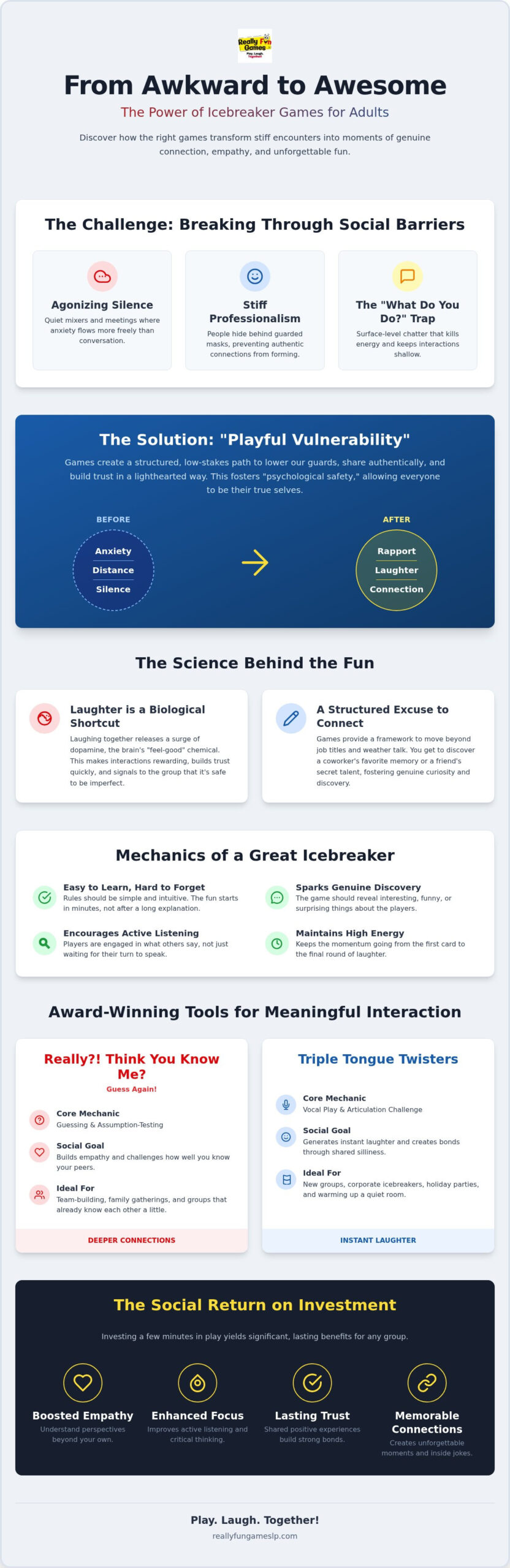
Skeptics often dismiss games as “just for fun,” but the return on investment for icebreaker card games for adults is remarkably high. When we play, we aren’t just killing time. We are building a foundation of social harmony that pays dividends long after the cards are put away. These games act as a workout for the social brain, requiring players to use critical thinking to analyze their peers’ values and past experiences. By engaging in these interactive sessions, groups develop a shared language of inside jokes and mutual understanding that translates into better collaboration and fewer misunderstandings in the long run. It’s a joyful way to turn a group of individuals into a cohesive community.
The Power of Perspective-Taking
Guessing games are secret weapons for building empathy. When you play Really?! Think You Know Me? Guess Again!, you are forced to step out of your own head and into someone else’s shoes. You have to ask yourself: “How would they react to this situation?” or “What do they value most?” This isn’t just a game mechanic; it’s a practice in perspective-taking. The prompts uncover shared values and life experiences that might never surface in a standard meeting or dinner conversation. Social empathy is the ability to guess a friend’s reaction correctly. By practicing this skill through play, we become more attuned to the people around us, fostering a deeper sense of connection and respect.
Reducing Social Anxiety in Large Groups
Large gatherings can be intimidating, but a physical game acts as a “social shield” that lowers the stakes of interaction. Having a card in your hand or a dial to turn reduces the intense pressure of constant eye contact. It gives everyone a focused task, which is especially helpful for those who feel drained by unstructured networking. This structure creates an inclusive environment where every voice is heard, not just the loudest ones in the room. For larger, more dynamic sessions, using Extra Number Dials allows you to scale the fun without losing the intimate feel of the game. It ensures that everyone, from the CEO to the newest intern, can jump in and contribute to the collective laughter.
Ready to boost your group’s social ROI? Discover the award-winning Really Fun Games collection and start building deeper connections today.
Really Fun Games: Award-Winning Tools for Meaningful Adult Interaction
Really Fun Games stands as a warm guide to connection, acting as the ultimate fun-loving facilitator for any social setting. We believe that play is a bridge. It is the fastest way to turn a room of quiet individuals into a vibrant community of friends. By focusing on simple, high-energy mechanics, we’ve created a suite of award-winning tools that make icebreaker card games for adults feel less like a chore and more like a celebration. These aren’t just one-time activities. One major flaw in many social tools is a lack of replayability, but our games are designed to grow with you. As your relationships evolve and your groups change, the games reveal new layers of humor and insight every time they hit the table.
Why “Really?! Think You Know Me?” is the Ultimate Adult Icebreaker
This isn’t your average conversation deck. “Really?! Think You Know Me? Guess Again!” features an award-winning design that prioritizes immediate engagement. You don’t need a rulebook the size of a novel to get started. The mechanics are so intuitive that you can begin playing within seconds of opening the box. Whether you are hosting an intimate dinner for four or a massive office party for forty, the game scales effortlessly. It uses a unique “Guess Again” mechanic that forces players to think critically about their friends and colleagues. It creates those electric moments of surprise that turn a simple game night into a legendary social event. How often do you get to truly test your assumptions in such a joyful way?
Mastering the Art of Vocal Play
If you want to inject raw energy into a room, look no further than the “Triple Tongue Twisters” collection. While these are beloved by speech therapists for their articulation benefits, they are secretly the perfect tool for high-energy icebreaking. There is something deeply human about everyone in a group failing at the same ridiculous task. It levels the playing field instantly. You can use these challenges to snap a stale meeting back to life or to kick off a holiday gathering with a burst of laughter. It turns a room of strangers into a chorus of giggles.
Our collection includes vibrant, sensory-focused editions like “Blooming Tongue Twisters” for spring or “Santa’s Tongue Twisters” for the winter holidays. Each deck offers a fresh way to experience vocal play, ensuring that your social toolkit is always ready for the season. We invite you to embrace the spontaneity and joy that comes with structured play. It’s time to discover how the right tools can transform your gatherings. Explore the full collection of Really Fun Games to find the perfect fit for your next team building event, family night, or social mixer.
Ready to Spark Meaningful Connections?
The journey from a room of quiet strangers to a high-energy session of laughter is shorter than you think. We have explored how the right social tools can bypass shallow small talk by prioritizing active listening and perspective-taking. Whether you are leading a corporate team building workshop or hosting an intimate dinner party, using icebreaker card games for adults creates a safe, vibrant space for genuine discovery. By embracing playful vulnerability, you aren’t just playing; you are building lasting social harmony and empathy.
Our award-winning communication tools are designed by experts to be easy to learn and highly replayable for homes, schools, and professional offices alike. These games are more than just entertainment; they are catalysts for trust and joy. It is time to see how the power of play can transform your social world and bring people together in ways that matter. Discover the “Really Fun Games” collection and find your perfect icebreaker today! We can’t wait to see the smiles and connections you’ll create at your next gathering. Let the laughter begin!
Frequently Asked Questions
What are the best icebreaker card games for small groups of adults?
The best icebreaker card games for adults in small groups are those that prioritize discovery over competition. “Really?! Think You Know Me? Guess Again!” is a standout choice because it encourages players to test their assumptions about one another in a lighthearted way. For groups that need a quick energy boost, “Triple Tongue Twisters” provides instant laughter. These games work well because they’re easy to learn and focus on building genuine human bonds.
How do you facilitate an icebreaker game without it feeling awkward?
Facilitating a game without the “cringe” factor starts with your own energy. Position yourself as a warm guide rather than a strict rule-follower. Start with a low-stakes challenge, like a quick round from the Tongue Twisters collection, to get everyone laughing at themselves first. When the facilitator embraces the silliness, the group feels safe to do the same. This approach lowers defenses and turns a potentially stiff activity into a spontaneous, joyful interaction.
Can icebreaker card games be used for professional team building?
Absolutely, these games are powerful tools for professional team building. They help establish psychological safety by allowing colleagues to see the human side of their peers. Using “Really?! Think You Know Me? Guess Again!” in the office can break down hierarchical barriers and build trust through empathy-focused conversation. It is a strategic way to improve communication skills and foster a more collaborative, inclusive culture where every team member feels heard and valued across the organization.
Are these games suitable for speech therapy sessions with adults?
Yes, speech-language pathologists across the country use these games to facilitate natural language production. “Triple Tongue Twisters” and “Tricky Tetra Tongue Twisters” are excellent for articulation practice in a low-pressure environment. Because the focus is on the fun of the challenge, adults often feel less self-conscious about their speech. These tools turn clinical goals into joyful social interactions, helping clients build confidence while they work on specific communication skills in a comfortable setting.
How long does a typical round of an icebreaker card game take?
A typical round of a Really Fun Games title is designed to be fast-paced and energetic, usually lasting between five and fifteen minutes. This short duration is perfect for keeping the momentum of a social gathering high without overstaying its welcome. Because the mechanics are simple, you won’t waste time on long explanations. This speed allows you to fit a quick “vocal play” challenge into a busy schedule or enjoy multiple rounds during a long evening.
What makes a card game “highly replayable” for social groups?
High replayability comes from the “Guess Again” dynamic and the changing nature of human groups. Unlike trivia games where you eventually learn all the answers, games like “Really?! Think You Know Me?” change every time you play with a new person or as your relationships grow. The surprise of a “Really?!” moment never gets old. Because the content is driven by the players’ own lives and perspectives, the game feels fresh and exciting every single time.
How do I choose between a conversation game and a vocal challenge game?
Choosing the right game depends on your group’s current energy level and your specific social goals. If the room feels quiet or stiff, a vocal challenge like “Triple Tongue Twisters” is the perfect spark to trigger laughter and movement. If the group is already chatting but needs more depth, a conversation-focused game is better. Think about your desired outcome: do you want high-energy chaos or a nurturing focus on human connection? Both are essential tools.
Can these games help reduce social anxiety in new groups?
Yes, icebreaker card games for adults are fantastic for reducing social anxiety. Having a physical card or a number dial to focus on acts as a “social shield,” taking the pressure off constant eye contact. It gives anxious players a structured task and a clear “excuse” to talk about interesting topics. This structure creates an inclusive environment where everyone can participate at their own comfort level, eventually turning a group of strangers into a connected, harmonious community.
