

Last holiday season, you might have noticed a familiar scene: a room full of loved ones, yet everyone is quietly scrolling through their phones or stuck in a loop of surface-level small talk. It is frustrating to feel miles apart when you’re sitting right next to each other, but the right card games that start conversations can instantly change that dynamic. These tools act as a joyful spark, turning awkward silences into electric moments where you finally feel truly seen and heard.
In this guide, you’ll discover how structured play can transform any gathering into a memorable experience of discovery and connection. We’ll explore the science behind why we open up more when there are rules and rewards, and we’ll compare the best decks for every group, from classroom settings to family reunions. Get ready to learn practical tips for hosting the ultimate game night and see how award-winning favorites like Really?! Think You Know Me? Guess Again! can help you foster lifelong bonds through the simple magic of laughter.
Key Takeaways
- Learn how structured play breaks through digital fatigue and surface-level small talk to create authentic human connections.
- Discover why card games that start conversations use the gamification of social interaction to make sharing personal stories feel safe and exciting.
- Find out how to choose the perfect deck for your specific group by balancing age-appropriate prompts with the right level of depth.
- Get practical tips for hosting a distraction-free game night that encourages even the most skeptical guests to join in the laughter.
- See how award-winning games like Really?! Think You Know Me? Guess Again! serve as powerful tools for building teamwork and empathy across generations.
Why Conversation-Starting Card Games are the New Social Essential
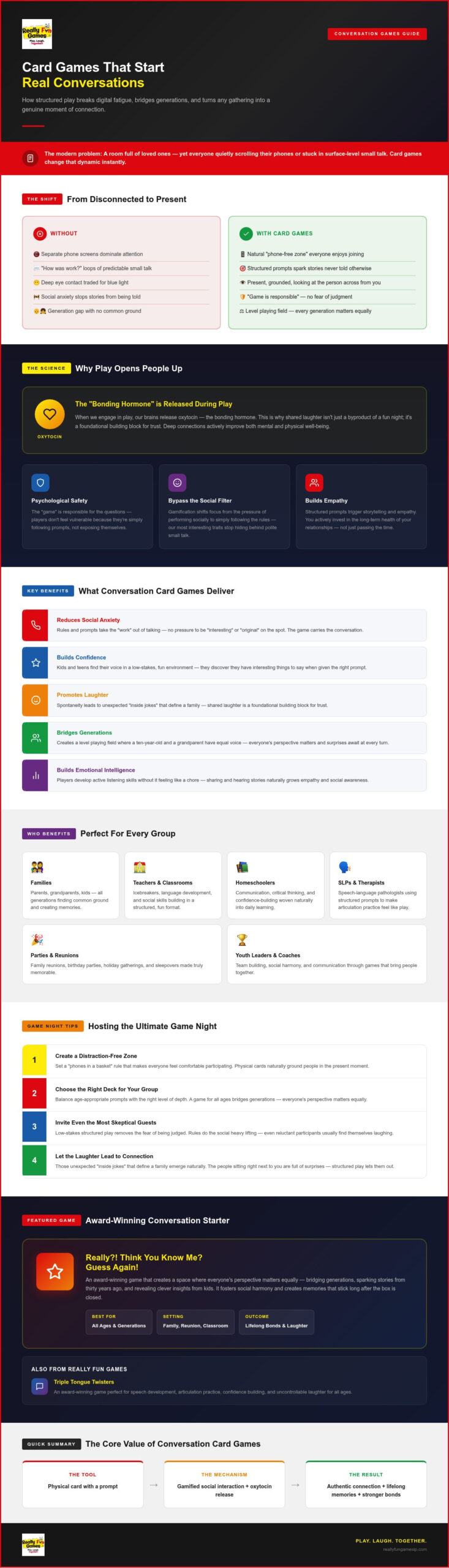
The social landscape of 2026 is defined by a powerful shift toward intentionality. We’ve reached a collective breaking point with digital noise, and the craving for authentic human interaction has never been stronger. People are no longer satisfied with just “hanging out” in the same room while scrolling through separate feeds. We want to be present. We want to be seen. This is exactly why card games that start conversations have moved from the back of the toy closet to the center of the coffee table. They act as social catalysts, turning a quiet evening into a vibrant journey of discovery.
Breaking the Digital Barrier
Screens have dominated our social lives for far too long, often acting as a shield against true vulnerability. We’ve traded deep eye contact for blue light, and it’s left us feeling more disconnected than ever. Using physical card games creates a natural, “phone-free zone” that guests actually enjoy joining. There’s a specific psychological benefit to holding a physical card in your hand. It grounds you in the present moment and provides a tactile focus that a digital app simply can’t replicate. When you’re holding a card, you aren’t checking notifications; you’re looking at the person across from you, waiting for their next big reveal.
The Power of Intentional Connection
Standard small talk is a conversational dead end. We’ve all been trapped in that loop of “How was work?” or “How’s school?” where the answers are predictable and the energy is low. Structured play changes the game by removing the pressure to be “interesting” or “original” on the spot. It gives everyone a safe framework to share stories they might never think to tell otherwise. This is how we build emotional intelligence and active listening skills without it feeling like a chore.
These tools are especially brilliant at bridging the generation gap. It can be tough for a ten-year-old to find common ground with a grandparent, but card games that start conversations provide a level playing field. When you bring out an award-winning game like Really?! Think You Know Me? Guess Again!, you create a space where everyone’s perspective matters equally. You’ll find yourself laughing at a story from thirty years ago or being surprised by a kid’s clever insight. It’s about more than just playing; it’s about fostering social harmony and creating memories that stick long after the box is closed.
- Reduces Social Anxiety: Rules and prompts take the “work” out of talking.
- Builds Confidence: Kids and teens find their voice in a low-stakes, fun environment.
- Promotes Laughter: Spontaneity leads to those unexpected “inside jokes” that define a family.
In a world that feels increasingly fast-paced, these games invite us to slow down. They remind us that the people sitting right next to us are full of surprises, waiting for the right prompt to let them out.
The Science of Play: How Card Games Spark Meaningful Dialogue
Why is it so much easier to share a secret or a funny story when you’re holding a hand of cards? The answer lies in the “gamification” of social interaction. Conversation-starting card games are specifically engineered tools that use structured prompts to trigger storytelling and empathy. By turning a conversation into a game, we shift our focus from the pressure of performing socially to the simple goal of following the rules. This structure acts as a psychological safety net, allowing us to bypass the “social filter” that usually keeps our most interesting traits hidden behind polite small talk.
When we engage in play, our brains release oxytocin, often called the “bonding hormone.” This chemical reaction is why shared laughter isn’t just a byproduct of a fun night; it’s a foundational building block for trust. Research highlights the health benefits of meaningful social bonds, showing that deep connections actually improve our mental and physical well-being. By using card games that start conversations, you aren’t just passing the time; you’re actively investing in the long-term health of your relationships.
The “Low-Stakes” Environment of Play
Game mechanics remove the fear of being judged because the “game” is responsible for the questions being asked. If a prompt asks for a silly memory, the player doesn’t feel vulnerable because they’re simply playing along. This is incredibly effective for kids and teens who might usually feel put on the spot during dinner table talk. In a low-stakes environment, humor acts as a natural lubricant for social anxiety, creating a safe space where every participant feels encouraged to express their true self without hesitation.
From Icebreakers to Deep Discoveries
The most effective games follow a natural progression. They start with lighthearted “this or that” questions to get everyone comfortable before moving into deeper territory. These specific prompts are designed to trigger vivid memory recall, bringing up stories that have been buried for years. This process creates what we call the Discovery Loop. The Discovery Loop is a social cycle where a shared prompt triggers a personal memory, leading to an emotional reveal that strengthens group trust and invites further storytelling.
Award-winning games like Really?! Think You Know Me? Guess Again! are masters of this loop. They keep the energy high while gently nudging players to discover new things about people they’ve known for decades. If you’re ready to see this science in action at your next family gathering, you might want to explore the full collection of games designed to bring people together through the magic of play.
Comparison Guide: Best Conversation Cards for Your Group
Finding the right spark for your social circle depends entirely on the atmosphere you want to create. You wouldn’t bring a deep-dive therapy deck to a high-energy birthday party, just as you wouldn’t use a silly icebreaker for a serious team-building retreat. When you’re hunting for card games that start conversations, start by looking at your group size and the age of your youngest players. For families with children aged 8 and up, the sweet spot is a game that feels inclusive, fast-paced, and easy to learn.
Replayability is what separates a dusty box on the shelf from a family favorite. Many decks fail because their questions are static; once you’ve answered them once, the mystery is gone. The most successful options focus on the players’ changing opinions and life experiences rather than fixed trivia. By balancing “get to know you” prompts with action-based elements, you create a dynamic environment where no two rounds ever feel the same. This is why the best card games that start conversations aren’t just about the questions; they’re about the people playing them. Award-winning designs like Really?! Think You Know Me? Guess Again! remain staples for game night because they adapt to whoever is sitting at the table.
Games for Families and Kids
Families thrive when the rules are simple and the rewards are emotional. You want to prioritize games that build confidence in kids and encourage them to speak up without feeling like they’re being interviewed. Using a guessing mechanic helps bridge the gap between generations, making the experience just as exciting for a grandparent as it is for a third-grader. It turns the act of sharing into a fun challenge rather than a chore. Explore games for better family communication to find tools that turn a standard Tuesday night into a treasure trove of new memories.
Tools for Speech Therapists and Educators
In a professional setting, the goals are more specific. Speech-language pathologists (SLPs) and teachers use these tools to target milestones like articulation, language development, and social-emotional learning (SEL). A game that challenges players to speak clearly, such as Triple Tongue Twisters, can be a brilliant way to practice speech sounds while having a total blast. These games help build classroom empathy by allowing students to see the world through their classmates’ eyes in a safe, structured way. Discover educational games for speech therapists that make the hard work of communication feel like pure play.
Practical Tips for Hosting the Ultimate Game Night of Discovery
A legendary game night doesn’t happen by accident; it’s the result of a thoughtful host who knows how to set the stage for magic. Creating a “connection-friendly” environment starts with the senses. Think warm, soft lighting rather than harsh overheads. Set out bowls of easy-to-grab snacks that don’t require forks and knives. Most importantly, create a dedicated “phone parking lot” in another room. When you remove the digital distractions, you’re telling your guests that their presence is the most valuable thing in the room.
Introducing card games that start conversations to a skeptical group requires a bit of strategy. If you have friends or family members who roll their eyes at “icebreakers,” don’t pitch the activity as a deep emotional exercise. Instead, frame it as a challenge or a fast-paced game. Start with something high-energy like Triple Tongue Twisters to get everyone laughing and stumbling over their words. Once the room is filled with giggles, the transition into deeper questions feels natural and unforced. Your role as the facilitator is to keep the pulse moving, ensuring that the talkers don’t dominate and the listeners feel invited to share.
Creating the Right Atmosphere
Timing is everything. While a rainy Sunday afternoon is perfect for a long session, many families find that the best time for card games that start conversations is right after dinner when everyone is already gathered. During play, encourage “yes, and” responses. This improv-inspired technique means accepting what someone shares and adding to it, which keeps the dialogue flowing. For the quieter souls in the group, give them space to think without rushing them. A supportive nod can be just as powerful as a loud laugh in making someone feel safe enough to open up.
Integrating Conversation into Travel
You don’t need a mahogany table to spark a great discussion. In fact, some of the most profound connections happen in the car or on a plane. Card games are the ultimate screen-free road trip companion because they turn “are we there yet?” into a journey of discovery. Many decks are designed to be played held in the hand, making them perfect for tight spaces. Check out the best travel games for kids to see how you can make your next family vacation a memory-making masterpiece.
Ready to host your own night of laughter and insight? You can browse the Really Fun Games collection to find the perfect deck for your next gathering.
Fostering Lifelong Bonds with Really Fun Games
The mission at Really Fun Games is simple: we want to ignite joy and bridge gaps through the power of play. We believe that the best card games that start conversations are those that make you laugh until your sides ache while teaching you something new about your favorite people. It isn’t just about winning a round; it’s about the lingering warmth of a shared story and the harmony that comes from truly connecting. When you make these interactions a regular part of your routine, you’re building a foundation of trust and understanding that lasts a lifetime.
Really?! Think You Know Me? Guess Again!
This award-winning game is the crown jewel of our collection for a reason. It masterfully challenges your assumptions about your loved ones by asking you to guess their answers to intriguing prompts. Designed for ages 8 and up, its easy-to-learn mechanics ensure that nobody feels left out of the loop. It has become a beloved staple for family reunions and holiday gatherings because it levels the playing field for everyone. Whether you’re a parent, a grandparent, or a youth leader, you’ll find that this game uncovers delightful surprises about people you thought you knew inside and out.
Building Confidence with Tongue Twisters
While some games focus on deep reflection, others build connection through the sheer chaos of vocal play. Our Triple Tongue Twisters collection turns the hard work of speech and articulation into a riotous game that everyone wants to win. There is a hidden educational value here, especially for teachers and speech therapists looking to boost confidence and language development. It’s a joyful way to practice communication skills without the pressure of a formal lesson. See how tongue twister games improve speech and fun to understand how these silly phrases can transform your child’s articulation and self-assurance.
Regularly incorporating these tools into your family game night does more than just fill an hour on a Friday. It creates a culture of active listening and mutual respect. By choosing card games that start conversations, you are choosing to prioritize the people in your life over the noise of the digital world. The laughter shared over a tongue twister or a surprising reveal in “Really?!” becomes the glue that keeps your bonds strong through every season of life.
Start Your Journey of Discovery Today
We’ve explored how structured play can bridge the generation gap and turn quiet rooms into hubs of laughter. By choosing high-quality card games that start conversations, you’re making an intentional choice to prioritize real human connection over digital noise. These tools don’t just fill time; they create a safe space for storytelling and empathy that standard small talk simply can’t reach. Every prompt is a chance to see a loved one in a brand new light, turning a simple evening into a landmark event.
Whether you’re a parent, therapist, or teacher, you can rely on our award-winning designs that are easy to learn and highly replayable. It’s no wonder these games are trusted by families and educators nationwide to foster social harmony and build confidence. Now is the perfect time to turn your next gathering into a joyful experience of discovery. Your next great memory is just one card away, waiting for you to flip it over and begin the talk.
Explore the full collection of Really Fun Games and find your new favorite way to connect. Let the games begin and the stories flow!
Frequently Asked Questions
How do card games help start conversations for shy people?
Card games that start conversations act as a social safety net by providing a clear structure for interaction. For shy individuals, the pressure to “be interesting” or initiate a topic is removed because the game provides the prompt. This shift from social performance to simple play helps lower anxiety. It’s a way for everyone to participate at their own pace while feeling supported by the rules and the collective energy of the group.
Are conversation card games suitable for kids under 8?
Most of our award-winning games, including Really?! Think You Know Me? Guess Again!, are specifically designed for players aged 8 and up. This age range ensures that children have the cognitive development and vocabulary needed for deeper connection. While younger kids might enjoy the laughter of our Tongue Twisters collection, the full strategic experience is best enjoyed by those who can engage with more complex social cues. They’re optimized for critical thinking.
Can these games be used for professional team building?
Yes, organizations and corporate teams frequently use these tools for professional team building. Structured play reduces the awkwardness of forced icebreakers and helps colleagues see the human side of their coworkers. By fostering empathy and social harmony, these games help build stronger, more resilient teams. It’s a powerful way to improve communication and encourage a culture of active listening within any professional organization, school, or youth leadership group looking for authentic connection and teamwork.
What is the best way to introduce a conversation game to my family?
The most successful way to introduce these activities is by keeping the energy light and spontaneous. Instead of announcing a “deep talk” session, simply bring out a deck after a meal or during a casual gathering. Start with something high-energy like Triple Tongue Twisters to get the laughter flowing. Once everyone is relaxed and engaged, it’s easy to transition into more meaningful conversation starter cards as a natural extension of the fun.
How do conversation games improve children’s social skills?
Card games that start conversations are brilliant tools for building confidence and social-emotional learning in children. By participating in structured play, kids practice active listening, turn-taking, and articulating their thoughts clearly. They learn to consider different perspectives and find common ground with others. These interactions help develop the critical thinking skills and social intelligence needed for healthy relationships, all while they think they’re just having a great time playing a game with family.
What makes Really Fun Games different from other card games?
Really Fun Games stands out because our award-winning designs focus on high replayability and joyful human connection. Unlike many decks that feel like a one-time interview, our mechanics ensure that every round feels fresh and surprising. We prioritize easy-to-learn rules that work for diverse groups. It’s our mission to create social catalysts that turn standard gatherings into memorable experiences of discovery, laughter, and genuine social harmony through our award-winning card games.
Can speech therapists use these games in their sessions?
Absolutely. Speech-language pathologists and educators find our collection incredibly useful for articulation and language development. Games like Triple Tongue Twisters turn repetitive speech practice into a riotous, engaging activity that kids actually look forward to. These tools help children work on specific sounds and vocal play in a low-stakes environment. It’s perfect for building confidence in students who might otherwise feel self-conscious about their communication skills during traditional therapy sessions or classroom activities.
Are these games portable enough for road trips and travel?
They are the perfect screen-free road trip companion. Our games are designed to be compact and highly portable, fitting easily into a backpack or glove compartment. Many of them don’t require a table, so you can play them in a car, on a plane, or while waiting at a restaurant. This portability makes it easy to turn travel downtime into a vibrant opportunity for connection and laughter with your family, friends, or travel group.
