

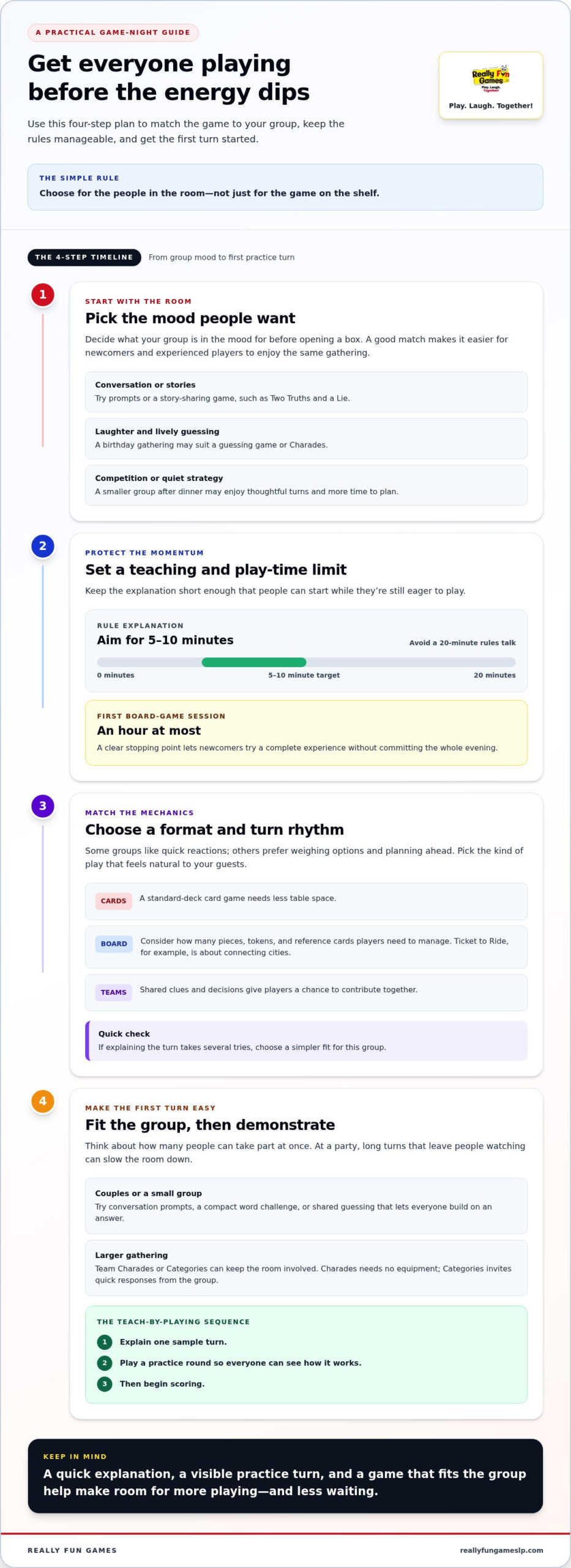
The best easy to learn games for adults get everyone playing before the room loses its energy. Choose a game you can teach in 5-10 minutes, and keep a first board-game session to an hour at most. For lively groups, party games with team play, quick decisions, and room for laughter make an easy starting point.
It’s frustrating when game night stalls because everyone is studying a rulebook or waiting for one person to take a turn. A simple game can still offer plenty to think about: teammates can share clues, weigh choices, and rally around a playful challenge without a long explanation.
This guide explores approachable options for different group moods, from party favorites and team-building games to choices with satisfying strategy. You’ll also find practical tips for matching a game to your gathering, so you can spend less time explaining and more time laughing, connecting, and playing.
Key Takeaways
- Match the game’s pace and style to your group, so first-timers and experienced players can enjoy the same gathering.
- For a larger party, choose activities that keep people involved, spark conversation, and make it easy to join in.
- Team-based play can turn quick clues and shared decisions into lively opportunities for connection.
- Simple rules can still leave room for clever choices, friendly competition, and a satisfying rematch.
- Explore conversation and wordplay games to find an option that fits the mood of your next adult get-together.
1. Choosing a game based on group preferences
Easy-to-learn games for adults work best when the choice fits the group’s mood, experience, and available time. Before opening a box, decide whether people want conversation, friendly competition, teamwork, or quiet strategy. A lively birthday gathering may suit a guessing game, while a smaller group settling in after dinner might enjoy a board game with thoughtful turns. Match the game to the room so everyone can join in.
Start with the clock. A first board-game session should last an hour at most, so newcomers can enjoy a complete experience without committing the evening. Beginner-friendly games should be teachable in 5-10 minutes. Avoid a game that needs 20 minutes of instructions before anyone can play; long explanations can drain the energy before the first turn.
Compare how a game handles turns and decisions. Some groups enjoy laying down cards and reacting quickly; others prefer planning several moves ahead. Consider the components, too. A board covered with pieces, tokens, and reference cards can feel difficult to learn, even if each rule is simple. Ticket to Ride is a familiar example of a board game about connecting cities, while a standard-deck card game needs less table space.
Use these steps to narrow the options:
- Choose the mood first: conversation, laughter, competition, or strategy.
- Check the teaching time and total playtime against your gathering.
- Consider whether the group prefers cards, a board, or shared team decisions.
- Read the turn structure aloud; if it takes several explanations, choose a simpler fit.
Which easy-to-learn games are free or inexpensive? Tic-Tac-Toe and Dots-and-Boxes need only paper and a pen, while a standard deck supports familiar card games without a dedicated board or pieces. The cost depends on what you already have at home.
What are fun card games adults can learn quickly? Crazy Eights and Go Fish use straightforward turns, making them approachable for a casual group. For conversation-led play, choose a card game that prompts guesses or stories instead of focusing only on scoring.
With a mixed group, explain one turn, play a practice round, then begin scoring. A short demonstration lets players see how cards move or pieces are placed before they need to remember every detail. With Ticket to Ride, for example, pointing to a route between cities makes the goal easier to picture than describing the whole board at once.
For more ideas suited to conversation and group play, browse card and conversation games and compare the style with your gathering. The right choice leaves enough room for everyone to talk, think, and enjoy the next turn.
Keep the first board game to an hour at most, as the author recommends. This gives the group a clear stopping point and room to judge whether the pace and interaction suit everyone. If interest fades, choose a better fit next time; if people stay engaged, use that response to guide your next choice.
2. Social and party games for larger groups
A party game should draw people into the fun, not leave them waiting through long turns. For friends who haven’t played together before, choose familiar mechanics: guessing, describing, acting, or sharing a quick story. Charades needs no equipment, and players can join by taking turns acting out a word or phrase. Two Truths and a Lie starts a conversation with personal stories, while Categories challenges everyone to name examples from a shared topic.
Couples and small groups can enjoy conversational games that give everyone room to explain a choice or tell a story. A prompt-based game works well because players respond directly instead of waiting through complicated placement or scoring. For a group with mixed tastes, try a cooperative word game where friends work toward a shared answer rather than competing for a winner.
For larger gatherings, look for games that keep people playing at once or make it easy to rotate into the action. Charades works in teams, while Categories lets the whole room respond quickly. Before choosing, read the player range on the box and consider how turns work near its upper limit. If a game leaves several people watching one player make a long decision, it may feel slow at a party.
- For couples: Pick conversation prompts or a compact word challenge, with turns that invite a little explanation.
- For a small group: Choose a shared guessing game, so every player can contribute ideas and build on friends’ answers.
- For a larger party: Use team charades or a whole-room category challenge to reduce downtime between turns.
- For mixed experience: Explain one sample turn first, then let beginners learn by playing.
What are easy party games for adults with no equipment? Charades, Two Truths and a Lie, and Categories need only people willing to join in. Agree on a topic or acting style before starting so everyone understands the prompt.
What are simple games for adult groups or game nights? Conversation prompts, team guessing, and word-association games offer quick turns and room for laughter. Choose one that fits the group’s energy, then keep the first round informal.
What easy-to-learn games suit adults who dislike strategy or competition? Try collaborative storytelling, light conversation prompts, or cooperative guessing, where the shared experience matters more than winning. Skip games built around tactical choices, such as Splendor, if resource placement and strategic mechanics feel like work. Expansions can add more rules to learn.
For a ready-to-play option that brings conversation into a group gathering, explore these conversation and party games. Choose a format that matches how your guests like to talk, laugh, and take part.
3. Party games for teams
Team party games turn a roomful of individual players into a shared challenge. Rather than waiting for one person to finish a long turn, teammates can suggest clues, build on ideas, and celebrate a clever answer together. Charades is a familiar example: one player acts out a word while their team guesses. A simple rule, a visible timer, and rotating turns keep the action moving.
For a lively round, split guests into teams and choose a prompt category everyone understands, such as movies, household objects, or travel. One teammate gives clues without saying the answer while the others try to guess before time runs out. Switch clue-givers after each round so a quieter guest can take part by acting, guessing, or offering ideas. That flexibility welcomes beginners.
Word-based games work well for teams, too. In a group storytelling challenge, one player starts a story with a sentence, then teammates add the next line in sequence. Give the story a shared setting, such as a train station or a haunted hotel, and let each person introduce a character. Connecting unexpected details often creates the funniest moments. The group builds something together instead of competing for individual points.
Board games can encourage team conversation, too, but their mechanics matter. In Carcassonne, players place landscape tiles and claim features with meeples, creating a map as play unfolds. It’s primarily competitive, so teams can discuss tile placement before taking turns, but this adds discussion and may slow a party. For a quick team activity, choose games where most players contribute during each round.
A clue-collection challenge is another option. Hide written prompts around a room, then ask teams to collect them and solve a shared riddle. Keep each clue short, and make the answer depend on combining information rather than simply finding the fastest route. This gives different strengths a role: one guest notices details, another remembers earlier clues, and someone else connects the pieces.
Before starting, explain the win condition in one sentence, demonstrate a sample turn, and agree on how teams rotate. For example, in charades, establish whether players can gesture, point, or use sounds before the first clue. Then start playing. Clear expectations prevent rules debates, while friendly team names or a playful theme add character without making the game harder to learn.
Choose a format that fits the gathering: active guessing for energetic guests, collaborative storytelling for conversation, or a clue hunt for people who enjoy moving around. Trying one short round before extending the game helps everyone understand the rhythm. A team game succeeds when every guest has a clear way to contribute, whether acting, noticing, remembering, or cheering.
4. Simple rules with satisfying strategic choices
A game can be easy to learn and still reward a thoughtful move. The sweet spot is a short rule set with choices that change what happens next. Tic-Tac-Toe shows the idea clearly: players place marks, block an opponent, or create a winning line. The rules take little explaining, but each turn asks players to read the board and anticipate a response.
Popular abstract strategy games include Tic-Tac-Toe, Chess, Checkers, Connect-4, Reversi, Mancala, Nim, Dots-and-Boxes, and Go, according to the Association for Computing Machinery, which gives the value 4. These classics vary in depth, so choose based on how much planning your group enjoys. Connect-4 offers a visible goal, while Chess asks players to consider how each piece may affect later turns.
What are the best easy-to-learn board games for adults? Try Connect-4 or Checkers for direct, visible choices, or Mancala for a simple turn structure with room to plan. For a more social style, a card game can offer strategic decisions through hand management, timing, or deciding which card to play.
Use this quick test before choosing:
- Explain the goal: Can someone say how to win in one sentence?
- Describe a turn: Can a beginner understand the available choices after one example?
- Spot the strategy: Does a move create a useful decision without requiring a long rule explanation?
- Check the pace: Will players make choices often enough to stay engaged?
Points can help a group track progress, but they don’t need to drive every decision. In a route-building game, for instance, a ticket or destination goal can guide choices while players decide which path to pursue. A classic game stays interesting when simple actions create different situations, not when players must memorize exceptions.
For a first gaming session, demonstrate one turn, then let players make their own choices. In Checkers, show how a piece moves and captures, then invite a beginner to identify a possible move. That quick example teaches through play. If someone makes a surprising choice, ask what they noticed; their answer may suggest a strategy to try next round.
Choose a game that matches the group’s appetite for planning. Connect-4 suits guests who enjoy spotting patterns, while Dots-and-Boxes offers a pencil-and-paper alternative with tactical choices. Check out the rules together before playing, then keep a first round relaxed. When everyone understands the goal, even a small decision can spark friendly debate and a satisfying rematch.
5. What are the easiest games for adults to learn?
The easiest games teach a clear goal through a small set of repeatable actions. For a casual evening, compare a cooperative card game, a word challenge, and a familiar two-player classic. Each suits a different mood: shared problem-solving, lively conversation, or focused head-to-head play. Start by asking whether your group wants to talk, laugh, or think together.
The Game offers a cooperative card-game format with four stacks: two count upward and two downward. Players work together to place cards in the correct direction, making a turn straightforward to demonstrate. It takes under half an hour to play, so it can fit between dinner and another activity. The shared goal keeps attention on group choices rather than individual scores.
For two players, choose a game with a compact turn sequence and a visible objective. The listed easy-to-learn two-player games take about half an hour to play. A quick abstract game suits people who enjoy spotting patterns; a word or drawing challenge may feel more relaxed for players who prefer creative prompts. Choose based on the kind of interaction you both enjoy.
Use these steps to find a comfortable starting point:
- Choose the social feel: Try a cooperative game for shared decisions or a guessing game for playful conversation.
- Check the first turn: If a beginner can follow one example, the core action is probably clear.
- Look for decision variety: A useful choice, such as which card to play, adds interest without extra rules.
- Match the pace: Select a short game for a busy gathering or a longer challenge for a quiet evening.
For guests who enjoy conversation, prompt-based card games make the first move simple: draw a prompt, answer it, then invite another player to respond. For wordplay fans, a tongue-twister challenge makes speaking the activity itself. Players can take turns attempting a phrase and laugh together over its tricky sounds. Neither format requires a strategy-heavy rules explanation.
Some adults prefer games with more depth. In that case, introduce a classic abstract game by teaching only the goal and legal moves first. Demonstrate a sample turn, then explain an extra rule when it becomes relevant. This staged approach helps beginners start playing without absorbing every possibility upfront.
Choose the format that matches your evening, then explore games for conversation and group play for more ideas. A clear goal, an easy first turn, and room for interaction can make a new game feel inviting from the start.
Really Fun Games: Really?! Think You Know Me? Guess Again
Really?! Think You Know Me? Guess Again brings a conversation-game option to gatherings where adults want playful prompts and meaningful exchanges. It suits friends or family members who enjoy discovering how well they know one another, sharing perspectives, and laughing together. For lively wordplay, Triple Tongue Twisters, Tricky Tetra Tongue Twisters, and Blooming Tongue Twisters offer another way to play with language.
Choose a conversation game when your group wants connection alongside the fun, or a tongue-twister game when everyone is ready to play with language. Both styles can add a fresh twist to a casual game night. Visit reallyfungameslp.com to explore the games and find a fit for your next gathering.
Make Your Next Game Night One to Remember
A memorable game night starts with the welcome, not the winner. Set out a comfortable place to gather, invite guests to bring their sense of humor, and make it clear that joining in matters more than knowing every answer. Easy-to-learn games for adults can help guests settle into the evening and find a shared rhythm.
Think about the atmosphere you want to create. A relaxed gathering might leave room for stories between turns, while a lively celebration can invite playful voices and team spirit. Let guests shape the fun, too: a favorite topic or an unexpected house rule can make the evening feel personal without turning it into a high-stakes contest.
Ready to bring a little more connection and laughter to your next gathering? Explore Really Fun Games and find inspiration for your group. Here’s to a welcoming table, good company, and moments you’ll be glad you shared.
Frequently Asked Questions
What are the best easy-to-learn games for two adults?
For two adults, Gin Rummy suits players who like making sets and sequences, while a question-prompt game fits a conversation-focused evening. Choose based on whether you want quiet decision-making or an exchange of stories. Before starting, agree on the card-game variant and scoring method, since house rules can differ. Read one turn aloud, then begin when both players understand the basic choices.
How long does it take to learn popular beginner-friendly games?
Learning time depends on how familiar a game’s actions feel, not just on the number of rules. A standard deck may feel intuitive to players who know common card-game patterns, while unfamiliar symbols or special cases can take extra explanation. To estimate the learning curve, read the goal and turn sequence, then try a sample move together. If players can explain their choices in their own words, they’re ready to continue.
What are the basic rules for popular easy adult games?
In Gin Rummy, draw a card, discard a card, and arrange matching ranks or consecutive cards from one suit into melds. The aim is to reduce unmatched cards before ending the hand. In War, each player reveals a card, and the higher rank takes the pair; tied cards lead to another comparison under agreed rules. Demonstrate one turn and settle house rules before dealing.