

What if screen-free family time didn’t need a strict plan or a battle over the remote? When everyone reaches for a device during a quiet moment, it can be hard to think of an alternative that feels fun rather than forced. The best family activities to reduce screen time are easy to start, fit the mood, and give everyone a reason to join in.
You don’t have to fill every free minute or ban screens altogether. A specific, playful invitation can make the transition easier: try a quick indoor challenge, head outside for a change of scenery, or gather around a game that sparks conversation and laughter. For players ages 8 and up, Really?! Think You Know Me? Guess Again! is a conversation game families can play together.
Here are practical ideas for different settings and energy levels, plus simple ways to make them part of family life without adding a big planning job to your day. Choose one that suits the moment, invite everyone in, and see where the fun goes.
Key Takeaways
- Think of family activities to reduce screen time as an invitation to connect, not a punishment or an all-or-nothing screen ban.
- Match an indoor activity to the mood, whether that means making something, sharing a story, or moving to music.
- Keep outdoor plans flexible: a walk, backyard game, or simple scavenger hunt can turn free time into a shared adventure.
- Compare options by setting, preparation, and energy level to find something that suits your family in the moment.
- Make screen-free plans easier to repeat by choosing a time, inviting everyone’s ideas, taking turns picking an activity, and reflecting together afterward.
Family activities to reduce screen time: start with connection, not a ban
When downtime arrives, a phone, tablet, or TV can be the easiest thing for everyone to reach for. That’s familiar family life, not a reason to blame yourself or your kids. Screens can be useful and enjoyable; the aim isn’t to label them all bad. It’s to make room for other ways to spend time together, too.
The most inviting family activities to reduce screen time offer something appealing right now: a chance to talk, move, make something, laugh, or simply share the same space. Think of screen-free time as an open door, not a punishment. An activity might fill a quiet gap between dinner and bedtime, add fun to a weekend afternoon, or stretch into a longer family plan when everyone’s in the mood.
A screen-free activity is an invitation to do something together; a screen-time rule is a boundary about device use. Both can have a place in family life, but an invitation gives people something positive to move toward. The broader idea of a digital detox also points to taking a break from devices and making space for offline activities. At home, that break can be as simple as putting out paper and pencils or suggesting a quick guessing game.
Choose activities that can flex with your family. A conversation card game can prompt everyone to share a story, while a movement challenge offers a quick burst of energy. For ages 8 and up, Really?! Think You Know Me? Guess Again! gives families another way to play and talk together. The goal isn’t a perfect result or a packed schedule. It’s a shared moment that feels enjoyable enough to try again.
What makes an activity a good screen-free alternative?
Look for an easy first step and room for different ages, interests, and energy levels. You might draw together for a few minutes, turn a household task into a playful challenge, or plan a longer craft when there’s time. Keep the focus on joining in and enjoying one another’s company, not on finishing something perfectly.
How to invite kids without turning it into a battle
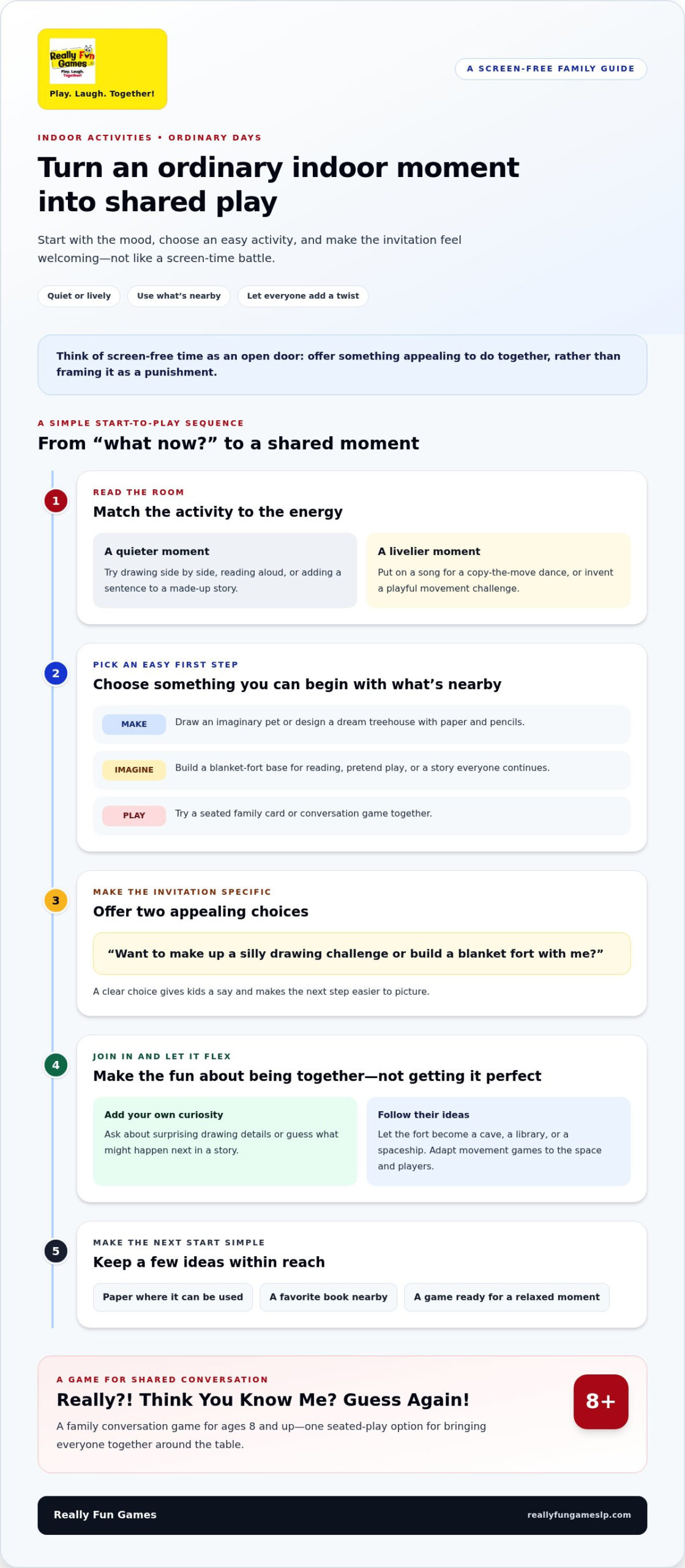
Offer two appealing choices instead of a broad command: “Want to make up a silly drawing challenge or build a blanket fort with me?” Join in yourself, show genuine curiosity, and let kids suggest their own twists. A warm, specific invitation makes the next step clear while giving children a say in how the shared time unfolds.
Indoor family activities to reduce screen time on ordinary days
Not every afternoon needs a grand plan. A good indoor activity can start with what’s nearby and shift to suit the mood: quiet enough for a low-key evening, lively enough to shake off restlessness, or silly enough to get everyone laughing. Keep a few kinds of ideas in mind, then pick the one that feels easiest to begin.
For families thinking about media habits, the American College of Pediatricians discusses health risks of excessive screen time in its position paper. This section focuses on a practical everyday alternative: making room for shared indoor fun without expecting every activity to become a big project.
Creative and cozy activities for quieter moments
Spread out paper and draw side by side, or make a simple craft from supplies already at home. Choose a playful prompt, such as drawing an imaginary pet or designing a dream treehouse—or build tiny imaginary settings using scene sticker sets from KreativeWall.com. The pictures don’t need to match, and nobody has to be “good at art.” Compare surprising details and let each person explain what they made.
For a calmer change of pace, take turns choosing a book to read aloud. Pause to guess what might happen next or share a memory that the story brings to mind. For a no-prep storytelling game, one person starts a made-up tale and each family member adds a sentence. Let the plot wander. A talking squirrel, a hidden door, a very confused astronaut? All welcome.
Lively indoor ideas when everyone needs a change of pace
Put on a song and invite everyone to make up a dance move for the rest of the family to copy. Or invent a movement challenge: move like a robot, tiptoe like a cat, or freeze in a silly pose when someone calls “pause.” Keep it playful and adapt the challenge to the space and the people joining in.
A blanket fort can become a cozy base for reading, pretend play, or continuing a shared story. Let the children decide whether it’s a cave, a library, or a spaceship, then join their make-believe world. The fort doesn’t have to be elaborate to feel special. Its real magic is having a space to create together.
For a seated activity, try a family card or conversation game. Really Fun Games makes family conversation games for ages 8 and up, including Really?! Think You Know Me? Guess Again! for shared play and conversation. Choose a game that suits the people around the table, and let the conversation take its own direction.
Make the next idea easy to reach: leave paper where it can be used, keep a favorite book nearby, or have a game ready for a relaxed family moment. If you’d like a conversation game in that mix, explore Really Fun Games for another way to bring everyone together indoors.
Outdoor family activities that turn free time into shared adventures
Going outside doesn’t have to mean planning an elaborate outing. A walk, backyard play, or time spent noticing what’s nearby can shift the mood and give everyone something to share. Treat outdoor time as a flexible option, not another family obligation. If you have little time or energy, choose a small plan that feels manageable.
An outdoor adventure can fit a backyard, a neighborhood route, or whatever open space your family has available. For families looking to make the most of their garden, outdoor structures from Simply Log Cabins can provide an inviting, sheltered space for games, reading, and creative projects in the fresh air. The shared goal matters more than the destination. Choose something simple to notice, find, or do together, and let the activity grow from there.
Nature walks, scavenger hunts, and neighborhood exploring
Give a familiar walk a playful focus. Ask everyone to spot something round, a particular color, an interesting shape, or a plant they haven’t noticed before. You might look for small details along the way, such as a patterned gate or an unusual cloud. There’s no need to cover a set distance or turn the walk into a race; curiosity can set the pace.
For a scavenger hunt, make it collaborative rather than competitive. One family member chooses something for the group to find, then passes the turn to someone else. Keep the clues open-ended, like “something that makes a sound” or “something with a zigzag shape.” Children and adults can contribute ideas, and taking turns gives everyone a chance to lead.
Even a routine errand on foot can become a shared mini-adventure. Give the group a lighthearted mission: notice different leaf shapes, find something that looks like a letter, or invent a story about a passing cloud. The point isn’t to collect a perfect set of finds. It’s to look around together and see what sparks conversation.
Active play for different energy levels
Some days call for movement. Take a bike ride, kick a ball back and forth, or dance outside if there’s room. You can also make up a movement game, taking turns suggesting a way to move or a pose for everyone to try. Keep the rules loose so younger children can contribute ideas and older family members can add their own twists.
Let each person join in at a comfortable pace. One family member might kick the ball while another keeps score or calls out playful challenges. On a lower-energy day, turn the same outing into a slower stroll or take turns choosing what to notice. A shared activity can include different kinds of participation.
Travel days offer a different setting for screen-free play. Before or after a stop, families can look for screen-free road trip games that invite conversation and keep everyone involved along the way.
For another easy option to bring into shared family time, explore games from Really Fun Games and find playful ways to connect at home or on the go.
How to choose family activities that fit your time, mood, and group
The right activity isn’t always the biggest or most exciting one. It’s the one your family can enjoy in the moment. Before suggesting an idea, consider how much time you have, whether people feel calm or restless, what they’re interested in, and who’s joining. These quick checks can turn a long list of family activities to reduce screen time into an easy choice.
Use this comparison as inspiration, not a rigid schedule. Preparation is relative: a dance break may need only a song, while a creative project can take more gathering and tidying. Choose what fits today, and change direction if needed.
| Activity type | Setting | Preparation | Group energy |
|---|---|---|---|
| Dance break or movement challenge | Open indoor space or backyard | Low | Lively |
| Reading or storytelling | Cozy spot indoors | Low | Calm |
| Drawing or simple craft | Table or shared work surface | Some gathering | Calm to moderate |
| Walk or scavenger hunt | Neighborhood or available outdoor space | Low | Flexible |
| Family card or conversation game | Table or comfortable seating | Low | Calm to lively |
Match the activity to the time and energy available
If there’s room for just a quick reset, try a dance break or a small movement challenge. A shared craft may suit a more settled stretch, while reading or a storytelling prompt can feel right when everyone wants a quieter pause. These aren’t strict pairings. A story can get animated, and a creative project can be as simple as a few quick sketches.
Ask yourself: Does the group want to move, talk, make something, or unwind? Let the answer guide you rather than trying to squeeze an activity into a fixed routine. Some days, a brief shared moment is plenty. Other times, one idea naturally leads to another.
Make one activity work for a mixed-age family
Give everyone a way to contribute. Older children can explain a game or suggest a simpler variation; younger players can take a turn as chooser, storyteller, scorekeeper, or idea-giver. Adults can join in rather than supervise from the sidelines. For ages 8 and up, Really?! Think You Know Me? Guess Again! is a family conversation game that can bring different generations together around questions and shared stories.
Family conversation games are a ready-to-play option for adding shared time to your activity mix. Explore Really Fun Games and choose a game that suits your family’s next moment together.
Build a screen-free family routine with games and small shared plans
A screen-free routine doesn’t mean doing the same activity every day. Instead, create a few natural openings for shared time: after dinner, during a quiet weekend morning, or whenever the family has a little breathing room. A flexible plan gives everyone something to look forward to without turning connection into another strict schedule.
Try this simple approach when you’re ready to choose an activity:
- Choose a moment. Pick an everyday opening that works for your household, such as after a meal or before a weekend outing.
- Invite ideas. Ask what sounds good, or offer a few choices that suit the available time and energy.
- Pick one activity. Choose something manageable, whether it’s a walk, a creative project, a conversation game, or another shared pastime.
- Reflect together. Afterward, ask what people enjoyed and whether they’d like to try it again or change it next time.
That last step helps your family learn what feels inviting without treating every activity as a success-or-failure test. If a plan doesn’t fit the day, switch to something simpler. The point is to make shared time feel possible, not to complete a checklist.
Create a simple family plan that can change with the week
Keep a family idea list where everyone can add suggestions. Include indoor and outdoor choices, quieter ideas and active ones, plus activities that need little preparation. When it’s time to choose, rotate who gets the first pick. A child might choose a story one day, while an adult suggests a walk another time. Let the person choosing adapt the idea to the mood and time available.
Games can be one repeatable option alongside everyday activities, not the centerpiece of every screen-free moment. A card game might suit a relaxed evening, while another day calls for drawing, movement, or simply talking during a routine task. A varied list makes it easier to offer a fresh choice when one idea isn’t right for the group.
Use conversation games to make shared play easy to start
A ready-to-play game can bring everyone together around one shared activity without needing to invent a plan from scratch. Really?! Think You Know Me? Guess Again! is a family conversation game, while Triple Tongue Twisters adds a playful option for vocal fun. Both can sit alongside other ways families connect, from creative projects to outdoor exploring.
Add a game to your family’s shared-play list by browsing award-winning family games and choosing one that fits the people and mood around your table. Explore Really Fun Games to find a game for your next family moment.
Make room for your next shared moment
You don’t need to transform every quiet moment into an activity. Start with one small invitation that feels natural for your family, then notice what makes people want to join in. It might be a playful challenge, a question that opens up a story, or a shared game that brings everyone to the same table. Bring back the ideas that spark genuine enjoyment.
Keep the plan flexible, too. Interests shift, energy changes, and what works this week may not fit next week. A growing menu of family activities to reduce screen time makes it easier to choose connection without adding pressure or turning family time into another task.
For another easy way to get everyone sharing, laughing, and playing together, explore Really Fun Games’ award-winning titles designed for ages 8 and up. Their easy-to-learn, replayable games offer a welcoming starting point for a family game night or an everyday moment together.
Explore the Really Fun Games collection and choose a game to bring your family together. Your next favorite shared moment can start with one simple invitation.
Frequently Asked Questions
How much screen time is too much for children?
There isn’t one screen-time number that suits every child and family. Consider your child’s age, the kind of media they use, and whether screens are interfering with sleep, schoolwork, movement, or time with others. For age-specific guidance, consult the American Academy of Pediatrics’ current recommendations. It can also help to look at your family’s daily rhythm: what feels balanced on a school day may differ from a relaxed weekend.
Is all screen time bad for kids?
No, screen use can support learning, creativity, communication, and entertainment. A video call with relatives, for instance, offers a different experience from watching videos alone. Rather than treating every screen as a problem, consider how it fits into the day and whether other needs are being met. Shared activities can be a welcome change of pace when family members want a break from individual viewing or scrolling.
How do I get my child to try a screen-free activity without an argument?
Use a calm transition and make the next step clear. For example, let your child know they can finish the current level or episode, then invite them to help decide what happens next. Joining them can make a new activity feel less like an order. If they’re not interested in your first idea, stay friendly and try another time; preferences and energy can change from day to day.
What are screen-free activities families can do without special supplies?
Try a verbal category game: choose a topic, such as favorite foods, and take turns naming something that fits. You can also play “two truths and a story,” where one person shares a real memory and the others ask questions to learn more. These family activities to reduce screen time need no equipment and can fit into a meal, a car ride, or a quiet pause at home.
Can screen-free family activities work for different ages?
Yes, especially if you choose a shared theme and let each person engage at a comfortable level. During a storytelling game, a younger child might contribute a character or sound, while an older child adds a twist to the plot. Adults can keep the story moving with questions. The aim isn’t for everyone to do the same thing in exactly the same way, but to share an experience that welcomes different contributions.
How can families make screen-free activities feel less repetitive?
Change one small element instead of replacing an activity your family already enjoys. A familiar guessing game can use a new topic, or a story can switch settings from a forest to outer space. You might also jot down what made an activity fun, such as a surprising answer or a funny family rule. Those details give you fresh starting points next time.