

What if the best family game night isn’t about finding one perfect game, but choosing a way to play that works for the people around the table? Finding family game night ideas for all ages can feel tricky when kids, teens, parents, and grandparents have different interests, attention spans, and comfort levels. Complicated rules can stall the evening, while a game that feels too simple may not hold everyone’s attention.
A few small adjustments can help different generations play together. Team up players, keep turns moving, and give everyone an easy way to join the conversation. A welcoming game night leaves room for laughter, teamwork, and quieter players to take part at their own pace.
Here, you’ll find adaptable game formats, practical tips for making rules easy to follow, and ways to choose replayable games that suit your family. Conversation games like Really?! Think You Know Me? Guess Again! and wordplay games like Triple Tongue Twisters, designed for ages 8 and up, can bring lively moments to the table. Pick an idea that fits your group, and let the fun unfold.
Key Takeaways
- Build a welcoming game night around your family’s mix of ages, interests, confidence levels, and attention spans.
- Explore conversation, wordplay, guessing, storytelling, cooperative challenges, and light team play to find a format that suits the group.
- Compare games by how people interact, how quickly they can learn the rules, and how comfortable everyone feels joining in.
- Keep the evening flowing: choose a mood, explain the rules simply, play, and check in before switching things up.
- Use these family game night ideas for all ages to find replayable card and conversation games that make room for laughter and meaningful interaction.
Family Game Night Ideas for All Ages Start with Making Everyone Feel Welcome
A great family game night doesn’t depend on finding one magical game that every person loves in exactly the same way. It starts with noticing who’s gathered around the table and choosing a format that gives each person a comfortable way to participate. Kids may be ready to jump in, while grandparents might prefer a calmer pace. One person may love a quick challenge, while another enjoys listening before speaking. Those differences add variety to the evening. They’re not problems to solve.
The goal of family game night ideas for all ages is shared enjoyment: a little laughter, lively conversation, and the feeling that everyone belongs. The phrase also appears in TV and video-game contexts, as the Wikipedia page for Family Game Night shows. At home, though, the tradition is shaped by the people playing together.
A few thoughtful choices can make the table easier to join:
- Keep the first explanation brief. Explain the main goal and what happens on a turn. Clarify other details as they come up.
- Make participation flexible. Players can answer, make a guess with a teammate, or watch a round before joining.
- Choose different kinds of play. Mix talking and thinking with a playful performance or team challenge, so more personalities have a chance to shine.
Really Fun Games’ card and conversation games are designed for ages 8 and up. Explore the card and conversation games and choose a format that suits the ages and interests of your group.
What makes a game night work across generations?
Look for turns that are easy to follow and instructions that don’t require a long explanation before the fun begins. A game can still invite thought and creativity without making everyone compete at the same pace. Teammates might talk through a guess together, for example, or take turns sharing ideas. Success isn’t a perfectly even contest. It’s the shared grin when someone surprises the group or helps another player along.
How can families make quieter players comfortable?
Let anyone who prefers to watch a round do so before joining. Normalize passing, asking for a hint, or teaming up. These options make participation feel like an invitation, not a performance. When a prompt asks for a story or opinion, give people time to think and let them choose how much to share. Instead of calling on someone unexpectedly, offer the question to the whole group and let the conversation find its own rhythm.
That small shift can change the feel of the evening. Players don’t have to be the loudest, quickest, or most competitive person at the table to be part of the fun.
Six Family Game Night Ideas for Different Ways of Playing
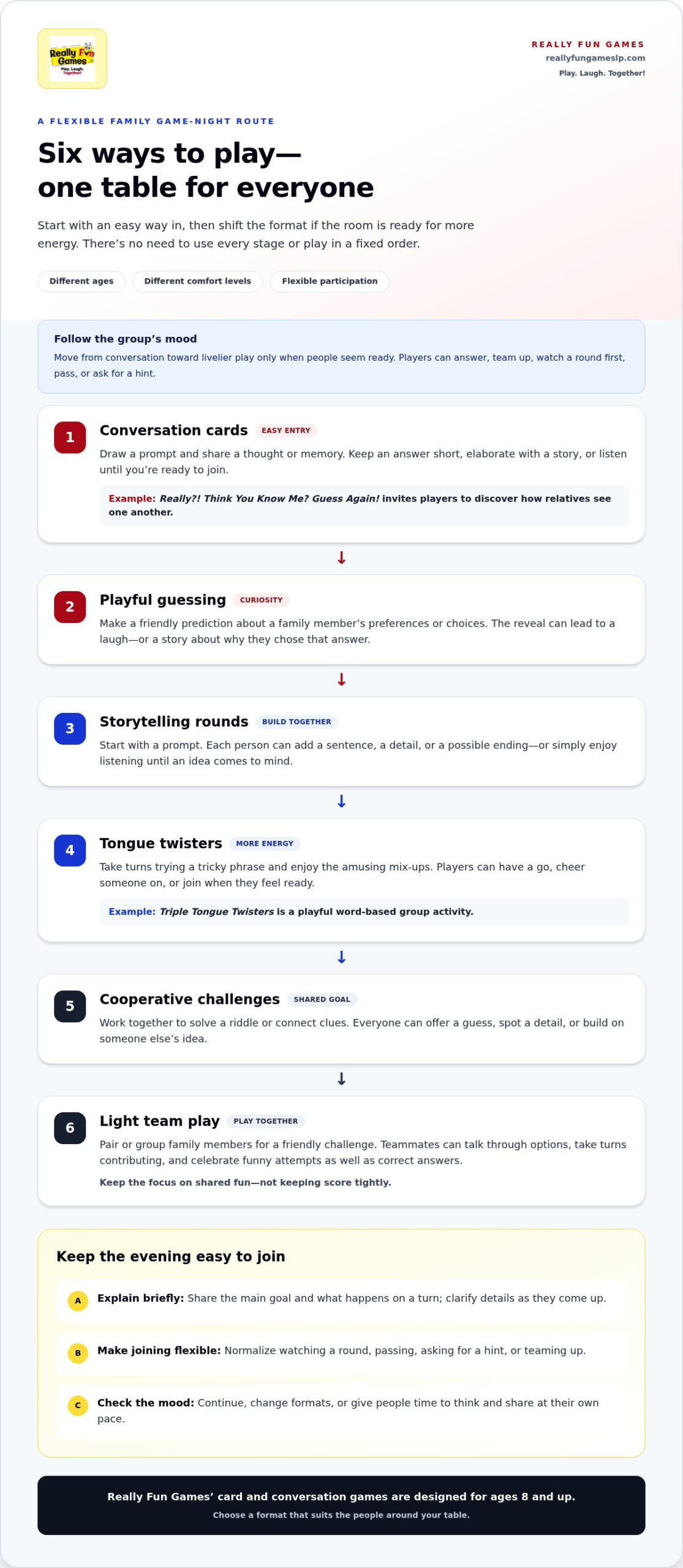
The best family game night ideas for all ages offer more than one way to join the fun. Try a quieter conversation round, then switch to wordplay or a shared challenge if the room is ready for more energy. These six formats can help you choose family card games and other engaging games to purchase, while making room for different strengths and styles.
Conversation and guessing games that invite family stories
Conversation formats turn curiosity into play. A prompt can bring out a memory, a surprising opinion, or a friendly guess about what someone else might say. Choose a game with clear prompts and let players answer aloud, think for a moment, or share an idea with a teammate. The aim is easygoing discovery, not perfect answers.
- Conversation cards: Draw a prompt and invite everyone to share a thought or memory. Players who enjoy telling stories can elaborate, while others can keep their response short. Really?! Think You Know Me? Guess Again! is a family conversation-game example that invites players to discover how relatives see one another.
- Guessing games: Let players make playful predictions about a family member’s preferences or choices. A guess can lead to a funny reveal or a story about why someone chose that answer, giving quick thinkers and thoughtful listeners a way in.
- Storytelling rounds: Start with a prompt and invite each person to add a sentence, detail, or possible ending. Someone can build on the story, suggest a twist, or enjoy listening until an idea comes to mind.
Wordplay and team formats for a livelier room
Ready to turn up the energy? Wordplay and team challenges bring speaking, listening, and shared problem-solving into the mix. Keep the mood light: the fun comes from trying, reacting, and cheering one another on, not from delivering a flawless performance. For more ideas, explore family-friendly tongue twister games.
- Tongue twisters: Take turns trying a tricky phrase, then enjoy the amusing mix-ups. A confident speaker can have a go, while a quieter player can listen, offer encouragement, or join in when ready. Triple Tongue Twisters is a playful word-based group activity.
- Cooperative challenges: Give the group a shared goal, such as solving a riddle or working out a clue together. Players can offer a guess, spot a detail, or help connect everyone’s ideas, so success feels shared.
- Light team play: Pair or group family members for a friendly challenge. Teammates can talk through options, take turns contributing, and celebrate funny attempts along with correct answers. Keep the focus on playing together rather than keeping score tightly.
Choose a format that fits the room’s mood, then let the group’s reactions guide what comes next. For a conversation-centered option, explore Really Fun Games and find a game to bring fresh stories and laughter to your family table.
Choosing Family Games for Mixed Ages and Interests
Choosing games for families doesn’t mean finding one activity that entertains every person in exactly the same way. Instead, look for a format with an inviting way in for different players: sharing a story, trying a silly phrase, or contributing to a team. These family game night ideas for all ages are easier to match to your group when you compare how a game feels to play, not just its theme.
Which game format fits your family’s mood?
Start by asking what kind of interaction sounds fun tonight. A game that sparks conversation may suit a family in a story-sharing mood, while wordplay can bring a playful burst of energy. Team formats offer a shared goal for people who like solving something together.
| Format | Interaction style | Learning curve | Group comfort |
|---|---|---|---|
| Conversation games | Share opinions, memories, and playful guesses | Often easy to begin when prompts make the next step clear | Good for people who enjoy talking; allow short answers or time to think |
| Wordplay | Listen, speak, and enjoy silly verbal challenges | Simple to understand, though saying a phrase can take practice | Works for playful groups; participation can range from trying a turn to cheering others on |
| Team formats | Discuss ideas and work toward a shared goal | Depends on the rules and challenge | Can ease pressure by letting teammates contribute in different ways |
Conversation games suit relatives who like hearing one another’s stories or comparing opinions. Wordplay brings a livelier feel for groups happy to speak up and laugh at amusing slips. Teams can balance different strengths: one person may spot a clue, another may suggest an answer, and someone else may encourage the group. No single format has to carry the whole evening. A change of pace can make room for different interests.
How to make age guidance and comfort part of the choice
Follow each game’s stated age guidance when deciding whether it suits the youngest intended players. Then consider the needs and preferences of everyone who may join. Is reading a prompt aloud comfortable? Does anyone prefer time to think before responding? Would a new player appreciate seeing a sample turn before the game begins? These details help you choose thoughtfully without assuming that one title fits every age or ability.
A quick preview can help: explain the basic turn, show an example, and let everyone decide whether the format sounds appealing. If reading aloud feels like a barrier, a family member can read the prompt. If speaking on the spot feels uncomfortable, a player might listen first or share with a teammate. These adjustments don’t change the spirit of the game; they make it easier to find a format for this particular group.
Use the comparison as a starting point, then choose a game that matches your family’s mood and comfort. Browse the family and conversation games for a format that could add a fresh spark to your next game night.
A Simple Game Night Plan That Keeps Everyone in the Mix
A little structure can help game night feel relaxed instead of turning the host into a full-time referee. Keep the plan flexible: choose a mood, explain the essentials, start playing, and check in as you go. This simple rhythm gives everyone a sense of what’s happening while leaving room to change course if the group wants something different.
Set the tone before the first round
Start by agreeing that the aim is to enjoy one another’s company, not prove who’s best. Then choose a format that feels low-pressure for your group, such as a conversation game or an easy team activity. If the mood calls for it, move on to livelier wordplay.
Explain the rules in plain language. Cover the goal, what a turn looks like, and how the round ends. If the game has more details, introduce them when they become useful rather than delivering a long explanation up front. Ask if anyone has a question, give an example turn if helpful, then begin. Players often understand the flow more easily once they see it in action.
Make comfort part of the ground rules, too. Anyone can ask for help, take a break, or choose not to answer a prompt. That flexibility helps game night welcome different ages and confidence levels without making anyone explain why they need a pause.
Keep the energy welcoming as play continues
Let participation take different forms. A player might take a turn, help a teammate think through a choice, cheer from the side, or observe for a while. Rotate who starts or reads the next prompt so one person doesn’t have to lead every round. For a team game, invite players to share ideas before settling on an answer. For a conversation format, allow quieter players time to gather their thoughts.
Pay attention to the room, not just the rules. If attention starts to drift, pause for a stretch or a snack. If a quieter game has everyone chatting, stay with it. If the group is ready for a burst of energy, switch formats. These small adjustments help family game night ideas for all ages work in real life, where moods shift and not everyone wants to play at the same pace.
To wrap up, invite each person to name a funny, surprising, or memorable moment. Keep it optional and brief. One shared laugh or unexpected answer can give the evening a warm ending without turning the closing round into another competition.
A good plan is a guide, not a script. Choose a game that suits your family’s mood, keep the rules easy to follow, and adjust as you go. Explore games for your next family game night and find a playful fit for your gathering.
Bring Your Family Game Night Ideas to Life with Conversation and Card Games
Once you’ve picked the kind of interaction your family enjoys, an easy-to-learn card game can make it simple to get started. Replayable family and conversation games offer a ready-made way to bring people around the table, with a format you can return to when everyone wants another round. Choose based on your group’s mood: are people ready to share stories, or would they rather laugh over playful word challenges?
When conversation games are a good fit for family night
Conversation games use prompts to open the door to opinions, memories, and lighthearted guesses. A question can spark a story someone hasn’t heard before or reveal a funny difference in how relatives see one another. Players can contribute in their own way, whether that means offering a quick answer or adding details to a story. The point is to make space for conversation, not to demand a big personal reveal.
Really?! Think You Know Me? Guess Again! is a family conversation game from Really Fun Games. Its focus on communication and social skills makes it a natural option for a family seeking both laughter and meaningful interaction. Browse family conversation and guessing games for a format that fits your group’s interest in stories, opinions, and playful predictions.
When wordplay gives the group a different kind of fun
Not every game night needs a question-and-answer format. Tongue twisters bring a different kind of energy, inviting players to listen, speak, and enjoy the silly moments that come with a tricky phrase. Triple Tongue Twisters is a vocal-play option from Really Fun Games. A player can try a turn, listen closely, or laugh along with the group, keeping the activity lively without making personal sharing the focus.
Wordplay can also work as a warm-up before a longer game or as a change of pace when the conversation starts to fade. For other ideas that help a group get comfortable together, explore icebreaker games for social gatherings. Choose a format that suits the family’s mood, and let the evening take shape around the stories, smiles, and playful moments that follow.
Easy-to-learn, replayable games can give your family a dependable starting point for family game night ideas for all ages. Pick conversation for a story-filled evening or wordplay for a more energetic one, then adjust as you go. Discover the Really Fun Games collection and find a card or conversation game for your next family gathering.
Make Your Next Game Night a New Family Tradition
Let your next gathering be an invitation to discover what makes your family laugh, think, and open up. A small ritual can make it feel special: let someone choose the game, pick a playful theme, or save a favorite moment to bring up next time. There’s no need to make every evening elaborate. A little shared attention can turn an ordinary night into a memory everyone carries forward.
As you try different family game night ideas for all ages, notice which moments bring people closer. Maybe it’s an unexpected answer, a silly tongue-twister attempt, or a story that sparks conversation long after the cards are put away. Let those moments guide what you play next.
For a fresh addition to your family’s game shelf, Really Fun Games offers award-winning family, conversation, and educational games. Discover the Really Fun Games collection and find a playful way to bring your people together. Here’s to a table full of smiles, stories, and more nights worth remembering.
Frequently Asked Questions
How do you make family game night fun for different ages?
Choose a game with more than one way to contribute, such as sharing a quick answer, thinking through a clue, or helping a teammate. Before starting, ask each person what sounds fun: a chatty game, a silly challenge, or something thoughtful. For family game night ideas for all ages, try a short first round and let the group decide whether to continue or switch formats.
What games can grandparents and children enjoy together?
Conversation games, guessing games, and simple team activities can give children and grandparents common ground without relying on the same hobbies or pop-culture knowledge. Try prompts about favorite foods, family traditions, or memorable firsts. A child can ask a grandparent a question, then the grandparent can ask one back. Shared stories often become part of the fun, even between turns.
Are card games a good choice for a family game night?
Yes, card games can be a handy choice because the cards keep turns and prompts visible, giving players a clear next step. They’re also easy to bring out for a short gathering or revisit another evening. Look for a game whose language, age guidance, and pace fit your group. Conversation card games are especially useful when you want play to spark stories as well as laughter.
How can you include someone who does not like competitive games?
Choose play that emphasizes creating, guessing together, or reaching a shared goal rather than beating another person. If a game has points, treat them as a lighthearted part of play, not the measure of success. You can also invite someone to be a clue-giver, story-builder, or encouraging teammate. Offer the role without pressure, and let them choose how involved they’d like to be.
What can you do if family members do not want to play the same game?
Agree on a simple compromise: let one person choose the first activity, then give another family member the next pick. You might also plan an evening with two different short games, so each gets a turn without asking everyone to commit to one style all night. If preferences are far apart, take turns choosing on future gatherings rather than trying to settle every disagreement at once.
Can a family game night include children under age 8?
Yes. Check the game’s stated age guidance and choose an activity that suits the child’s age and abilities. A younger child might enjoy helping a grown-up, taking a simple role, or joining a separate age-appropriate activity nearby. Keep participation relaxed, and let the child engage in a way that feels comfortable. Not every game will be a fit for every child.
How often should a family have a game night?
There’s no required schedule. Pick a rhythm that feels enjoyable rather than like another obligation, whether that means a regular evening or bringing out a game during family visits. A small, predictable cue, such as setting aside a favorite snack or letting someone choose the next game, can make it easier to restart the tradition after a busy stretch. Keep it flexible as routines change.