

Fun conversation games for groups help friends, teammates, and new acquaintances get talking. Choose a game to suit the group and the moment: try a playful icebreaker to ease into a gathering, a team challenge to encourage collaboration, or a thoughtful prompt when friends want to catch up.
Conversation doesn’t always flow on its own, but a little structure can give everyone a way in. A game offers something fun to respond to, whether the group is meeting in person or virtually.
Here are ideas for team building, getting-to-know-you moments, online and in-person gatherings, and relaxed time with friends. Each gives people a simple way to join the conversation, share a laugh, and discover something new about one another.
Key Takeaways
- Match the game to your group’s purpose, whether you want teamwork, a relaxed icebreaker, or a lively catch-up with friends.
- Use simple prompts and clear turns to help new acquaintances feel comfortable joining the conversation.
- Adapt familiar games for virtual or in-person gatherings by choosing formats that keep everyone involved.
- For larger groups, split players into smaller teams or circles so more people get a chance to speak.
- Explore conversation and tongue-twister card games for a ready-to-play way to bring laughter and connection to your next gathering.
1. Team-building conversation games
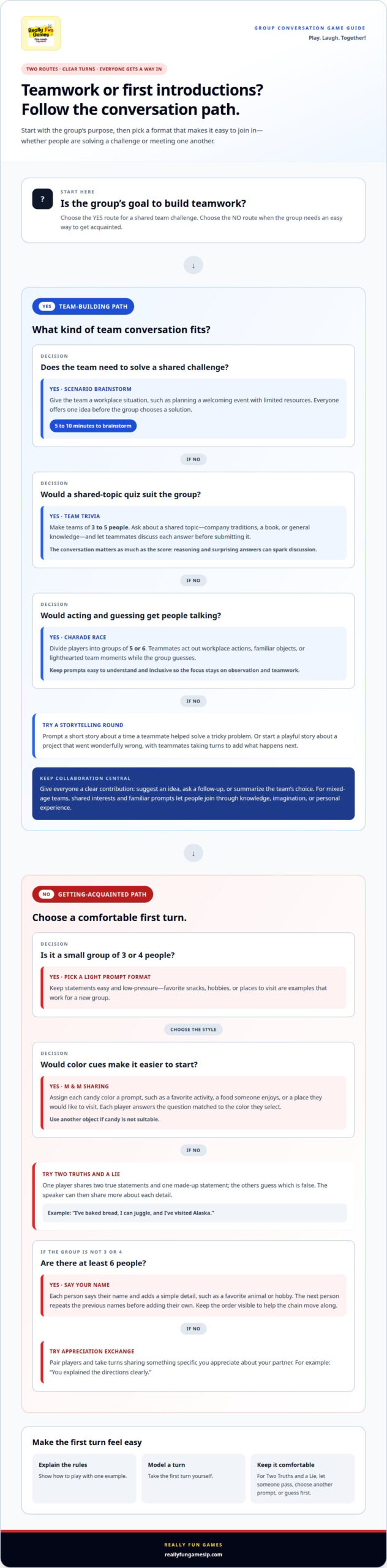
Team-building conversation games turn a shared challenge into a chance to listen, explain ideas, and build on colleagues’ suggestions. For a quick collaboration round, give a team a workplace scenario, such as planning a welcoming event with limited resources. Let everyone offer one idea before the group chooses a solution. Teams may be given 5 to 10 minutes to brainstorm solutions, keeping the discussion focused and giving quieter players a clear opening.
Team trivia adds friendly competition while making room for different strengths. Form teams of 3 to 5 people, then ask questions about a shared topic, such as company traditions, a book, or general knowledge. Invite teammates to discuss each answer before submitting it. The conversation matters as much as the score: a player who explains their reasoning can help others learn, while a surprising answer can spark a story.
Storytelling can make team conversations more personal without asking anyone to give a speech. Offer a prompt such as, “Describe a time a teammate helped solve a tricky problem.” Each person can share a short example and name one action that made the collaboration work. For a more imaginative round, have someone start a story about a project that went wonderfully wrong. Teammates take turns adding the next event to build a playful narrative together.
For an energetic competition, try Charade Race. Divide players into groups of 5 or 6, then have teammates act out workplace actions, familiar objects, or lighthearted team moments. The group guesses each prompt, and the next actor takes a turn. Keep prompts easy to understand and inclusive, so success depends on observation and teamwork rather than specialist knowledge. A lively round can loosen up a meeting before a planning discussion.
Mixed-age teams can try trivia based on shared interests or tell stories in response to a familiar prompt, such as a memorable meal. These formats let players contribute through knowledge, imagination, or personal experience, so everyone has a way to participate.
For kids and families, try a storytelling circle or Charade Race with familiar prompts such as animals, favorite foods, or everyday activities. Adults can model a short answer first, then give each child a comfortable opportunity to add an idea or make a guess.
To keep collaboration at the center, give every player a role in the conversation: suggest an idea, ask a follow-up, or summarize the team’s choice. For a picnic-planning round, conversation and team-building games can provide a playful starting point as teammates share menu ideas and agree on a plan.
2. Icebreakers and getting-to-know-you activities
A good icebreaker gives everyone a straightforward first turn. In Two Truths and a Lie, one player shares two true statements and one made-up statement. Everyone else guesses which is false, then the speaker can share more about each detail. For example, “I’ve baked bread, I can juggle, and I’ve visited Alaska” invites guesses and follow-up questions.
Two Truths and a Lie is suggested for groups of 3 or 4 people, where everyone can listen closely and take a turn. Keep statements light for a new group. Favorite snacks, hobbies, or places to visit offer conversation without requiring personal disclosures. If a player would rather pass, let them choose a different prompt or guess first.
For a warm, affirming start, try Appreciation Exchange. Pair players and take turns sharing something you appreciate about your partner. A specific observation, such as “You explained the directions clearly,” makes the compliment more meaningful. In a classroom, club, or work gathering, this format focuses attention on helpful actions rather than generic praise.
M & M Sharing uses candy colors as conversation cues, making it easy to begin without preparing question cards. It is suggested for small groups of 3 or 4 people. Assign each color a prompt, such as a favorite activity, a food they enjoy, or a place they’d like to visit. Players select a piece and answer its matching question; use another object if candy isn’t suitable.
For a larger circle, Say Your Name is suggested for groups of at least 6 people. Have each participant say their name and add a simple detail, such as a favorite animal or a hobby. The next person repeats the previous names before adding their own. Keep the chain moving with a visible order, especially when colleagues or classmates are meeting for the first time.
How do you play Would You Rather in a group? One player asks a question that presents two scenarios, such as “Would you rather explore a forest or visit a museum?” Everyone chooses a preference, then a few players explain their reasoning or ask a follow-up.
What are no-prep conversation games for parties? Two Truths and a Lie, Would You Rather, and Say Your Name need only spoken prompts and turn-taking. Choose a format to suit the group: paired sharing for a quieter start, or a name circle to bring everyone into the party.
For a smoother icebreaker, choose a format from these conversation game ideas that suits the group’s energy, explain the rules with one example, and take the first turn yourself.
3. Virtual and in-person group games
Choose a game that suits the room, screen, and group’s energy. For a video call, use spoken prompts that need no shared materials, such as Twenty-One Questions. In person, add movement with Stress Charades or a Backpack Scavenger Hunt. A clear turn-taking rule helps everyone follow along in either setting.
In Twenty-One Questions, players try to identify a person, place, or object within twenty-one yes-or-no questions. One player chooses the answer while the others ask questions to narrow down the possibilities. On a virtual call, use the chat to track questions or ask someone to keep count. In person, take turns asking aloud.
Micro Story brings a quick burst of creativity to a remote meeting or living room. Give a player 10 seconds to tell a story with a clear beginning, middle, and end. Try a prompt such as “a lost lunchbox finds its way home.” The short limit encourages playful choices instead of long pauses.
The Alphabet Game works well when everyone can hear the same prompt. Choose a category, such as animals, then name an item beginning with each successive letter. Players who can’t think of a word on their turn are out. For a virtual group, say the current letter clearly and let players take turns in a set order.
For lively face-to-face play, Stress Charades gives every player 4 pieces of paper. Players write prompts, mix them together, and take turns acting them out. Give each person 20-30 seconds to perform a prompt while others guess. On video, keep gestures in view and let the group use chat for guesses.
Name Swap can help a group learn names through a simple card exchange. Give each participant a name card, then have players mingle and introduce themselves using the name on their card. For a virtual gathering, assign names verbally or display them onscreen, then invite participants to introduce themselves in turn.
Backpack Scavenger Hunt is suggested for small groups of 5 or 6 people. Call out an everyday item, such as a pen or a notebook, and let players find it in their bags. For a remote group, each person can search nearby and show the item onscreen. Keep prompts easy to find and comfortable to share.
Before play begins, explain the goal and demonstrate one turn. For a hybrid gathering, ask someone in person to repeat remote players’ guesses aloud so everyone can follow the same round. Games with spoken clues, visible turns, and simple prompts help people join in from both screens and sofas.
Never Have I Ever can work when a group wants a clear winning condition. The last player with a finger still raised wins. State the outcome before play begins, and keep an eye on the round so everyone can tell when a winner emerges.
For Name Swap, give each participant one name card. Allow a moment to check the card before introductions begin, then keep the focus on using the name shown.
4. Conversation games for friends
Friends can use conversation games to move beyond the usual “How’s work?” and trade stories, opinions, and unexpected discoveries. Choose a prompt that suits the mood, then let each person decide how much to share. For example, ask everyone to name a small thing that made them laugh recently. Follow up with “What made it funny?” to turn a quick answer into a story.
Try “Things in common” when friends want to find familiar threads without choosing a competitive game. According to the International Labour Organization, the game works for small groups of 2-4 people, who identify what they share. Start with a broad topic, such as favorite ways to relax, then take turns naming possibilities. Keep going until the group finds a shared interest, habit, or memorable experience.
What are easy conversation games for small groups? “Things in common” needs only a topic and turn-taking, while “One-word story” has players build a tale together, one word at a time. For example, one friend starts with “Yesterday,” and each person adds the next word until the group reaches a surprising ending.
“Memory Lane” gives friends a playful way to revisit shared experiences. Name a place you’ve visited together, such as a favorite café, and invite each person to recall one detail. One friend might remember the music, while another recalls a dessert or an amusing mix-up. Different details can lead to fresh stories about the same outing.
For a more imaginative round, play “Choose Your Superpower.” Each person invents a power, such as understanding pets or instantly finding lost keys, then explains how they’d use it. Friends can ask follow-up questions or invent a playful limitation. “You can understand cats, but only when they’re hungry” adds a twist and keeps the conversation going.
“Question Relay” helps everyone participate without putting one person in the spotlight. A player asks a light question, such as “What song belongs in a road-trip playlist?” The next person answers and asks a new question. Friends can pass, change the subject, or ask why someone chose their answer. That flexibility keeps the exchange relaxed and personal.
Use open-ended prompts, but avoid topics that feel too private for the group. A question about a dream weekend lets friends share as much or as little as they like. If the conversation stalls, offer an example answer first, then invite someone else to share a different take.
Choose “Things in common” to discover shared interests, “Memory Lane” to revisit a favorite outing, or “One-word story” for spontaneous silliness. These simple conversation games suit a coffee catch-up, casual dinner, or quiet evening with friends because they turn a prompt into a shared exchange.
5. What are the best conversation games for large groups?
Large groups need a simple prompt, clear turns, and a way for everyone to join. The Line Up game works with teams of 10-15 people. Choose a light topic, such as favorite seasons, and ask teammates to arrange themselves by preference. As they decide where to stand, they can trade reasons and compare experiences. Follow with a quick round where a few participants explain their choices, giving the group more conversation than movement alone.
For a shared challenge, try The Movie Game. It’s suggested for large groups of about 20 people, divided into groups of about 5. One player gives clues about a movie while teammates guess the title. After each turn, invite players to explain which clue helped or share a favorite scene. For instance, a team might recognize a film from its setting, then compare which character they remember best.
The Winds Are Blowing is suggested for groups of 10-20 people. Have players stand in a circle, then call out a prompt such as “The wind is blowing for everyone who enjoys mystery films.” People who relate to the statement move to a different place in the circle. Use friendly topics, such as favorite foods or weekend activities, and invite movers to share a quick reason for their choice.
For a family reunion or workplace gathering, adapt prompts to the people in the room. “Find someone who enjoys cooking” can start a conversation between guests who haven’t met. Ask each pair to share a favorite dish or cooking mishap, then bring everyone back together. A follow-up such as “Who taught you to make it?” can turn a quick match into a real exchange.
To keep a large circle lively, alternate active games with seated rounds. After The Line Up, invite each participant to share one reason for their choice. After The Movie Game, ask each small team to recommend a film to the room. These short follow-ups give more players a chance to speak, while small teams offer space to shape an answer before sharing it with everyone.
Choose The Line Up when movement can energize the room, The Movie Game for team guessing, or The Winds Are Blowing for quick shared-interest prompts. Explain the rules with one example before play begins. For a mixed group, use familiar topics and let players pass on prompts that don’t suit them.
For a gathering where teammates need shared prompts and simple turn-taking, conversation games can give the group a ready starting point while you choose a format that fits the room.
Really Fun Games: Really?! Think You Know Me? Guess Again
Really?! Think You Know Me? Guess Again gives friends and families a playful way to see how well they know one another. It suits a game night, reunion, or group gathering when lively guesses can open the door to stories and conversation. For a vocal twist, Triple Tongue Twisters, Tricky Tetra Tongue Twisters, and Blooming Tongue Twisters add playful word challenges to the table.
Choose a style to match your group’s mood: personal conversation or tongue-twisting fun. Really Fun Games offers social and educational card games for families, friends, and groups who want to connect through play.
Visit reallyfungameslp.com to explore Really Fun Games and choose a game for your next gathering.
Make your next gathering a little more connected
The best conversations don’t have to end when the game does. Let a favorite answer spark a shared plan, a new question, or a story you’ll bring up again later. For your next gathering, decide what you want to bring into the room: easy laughter, fresh discoveries, or stronger teamwork. That intention can help you choose Fun conversation games for groups that suit the people around you.
Keep the invitation simple. Set out a game, welcome different personalities, and let the group shape the moment together. A relaxed round can become a bright spot in family time, a classroom break, or a team gathering, especially when everyone has room to join in their own way.
Ready to bring more playful connection to your group? Contact Really Fun Games and explore ideas for your next gathering. Your next memorable conversation can start with one shared turn.
Frequently Asked Questions
What are fun conversation games for groups?
Fun conversation games for groups use prompts, playful challenges, or shared storytelling to help people connect. At a family dinner, ask everyone to invent a name for a new dessert and describe its ingredients. At a club meeting, invite each person to share a skill they’d like to learn. Choose a format that suits the group’s energy, and make passing on a prompt an option.
How do you play Two Truths and a Lie?
Each player shares three statements about themselves: two true and one invented. The others guess which one is made up. For example: “I can solve a Rubik’s Cube, I’ve met a famous chef, and I once camped in a treehouse.” After the guesses, the speaker reveals the false statement. To keep the round lively, invite one follow-up question about a true detail before moving to the next person.
What are good conversation games for work team building?
Work-friendly options include paired interviews, shared problem-solving prompts, and collaborative storytelling. For a paired interview, ask coworkers to learn about each other’s preferred way to receive feedback, then introduce their partner’s answer to the team. This gives everyone a chance to listen and helps colleagues understand different working styles. Choose light, inclusive prompts connected to teamwork, and avoid questions that call for private details.
