

A good listener does more than stay quiet. Active listening means giving the speaker your attention, holding back judgment and interruptions, and showing interest through responsive body language. Games for active listening skills make these habits easier to practise through play, from following directions to listening closely and recalling what you heard.
Listening is more than hearing words. Understanding also means noticing details and giving someone room to finish. With simple activities, kids and adults can practise these skills in a playful, low-pressure way.
Explore games that involve movement and following directions, activities for classrooms and workplaces, and playful ways to paraphrase or reflect on what someone said. You’ll also find a clear explanation of active listening and practical ways to adapt each game for your group.
Key Takeaways
- Build listening practice from simple spoken directions, then add steps as players grow more confident.
- Use movement games to make listening active and playful for young children.
- Bring listening activities into classrooms and workplaces, then discuss how the skills apply to everyday conversations.
- Practice paraphrasing by restating a speaker’s main idea and asking a clarifying question when needed.
- Look for more than silence: attention, patience, and responsive body language help show that someone is truly listening.
1. Listening and following spoken directions
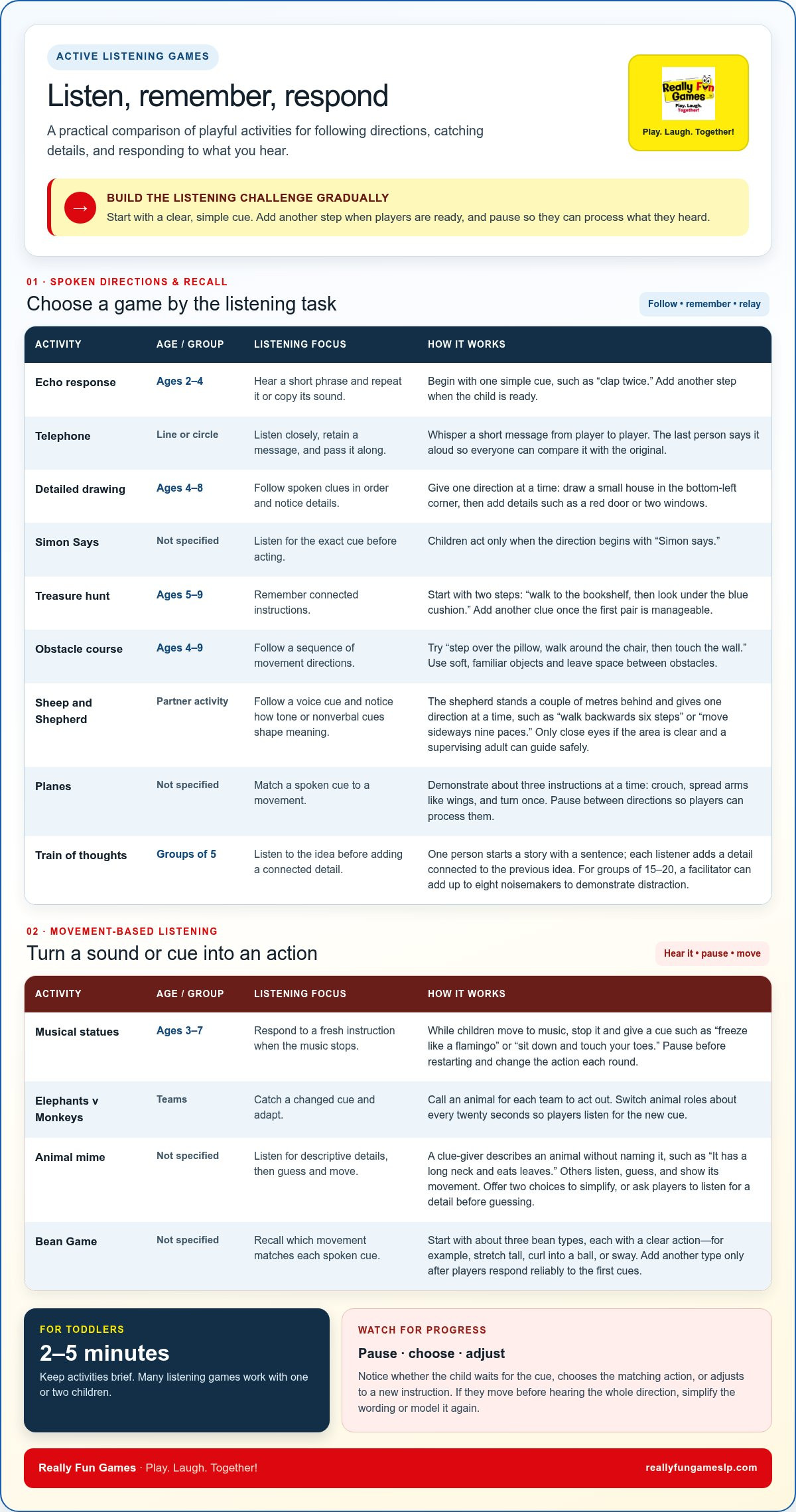
Spoken-direction games turn listening into something players can hear, remember, and do. For children ages 2 to 4, try an echo response game: say a short phrase, then invite the child to repeat it or copy its sound. Keep the first instruction simple, such as “clap twice,” and add another step when the child is ready. This helps engage little listeners through clear instructions and playful experiences.
In Telephone, players sit in a line or circle. The first person whispers a short message to the next player, who passes along what they heard. Each person repeats the message to the next listener, and the last player says it aloud so everyone can compare it with the original.
For ages 4 to 8, use detailed drawing directions. Give one instruction at a time, such as “draw a small house in the bottom-left corner,” then add details like a red door or two windows. Players listen before drawing, and the finished pictures show how carefully they followed each spoken clue. Simon Says adds a movement choice: children listen to each direction and act only when it begins with “Simon says.”
A treasure hunt can build memory for connected instructions. Start with two steps, such as “walk to the bookshelf, then look under the blue cushion.” For children ages 5 to 9, add another clue once they can follow the first pair. A direction-following obstacle course suits ages 4 to 9: say, “step over the pillow, walk around the chair, then touch the wall.” Use soft, familiar objects and leave space between each obstacle.
In Sheep and Shepherd, one player follows a partner’s voice across an open space. The shepherd stands a couple of metres behind the sheep and gives one direction at a time. Try “walk backwards six steps” or “move sideways nine paces.” The sheep can close their eyes only if the space is clear and a supervising adult can guide them safely. Here, tone and other nonverbal cues, such as a hand signal, can also shape how the direction is understood.
For the Planes game, demonstrate about three instructions at a time before adding more. Players might crouch, spread their arms like wings, and turn once when they hear the matching cues. Pause between directions so players can process what they heard instead of relying on speed.
To follow a train of thoughts, divide participants into small groups of 5. One person begins a story with a sentence, and each listener adds a detail that connects to the previous idea. A facilitator can introduce background noise for groups of 15 to 20 participants by nominating up to eight noisemakers. Listeners then notice how distractions affect their ability to catch each instruction. For more communication-centered group play, explore games that encourage conversation.
2. Movement-based listening games for young children
Movement gives young children a visible way to respond to a sound or saying. For children approximately 3 to 6 years old, games that pair a spoken cue with an action can help them practice listening while moving, waiting, and changing direction. Keep instructions short, demonstrate the action once, then let the children try.
You don’t need special equipment. A clear space, a few familiar objects, and music from a phone or speaker can set up several activities. Many listening games work with one or two children, so a parent, teacher, or therapist can join in without organizing a large group.
Try musical statues with instructions, suggested for ages 3 to 7. Play music while children move around the space. When the music stops, give a cue such as “freeze like a flamingo” or “sit down and touch your toes.” Pause before restarting so children can hear each new instruction. Change the action each round to encourage careful listening instead of simply copying the previous move.
In Elephants v Monkeys, call out an animal and have each team act it out. An elephant might take slow, heavy steps; a monkey might pretend to swing or scratch its head. Switch animal roles about every twenty seconds so players have to catch the new cue and adapt. Keep the movements simple, especially while children are learning to wait for the instruction.
A mime game can bring listening and language together. Ask a child to choose an animal, then describe it aloud without naming it: “It has a long neck and eats leaves.” The others listen, guess, and show the animal’s movement. Change the clue-giver each turn. To make the activity simpler, offer two choices. For more of a challenge, ask players to listen for a detail before guessing.
For another movement activity, start with about three bean types in the Bean Game. Give each type a clear action, such as stretching tall, curling into a ball, or swaying side to side. Call one type at a time, and introduce another only after players respond reliably to the first cues. This gives children a chance to practise listening and recall without crowding instructions together.
How long should active listening games take, and how many players do they need? For toddlers, keep a listening activity to 2 to 5 minutes; many games work with one or two children. A simple stop-and-start round can be enough, especially when young players are still learning the cues.
How can you tell whether a game is working? Notice whether a child pauses for the cue, chooses the matching action, or adjusts after a new instruction. If they move before hearing the whole direction, simplify the wording or model the action again. These visible responses help you decide whether to repeat a cue or make the next round more complex. For more playful ways to connect through conversation, explore games for shared play.
3. Practicing listening skills in schools and workplaces
In school, listening practice can grow from short exchanges into shared conversations. For school-age children, activities can run 15 to 20 minutes. Children ages 6 to 8 can work on more complex listening, such as holding onto an idea and adding a relevant detail. Try popcorn storytelling: each player adds a sentence to a shared story, using what they heard to continue it.
After popcorn storytelling, pause for a group discussion. Ask learners which detail helped them continue the story or when they had to listen especially carefully. Then invite them to connect that skill to a classroom moment, such as following a classmate’s explanation during a group project. This helps children recognize listening as part of everyday teamwork, not just a game.
Role-play makes workplace and classroom conversations easier to examine. Pair participants as a speaker and an absent-minded listener. The speaker shares a simple idea, such as planning a class event; the listener glances away or changes the subject. After 5 minutes, switch roles. Discuss how interruptions, distracted body language, and missed details affected the exchange.
For a more focused role-play, ask one person to describe a recent success while a partner practices paying attention. In the Loud Brain activity, the speaker shares something they have been finding success in lately for 60 seconds. The listener then repeats the main point and asks a clarifying question. This gives both partners a clear verbal task and makes careful attention easier to notice.
What are engaging active listening activities for adults? Try Dream Vacation: one person describes their ideal trip for 60 seconds, while listeners remember preferences and ask a follow-up question. In a group, popcorn storytelling also works well because each person must respond to the previous contribution.
What are active listening exercises for couples and teams? Try Looking vs. Not Looking: partners talk for 5 minutes, then turn their backs and continue the conversation for 5 minutes. Compare which details felt easier to share or remember in each position. Couples can use a light topic, while teams might discuss a shared project.
Practising at home can be part of an ordinary conversation. A parent can set aside a phone, ask a child about a school activity, and wait for the answer to finish. Then repeat one important detail, such as, “You liked building the model with your group,” and ask what happened next. This response shows the child their words were heard.
Set a specific goal for each practice: recall a detail, wait for a speaker to finish, or ask a relevant question. After a role-play or story game, ask participants to name one listening action they used. A concrete example, such as remembering a teammate’s suggestion, helps families, classrooms, and workplaces carry the practice into their next conversation.
4. Reflective listening and paraphrasing
Reflective listening lets the speaker hear their idea understood in someone else’s words. In a simple “What I Heard” exercise, one person shares a thought, and the listener paraphrases its main point. For example: “I’m hearing that you felt left out when the team chose partners.” The speaker can then clarify or add context.
Try this three-step listening exercise with a family member or classmate: listen without interrupting, restate the key message, then ask whether you understood correctly. If a child says, “My drawing got bent in my backpack,” the listener might respond, “You’re upset because the picture was damaged on the way home. Is that right?” That final check lets the speaker clarify what they mean.
Question practice makes paraphrasing more than a memory test. After a partner describes a favorite activity, repeat one detail and ask an open question: “You like making bead bracelets. What patterns do you enjoy?” A focused question invites the speaker to continue, while repeating a detail shows that the listener was paying attention.
Listeners can also reflect the feeling behind someone’s words without presenting a guess as fact. If someone says, “I practiced my part, but nobody noticed,” try, “It sounds like you wanted your effort to be recognized.” Then pause. The speaker can confirm, correct, or explain further, while the listener practises separating the words from their interpretation.
What skills do active listening games practise, such as paraphrasing and asking questions? They give players practice recalling a speaker’s main idea, checking understanding, noticing emotion, and asking relevant follow-up questions. For example, after hearing about a tough day, a listener can summarize one detail and ask, “What would have helped?”
To practise listening during conflict, role-play a disagreement about choosing a family movie. One player argues for a comedy; the other wants an adventure film. Before responding, each person restates the other’s preference: “You want something funny because you’ve had a long day.” Then they can ask what matters most and look for a choice that respects both views.
For younger children, start with a short story or picture. After sharing a sentence such as, “The puppy hid under the table during the storm,” ask the listener to say what happened and how the puppy might feel. If the child misses a detail, repeat the sentence slowly and invite them to try again.
These reflective listening exercises work at home, in classrooms, and during speech practice. A teacher can ask partners to summarize one idea from a group discussion; a parent can reflect a child’s concern before offering advice. In each case, the listener’s next step is to check the meaning, not rush to fix the situation.
5. The meaning of active listening
Active listening means giving a speaker your undivided attention, rather than simply waiting for your turn to talk. In a family discussion, that might mean listening to a child describe a playground disagreement without planning a reply before they finish. The listener focuses on the child’s words, considers their meaning, and avoids immediate judgment. This attention gives the speaker room to share a complete thought.
Listening also has visible signals. During a conversation about a school project, a listener might face the speaker, nod, and use responsive body language. Eye contact can show interest, but comfort and communication styles differ, so it shouldn’t become a test. What matters is whether the listener’s attention stays with the speaker instead of shifting to a phone or another task.
Interruptions can change what a speaker chooses to share. Imagine a teammate describing a plan, then being cut off before explaining a key step. Waiting lets them finish and gives the listener more context. Follow the pause with a focused question, such as, “What part should we handle first?” This encourages discussion instead of turning the exchange into competing speeches.
Meaning can include feelings and context, not only the words themselves. If a friend says, “I didn’t get picked for the team,” an attentive listener notices the disappointment without deciding what the friend should do. They might say, “That sounds like a letdown,” then wait. The friend can confirm that feeling, describe another part of the experience, or correct the listener’s impression.
Storytelling makes the difference between hearing and listening easy to notice. One person shares a short story about losing a library book; the listener follows the sequence, remembers what happened, and responds to the details. If the listener asks about the missing book before hearing how it was found, they’ve skipped part of the story. Following the whole account gives each detail its place.
A simple discussion can help players notice their own habits. After a conversation, each person can name one listening action they observed, such as waiting until the speaker finished or asking about a detail. Then they can identify a moment when their attention wandered. This isn’t about scoring eye contact or silence; it’s about noticing which actions helped everyone understand the speaker.
The main takeaway is that active listening combines attention, patience, and a response connected to what someone actually said. During a family conversation about weekend plans, a listener can pause, hear each person’s preference, and respond to those ideas before suggesting an activity. Practice games make these choices concrete: players can notice when a detail was missed, an interruption changed the exchange, or a thoughtful response kept the conversation moving.
Really Fun Games: Really?! Think You Know Me? Guess Again
Really?! Think You Know Me? Guess Again gives families and groups a playful way to keep communication and meaningful conversation going. It’s a natural next step when you’re ready to move from listening practice into a shared game with family, friends, teachers, or speech therapists.
Designed for ages 8 and up, Really Fun Games’ award-winning games bring communication, teamwork, and social skills into play. For lively language practice, Triple Tongue Twisters, Tricky Tetra Tongue Twisters, and Blooming Tongue Twisters offer more playful options to explore together.
Choose a game that suits your family night, classroom, or group gathering, and make room for laughter and conversation. Visit reallyfungameslp.com to explore the games.
Keep the Conversation Going Through Play
Make listening part of the moments you already share. At your next family gathering, classroom activity, or team get-together, invite everyone to bring a curious question and make space for each answer. Games for active listening skills can help turn that intention into lively, shared play.
Choose a game that suits your group’s style, whether you’re gathering for family game night or looking for a playful way to connect with friends. The right fit makes it easier to relax, join in, and enjoy the conversation together.
Explore the Really Fun Games collection and choose a game that fits your family, classroom, or group. Here’s to more laughter, fresh conversations, and time spent connecting.
Frequently Asked Questions
What is active listening for kids?
For kids, active listening means noticing what someone says and responding in a way that fits. Games for active listening skills can help children practise responding with curiosity instead of simply waiting to speak. If a child hears a friend explain a playground game, they might ask, “Can you show me how to start?” Adults can model the same attention by setting distractions aside and engaging with children’s ideas.
What are the best games for practicing active listening skills?
The best choice depends on the listening habit you want to practice. For remembering details, try “Did You Notice?” Let players study objects on a tray for 10 seconds, cover them, then remove one object. Players recall what changed. For careful questioning, try 20 Questions, where players ask up to 20 yes-or-no questions to identify an object. Both activities give listening a clear purpose.
What are simple active listening games for children?
Story sequencing cards offer a simple way to listen for what happens next. Children ages 3 to 6 can begin with three cards, arrange the pictures, and describe the story in order. As their skills develop, expand the sequence to 6 to 8 cards. Ask a child to explain one clue that helped them choose what came first, rather than focusing only on getting the sequence right.
What are active listening games for groups or classrooms?
Partner interviews give classmates a reason to listen closely and remember personal details. Children ages 6 to 10 can interview a partner about a favorite hobby, then introduce that person using details they heard. For older students or adults, try a group object-guessing round: listeners ask clear yes-or-no questions, build on earlier answers, and avoid repeating questions already asked.
How can you adapt listening games for different ages and group sizes?
Adjust the language, pace, and number of details to suit the players. For a younger child, describe one picture and ask them to point to it; for an older child, ask them to explain how several clues connect. Teachers can use games for active listening skills in pairs or teams, giving each player a clear role. At home, let everyone take a turn speaking and listening.