

What if the easiest way to get everyone talking is to stop asking them to “just share”? Games for engaging discussions give conversation a playful starting point, so people can laugh, listen, and join in without feeling put on the spot. But a prompt that feels fun to one person may feel awkward or too personal to another, and a game that works at a family gathering may not suit a classroom or team.
Choose a game by considering who’s playing, what the occasion calls for, and how much structure your group prefers. Conversation cards invite stories and opinions; guessing games add curiosity; vocal-play games offer a lighter way to participate. A good fit is easy to learn, comfortable for the group, and enjoyable enough to bring out again.
This guide compares discussion game styles and offers practical ways to match one to your group’s ages, interests, and dynamic. You’ll also see how Really Fun Games’ award-winning Really?! Think You Know Me? Guess Again! and vocal-play game Triple Tongue Twisters can turn a quiet moment into lively, meaningful connection.
Key Takeaways
- Games for engaging discussions work best when their prompts and play style suit the people around the table.
- Compare conversation cards, guessing games, vocal-play challenges, and facilitated activities to find a format that fits.
- Keep discussion welcoming with prompts that let players share at their own comfort level.
- Match your game to the occasion, whether it’s family game night, a classroom activity, a party, or a team gathering.
- Look for easy-to-learn, replayable games with a clear purpose so conversation and laughter can come naturally.
Games for Engaging Discussions: What Makes a Game Spark Conversation?
A discussion game uses play to invite people to share, listen, or exchange ideas. Instead of leaving someone to figure out how to start a conversation, it gives the group a shared activity and a reason to take turns. Games for engaging discussions can use open-ended prompts, playful guessing, or vocal challenges, with each format creating a different kind of interaction.
Open prompts invite players to answer in their own words, perhaps by sharing a favorite memory or an opinion on a lighthearted topic. Guessing games add curiosity: players predict what someone else might say, then discover where their answers match or differ. Vocal-play challenges, such as tongue twisters, focus on speaking for fun. They may lead to laughter and lively participation rather than a long discussion, which can be just right for bringing a group into the moment.
These formats share the social spirit of a party game, where playing together gives people a natural reason to interact. Their value is the shared experience, not a promise of therapeutic or educational outcomes.
How a game can get people talking without forcing it
A good prompt is an invitation, not a demand. Players can answer briefly, tell a story, or pass if they’d rather listen. Clear rules show everyone when to speak, and taking turns makes room for quieter voices. A surprising question or delightfully tangled phrase can spark a laugh, making it easier for the next person to join in.
An engaging discussion game makes talking feel like part of the play, not a performance. That rhythm helps conversation unfold naturally, without expecting every answer to be personal or profound.
Who can enjoy conversation and discussion games?
Families and friends can use conversation games to freshen up game night. Teachers and homeschoolers can use a structured activity to invite group participation. In therapy sessions or facilitated groups, a leader can choose a format and prompts that suit the session’s purpose and participants’ comfort. A game is a shared activity, not a substitute for professional support.
Really Fun Games’ games are designed for ages 8 and up. Really?! Think You Know Me? Guess Again! brings a playful getting-to-know-you angle, while Triple Tongue Twisters offers vocal play that can get people laughing together. Explore the Really Fun Games collection to compare these conversation and vocal-play options. Choose prompts for sharing, guessing for curiosity, or vocal play for a lighter burst of fun.
Four Game Styles to Compare for Lively, Meaningful Discussion
Different games create different kinds of conversation. Some leave room for a story to unfold; others keep things moving with quick guesses, spoken challenges, or a facilitator’s prompts. The right choice depends on whether your group wants relaxed sharing, playful surprises, or energetic participation. Use this comparison to match the format to the occasion rather than expecting one style to suit everyone.
| Style | How players interact | Best-fit setting | Possible limitation |
|---|---|---|---|
| Conversation card games | Answer questions about memories, preferences, or opinions. | Family game night, friends, or small groups ready to share. | Open questions may feel demanding for players who prefer short answers. |
| Get-to-know-you guessing games | Make playful predictions about what another person might say or choose. | Families, parties, and groups building familiarity. | Players need some curiosity about one another to enjoy the guessing. |
| Vocal-play games | Try wordplay or tongue twisters aloud, with participation centered on sound and laughter. | Classrooms, family gatherings, or groups looking for a lively warm-up. | They may spark brief reactions more than extended discussion. |
| Facilitated prompt activities | A leader introduces questions or topics and guides the group’s responses. | Homeschool groups, therapy sessions, workshops, or team gatherings. | The facilitator may need to adapt prompts and guide turn-taking. |
Conversation cards and get-to-know-you games
Conversation cards can invite players to recall a favorite experience, name a preference, or explain an opinion. This open-ended structure gives people space to develop an answer, though some turns may last longer than others. Guessing games add a playful layer: instead of simply asking someone to share, players predict an answer and find out what they got right or wrong. Really?! Think You Know Me? Guess Again! is an award-winning example of this get-to-know-you style, designed for ages 8 and up.
Vocal play, creative prompts, and group activities
Vocal-play games shift the focus from personal stories to spoken fun. Tongue twisters bring sound, concentration, and laughter into the room, giving people a way to join in even if they’re not keen to share a personal answer. Triple Tongue Twisters, an award-winning Really Fun Games option for ages 8 and up, brings this kind of vocal play to a card game. For teams, a facilitator-led activity can provide a shared task; communication activities and games for employees offer examples for professional settings.
Facilitated activities are flexible, while a conversation card game provides a ready-to-use structure players can return to. Neither format is right for every group. When comparing Games for engaging discussions, consider how much guidance your group wants, how comfortable players are sharing, and whether the moment calls for thoughtful answers or quick laughs. Browse the conversation and vocal-play games to explore ready-to-play options.
Are Discussion Games Awkward or Too Serious? How to Keep Them Fun
They don’t have to be. A discussion game isn’t a request for everyone to reveal a secret or deliver a heartfelt speech. It can be as light as choosing a favorite snack, imagining a silly scenario, or guessing what a friend might pick. The game gives players something to respond to, while the people playing set the mood.
Games for engaging discussions can make it easier to take turns and listen, but they can’t guarantee that every group will feel comfortable or that every prompt will land. A large group may need shorter turns to keep the pace lively; a small group may enjoy more room for follow-up questions. Leave space for spontaneous jokes and stories, too. A good discussion game invites conversation, it doesn’t demand it.
What if players are shy or do not know one another well?
Start with easy preference or imagination questions before moving toward personal stories. A quick choice, such as describing a dream day out, gives people a low-pressure way to join in. Keep turns brief, let players pass or answer lightly, and give shared laughter room to do some of the icebreaking. Quietness isn’t a problem to solve; listening can be a comfortable way to take part.
It also helps to avoid making one person the focus. Apply the same rules to everyone, and don’t press for an explanation if someone gives a short answer. The aim is a welcoming shared experience, not equal airtime or a particular kind of response.
How do you keep meaningful conversation from feeling like homework?
Choose an easy-to-learn format so the group can focus on playing rather than decoding instructions. Look for a balance: enough structure to help turns flow, with enough flexibility for playful reactions, side comments, and laughter. Enjoy one another’s answers without judging them as right, wrong, interesting, or deep enough.
For a classroom or therapy setting, a teacher, SLP, or facilitator can select an activity that fits the group’s purpose and comfort level. A game may provide a shared way to practise taking turns or speaking together, but it shouldn’t be presented as a guaranteed educational or therapeutic result. Adapt the activity to the people in the room.
- Offer choice: Players can pass, respond briefly, or share more.
- Match the pace: Use shorter turns with larger or less familiar groups.
- Keep it playful: Let humor and surprise count as part of the connection.
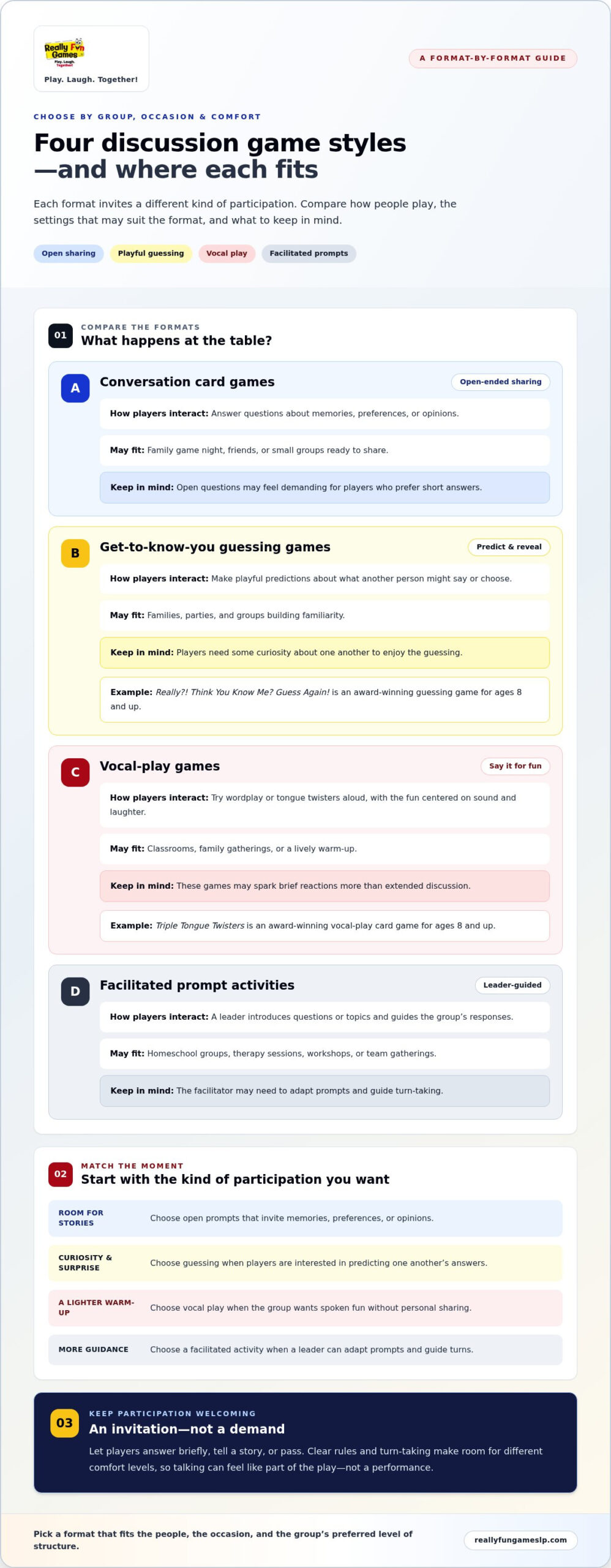
How to Choose Games for Engaging Discussions by Group and Occasion
The right pick depends on more than the prompt cards. Think about who’s playing, what brings them together, and whether they want a thoughtful chat, a burst of laughter, or both. Use this quick selection process to narrow your options.
- 1. Identify the group. Consider ages, familiarity, interests, and whether people enjoy sharing aloud. For mixed-age groups, choose a format that gives everyone a comfortable way to participate.
- 2. Name the occasion. Family game night, a classroom activity, a homeschool gathering, a therapy session, a party, and a team-building event each call for a different pace and tone.
- 3. Choose the interaction style. Open questions leave room for longer stories; guessing adds curiosity; vocal play creates quick, lively turns. Pick the kind of participation your group is most likely to enjoy.
- 4. Decide how you want it to feel. Are you hoping for relaxed connection, lighthearted icebreaking, or a playful way to support a planned discussion? A clear purpose helps you choose without making play feel like a task.
- 5. Check the practical fit. Look for age suitability, easy-to-learn rules, replayability, and prompts that respect different comfort levels. A game that’s simple to start and enjoyable to revisit can work for more than one occasion.
Choosing a game for family, friends, or a party
For family and friends, look for easy entry, laughter, and room for personal stories to emerge naturally. Really Fun Games’ conversation and vocal-play games are designed for ages 8 and up, including Really?! Think You Know Me? Guess Again! and Triple Tongue Twisters. For parties, choose short turns and clear instructions so newcomers can join without pausing the fun. With different ages around the table, favor prompts and play that don’t depend on everyone having the same experiences or interests.
Choosing a game for classrooms, therapy, or teams
Teachers and homeschoolers can connect a game’s format to the session’s purpose, such as inviting students to explain a choice, listen to classmates, or practise taking turns. SLPs and therapists can consider how an activity fits their communication goals and adapt participation to the people in the room. For workplace teams, look for shared challenges and playful conversation that invite collaboration without asking colleagues to disclose personal details.
For a larger gathering, an icebreaker-focused game can help people meet and take part, while a familiar card game gives the group a ready-made structure. Match the choice to your group, then explore conversation and vocal-play games from Really Fun Games. Discover Really Fun Games and find a playful fit for your next gathering.
Bring Your Group Together with Really Fun Games
The best choice isn’t necessarily the game with the deepest questions or the most energetic play. It’s the one that fits your people, your occasion, and the kind of interaction they’ll enjoy. Ask yourself: Is the group ready to swap stories, curious to guess what others might say, or more comfortable joining in through a playful vocal challenge? That quick check can turn a broad search for Games for engaging discussions into a more confident choice.
Find a game that fits the conversation you want to create
Conversation cards suit groups that want to trade opinions, share stories, and discover new things about one another. Really Fun Games’ award-winning Really?! Think You Know Me? Guess Again! adds a getting-to-know-you angle to play. For a group that would rather jump into sound and laughter than answer personal questions, Triple Tongue Twisters offers vocal play. Both games are designed for ages 8 and up and can bring people together in family, classroom, therapy, or group settings.
Really Fun Games creates easy-to-learn, replayable games, making it simple to get started while leaving room for each group to make the experience its own. At home, conversation play can invite stories and unexpected discoveries. In a classroom or homeschool group, a shared game offers a playful structure for participation. In a therapy session or facilitated group, the leader can choose an activity that aligns with the session’s purpose and participants’ comfort.
Make the next game night a chance to connect
Before choosing, consider the occasion, who’ll be there, and whether they’re in the mood for conversation or vocal fun. A game that suits family game night may also work for friends or a facilitated group, while a lively party may call for quick, welcoming turns that make it easy for newcomers to join. Keep the goal simple: shared attention, a few laughs, and a chance to hear something new from one another.
For more ways to bring vocal play into a gathering, explore the tongue-twister games from Really Fun Games. Choose a format that fits your group and occasion, then make room for a little fun together. Explore the Really Fun Games collection to find an easy-to-learn game for your family, classroom, or next group event.
Choose a Game and Let the Conversation Begin
The right discussion game fits the people playing and the moment you’re sharing. Choose conversation cards when you’re hoping for stories, opinions, and new discoveries; try vocal play when wordplay and laughter feel like a better invitation. Keep the prompts comfortable, the rules easy to follow, and room for everyone to join in their own way.
Games for engaging discussions don’t need to make every answer serious. Sometimes a playful guess or a tongue twister is all it takes to get people listening, laughing, and connecting. Really Fun Games creates award-winning, easy-to-learn, replayable games for ages 8 and up, including Really?! Think You Know Me? Guess Again! for getting-to-know-you play and Triple Tongue Twisters for vocal fun. These games give families, educators, and groups an enjoyable way to share a lively moment.
Ready to find a game for your next gathering? Explore the Really Fun Games collection and choose a playful way to bring your group together. Here’s to more laughter, fresh discoveries, and conversations that keep going.
Frequently Asked Questions
What makes a game engaging for discussion?
An engaging discussion game gives players a clear, enjoyable reason to share, listen, or respond to one another. Open questions can prompt stories and opinions, while guessing formats add curiosity and playful surprises. Short turns and simple rules help everyone follow along. The best Games for engaging discussions suit the group’s comfort and interests, leaving players free to answer briefly, share more, or enjoy listening.
What are the best games for engaging discussions with family?
The best family discussion game feels welcoming across the ages and personalities at the table. Choose conversation cards for sharing stories and preferences, or a guessing game for playful discoveries about one another. Really Fun Games’ award-winning Really?! Think You Know Me? Guess Again! offers a getting-to-know-you style of play and is designed for ages 8 and up. Keep the mood light and let everyone join at their own pace.
How do you make a discussion game less awkward?
Make the first turns easy and low-pressure. Begin with light topics, such as favorite activities or imaginative choices, rather than personal stories. Let players pass, keep an answer short, or share more if they wish. Avoid singling anyone out or insisting that every answer lead to a deeper conversation. A relaxed pace, clear turn-taking, and room for laughter can help the game feel like play, not an interview.
Can discussion games work in a classroom or homeschool group?
Yes, discussion games can give classroom and homeschool groups a shared structure for speaking and listening. Pick a format that supports the activity’s purpose, whether that means explaining an opinion, taking turns, or exploring a topic together. Keep the instructions clear and adapt prompts to the group’s age and comfort. A game can make participation playful, but it shouldn’t be treated as a guaranteed learning outcome.
Are conversation games suitable for speech therapy sessions?
Conversation games may be used as an activity within a speech therapy session when the SLP considers them appropriate for the individual’s communication goals. The therapist can decide how to adapt the pace, prompts, and participation. For example, Really Fun Games’ Triple Tongue Twisters is a vocal-play option designed for ages 8 and up. A game can be part of a session’s activity, but it doesn’t replace professional judgment or care.
How do I choose between conversation cards and icebreaker games?
Choose conversation cards if your group is ready for open-ended sharing, stories, or opinions. Icebreaker games are often a better fit when people are meeting for the first time or need an easy first step into group interaction. Consider the occasion and how comfortable players feel speaking up. A guessing game can offer a playful middle ground, prompting curiosity without asking everyone to launch into a personal story.
Can tongue twister games encourage engaging discussions?
Yes, tongue twister games can encourage participation and lively reactions, though their focus is vocal play rather than extended conversation. Trying a tricky phrase can spark laughter, friendly encouragement, or comments about the words themselves. Triple Tongue Twisters is a Really Fun Games example designed for ages 8 and up. It can suit families, educators, and groups looking for a lighthearted way to get voices and smiles going.
Ready to bring more playful conversation to your next gathering? Explore the Really Fun Games collection and find a game that fits your family, classroom, or group.