

The best icebreaker isn’t the loudest one; it’s the one that makes joining in feel comfortable. Games for getting to know new people can work well for introverts when questions stay light, passing is welcome, and everyone has room to think. A small-group format can make conversation feel more manageable, too.
If you’re concerned that introductions will turn into awkward spotlights or pressure to share something personal, that’s understandable. A good game offers a starting point, lets people listen before speaking, and makes room for laughter and unexpected common ground.
You’ll find low-pressure question games, quick icebreakers, team activities, and pairing games for first meetings, classrooms, family gatherings, and work groups. We’ll look at how to choose a format that fits the group, keep questions welcoming, and help new people connect at their own pace.
Key Takeaways
- Choose gentle, optional questions so quieter participants can join in at their own pace.
- Match the icebreaker to the group’s familiarity, setting, and available conversation time.
- Use collaborative challenges to help teammates discover shared ideas while working toward a common goal.
- Try rotating pairs when you want participants to meet several people without speaking to the whole group.
- Build from light prompts toward more reflective conversation as people become comfortable.
1. Are there good question games for introverts?
Yes. Question games can suit introverts when they offer clear prompts, thinking time, and permission to pass. Try a gentle opener such as, “What’s a small thing that made you smile this week?” It gives everyone an easy way into the conversation without asking for a personal story. Keep the first round light, then let the group decide whether to share more.
Group size and familiarity shape the experience. For a larger group, split participants into groups of six to eight so everyone can hear each answer. Begin with a familiar topic, such as favorite meals or relaxing activities. Make it clear that anyone can skip a question that feels too personal. That keeps participation voluntary rather than putting someone on the spot.
Adapt the same question game for in-person and virtual groups. In person, arrange small circles and let people answer in turn, pass, or write a response before speaking. Online, participants can use chat, speak aloud, or share in breakout rooms. A prompt such as “What’s a hobby you’d like to try?” works in either setting. The facilitator can read it aloud and leave a quiet pause before inviting responses.
Choose questions based on how well the group knows one another. At a first meeting, use light prompts such as “What kind of music helps you focus?” With established groups, reflective questions can invite more meaningful conversation: “What’s something you’ve learned about yourself recently?” Save deeper prompts for when people seem comfortable, and try them in smaller circles where listening feels manageable.
Facilitation matters as much as the prompt. Explain the format, answer a sample question yourself, and remind everyone they can pass. Use a sign-up, rotation, or small-group structure so people know when they may speak. For a team, try “What helps you do your best work?” or “What’s one small win from this week?” These prompts connect personal preferences with practical teamwork.
Match the game to the group’s energy. If people seem hesitant, choose playful questions such as “Would you rather explore a forest or a city?” If conversation is already flowing, invite a thoughtful follow-up. A light question can be a powerful start, not a test of confidence. Explore conversation games for shared play when you want prompts that bring people together.
2. Low-pressure icebreakers for first meetings
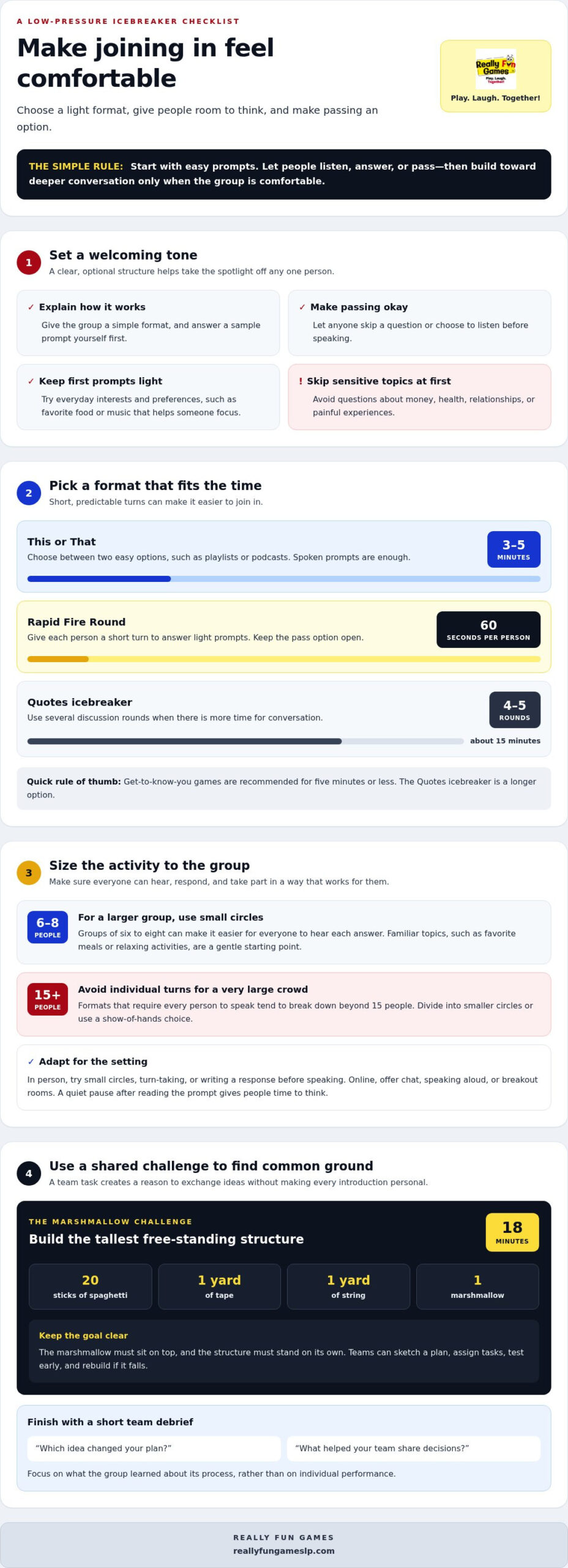
For teens and young adults, try This or That: choose between two easy options, such as playlists or podcasts. A Rapid Fire Round gives each person 60 seconds to answer light prompts, keeping turns short and predictable.
At an office meeting, ask practical questions that invite conversation without probing into private life. Try “What helps you focus?” or “What’s a small skill you’d like to learn?” The facilitator can answer first, then invite people to respond, pass, or add a thought after listening.
Name-based icebreakers give everyone a simple way to remember introductions. Ask each person to share their name and a favorite food. Before adding their own introduction, the next speaker repeats one earlier name. Keep the format forgiving: others can help with a name rather than turning recall into a test.
For a remote meeting, put one prompt on screen or in the chat, then let participants answer aloud or type. This or That works well with quick reactions, while a Rapid Fire Round can move through volunteers. Offer a pass option so no one is forced to speak on camera.
For a large group or party, use prompts people can answer together rather than making everyone take an individual turn. Games requiring each person to speak tend to break down beyond 15 people; divide a larger crowd into smaller circles or use a show-of-hands choice instead.
Quick get-to-know-you games are recommended for five minutes or less. This or That takes three to five minutes, while the Quotes icebreaker can use four to five discussion rounds over about 15 minutes. The first two formats need only spoken prompts; optional paper, pens, or a timer—which can be picked up from general retailers like My Store—can support other versions. Any cost depends on supplies chosen, so a verbal format keeps materials simple.
Keep pressure low by explaining the rules, modeling one answer, and choosing prompts about preferences or everyday interests. Avoid questions about money, health, relationships, or painful experiences at a first meeting. A useful closing prompt is “What’s one thing you’d like to hear more about?” For ready-to-use conversation prompts, try a conversation game for a group gathering and choose questions that fit the occasion.
3. Team games for finding common ground
A shared task can help coworkers connect without making every introduction personal. The Marshmallow Challenge gives teams 18 minutes to build the tallest free-standing structure they can, using 20 sticks of spaghetti, one yard of tape, one yard of string, and one marshmallow. Participants quickly move from planning to testing, so different ideas become part of the conversation.
Set the supplies in the center, explain the goal, and start the timer. Encourage teams to sketch a plan, assign tasks, and test their structure before time runs out. The marshmallow must sit on top, and the structure must stand on its own. If it falls, rebuilding together can turn a wobbly attempt into a moment of laughter and teamwork.
After the challenge, make space for a short debrief. Ask, “Which idea changed your plan?” or “What helped your team share decisions?” These prompts focus on the group’s process, not individual performance. Participants can name a useful discovery, such as testing early or listening before choosing a design. The reflection connects the activity with everyday collaboration.
For meetings, retreats, or onboarding, workplace questions can uncover preferences that support smoother teamwork. Try “How do you like to receive feedback?” or “What helps you focus during a busy day?” Invite each person to answer briefly, then ask what the team can put into practice. Keep prompts connected to shared work, and let people pass on anything they’d rather not discuss.
Not every connection activity needs building materials. In a team “common ground” round, ask participants to find a shared interest, such as a favorite lunch or a hobby they enjoy. Each pair or small group shares one discovery with everyone. For a remote group, use the same prompt in chat or a video-call breakout room, then gather a few answers afterward.
Match the activity to the setting and the team’s energy. A hands-on challenge suits a retreat with room for supplies; a single question fits an onboarding meeting with limited time. Give clear instructions, model a thoughtful answer, and focus on sharing rather than winning. A final prompt, such as “What’s one idea from another person you want to remember?” can turn a lively game into a useful point of connection.
4. Pairing games for meeting multiple people
Pairing games turn introductions into a series of manageable conversations. Instead of addressing the whole room, each person talks with one partner, then meets someone new. In a half-hour Speed Meet, 60 people can have conversations with eight people. That format gives a large gathering a clear rhythm without asking anyone to hold the floor alone.
To host a simple rotation, arrange chairs in two facing rows. Give each pair a prompt, such as “What’s a hobby you enjoy?” or “What place would you recommend visiting?” After each conversation, one row moves along while the other stays seated. Use a clear spoken cue for the transition, so participants know when to wrap up and meet their next partner.
Prompts can keep each conversation fresh. Start with an easy preference, such as a favorite meal, then shift to a shared experience: “What’s something you’ve learned recently?” Partners can take turns asking and answering instead of firing off questions like an interview. If someone needs a pause, they can reflect on the prompt or choose a simpler example.
For a playful pairing challenge, ask people to find someone who shares a harmless preference. Call out choices such as tea or coffee, books or films, or morning walks or evening walks. Participants mingle, ask each other, and pair up when they find a match. In a virtual meeting, use a poll first, then place people with similar answers in breakout rooms.
Another option is a “question exchange.” Give each pair a prompt, then have partners create a follow-up question together. For example, “What music do you enjoy?” might lead to “Which song brings back a good memory?” Each person can answer both questions, then take one new discovery into the next conversation. This structure encourages listening, not just asking.
Make the format welcoming by explaining the rotation before starting. Demonstrate how to end a chat with “Thanks, I enjoyed hearing that,” then move calmly to the next partner. Let participants stay seated or pass on a prompt if moving or answering feels uncomfortable. For a family reunion, school orientation, or team gathering, choose relevant questions and avoid turning each exchange into a performance.
Pairing games work best when the goal is curiosity, not collecting the most introductions. A short closing round can invite people to share one interesting thing they heard, without revealing anything private. This helps the group notice common ground and gives the conversations a natural ending.
5. Games for getting to know each other
Choose a game that lets people reveal themselves gradually, moving from playful facts toward deeper reflection. Most get-to-know-you games fit into five to twenty minutes, so you can match the exercise to your gathering. Start with a quick round of Would You Rather, then choose a more thoughtful prompt once participants have learned a little about one another.
Would You Rather takes about a minute per prompt. Ask, “Would you rather spend a day near the ocean or in the mountains?” Each choice gives partners a natural reason to explain what they enjoy. For a longer conversation, 21 Questions has players take turns asking questions, up to a total of 21. Keep questions friendly and let anyone pass.
In speed rounds, each person answers five rapid-fire questions. Choose prompts that go beyond basic introductions, such as “What’s something you’d like to learn?” or “What makes a day feel successful?” This format keeps sharing lively while giving everyone the same chance to speak. A future flash-forward can then invite partners to imagine their lives five years from now.
Two Truths and a Lie works well with small groups of three to four people. Each player shares two true statements and one false statement, and the others guess which one is false. Choose details that feel comfortable to share, such as a favorite food, a hobby, or a place visited.
For a creative exercise, give participants five to ten minutes to make a personal trading card. They can include a strength, a favorite activity, and a fun fact, then share their cards with a partner. A Life Map offers another visual option: participants sketch meaningful places or milestones, then spend five minutes sharing their maps with the group.
Established groups can try a Four Quadrants Activity. Draw a 2 × 2 grid and label each section with a prompt, such as “something I enjoy,” “something I’m learning,” “a place I value,” and “a goal.” People fill each space, then choose one answer to discuss. The grid offers structure without requiring everyone to share every detail.
Close the session with a brief reflection: “What surprised you?” or “What would you like to ask about next time?” The answers help the group notice what it learned and choose where conversation can go deeper. If your group needs fresh prompts, conversation games for meaningful group connection can give participants a playful starting point for sharing.
Really Fun Games: Really?! Think You Know Me? Guess Again
Really?! Think You Know Me? Guess Again offers a playful conversation-game option for gatherings where people want to learn more about one another. It can suit family game night, a group get-together, or a new social circle ready to share a few laughs. For a lively change of pace, Triple Tongue Twisters, Tricky Tetra Tongue Twisters, and Blooming Tongue Twisters add tongue-twister play.
Choose a conversation game when your group wants to discover how well people know each other; choose a tongue-twister game when vocal play is a better fit. Both give people a shared activity to enjoy together.
Explore the Really Fun Games collection at reallyfungameslp.com and find a game for your gathering.
Make your next gathering easier to join
The best games for getting to know new people create an opening, not an obligation. Choose a playful activity that suits your group, then give conversation room to unfold naturally. A shared laugh, a surprising answer, or a clever guess can give people something to build on after the game ends.
For a ready-to-play option, Really Fun Games offers Really?! Think You Know Me? Guess Again, Triple Tongue Twisters, and Tricky Tetra Tongue Twisters. Choose the first for a gathering focused on discovering what people know about one another, or a tongue-twister game when you want vocal play and laughter.
Bring a fresh spark to your family gathering, classroom, or group event with a game that fits the moment. Explore Really Fun Games and find a playful way to help people connect.
Frequently Asked Questions
Are there good question games for introverts?
Yes. Try a “choose your category” round where players pick a topic before answering, such as food, music, or travel. This gives quieter participants some control and helps avoid unexpected personal questions. Keep the pace unhurried, and let people add detail only if they want to. A specific topic can make starting easier than an open-ended request to “tell us about yourself.”
How can I have fun with a group of people using questions?
Give questions a shared theme, then let answers build on one another. For example, ask everyone to name an imaginary restaurant, describe its signature dish, and explain its unusual rule. The group can vote on which restaurant they’d visit first. A playful theme gives people something to invent together, while follow-up questions turn quick answers into lively conversation.
What are get to know you games?
These are structured activities that help people discover one another’s interests, viewpoints, or stories through playful prompts. Unlike trivia, which tests knowledge of a subject, these games focus on the people playing. A group might create a shared “ideal weekend” by combining everyone’s suggestions. It’s a simple activity with a natural opening to talk about different tastes and ideas.
What if someone doesn’t want to answer a question?
Keep the game welcoming by treating a skipped question as an ordinary choice, not a problem to solve. The facilitator can move directly to the next person or offer a neutral prompt instead. Avoid teasing, pressing for a reason, or making the group guess why someone declined. Responding calmly shows that participation doesn’t require explaining personal boundaries.
What’s the best question game for a first date?
Choose a game that encourages balanced conversation rather than rapid-fire questions. Take turns asking about enjoyable experiences, like a memorable meal or a favorite way to spend a free afternoon. Share your own answer, too, so the exchange feels mutual. Follow the other person’s interest and let the conversation flow instead of treating prompts like a checklist.
What are the best icebreaker games for getting to know new people?
Pick an activity that fits the occasion and gives people something specific to respond to. At a creative gathering, invite everyone to invent a title for a movie about their week, then explain their choice. For a school or workplace event, choose a topic connected to the shared activity. A relevant prompt makes introductions feel less like a formal exercise.
What are easy no-prep icebreaker games for groups?
Try a group story told one sentence at a time. One person starts with a setting, such as “The door opened to reveal a garden,” and each participant adds the next sentence. Another option is word association: choose a theme, say a related word, and pass the turn along. Both games need no materials and can suit the group’s mood.
What are good getting-to-know-you games for adults?
Adults may enjoy prompts that invite recommendations or compare perspectives. Ask each person to share a small everyday discovery, such as a useful cooking shortcut or a favorite way to unwind after work. Others can respond with their own suggestions. The exchange offers practical ideas and a glimpse of what each person enjoys.
Ready to bring more conversation and laughter to your gathering? Explore the Really Fun Games collection and choose a game that suits your group.