A team can talk through an entire meeting and still miss the message. Games for improving verbal communication turn speaking and listening into shared practice: players pass along a whispered message, keep a conversation going with questions, or describe something for a teammate to draw. Each activity gives people a chance to practise explaining ideas, listening closely, and responding thoughtfully.
Clear communication takes more than having something to say. It also means making room for others, checking that a message is understood, and finding a way forward together. Games make these skills easier to notice and practise without turning every conversation into a formal lesson.
Here are practical activities for building listening accuracy, clearer messages, lively conversation, and stronger teamwork. We’ll cover options for workplace teams, families, classrooms, and other groups, and explain what players do in each game. Choose the communication skill you want to practise, then pick an activity that gives everyone a way to join in.
Key Takeaways
- Choose an activity based on the skill your group wants to practise, such as clearer instructions, careful listening, or taking turns in conversation.
- Use message-passing and description games to notice where details get lost and practise making ideas easier to understand.
- Try question-based and storytelling activities to encourage curiosity, thoughtful responses, and more balanced conversations.
- For workplace teams, select exercises that help colleagues explain ideas to different audiences and understand one another’s perspectives.
- Match the game to your group and setting, then make time to reflect on what helped everyone communicate and work together.
1. What are communication activities, exercises, and games?
Communication activities give people an engaging way to practise speaking, listening, and responding. In a partner exercise, one person might describe an object while another draws it. In a group game, players might pass a spoken message around a circle, then compare the final version with the original. These simple activities make communication habits easier to notice and discuss.
In partner mirroring, one person leads slow movements while the other copies, then they switch roles. This nonverbal activity practises attention to timing, gestures, and another person’s cues. Playing with Status adds speech: pairs perform neutral dialogue while changing status through nonverbal behavior. In One-Two-Three, partners stand about a meter apart and replace counting with movements or sounds. The quick pattern encourages focus and playful coordination.
Clapping activities bring rhythm and listening into the room. In Copy Claps, one player creates a pattern and a partner repeats it; the activity typically lasts 1–2 minutes. The Clapping Game is listed for groups of 30 or more people and typically lasts 1–2 minutes. Finger Snaps typically lasts 15–20 minutes, giving a group more time to build a shared rhythm. These activities need no special equipment, just a clear cue and attentive listening.
Team-building activities give a group a shared task. In the Blindfold Game, students split into two groups, and one person in each group navigates an obstacle course using spoken directions. Keep at least one person near each blindfolded student to help maintain safety. A marshmallow tower challenge is another option: players use spaghetti, tape, and string to build a tower that holds a marshmallow on top. The task encourages teammates to explain ideas, listen, and adjust their plan.
Non-verbal team-building activities can still strengthen conversation afterward. Silent Line-Up asks participants to arrange themselves without speaking, then reflect on the signals they used. Birthday Lineup takes 20–30 minutes. Five Handshakes in Five Minutes is listed for groups of 30 or more people, and challenges participants to high-five as many people as possible in 20 seconds. A short debrief helps connect gestures and teamwork to everyday interactions.
What communication games work well for children and teens? Copy Claps, One-Two-Three, and object-description drawing have clear turns and simple ways to participate. For groups or teams, try the Blindfold Game, a marshmallow tower, or Silent Line-Up. Choose according to whether you want to practise spoken directions, planning, or nonverbal coordination.
Are there free online games or apps for practicing verbal communication? Yes, groups can play Telephone or question relay over a video call without a dedicated app; use a shared prompt or spoken message. Games build practice in listening and clarity, but a playful round cannot show every challenge someone may face in everyday conversation. A useful next step is choosing a format your group can repeat, such as the conversation and communication games collection.
Listening accuracy and message clarity
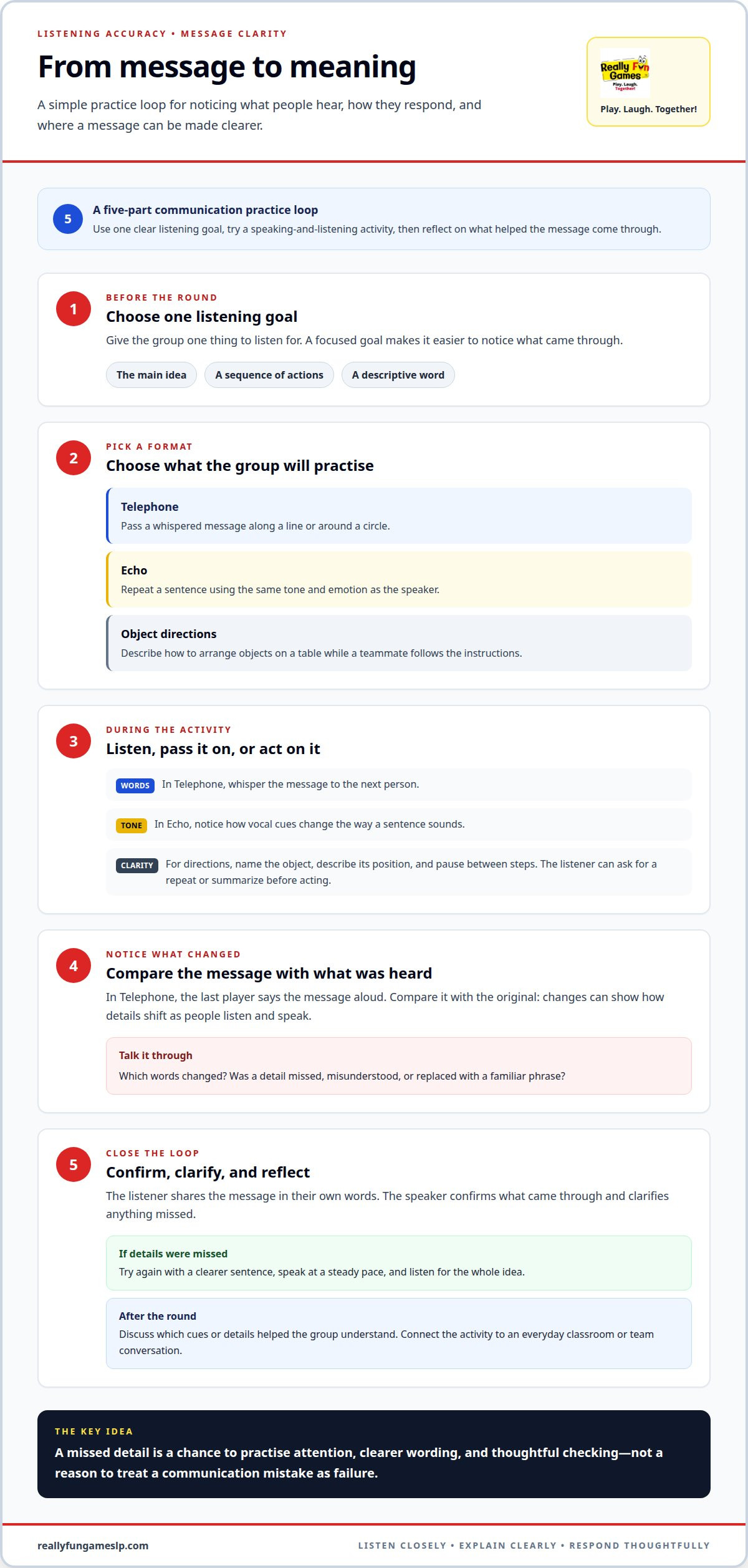
Listening accuracy is reflected in what someone can repeat, explain, or act on after hearing a message. In Telephone, players whisper a message from one person to the next along a line or around a circle. The last player says it aloud, and the group compares that version with the original. Any changes show how easily details can shift as people listen and speak.
Keep the message short enough for the group, then discuss which words changed and where the meaning shifted. Was a detail missed, misunderstood, or replaced with a familiar phrase? This turns a funny result into a practical conversation about attention. In a classroom, participants can try again with a clearer sentence, speak at a steady pace, and listen for the whole idea before passing it on.
The Echo game focuses on how a message sounds, not just its words. One player says a sentence, and the next repeats it using the same tone and emotion. A cheerful “That’s a great idea” sounds different from a doubtful version. Discuss which vocal cues helped players interpret the speaker’s meaning, then try a new sentence with a different feeling.
Clarity also depends on how speakers organize information. Ask one player to give a teammate simple directions for arranging objects on a table. The listener follows each instruction, then explains which details made the task easier or harder. Speakers can practise naming the object, describing its position, and pausing between steps. Listeners can ask for a repeat or summarize what they heard before acting.
Set one listening goal before each round to focus attention. Participants might listen for the main idea, a sequence of actions, or a descriptive word. Afterward, the listener shares the message in their own words. The speaker can confirm what came through and clarify anything missed. This exchange builds communication skills without treating every mistake as a failure.
Which games practise active listening, clarity, vocabulary, and public speaking? Telephone practises listening accuracy, Echo highlights tone, and Question Relay encourages responsive speaking. For vocabulary and speaking practice, invite players to describe an object with precise words or speak briefly about a familiar topic.
Games offer a lively way to practise, but the group’s debrief matters too. A quick discussion helps connect a missed instruction or unclear phrase to an everyday classroom or team conversation. For more playful prompts that get people talking, explore these conversation game ideas.
Broken Telephone is listed as a 10-15 minute communication activity. Use the debrief to connect listening and speaking procedures with empathy, respectful vocabulary, pausing, and turn-taking. Participants can reflect on what helped them understand one another, then practise the same skills in natural settings. Repeated rounds offer practice in conversation skills and introspection, while keeping attention on clear, considerate exchanges.
3. Conversation, questioning, and storytelling
Conversation games give each participant a reason to listen, respond, and share an idea. Beach Ball Questions takes 20–30 minutes: write prompts on a ball, toss it, and invite the catcher to answer the prompt nearest their hand. Questions can encourage players to explain a preference, describe a memorable experience, or imagine a solution. The activity practises turn-taking and helps conversations move beyond one-word replies.
Question Relay provides a repeating structure. One player asks a question, the next answers it and asks a new question, and the sequence continues around a circle. To encourage active conversation, ask players to respond to something they heard before introducing another topic. For example, after “What’s a food you enjoy making?” the next player might explain who taught them the recipe. This connection makes sharing feel like a genuine exchange.
Story Round Robin turns a group’s ideas into one unfolding tale and takes 20–30 minutes. One person begins with a character and a setting; each participant adds a sentence before passing the story along. A teacher might invite the group to build a story about a lost library book. Players practise keeping details consistent, adding descriptive vocabulary, and listening for what the previous speaker contributed.
The Eye Contact Circle combines a shared question with movement. Participants answer the same question, make mutual eye contact with someone across the circle, then switch places while maintaining eye contact. Choose a light prompt, such as naming a favorite place to relax, so players can focus on answering and noticing others. As a quieter alternative, let participants look toward a partner’s face rather than require direct eye contact.
Role reversal invites children and adults to switch roles and act as each other in a conversation or task. A child might pretend to be the teacher explaining a classroom routine, while the adult plays a student asking for clarification. Keep the scene respectful and brief. Afterward, ask what felt easy, surprising, or emotionally challenging about speaking from another perspective.
These activities work best with clear, friendly ground rules: let each person finish, use respectful language, pause before responding, and allow anyone to pass on a prompt. A facilitator can encourage curiosity with questions such as, “What made you choose that?” or “Can you explain more?” For natural practice, try a round at dinner or during a classroom check-in. A brief reflection afterward helps participants notice how questions, patience, and turn-taking shaped the conversation.
4. Communication games for workplace teams
Workplace games can make everyday communication habits visible without turning practice into another presentation. Back-to-Back Drawing takes 20–30 minutes. One teammate describes a simple image while another draws without seeing it. The speaker practises giving clear, ordered instructions; the artist practises asking for clarification. Compare the drawing with the original, then discuss which descriptions helped and which left room for confusion.
Spread the Word helps colleagues adapt information for a different audience. Small groups prepare a 3-minute presentation covering key points from an initial presentation. One variation asks teams to explain their presentation to an audience of 7-year-old children. That constraint encourages plain language, concrete examples, and careful choices about what matters most. After each delivery, participants can discuss whether the explanation stayed accurate and easy to follow.
The 500-year-gap activity makes assumptions part of the conversation. One participant role-plays someone from 500 years ago; a partner explains a modern object without naming it. During the debrief, discuss which explanations made sense across the knowledge gap and what each person assumed. This exercise gives teams practice translating unfamiliar ideas instead of relying on shared jargon.
For focused speaking practice, try One Breath Feedback. Each participant shares one concise observation or suggestion, with most people having about 20 to 25 seconds to speak. A facilitator can set a useful frame: describe a specific moment, explain its effect, and offer one next step. The brief turn encourages direct expression while keeping feedback connected to an example.
Role Reversal Debate takes 30–45 minutes. Participants argue a position they don’t personally hold, then discuss what changed when they represented another perspective. Wordless Acting, listed as a 20–30 minute communication activity, offers a different challenge: teams convey a workplace scenario without speech, then explain which gestures or expressions helped. Both activities can prompt reflection on how tone, assumptions, and audience shape a message.
What are effective verbal communication games for adults? Back-to-Back Drawing, Spread the Word, and Role Reversal Debate suit adults practising instructions, audience awareness, or perspective-taking. Choose according to the skill your team wants to strengthen, then leave time to discuss what made each message effective.
What are quick verbal communication games for classrooms or meetings? Five Handshakes in Five Minutes typically lasts 2–5 minutes and can open a session with brief introductions. For a speaking-focused option, One Breath Feedback gives participants a concise turn to express one observation or suggestion.
Close each activity with a practical question: “What could we repeat in our next meeting?” A specific answer, such as summarizing a decision before moving on, turns an engaging exercise into a small team habit. Success isn’t about winning; it’s about noticing how clear instructions, thoughtful expression, and active discussion help colleagues work together.
5. What games help improve verbal communication skills?
Choose an activity that gives players a clear reason to speak, listen, and respond. Drawn Understanding pairs students back-to-back: one describes an object while the other draws from the description. The speaker practises naming details and organizing instructions. The artist can ask clarifying questions, then both compare the drawing with the object. That comparison reveals which words helped create a clear mental picture.
For lively introductions, Speed Introductions gives each player 30 seconds to share three fun facts. Listeners can choose one fact to ask about afterward, turning a quick introduction into a natural conversation. Three-Word Introductions offers a more focused alternative: each player describes themselves using only three words, then explains one choice. Both formats encourage concise speaking without requiring a long prepared speech.
Famous Pairs gives participants three questions each to identify the famous person written on their back. Players need to ask useful questions, remember the answers, and adapt their next question. To keep the conversation flowing, make questions open-ended rather than answerable with yes or no. A follow-up such as “What made you choose that?” practises curiosity and turn-taking.
Two Truths and a Lie works well for sharing personal stories. Each player offers three statements about themselves: two true and one false. After others guess the false detail, the speaker can explain the real stories behind the statements. Keep prompts comfortable for the group; no one needs to share anything private to participate.
Desert Island practises explanation and critical thinking. Each player chooses three items to bring for survival and explains their choices. Other participants can ask how each item would help or suggest a new challenge that changes the plan. Players practise supporting an idea with reasons, listening to alternatives, and responding respectfully when teammates disagree.
For a small-group sharing activity, The Enigmatic Self asks each student to write three things about themselves that others don’t know. Students then share their facts in groups of three or four. A facilitator can let players pass on any detail and encourage gentle follow-up questions. This structure gives quieter participants time to prepare before speaking.
The Name Game takes 15–20 minutes and offers a structured option for practising names and attention. Choose an activity by matching it to your group’s goal: Drawn Understanding for precise descriptions, Famous Pairs for questioning, or Desert Island for explaining choices. For a ready-to-play way to spark group conversation, explore conversation games that bring people together through playful prompts.
Really Fun Games
Really Fun Games offers playful ways to make communication practice fun. For groups looking to spark conversation and learn more about one another, Really?! Think You Know Me? Guess Again! gives players a game-based way to connect. Triple Tongue Twisters, Tricky Tetra Tongue Twisters, and Blooming Tongue Twisters bring vocal play and speaking practice to family time, classrooms, and group gatherings.
Choose a conversation game when your goal is sharing and connection, or a tongue-twister game for lively speech practice. To explore which option might suit your family, class, or group, contact Really Fun Games.
Make your next conversation a little more intentional
Let your next team conversation build on the energy of play. Before choosing an activity, decide what you want people to practise: asking follow-up questions, explaining an idea, or making space for every voice. Afterward, invite the group to name one habit they’d like to carry into their next meeting. Pausing before responding is one simple way to put the experience into practice.
Games for improving verbal communication offer a starting point, not a script for every conversation. Keep the atmosphere welcoming, adapt prompts to your group, and let people participate in ways that feel comfortable. A shared laugh can open the door; curiosity and respectful listening help keep it open.
If you’d like help finding a playful fit for your family, classroom, or team, contact Really Fun Games. Keep the next conversation lively, thoughtful, and open to everyone.
Frequently Asked Questions
What are communication activities, exercises, and games?
They’re guided ways to practise exchanging ideas and understanding one another. For example, a group can rehearse a friendly disagreement: one person states a preference, another responds with a different view, and both explain their reasoning. Games for improving verbal communication make this practice more playful. Choose an activity by deciding what participants should try, such as giving a reason or acknowledging someone else’s point.
How do you play common communication games like Two Truths and a Lie or storytelling circles?
In Two Truths and a Lie, each player shares three statements about themselves, two true and one false, while the others guess which is false. Keep details light and let the speaker reveal the answer. For a storytelling circle, agree on a character and situation, then build the tale together. Add a twist by inviting someone to retell the finished story from another character’s perspective.
How can you adapt communication games for shy players or different skill levels?
Adjust the challenge rather than putting anyone on the spot. Someone who prefers a gentle start can share a simple preference, while a more experienced speaker can explain their reasoning or respond to a different viewpoint. Let participants choose from a few prompts and give everyone a moment to think before speaking. A calm pace and respectful listening make it easier to take part.