

A memorable game doesn’t need a scoreboard; it needs a reason to tune in to one another. Games that foster connection invite players to share ideas, listen, respond, and create something together through conversation, pretend play, or a collaborative challenge. For families, adults, and mixed-age groups, the best fit makes participation comfortable and gives everyone a way to join in.
A good game can spark laughter and bring people closer. Choosing one that suits different ages, personalities, and comfort levels takes a little more thought, especially when you want genuine conversation rather than forced sharing.
This guide explains what connection games are and how to choose them for collaborative storytelling, creative play, and group bonding. You’ll find practical ideas for adults and mixed-age groups, plus tips for matching an activity to your group’s size, available time, and needs. The aim is simple: help people listen, contribute, and enjoy being together.
Key Takeaways
- Collaborative stories and pretend play give players a shared goal while leaving room for everyone’s ideas.
- Choose conversation games that invite genuine listening and follow-up, not just quick answers.
- Use common interests and creative prompts to help a group find easy starting points for connection.
- Match activities to the group’s age, size, available time, and comfort with sharing.
- For adults, choose games that make conversation feel relaxed and keep personal responses respectful.
1. Collaborative storytelling and pretend play
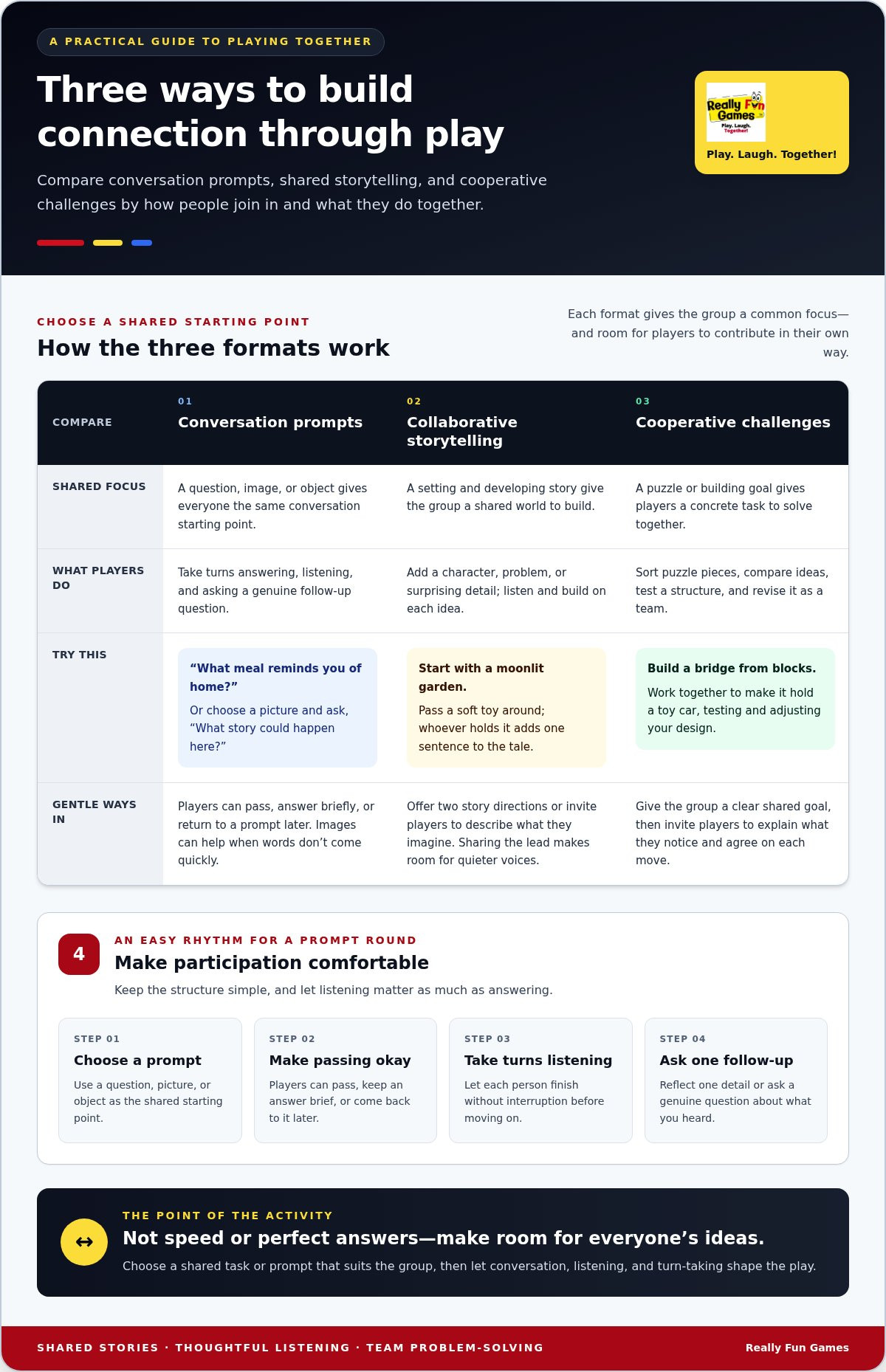
A shared story gives every player a chance to shape what happens next. Start with a simple setting, such as a moonlit garden, then let each person add a character, problem, or surprising detail. One player might introduce a lost rabbit; another can invent a friendly mapmaker. The group listens, builds on each idea, and decides together how the characters solve the problem. Storytelling is a flexible activity for families, classrooms, and indoor game nights.
Keep the first round structured, then loosen the rules as players grow comfortable. For example, pass a soft toy around the circle and let its holder add one sentence to the tale. A teacher might invite students to describe the picture they imagine, while a parent can offer a choice between two story directions. Sharing the lead keeps one confident storyteller from taking over and gives quieter players a clear, low-pressure way to contribute.
Pretend play adds movement and emotion to a story. Children can use dolls or stuffed animals to act out a playground disagreement, then explore different ways the characters might respond. They can notice feelings, adapt as the story changes, and calm a tense scene through play. In a make-believe restaurant, one child can welcome guests while another takes orders; switching roles gives each player a fresh perspective.
Collaborative puzzle-solving works well when a group wants a clear, shared goal. Spread a jigsaw puzzle on a table and invite players to sort edge pieces, match colors, and explain what they notice. For a building challenge, give the team blocks and ask them to make a bridge that can hold a toy car. Players can compare ideas, test the structure, and revise it together. The point is not speed; it’s the conversation around each choice.
Indoor collaborative games need little space or equipment. Try building a story from a picture book: cover the text, study one illustration, and take turns predicting what happens next. Or build a blanket fort together, assigning jobs such as choosing the entrance, arranging cushions, and checking that the structure stays upright. These tasks create natural moments for planning, turn-taking, and problem-solving.
What cooperative board games encourage teamwork and communication? Choose games built around a shared objective, such as solving a mystery, completing a route, or protecting a team from a challenge. In a cooperative puzzle game, players can explain their clues aloud and agree on each move instead of competing for points.
Where can you buy or play connection-building games in the United States? Families, teachers, and community groups can play at home, in classrooms, or during organized gatherings. For a ready-to-play option, browse games for conversation and shared play.
2. What are connection games?
Connection games give people a shared activity that makes conversation easier to start and sustain. In a question game, one player draws a prompt such as “What meal reminds you of home?” Everyone gets a turn to answer, listen, and ask a genuine follow-up. The goal isn’t to find the perfect response. It’s to make room for everyone’s ideas and notice what they share.
Games that foster connection can give players a chance to practice conversation and attentive listening. Try a listening round: one person talks about a favorite place, and the next reflects one detail before adding a question. For example, “You loved the beach because you collected shells. What did you do with them?” This small step keeps attention on another person’s perspective, rather than on waiting for a turn to speak.
Image cards offer a prompt when words don’t come quickly. Lay out pictures of a kite, a crowded kitchen, and a winding road, then invite each player to choose one. Ask, “Which picture feels like a good day to you?” or “What story could happen here?” Children can point, describe colors, or invent a character; adults can use the same image to share a memory. The picture gives the conversation a common starting point.
For a virtual gathering, use a shared screen with a landscape photo or let each person choose an object nearby. A player might show a travel mug and explain where it came from, while others ask about its story. Keep the pace comfortable: invite people to pass, answer briefly, or return to a prompt later. These options let everyone participate without turning personal sharing into a performance.
How much do popular connection-building games cost, and are there free options? Prices vary by game and seller, while free options include prompt rounds, shared storytelling, or asking a question about an image already in the room. A purchased conversation game offers prepared prompts; a homemade round lets the group choose its own topics.
What are the rules and setup steps for easy games that foster connection? Choose one prompt, agree that players may pass, and take turns answering without interruption. After each response, invite one follow-up question, then move to the next person. For a no-materials version, ask everyone to name a small joy from the day and share one detail about it.
For ready-made prompts and playful conversation ideas, browse conversation games for shared play.
3. Team commonalities and creative thinking
Shared interests give a team a natural starting point for conversation. Try a “Who Am I?” round in which each person shares a favorite color, food, animal, hobby, and vacation spot. As answers come out, invite players to notice overlaps: two people may love hiking, while another pair might choose the same comfort food. Those discoveries can make relationships feel more personal, whether the group is a family, a classroom, or coworkers meeting for the first time.
Keep the activity welcoming by letting players choose how much to share. A child might name a favorite animal without explaining why; an adult might tell a short story about a memorable trip. For a larger group, ask people to find someone with a shared interest, then talk about what they enjoy doing together. At a team meeting, this turns introductions into a natural exchange instead of a list of names and job titles.
Creative thinking adds a playful challenge: build on another person’s idea rather than replacing it. Start a group story with a character and a goal, such as a baker who wants to deliver a pie before sunset. Each player adds a sentence to keep the story moving. One person could invent a shortcut, another could add an unexpected obstacle, and the next could suggest a solution. The plot belongs to the whole group.
For a fresh variation, let players create a story using three objects from the room, such as a scarf, a spoon, and a paper cup. Ask the group to decide how each object enters the plot. A scarf might become a royal flag, while the cup becomes a tiny boat. This creative play encourages listening, flexible thinking, and cooperation, since each new detail needs to connect with what came before.
Creative self-expression games also let people communicate without relying on long answers. Invite each player to draw a symbol for a favorite weekend activity, then let the group guess its meaning. Another option is to use a gesture, sound, or short phrase to represent a mood or imagined character. Players can pass or choose a simpler form of expression, making participation comfortable across ages and communication styles.
For younger children, dolls or stuffed animals can act out a tricky situation, such as joining a game already in progress. Let the child choose what the toy says, then try a different response together. The pretend character creates some distance from the challenge, while the child practices words and ideas they might use in real life.
To keep a group activity balanced, give each person a clear contribution and make room for follow-up ideas. During a meeting, for example, ask everyone to add one detail to a shared design for an imaginary community park. One person might suggest a garden, another a quiet bench, and someone else a path connecting both. The result reflects the group, not just its quickest thinker.
4. Choosing games by group size, age, time, and comfort
Start with the group, not the game box. A circle game gives each person a turn, but a round can feel slow as the group grows. Budget 45 seconds per person per round, then choose pairs or breakout groups for groups above about 20 people. For groups above 60, aim for three meaningful conversations per person instead of asking everyone to meet everyone.
Age matters because players differ in reading comfort, attention, and willingness to share. Choose an icebreaker with simple directions for younger children, such as naming a favorite snack or copying a movement. For teens and adults, a question game can invite longer answers, while a hands-on activity lets people participate without speaking at length. Check that the rules make sense to the youngest players present.
Match the activity to the time available. Quick icebreakers or problem-solving challenges can fit into 15- to 20-minute meetings. Give more structured team-building games 45 minutes to an hour, so groups can understand the rules, participate, and reflect afterward. Relationship games may take 15 minutes or several hours, depending on the format and conversation.
A virtual platform changes what works. Choose a game that gives each person a clear turn, such as sharing one object from their desk and explaining its story. Online group games designed for at least 3 people take 30-60 minutes, and web resources such as coopgames.app can help groups find titles suited to that player count. For a shorter virtual check-in, use one prompt and let participants answer aloud or in the chat.
Comfort affects whether players join in. Before a personal conversation game, explain that passing is allowed and demonstrate a light example, such as describing a favorite dessert. Avoid prompts that ask players to reveal private experiences in front of classmates or coworkers. A choice between speaking, drawing, or selecting an object gives people different ways to participate.
What risks or drawbacks should facilitators consider when using personal conversation games? A prompt may feel too intimate, invite unwanted disclosure, or leave someone feeling exposed. Set a pass option, choose age-appropriate questions, and keep responses private rather than using them against participants.
For a mixed-age family group, combine a simple icebreaker with a shared challenge, then let players choose their roles. In a classroom, use pairs before whole-group sharing; in a team meeting, start with small groups before inviting volunteers to report back. These steps reduce pressure and give quieter people time to form their thoughts.
Before play, state the goal, explain the turns, and show one example. If a game feels uncomfortable or confusing, switch to a lighter prompt or a cooperative task. The best fit gives people room to participate in a way that suits them while keeping the group focused on a shared activity.
5. Connection games for adults
Adult connection games work best when they give conversation a clear shape without making it feel like an interview. At a family gathering, a team event, or dinner with friends, a shared prompt can help participants move beyond small talk. Choose a format that offers structure, lets people pass, and leaves room for a genuine response.
For a reflective option, try Penny for Your Thoughts. Each participant gets 2-3 minutes to share a thought or experience, such as a small win from the week. Listeners can ask a follow-up after the speaker finishes. A simple time limit helps keep the activity balanced, while a low-pressure topic makes it easier to join.
Good News Interviews turn listening into a collaborative exercise. Give everyone the same list of 5-10 interview questions, then pair participants to talk. Questions might focus on a recent moment of pride or a skill someone enjoys using. Afterward, each person shares one or two pieces of good news they learned about their partner. This format gives adults a reason to listen closely and remember details.
For a lighter conversation, try Comfort Food. Partners spend 3-5 minutes discussing a favorite dish and its significance. One person might describe a soup made during winter visits, while the other shares a meal connected to a celebration. The prompt is specific enough to get the conversation moving, yet flexible enough for each participant to choose what feels comfortable.
The question game “36 Questions to Fall in Love” offers another model for adult conversation. Its prompts can progress from light topics to deeper subjects. Use that progression thoughtfully: begin with everyday preferences, then move toward more reflective questions only if participants feel at ease. A pass option keeps the activity welcoming rather than demanding disclosure.
For remote colleagues, a Morning Coffee activity can fit into 15-30 minutes. Invite each participant to bring a drink and answer one shared prompt, such as “What’s something you learned recently?” A facilitator can invite responses in turn, while a chat option helps people who prefer writing. This works especially well when a virtual meeting needs a human moment without becoming a long workshop.
Privacy matters in every adult group. Before a personal question game, agree that responses stay within the group and won’t be used against anyone later. Avoid asking participants to explain sensitive experiences; choose everyday topics, such as a favorite place or a skill they hope to learn. Clear boundaries protect trust and keep the focus on connection.
If you’re looking for a ready-made activity for adult gatherings, choose a game that balances easy entry with room for meaningful conversation. Explore conversation games for shared play to find a format suited to friends, families, or group events.
Really Fun Games: Really?! Think You Know Me? Guess Again
Really?! Think You Know Me? Guess Again gives families and friends a playful way to compare what they know about one another. It’s a natural choice for game night, a gathering with friends, or any group looking to spark conversation through play.
For a different kind of shared fun, Triple Tongue Twisters, Tricky Tetra Tongue Twisters, and Blooming Tongue Twisters bring playful word challenges to the table. Choose the style that suits your group, whether you’re looking for personal conversation or lively vocal play.
Really Fun Games offers options for families, educators, speech therapists, and organizations who want to make communication and laughter part of playing together. Explore the Really Fun Games collection to find a game that fits your next gathering, or visit reallyfungameslp.com.
Make your next gathering a moment to connect
Choose one small next step for your next get-together: invite each person to contribute an idea, share a story, or bring a little laughter to the table. Games that foster connection work best when they suit the people playing, so let the group’s mood guide your choice between personal conversation and playful word challenges.
For a ready-to-play option, Really?! Think You Know Me? Guess Again can prompt lively exchanges, while Triple Tongue Twisters and Tricky Tetra Tongue Twisters bring playful speaking challenges. Pick the kind of play that feels right for your family, friends, classroom, or group, then give everyone space to join in their own way.
A shared game can be a simple starting point for a more relaxed, memorable gathering. Explore the Really Fun Games collection and find an option to bring to your next game night.
Frequently Asked Questions
What are connection games?
To spot a connection-building game, look at what the rules ask players to do together. If success depends on noticing another person’s idea, making a joint choice, or responding to someone’s contribution, the activity creates space for interaction. A simple test: after a round, can players name something they learned about another person or decided as a group? That’s a useful sign the game encouraged shared engagement.
What types of games help people build connection and strengthen relationships?
Choose a game based on the interaction you want: cooperative tasks create a common goal, guessing games invite players to think about one another, and performance games give the group something to laugh about. For a family gathering, ask players to predict which option someone else would choose, then let that person reveal their answer. The comparison can spark playful discussion without requiring a personal story.
What are the best conversation games for friends, couples, and families?
Look for prompts that suit the relationship, not simply the biggest stack of questions. Friends might enjoy choosing between amusing hypothetical options, while couples could compare how they’d plan a shared day. Families can let each generation choose a topic for the next round. Before starting, agree whether players should answer briefly or explain their choices, so everyone knows what kind of conversation to expect.
What party games help groups of strangers get to know each other?
Try human bingo with squares such as “has a garden” or “plays an instrument.” Guests mingle to find someone who matches each description, then ask a light follow-up. This gives newcomers a clear reason to approach one another and keeps introductions moving. For a seated event, invite each person to choose a word describing their ideal weekend, then let others guess which activities might go with it.
How do you choose connection games for different ages and group sizes?
Check more than the age range: consider reading comfort, hearing, mobility, and whether players can follow spoken directions. For example, provide large-print prompts for anyone who finds small text difficult, or allow a seated version of a movement activity. If a game depends on quick reading, read each prompt aloud and give the group time to think. These adjustments help players take part without changing the shared goal.
How long do popular connection games take, and how many players do they support?
Some formats have clear time and group guidance. Birthday Line Up takes 10-15 minutes, while trivia is designed for teams of 6-20 people and takes 30-90 minutes. Round Table discussions use small groups of about 4-6 people. Use those examples to plan the schedule, then leave room for instructions, transitions, and conversation that continues after a round ends.
What cooperative board games encourage teamwork and communication?
Choose cooperative games with a shared goal, such as solving a mystery, completing a route, or protecting a team from a challenge. Players can explain clues aloud and agree on each move.
What online games can friends play together to stay connected?
Friends can share a landscape photo on screen or show an object nearby, tell its story, and ask one another questions. An online group game can be played by at least three people and takes 30-60 minutes.