
What if the easiest way to get a conversation going was to turn it into a game? Conversation starters can feel forced when a group includes new friends, different ages, and quieter personalities. The best games to get to know me make sharing feel less like answering interview questions and more like laughing, guessing, and discovering something unexpected.
With the right game, players can trade favorite things, tell stories, and find out how well they really know one another, at a pace that feels comfortable. A guessing-style card game such as Really?! Think You Know Me? Guess Again! adds a playful twist, inviting friends and family to see whether their guesses match the person they’re getting to know.
Here are game formats and practical tips for family game night, parties, classrooms, and other gatherings. Whether your group is after silly surprises or more meaningful conversation, choose an activity that suits the players and gives everyone an easy way to join in.
Key Takeaways
- Choose a prompt, guessing, or team-based format to suit your group and the occasion.
- Make games to get to know me comfortable for everyone by explaining the activity, taking turns, and letting players pass.
- Start with easy themes like favorites and everyday choices, then invite follow-up stories when players feel like sharing.
- Use lighthearted guessing moments to discover how people see one another and spark fresh conversation.
- Try a ready-to-play conversation card game like Really?! Think You Know Me? Guess Again! for playful discovery.
What Are Get-to-Know-Me Games and Why They Work
A good get-to-know-me game makes sharing something people do together, rather than a series of questions aimed at one person. Players reveal preferences, memories, opinions, or imaginative answers through prompts, guesses, and playful choices. The point isn’t to uncover everything about someone. It’s to create easy openings for conversation, laughter, and the occasional surprise.
That shared structure helps with a familiar social snag: wanting to talk but not knowing how to begin. Instead of putting one person on the spot, the group can respond to the same prompt or try to predict one another’s answers. Everyone has a clear way to join in, and no single response has to carry the conversation.
These activities are closely related to icebreakers, which help people interact and feel more at ease in a group. For a concise overview of What are icebreaker games?, see how common formats include getting-to-know-you activities.
Are these games about favorite video games or meeting people?
The phrase can mean two different things. Someone might share a list of video games that shaped their interests or personal history. That can introduce the storyteller, but the list itself isn’t necessarily an activity the group plays together. This guide focuses on social games where everyone can answer, listen, guess, or build on one another’s ideas.
How playful prompts help conversation get started
A prompt gives the group a shared starting point, such as choosing a favorite way to spend a free afternoon or guessing which snack a friend would pick. Players can give a quick answer, then add a story if they feel like it. Different answers can reveal common ground, while an unexpected choice gives the group something new to ask about.
A get-to-know-me game is a shared activity that helps people discover one another’s preferences, stories, and perspectives through play. A guessing-style card game like Really?! Think You Know Me? Guess Again! brings that idea to life by inviting players to consider how well they know each other. For more ready-to-play options, explore the family and conversation games.
Keep the activity voluntary and suited to the group. A light question about favorite foods may work for a classroom, family gathering, or new team, while a personal topic may feel too intimate for people who have just met. Let players pass, give a lighter answer, or simply listen. Comfortable sharing can spark genuine connection without turning play into an interview.
Which Get-to-Know-Me Game Format Fits Your Group?
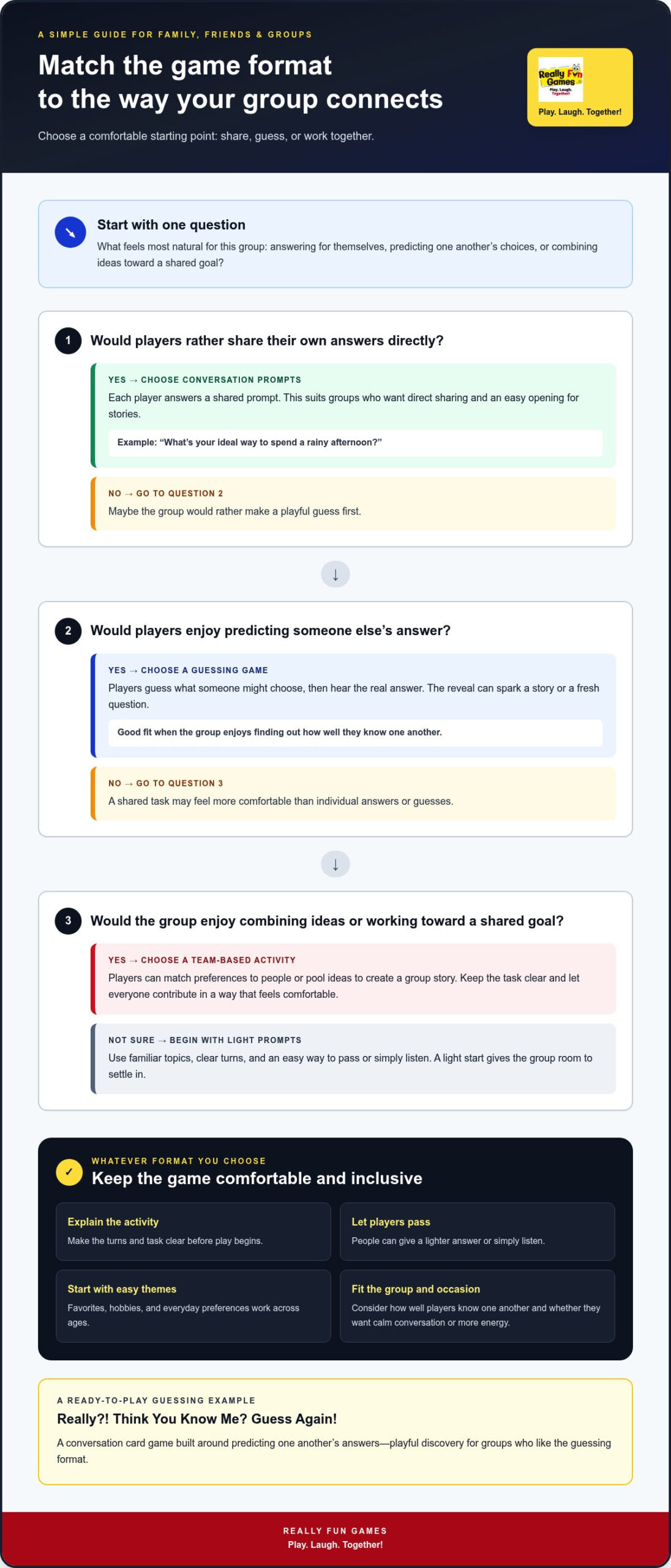
The right format depends on who’s playing, how comfortable they feel together, and whether they want open conversation or clearer turns. A family gathering, first-day classroom activity, and party with new acquaintances may all benefit from different games to get to know me. Think about the group’s energy and choose an activity that makes joining in feel natural, not compulsory.
Three useful formats are conversation prompts, guessing games, and collaborative activities. Prompts give each player a chance to share. Guessing games let people predict one another’s choices. Team activities invite players to combine ideas or work toward a shared goal. Use the format that fits the group’s comfort level and the time you have.
Conversation prompts versus guessing games
With a prompt, players answer for themselves: “What’s your ideal way to spend a rainy afternoon?” In a guessing game, the group predicts what one person might choose before hearing their answer. That twist adds anticipation, and the reveal gives the person a chance to explain their choice. Prompts suit groups who want direct sharing; guessing games work well when players enjoy testing how well they know one another.
Choosing a format for families, friends, and groups
For families, pick accessible topics that grandparents, parents, and children can all enjoy. Favorites, hobbies, and everyday preferences give different generations plenty of ways to contribute. New acquaintances may appreciate clear turns and light questions, so no one has to invent an answer on the spot or share more than they want.
For classrooms, youth groups, and team gatherings, consider whether players would rather talk, guess, or solve something together. Collaborative activities shift attention from individual answers to listening and teamwork. If you’re planning a social or workplace gathering, an icebreaker game can provide structure while helping participants start interacting.
When a team-based activity makes sense
Choose a collaborative format when the group enjoys shared goals or needs a reason to communicate beyond taking turns. Players might work together to match preferences to people or pool ideas to create a group story. Keep the task easy to understand, and give everyone a comfortable way to contribute, whether by suggesting an idea, listening, or helping the team decide.
Before choosing, ask yourself: Do players already know one another? Would they enjoy sharing their own answers or guessing someone else’s? Does the occasion call for calm conversation or more energy? There’s no single format for every age, relationship, or event. A guessing-style conversation card game such as Really?! Think You Know Me? Guess Again! suits groups that enjoy discovering how well they know one another. Browse family and conversation games for more ways to bring playful connection to your gathering.
For a ready-to-play option with guessing built in, explore Really Fun Games and choose a game that fits your group’s comfort and energy.
Keep Get-to-Know-Me Games Fun and Inclusive
A welcoming game isn’t about getting the most personal answer or making everyone speak. It’s about creating a shared moment where people can join at their own comfort level. Explain the activity, set a relaxed tone, make turns predictable, and end with a quick reflection. These small choices can help games to get to know me feel inviting for kids, adults, and everyone in between.
- Explain the activity. Describe what players will do, how turns work, and whether answers are shared with the group. A brief demonstration helps children, new players, or anyone who prefers an example before joining.
- Set a comfortable tone. Let everyone know they may pass, choose a lighter answer, or share only what feels right. Start with everyday topics rather than questions that call for private details.
- Take turns without rushing. Give each person a moment to think. Make room for answering, guessing, or listening, and don’t circle back to someone who has chosen to pass.
- Close with reflection. Invite players to share a favorite moment or something they learned, while keeping this optional too. A cheerful wrap-up ends the activity on connection rather than pressure.
Set simple boundaries before play begins
Say plainly that players can skip any prompt or answer briefly. For example, someone can name a favorite kind of music without explaining why. Begin with familiar topics, such as favorite snacks or ways to spend a free afternoon. If a surprising answer gets a laugh, make sure the laughter is shared, not at the person’s expense. Curiosity should open a door, not put someone on trial.
Clear boundaries also help a facilitator respond if a prompt lands awkwardly. Don’t demand an explanation from someone who passes, and don’t treat a personal answer as permission to ask increasingly private follow-up questions. Keep the focus on enjoying the activity together. Players are more likely to relax when they can choose how much to share.
Help quieter players and mixed-age groups join in
Silence doesn’t always mean someone has nothing to say. Allow thinking time, and avoid putting a quieter player on the spot with a sudden follow-up. Offer different ways to take part: a player might answer, make a guess, or listen until a prompt feels right. For families and classrooms, use familiar language and examples that don’t depend on everyone having the same hobbies, home life, or experiences.
Participation works best when players control how they join in, making the game feel welcoming rather than demanding. This matters in mixed-age groups, where one person may love telling stories while another prefers quick answers. Model a short, light response yourself, then let the group find its rhythm.
For a ready-to-play way to bring shared turns and conversation to a gathering, explore family and conversation games. Choose an option that suits the group, then let comfort and laughter guide the pace.
How to Choose Questions and Prompts That Spark Real Conversation
A strong prompt gives someone an easy way into the conversation, then leaves them in control of how much to share. For games to get to know me, include variety: light prompts for quick answers, playful ones that invite a laugh, and thoughtful ones that may lead to a story. The goal isn’t to collect the most revealing responses. It’s to make sharing enjoyable and natural for the people playing.
Group prompts by theme so the activity doesn’t feel like a string of unrelated questions. Familiar topics give players an easy starting point, while imagination adds energy. Consider the group’s ages, relationships, and setting. A prompt that feels fun among close friends may feel too personal for new acquaintances.
Prompt themes that make sharing feel natural
Favorites and everyday choices are easy entry points: ask about a preferred way to relax, a small skill someone enjoys using, or the kind of celebration they look forward to. A memory prompt can invite a story without demanding a deeply personal one, such as recalling a meal they still remember fondly. Imaginative prompts work too when they stay simple, like choosing a fictional place for a day trip.
Keep themes broad and inclusive. Avoid assuming everyone has the same family structure, traditions, budget, or life experience. A prompt about a favorite way to celebrate leaves room for players who celebrate differently or not at all. For a mixed-age group, use clear wording and topics that children, teens, and adults can interpret in their own way.
Keep the conversation moving without pressure
After someone answers, show interest with a gentle follow-up, such as asking what they enjoy about that choice. Don’t challenge their response or ask them to justify it. If another player connects with the answer, let them add a brief story, then bring the turn back to the game so everyone has a chance to participate.
A simple rhythm keeps prompts feeling like play rather than an interview. Rotate between a funny or imaginative theme, an everyday preference, and a more reflective topic. Let players keep answers short, pass, or share more if they choose. If the group starts chatting naturally, enjoy the moment without letting one story take over every turn. A facilitator can move things along warmly: “That’s a great detail. Let’s hear the next answer.”
Ready-to-play conversation card games take the pressure off inventing prompts as you go. Really?! Think You Know Me? Guess Again! brings a guessing element to learning about one another, while browsing family conversation games can help you find a format suited to your gathering.
For a ready-made way to turn answers and guesses into shared play, explore Really Fun Games and find a game that fits your group.
Turn “Guess Again” Moments into Shared Play with Really Fun Games
A guess can turn a familiar conversation into a lively moment of discovery. Someone makes a prediction, the answer comes out, and suddenly the group has a new detail to laugh about or talk over. That simple rhythm is part of the appeal of guessing-style games to get to know me: players aren’t only sharing about themselves, they’re also paying attention to what others might say.
Really?! Think You Know Me? Guess Again! is a get-to-know-me card game from Really Fun Games. Its name captures the playful possibility at the heart of guessing: you may feel sure you know someone’s answer, then discover they had something else in mind. The fun comes from comparing guesses and answers, not from getting every guess right.
Why a guessing-style card game can make discovery playful
Guessing gives players a shared focus. Instead of searching for a personal question to ask, they can make a prediction, hear the answer, and respond to what they learned. A mismatch can prompt a surprised laugh; a match can reveal a point of connection. Either way, the conversation grows from the group’s curiosity, without requiring anyone to share more than they’re comfortable sharing.
This format can work well for friends and families who enjoy seeing how their impressions line up. A guess isn’t a verdict on how well people know each other. It’s a starting point for a friendly exchange: “I thought you’d choose that because…” or “I didn’t know that was your favorite.” Keep reactions warm, and each reveal becomes an invitation to learn rather than a reason to tease.
Ready-to-play cards also give groups a structure when they’d rather begin with an activity than invent conversation from scratch. Really Fun Games creates award-winning family and conversation games designed for ages 8+. For an overview of options suited to shared play, browse the conversation and card games collection.
Choose a game that suits the people playing
Think about what the group enjoys: telling stories, making guesses, or mixing both. For a family gathering, consider whether younger and older players can follow the activity and enjoy taking part. For newer acquaintances, a clear structure and light tone can make answers easier to share. Choose a format for the people around the table, not an imagined ideal group.
The best fit is the one that lets your group relax into the activity. If guessing gets people smiling and chatting, follow that energy; if players prefer direct sharing, choose a format built around their answers. A game creates an opening, but the group shapes the conversation. For your next family game night, classroom gathering, or get-together with friends, explore Really Fun Games and choose a card game that suits your players.
Make Your Next Gathering a Little More Playful
Connection doesn’t need a perfect question or a big plan. Start with one shared activity, let the group’s mood shape the conversation, and leave room for answers that surprise you. The best games to get to know me aren’t about uncovering everything at once. They make it easier to enjoy the small discoveries that build familiarity over time.
For your next family night, classroom activity, or get-together with friends, choose a game that suits the people playing. A ready-to-play card game gives everyone a comfortable starting point, while laughter and genuine curiosity help the conversation find its own direction.
Explore the Really Fun Games collection and choose a playful way to bring your people closer. Here’s to more shared stories, unexpected answers, and moments worth remembering.
Frequently Asked Questions
What are games to get to know me?
“Games to get to know me” can describe social activities for mutual discovery, while a personal list of favorite video games is usually one person’s introduction to their tastes. The useful distinction is what participants do: in a group activity, people respond to one another; with a personal list, others mainly learn what the list-maker enjoys. That difference helps you choose an activity for your gathering.
What are some fun games to get to know someone?
Try a prompt round where everyone responds to the same theme, a prediction round where players guess a friend’s choice, or a shared task that calls for ideas from the whole group. For a casual dinner, a quick preference prompt can fit between courses; for a reunion, a guessing format can draw on familiarity. Choose an activity people can understand quickly and enjoy without much preparation.
How do you play a get-to-know-me game?
Keep the setup simple: choose one short activity, explain what counts as a turn, and try a sample round before continuing. If a response sparks a side conversation, allow a brief exchange, then return to play so the group stays together. Close by asking which moment surprised or amused players, rather than asking them to disclose something new. This gives the activity a clear beginning, middle, and end.
Can get-to-know-me games work for families and mixed-age groups?
Yes. Check that everyone understands the wording and that the topic is accessible to the youngest participants without talking down to older players. Reading a prompt aloud and giving a neutral example can help. In a family or classroom with varied reading confidence, one person can read the cards while each player responds in their own way. That keeps the activity shared without requiring identical answers.
What if someone does not want to answer a question?
If someone declines, accept it lightly and move on without asking for a reason. A facilitator can say, “No problem, let’s hear the next thought,” then keep the same welcoming energy for everyone. Don’t turn a pass into a joke or a challenge to persuade them. Players feel more at ease when their boundaries are treated as ordinary, not made the focus of the room.
Are get-to-know-me games the same as icebreaker games?
Often, yes, but the labels emphasize different uses. Icebreakers are commonly chosen to help a group begin interacting, such as when participants meet for the first time; a get-to-know-me activity may also suit people who already share a history. Consider whether your aim is to ease introductions, add variety to an established gathering, or create a structured activity for a particular occasion.
Can a card game help friends and family learn more about each other?
Yes. A card provides a common cue, so players don’t have to invent a topic on the spot. After a prompt about a favorite way to spend a free day, for instance, someone might hear a detail they hadn’t learned before, while another player recognizes a shared interest. The game offers a framework for exchange; what the group talks about or discovers depends on the players.