

Replay value comes from meaningful variation, not simply a long campaign. Highly replayable games for adults make another session feel fresh through branching story choices, different strategies, or changing outcomes. The best fit depends on whether you want a quick return visit or a story you can revisit and reshape.
Key Takeaways
- Compare playtime estimates with the kind of evening you want, from a quick session to a longer, more involved game.
- Look for replay value in changing choices, strategies, player interactions, or story outcomes.
- Choose board games when you want deeper shared decisions, or card and party games when you want flexible, social play.
- Judge value by how often a game feels fresh, not just by its first playthrough.
- Explore conversation and tongue-twister games for lively rounds built around connection, quick thinking, and laughter.
1. Average playtime estimates
Playtime estimates help you plan game night, but they need context. A box estimate may describe active play, not setup, rules explanations, or breaks. Consider those pieces before choosing a game for a short evening or a longer gathering. Frequent turns can keep a game brisk, while shared decisions may stretch play.
Use this method to compare estimates: check the listed duration, allow time for setup, then consider how familiar players are with the rules. A first session often takes longer because players are learning. Later sessions may move faster as everyone recognizes the choices and turn sequence. Discussion can also affect the pace, especially in cooperative games or games with story decisions.
Cooperative games with strong replay value include Pandemic, Spirit Island, and The Crew: Mission Deep Sea. Each gives players shared goals, while changing challenges or decisions encourage a new approach. Compare them by considering whether your group prefers strategic planning, changing scenarios, or concise teamwork.
For adult groups of four or more, try Codenames, Just One, or Decrypto. These party games create lively rounds through clues, teamwork, and interpreting other players. Check the player count on the box, then match the format to your group’s appetite for conversation and competition.
In the United States, adults can buy games through game retailers and publishers’ stores. Prices vary with the game’s format, components, and retailer, so compare the product details and current listing before choosing. For conversation-led options, browse the conversation and party games collection.
For two adults, 7 Wonders Duel, Jaipur, and Patchwork offer focused head-to-head play. They stay engaging through tactical choices, changing turns, or competing plans. Before buying, look for rules that create meaningful decisions on each turn, rather than relying only on surprise. That difference can make another session feel distinct.
For a fair playtime comparison, use the same checklist for every option:
- Estimate: Note the duration printed on the box or listing.
- Setup: Include time for arranging components and explaining rules.
- Group: Consider whether more players add discussion or waiting.
- Replay: Look for changing goals, choices, or strategies between sessions.
This approach makes highly replayable games for adults easier to compare. Choose an estimate that fits your available evening, then consider whether the game’s choices will bring your group back for another session.
3. What makes a game highly replayable for adults?
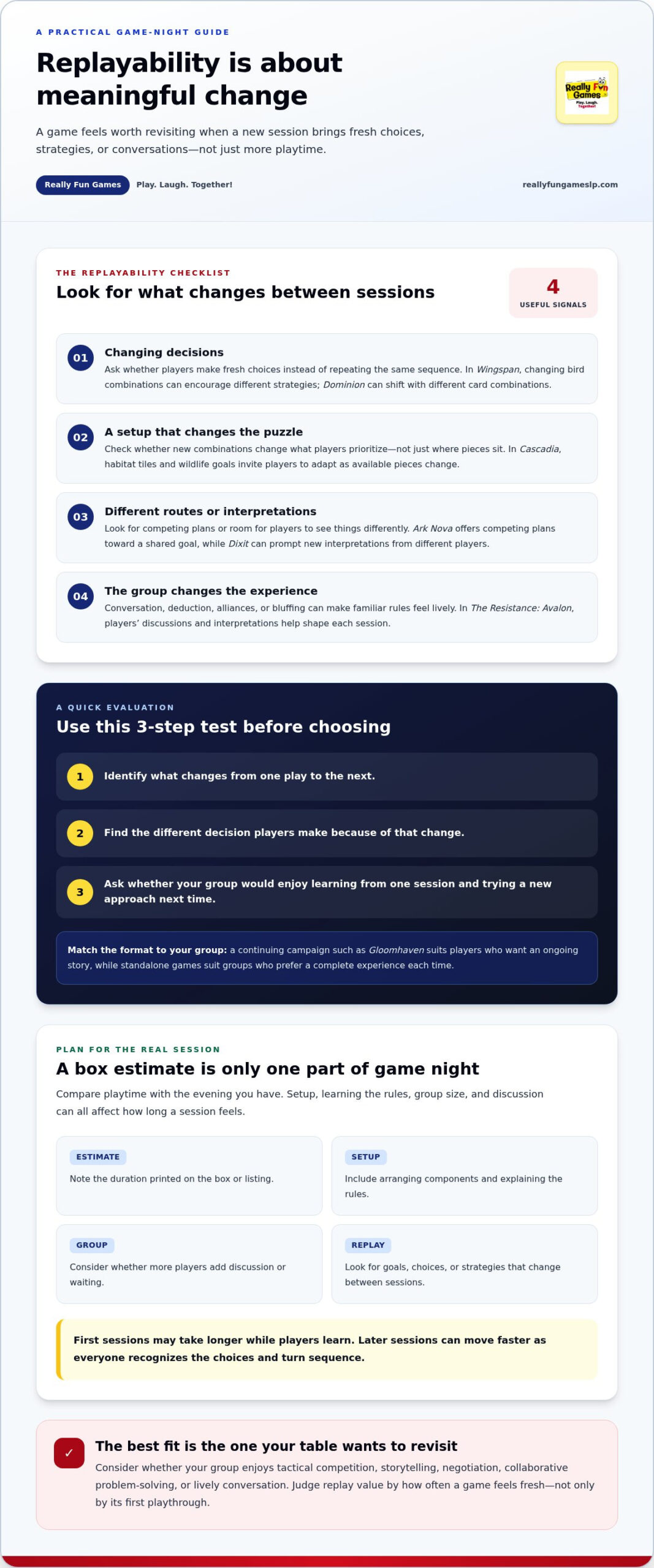
Replayability begins with meaningful variation, not simply a thick rulebook. In Wingspan, changing bird combinations can encourage different strategies across sessions. A new approach feels worthwhile when players make fresh decisions instead of repeating the same sequence. Look for games where choices shape your plan, the shared board, or the group’s next move.
Variable setups offer another reason to return. Cascadia pairs habitat tiles with wildlife goals, inviting players to adapt as the available pieces change. Different combinations can prompt players to rethink their priorities. When comparing games, check whether the setup changes the puzzle or merely rearranges components without affecting decisions.
Player interaction matters, too. In The Resistance: Avalon, conversation and deduction make each group’s discussion part of the experience. Players bring different instincts, clues, and interpretations to the table. This social variation can keep familiar rules lively, especially for groups who enjoy reading one another and explaining their reasoning.
- Changing decisions: Ask whether Dominion offers different card combinations that alter your strategy.
- Multiple routes: Check whether Ark Nova lets players pursue competing plans toward a shared goal.
- Fresh information: Consider whether Dixit prompts new interpretations from different players.
- Group influence: Notice whether discussion, alliances, or bluffing change how a session unfolds.
Replayability also depends on the people playing. Carcassonne can feel different when players compete for shared spaces, while a quieter group may focus on building their own regions. Before choosing, picture your regular group: do they enjoy tactical competition, storytelling, negotiation, or collaborative problem-solving? A game’s strengths matter most when they suit the table.
Use a simple three-step test when reading a game description. First, identify what changes between plays. Next, find the decision players make differently because of that change. Finally, ask whether your group would enjoy learning from one session and trying a new approach the next time. Gloomhaven, for example, centers on a continuing campaign, while standalone games suit groups who prefer a complete experience each time.
Highly replayable games for adults often combine changing choices with strong player interaction. If your favorite moments come from conversation and shared laughter, explore conversation games for lively groups as another way to keep gatherings engaging.
4. What are the best highly replayable board games for adults?
The strongest board-game picks offer new decisions, not just more pieces. Terraforming Mars suits adults who enjoy building an engine and adapting to the available cards. Its corporations and card combinations can lead players toward different development plans. Choose it if your group likes long-term planning and competing priorities.
For tense interaction, Brass: Birmingham rewards timing, route planning, and reading opponents. Players develop industries and connect them through a shared network. One player’s choices can change which opportunities remain open. It’s a rewarding option for groups who enjoy economic strategy and indirect competition.
Root stands out for its asymmetric factions. Each faction follows distinct rules and pursues victory differently, so learning one role doesn’t reveal every strategy. Its woodland conflict asks players to negotiate, compete, and track shifting alliances. Pick it for a group willing to learn varied play styles.
If you want a welcoming, storybook feel with strategic choices, consider Everdell. Players build a woodland settlement by placing workers and combining cards. The available cards and resource decisions shape each city. It offers a gentler table presence while still rewarding careful planning and flexible tactics.
For mystery and deduction, The Search for Planet X gives players a hidden-sky puzzle to solve. They gather clues, make deductions, and submit theories about objects in the solar system. Different hidden arrangements create new logic challenges. Choose it when your group prefers focused reasoning to direct conflict.
Prefer adventure and playful surprises? Clank! Catacombs combines deck-building with a changing dungeon. Players explore, collect treasure, and manage the noise they make. Its shifting map changes routes and risks from one session to the next. It’s a lively fit for adults who enjoy push-your-luck decisions.
- For strategic depth: Compare Terraforming Mars and Brass: Birmingham.
- For distinct roles: Consider the faction-driven choices in Root.
- For lighter themes: Try building a settlement in Everdell.
- For puzzles or exploration: Choose The Search for Planet X or Clank! Catacombs.
Before buying, match the game’s demands to your regular group. Check the rules’ complexity, preferred interaction, and appetite for competition. A strategy-heavy title may delight players who enjoy learning systems, while a deduction game can suit friends who like talking through clues. For enthusiasts whose collections are expanding into substantial storage footprints, utilizing professional loft flooring from JR Loft Boarding can keep those heavy board game boxes organized and within easy reach. Ultimately, the best choice is one your group will gladly bring back to the table.
5. What are the best replayable card and party games for adults?
Card games earn repeat plays through changing hands, plans, and player reads. Scout keeps hand management fresh because players can’t rearrange their cards. Choosing when to play a set matters as much as choosing which set. It suits adults who enjoy compact rules and tactical choices.
Sea Salt & Paper offers a different kind of tension. Players collect card sets, then decide whether to continue or end the round. That push-your-luck choice changes as opponents build their collections. It’s a strong pick for groups who enjoy quick decisions and keeping an eye on the table.
For cooperative card play, try The Crew: Mission Deep Sea. Players complete shared objectives while communicating within the game’s limits. Each mission changes the task, so the group must adjust its plan. It works especially well for friends who enjoy solving puzzles together.
Party games gain replay value from the people around the table. Codenames turns clue-giving and interpretation into team play. New clue-givers bring different associations, and teammates make fresh guesses. Just One also changes with every group as players try to offer useful clues without duplicating one another.
For lively discussion, consider Decrypto or Wavelength. Decrypto asks teams to communicate coded information while keeping its meaning from opponents. Wavelength invites players to place ideas along a shared spectrum. Both games thrive on the different ways adults interpret the same clue.
If your group prefers bluffing, Skull keeps the challenge focused on reading confidence and risk. For spontaneous storytelling, Monikers builds a shared pool of comic references across rounds. These games feel distinct when players bring new guesses, jokes, and strategies to familiar prompts.
- For tactics: Pick Scout or Sea Salt & Paper.
- For teamwork: Choose The Crew: Mission Deep Sea or Codenames.
- For conversation: Try Just One, Decrypto, or Wavelength.
- For bluffing and laughs: Bring out Skull or Monikers.
Before choosing, match the game’s energy to your gathering. A close-knit group may enjoy the deduction in Decrypto, while a mixed crowd may prefer the accessible clue-giving of Just One. For highly replayable games for adults, look for mechanics that invite different responses each session. Familiar cards can then spark fresh conversation and laughter.
5. Which adult games offer the most replay value for the price?
The best value depends on how often a game reaches your table. Love Letter uses a compact deck and quick rounds, making it easy to revisit between longer games. Azul offers a different kind of value: its tactile tiles and changing drafting decisions suit groups who enjoy thoughtful, repeatable turns. Neither needs a branching story to offer fresh choices.
Try a simple comparison before buying. Divide a game’s current purchase price by the number of times your group realistically expects to play it. This isn’t a universal value score, but it can help compare a frequently played card game with a larger box that may come out less often. Use your own budget and habits, not another group’s estimate.
Consider Hanabi for cooperative card play. Players work together to organize a fireworks display while managing limited communication. Shared deduction gives the group a reason to refine its approach over repeat sessions. Cartographers offers another compact option: players draw maps as changing scoring goals shape each plan.
For social gatherings, Just One can offer value through the group’s changing clues and interpretations. Codenames likewise feels different as clue-givers and teams bring new associations. These games are worth considering if you host often and want one purchase to work as an icebreaker, party game, or casual after-dinner activity.
Replay value can also come from versatility. Sushi Go Party! lets players select a menu of cards before play, changing the available combinations. Quacks of Quedlinburg brings a push-your-luck challenge, with players deciding how far to press their luck. Compare each game’s setup and rules with your group’s appetite for learning new systems.
- For compact card play: Compare Love Letter and Hanabi.
- For shared table strategy: Consider Azul or Cartographers.
- For gatherings: Weigh Just One against Codenames.
- For changing combinations: Look at Sushi Go Party!.
Before purchasing, list your likely players, preferred mood, and realistic play frequency. Then compare those needs with the game’s format, replay mechanisms, and current price. A game that fits your regular group may offer stronger practical value than a more elaborate title that rarely gets played. For conversation-centered play, explore the Really Fun Games collection for lively gatherings and choose an option that suits your table.
Really Fun Games: Really?! Think You Know Me? Guess Again
Really?! Think You Know Me? Guess Again brings conversation and playful discovery to game night. It’s a natural choice when your group wants to learn how friends or family members see one another, share answers, and spark memorable discussions. For a lively speaking challenge, Triple Tongue Twisters, Tricky Tetra Tongue Twisters, and Blooming Tongue Twisters add vocal play and laughter to a gathering.
These games offer a different kind of replay value from branching story paths: people’s responses, guesses, and performances can make each session feel personal to the group. Choose a conversation game for connection or a tongue-twister game for a playful challenge. Visit reallyfungameslp.com to explore the games and find one for your next gathering.
Make Your Next Game Night Your Own
Let your next game night reflect the people around your table. A familiar group might enjoy a fresh challenge, while friends meeting for the first time may prefer a playful way to get talking. Choose an activity that suits the mood you want to create.
Highly replayable games for adults can turn a gathering into a shared ritual, with new stories and inside jokes emerging along the way. Invite a different mix of players or let someone new choose the evening’s game. Small changes can reveal what your group enjoys most.
Ready to bring more conversation and laughter to your next gathering? Explore the Really Fun Games collection and choose a game that fits your family, friends, or event. Here’s to good company and joyful surprises around the table.
Frequently Asked Questions
How long do highly replayable adult games typically take to play?
There’s no single typical playtime; the game’s format makes the biggest difference. A standalone card or party game usually ends when its round or match ends, while a campaign game may tell its story across separate sessions. Before choosing, decide whether you want one complete evening’s activity or a game to return to over several gatherings. That distinction can matter more than replay value alone.