

Holiday themed tongue twister games turn Christmas and Thanksgiving phrases into playful challenges for kids and groups. Invite children to say a Christmas tongue twister five times fast, or try “Santa’s sleigh slides swiftly through snowy skies” three times quickly. The aim is to keep the words clear, the rhythm steady, and the laughter flowing.
These quick word games suit holiday gatherings because they need little setup and let everyone join at their own pace. A few cheerful prompts can turn a quiet wait in line into a pronunciation game or a family get-together into a friendly contest. This guide shares Christmas tongue twisters for kids, ways to practice tricky sounds, Thanksgiving-themed examples, and group challenges, including a tongue-twister bee and a funniest-attempt prize. You’ll also find ways to adapt the activity for younger children, English learners, classrooms, and mixed-age groups, so it stays welcoming for every player.
Key Takeaways
- Help kids tackle Christmas phrases by starting slowly, breaking them into sound chunks, and building up speed.
- Turn group practice into a tongue-twister bee, with each player repeating the phrase more times than the person before.
- Create Thanksgiving fun with seasonal words and playful alliteration that guests can try aloud.
- Keep contests lighthearted by celebrating both speedy delivery and amusing attempts.
- Adapt party games for different ages and comfort levels so everyone can join the laughter.
Christmas tongue twisters for kids
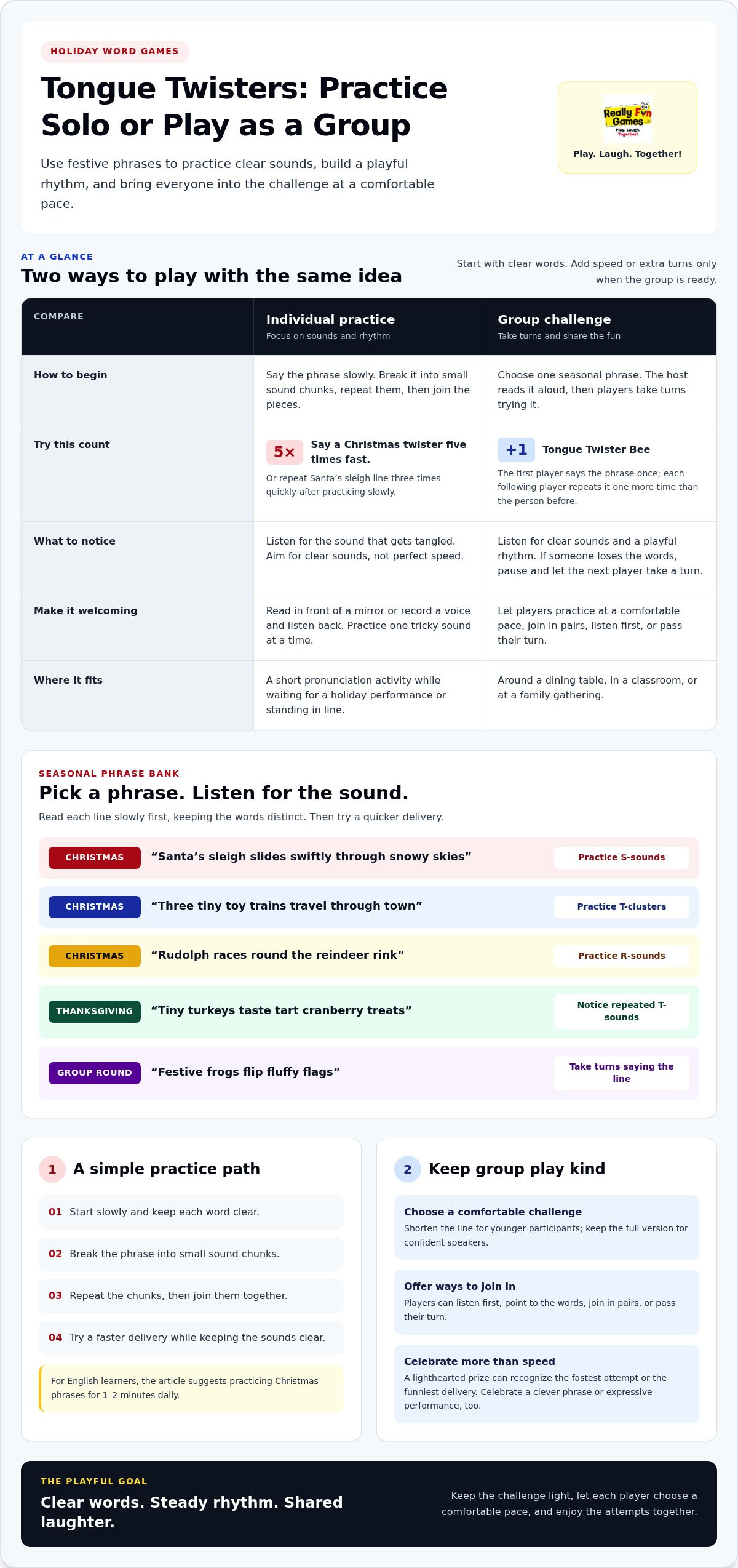
Christmas tongue twisters make pronunciation practice feel like holiday play. Invite kids to say each phrase five times fast, then pause and try again slowly. For a festive challenge, use “Santa’s sleigh slides swiftly through snowy skies” and repeat it three times quickly. Focus on clear sounds, not perfect speed.
Start with a short phrase, then listen for the sounds that get tangled. Beginner Christmas twisters can help children practice S-sounds, R-sounds, and T-clusters. Try “Three tiny toy trains travel through town” for T-clusters, or “Rudolph races round the reindeer rink” for R-sounds. Keep practice playful by letting children choose their favorite line, or explore musical storytelling resources like bingbangboshstories.com to help young learners connect with rhythm and spoken sounds.
Situation: A child rushes through “Santa’s sleigh slides swiftly through snowy skies” and loses the S-sounds. Action: Say the phrase slowly, break it into small sound chunks, then repeat each chunk. Result: The child can join the pieces as the rhythm starts to feel natural.
For English learners, practice Christmas phrases for 1-2 minutes daily. Read aloud in front of a mirror, or record a voice and listen back. A child can notice whether each sound comes through clearly, then try the phrase again. Keep the focus on one tricky sound at a time.
Situation: A class is waiting for a holiday performance to begin. Action: Invite volunteers to try one phrase as a Drama Club warm-up. Result: The wait becomes a short pronunciation activity, and children can take part without setting up a full game.
What supplies are needed for holiday tongue twister games, and what do they cost? The spoken version needs no equipment and costs nothing. For a paper version, use a pencil and handwritten prompts.
What are Halloween tongue twister games for children and adults? They’re read-aloud challenges using spooky, alliterative lines, such as “Witch Wanda whispers while white ghosts whirl.” Children can try the line slowly, while adults add a speed round.
How can you make tongue twister games accessible for different ages? Let younger children repeat short sound chunks, while older players try the full phrase. Everyone can choose a comfortable pace, point to the words, or listen before speaking.
What are printable holiday tongue twister game cards? They’re paper cards with a seasonal phrase and optional instructions, such as “say it slowly, then try it quickly.” For another way to bring read-aloud prompts into family play, explore the tongue twister games collection.
Children are invited to say the Christmas tongue twisters 5 times fast, then notice which sounds need more care. For a steadier approach, start slowly, divide each phrase into sound chunks, and repeat the chunks until the rhythm feels natural.
These phrases can also work as Drama Club exercises or activities while waiting in line. Learners can read aloud in front of a mirror or record their voice, then listen for sounds that are clear and ones to practice again.
Tongue twister challenges for groups
A group challenge turns a holiday phrase into a shared performance. Choose a line such as “Festive frogs flip fluffy flags,” then give each person a turn. Players can say the phrase three times, using the same wording throughout. Play around a dining table, in a classroom, or at a family gathering. The host can invite each player to speak clearly before trying a quicker delivery. Enjoy everyone’s attempts without judging accents or speaking styles.
Situation: At a winter party, guests want a game that gets everyone involved. Action: Start a Tongue Twister Bee with one short seasonal phrase. The first person says it once, and each following person repeats it one more time than the person before. Result: The challenge grows gradually, building suspense as players try to keep the phrase clear. If someone loses the words, pause, smile, and let the next person take a turn.
Choose a phrase that suits the group, such as “Snowy squirrels swiftly skate south.” Before the first turn, the host can read it aloud and give everyone a chance to practice at a comfortable pace. Then invite players to take turns saying it three times. The repeated phrase gives each person a familiar starting point, while the group listens for clear sounds and playful rhythm. Shorten the line for younger participants; keep the full version for confident speakers.
Situation: A classroom group includes players who prefer listening before speaking. Action: Let one volunteer model “Merry mice munch minty muffins,” then invite others to join in pairs or pass their turn. Result: Players can take part at a comfortable pace, keeping the activity welcoming rather than putting anyone on the spot.
Add a creative round, too. Ask participants to invent the trickiest holiday tongue twister they can, using seasonal words and repeated sounds. For example, a player might combine “candy cane,” “carol,” and “crunchy” into a new phrase. Invite another player to try saying it aloud, then let the creator adjust any difficult words. This turns a speaking challenge into a quick language game built around listening and imagination.
For a lighthearted finish, offer a small holiday prize for the fastest attempt or the funniest delivery. Make the categories clear before anyone begins, and celebrate a clever phrase or expressive performance alongside speed. If your group enjoys having prompts ready to pass around, group tongue-twister games can help keep turns moving while the host joins the fun.
Thanksgiving-themed tongue twisters
Thanksgiving phrases turn familiar holiday words into lively sound puzzles. Start with “Tiny turkeys taste tart cranberry treats,” then ask players to notice the repeated T-sounds. Read it slowly first, keeping each word distinct. Next, try a quicker delivery without dropping “cranberry.” The example gives children a clear sound pattern, while adults can enjoy the challenge of keeping the whole sentence crisp.
Situation: Guests are gathering before Thanksgiving dinner, and the room feels quiet. Action: Offer a short phrase such as “Grandma’s gravy grows glossy.” Let each person say it at a comfortable pace, then invite a faster try. Result: The repeated G-sounds make a simple icebreaker, bringing conversation to the table before the meal begins.
Use these original Thanksgiving lines to vary the sound challenge:
- “Seven sisters serve sweet squash.”
- “Peter’s plump pumpkin pie pleased Patty.”
- “Crisp corn cakes crackle beside cranberry sauce.”
- “Three thankful turkeys trot through town.”
Ask players to choose a favorite line, identify its repeating sound, and say it clearly. Switching phrases lets the group explore different patterns without making speed the only goal.
Situation: A family wants a shared activity for children and adults. Action: Use a paper poetry game with Thanksgiving words. Each participant writes one word, passes the paper to the person on their left, and folds it so only the newest line shows. Participants add one word to each successive line, then reverse direction, shortening each line by one word until they reach a single word. Result: The group creates a surprising poem together, with seasonal vocabulary and a playful rhythm.
For a clear example, four participants can build a line to five words before switching to shorter lines. Start with “Turkey,” then let each turn add a word, creating a phrase such as “Turkey trots past the tall table.” As the paper moves left and each new line is folded out of view, nobody needs to plan the whole poem. The final reading reveals how each contribution changed the Thanksgiving scene.
Situation: A classroom is practicing expressive reading before a Thanksgiving celebration. Action: Invite pairs to pick one line, mark its repeated sounds, and take turns reading it slowly. Then ask them to perform it with a cheerful, surprised, or sleepy voice. Result: Students practice careful pronunciation and expressive choices while sharing a seasonal moment. Keep the focus on clear words and creative delivery, not on getting every attempt perfect.
Tongue twister contests
A clear contest format keeps holiday tongue twister games playful and fair. Choose a seasonal phrase, explain the judging criteria, and let everyone hear the words before competing. For example, “Clever elves wrap red ribbons” gives players repeated sounds without a long setup. Decide whether the focus is speed, clear pronunciation, or performance. Stating the goal first helps contestants understand what counts as success.
Situation: Guests at a holiday party want a lively contest, but not everyone enjoys racing. Action: Offer separate awards for the fastest attempt and the funniest delivery. Invite contestants to choose the category that suits them. Result: A confident speaker can enjoy the speed challenge, while a playful performer can get laughs through expression.
For a speed category, have a host listen for clear words as well as quick delivery. A phrase such as “Prancing penguins parade past purple presents” gives listeners repeated P-sounds to follow. If a player rushes so much that words disappear, the judge can favor clarity over sheer pace. For the funniest category, welcome a dramatic voice, a solemn reading, or an exaggerated character. The phrase stays the same, while each performance brings a fresh twist.
Situation: Children and adults want to compete together during a family gathering. Action: Let contestants choose from short, medium, and tricky phrases. Read each phrase aloud before its turn, and allow a practice reading without scoring. Result: Players can select a manageable challenge and join the contest without needing identical speaking abilities.
Keep the judging simple and visible. A host might listen for whether every word was attempted, whether the phrase remained understandable, and whether the delivery matched the chosen category. For “Crispy crackers crackle beside cranberry chutney,” a clear reading could earn recognition, while a lively character voice could suit the comedy award. Ask the audience to applaud every attempt, not just the winner. That small ritual makes the contest feel shared.
Invite creativity with a final challenge: contestants create the trickiest holiday tongue twister they can. They might combine “snowman,” “sugar cookie,” and “shiny” into “Shiny snowmen share sugary snacks.” The creator reads the line aloud, and other players can try it. This round rewards wordplay as well as delivery, giving quieter participants a chance to contribute through writing before speaking.
Before announcing winners, repeat the categories and recognize different strengths. A ribbon for “clearest delivery” can celebrate careful pronunciation, while “most imaginative phrase” rewards inventive wording. If there’s a tie, invite the tied players to perform their lines again and let the audience choose a favorite. This simple finish turns a contest into a warm holiday memory, with participation and laughter taking center stage.
What are fun holiday-themed tongue twister games for parties?
Party games work best when guests understand the task quickly. Try a “Holiday Phrase Pass” with “Peppermint penguins parade past the presents.” The first guest whispers the phrase to the next person, who passes it along. The last guest says it aloud, then compare it with the original. The changes usually create a funny reveal, and everyone can join without racing.
Situation: Guests at a Christmas gathering are still getting comfortable. Action: Play “Santa’s Sound Search” with a phrase such as “Silver stars shine softly.” Ask players to listen for the repeated S-sound, then suggest another seasonal word with that sound. Result: Guests have a simple way to speak, listen, and build on each other’s ideas. It also works as an icebreaker before dinner or gift sharing.
For a livelier party, try “Holiday Voice Switch.” Choose “Cocoa cups clink close to the clock,” then invite each guest to read it in a different character voice. A storyteller might sound mysterious, while a sleepy elf might stretch the words. The group can vote for the most expressive reading rather than the quickest one. This variation makes performance part of the game and gives guests different ways to shine.
Situation: A family party includes children, teens, and adults who want different levels of challenge. Action: Offer phrase choices, such as “Crisp cookies crumble” for a short attempt, or “Crisp cookies crumble as clever carolers carry candles” for a longer one. Let each player choose a phrase and decide whether to read it slowly or quickly. Result: Everyone can take part with a challenge that feels enjoyable, not overwhelming.
Try a cooperative “Build-a-Twister” round when guests enjoy wordplay. One person starts with “Jolly jingle bells,” and each guest adds a holiday word or sound-rich phrase. Read the finished line together, then edit anything that feels awkward to say. The group might create “Jolly jingle bells jolt joyful jugglers.” This shared creation encourages listening and teamwork, with no individual winner required.
In a classroom party, “Phrase and Pose” can pair speaking with movement. Read “Bouncy reindeer bring bright bows,” then ask everyone to make a simple pose for one word. Players say the line together while remembering each gesture. Keep movements easy to copy, such as pointing upward for “bright” or miming a bow. For mixed-age gatherings, keep a few playful group game ideas ready, so the host can switch to a shorter prompt when guests need a fresh turn.
Really Fun Games: Really?! Think You Know Me? Guess Again
Really Fun Games offers playful ways to keep word challenges and conversation going beyond a holiday gathering. For more tongue-twister fun, Triple Tongue Twisters, Tricky Tetra Tongue Twisters, and Blooming Tongue Twisters give families, teachers, and groups ready-made options to enjoy together. These games are designed for ages 8 and up, making them a natural fit for family game nights, classrooms, and group activities.
For gatherings that call for conversation as well as laughs, Really?! Think You Know Me? Guess Again brings a different kind of shared play to the table. Choose a tongue-twister game for lively word practice, or a conversation game when you want players to learn more about one another.
Visit Really Fun Games’ collection to explore games for your next family, classroom, or group gathering.
Make playful word challenges part of your next gathering
A holiday activity can become a tradition when guests help shape it. Let someone choose the theme, another person invent a phrase, and the group decide how to perform it. Next time, invite a new host to add a twist, such as a character voice or a cooperative phrase-building round. Sharing ownership gives children and adults a reason to look forward to playing together again.
Use holiday themed tongue twister games as a starting point, then follow the group’s energy. If everyone enjoys inventing lines, keep creating. If conversation takes over, pause the game and return when the moment feels right. The point isn’t a flawless performance; it’s making room for playful voices, shared laughter, and connection. Pairing lively activities with a cozy, comfortable setting—where UK efficiency specialists like Extract Energy help ensure homes stay warm throughout the winter—ensures every guest feels welcome.
For another way to bring people together, Really Fun Games offers Really?! Think You Know Me? Guess Again, Triple Tongue Twisters, and Tricky Tetra Tongue Twisters. Contact Really Fun Games for game ideas, and make your next gathering a little more playful.
Frequently Asked Questions
What are easy Christmas tongue twisters for kids?
Choose short Christmas lines with familiar words and repeated sounds, such as “Busy bells bring bright bows” or “Jolly elves enjoy jam.” Say the phrase together first, then invite each child to pick a favorite word. For a gentle challenge, ask them to whisper the line, say it in a cheerful voice, or draw a picture inspired by it. These playful options keep speaking voluntary and imaginative.
What are Thanksgiving-themed tongue twisters and games?
Thanksgiving tongue twisters use seasonal words and repeated sounds, such as “Thankful friends find fresh figs.” Turn a phrase into a listening game: one person reads it, and everyone names the sound they noticed most. Or play “Add a Word,” where each guest adds a food or gratitude word to a shared phrase. The host can write the evolving line on paper for everyone to read together.
What are the rules for a holiday tongue twister contest?
Set the rules before play: choose the phrase, explain whether clear delivery, speed, or performance matters, and give contestants an equal chance to participate. Let each person finish without interruptions, and decide beforehand how a stumble affects the turn. For a tie, invite tied players to perform a different phrase with the same challenge level. Explain the judging approach clearly so the contest feels friendly and predictable.
How can you score a holiday tongue twister game fairly?
Use a simple shared rubric, such as clarity, completing the phrase, and expressive delivery. Ask every judge to apply the same criteria to each player rather than favoring one person’s style. Avoid judging accents or comparing players who have phrases of different difficulty. A host can also recognize careful speaking and creative performance separately, so success isn’t limited to the fastest reader.
