

What if a deck of cards could turn a quiet gathering into a table full of stories, playful guesses, and laughter? Interactive card games for groups give everyone a shared reason to take part, but the right choice matters. A complicated rulebook can stall the fun, while overly personal prompts may leave some players sitting out.
Whether you’re bringing together family, friends, students, or colleagues, look for a game that suits different personalities and comfort levels. The best fit gives everyone a simple way to join in without making conversation feel forced.
This guide will help you choose interactive card games for your group and occasion. You’ll find practical ways to compare game styles, keep play welcoming, and get everyone started. Conversation games such as Really?! Think You Know Me? Guess Again! and vocal-play games such as Triple Tongue Twisters offer different ways to spark interaction.
Key Takeaways
- Choose interactive card games for groups based on the occasion, the kind of interaction people enjoy, and their comfort levels.
- Compare game mechanics such as conversation prompts, playful word challenges, guessing, and teamwork to find an easy way for everyone to join in.
- Make it easy to get started: explain the activity, demonstrate a sample turn, and keep the pace comfortable for the group.
- Conversation games like Really?! Think You Know Me? Guess Again! and vocal-play games like Triple Tongue Twisters offer different ways to get people participating.
- Check the game’s purpose and age guidance. Really Fun Games’ award-winning games are designed for ages 8 and up.
Why interactive card games for groups make it easier to connect
Getting a group talking can be surprisingly tricky. At a family gathering, classroom, team event, or party, some people jump into conversation while others need a gentler invitation. A shared activity offers an easy starting point: attention turns to the cards, and everyone has something specific to react to.
Interactive card games for groups are card-led activities that invite players to respond, share, guess, or perform together. The cards provide a common cue, while each person’s response makes the moment their own. This structure gives players something to talk about without asking anyone to carry the whole room or share a personal story.
Card games are one way to enjoy time together, alongside a meal, craft, or other group activity. Their particular advantage is a shared focus: players can take turns contributing, listening, and responding rather than simply watching the activity unfold.
What makes a card game interactive for a group?
The key is active participation. A turn or prompt invites someone to say, guess, choose, act, or help solve something, then gives the rest of the group a reason to listen and respond. A conversation starter might invite a story or opinion; a guessing challenge can spark playful debate; a wordplay task gets people speaking and laughing together.
In a less interactive activity, one person may do most of the work while everyone else waits. Shared turns spread participation around the group. A prompt might lead one player to answer, then give others a chance to react, compare ideas, or make a guess. Taking turns makes joining in part of the game, not an extra social demand.
Why shared play can feel more welcoming than small talk
Small talk can leave people searching for a topic. A card prompt supplies one, so players can respond to the same question, challenge, or surprising guess. Curiosity gives the conversation somewhere to go, and a shared laugh can ease the awkwardness of meeting new people or reconnecting after time apart. Players don’t need to be quick-witted; a simple reaction can keep the moment moving.
A welcoming game lets people connect through amusing answers, teamwork, or playful speaking without asking them to reveal anything deeply personal. Hosts can choose a style that suits the occasion, from lively wordplay to conversation-led guessing. Traditional games can bring people together through shared play, too. Rummy is a group of games related by the feature of matching cards of the same rank or sequence and same suit.
For a ready-to-play conversation activity, Really Fun Games card and conversation games make interaction part of the play. Whether the group is made up of relatives, classmates, friends, or coworkers, ask one practical question: does the game offer each person a comfortable way to join in? When it does, conversation can grow naturally from the activity.
How interactive card games create conversation, laughter, and teamwork
A good turn does more than keep a game moving. One person responds to a prompt, the others listen, and their reactions give the next turn fresh energy. That simple rhythm creates chances to speak and pay attention without asking one player to lead the whole conversation.
A shared card prompt gives a group an easy starting point: respond, listen, and build the next moment together. Depending on the game, the response might be an opinion, a guess, a word challenge, or an idea offered alongside teammates. The group’s participation shapes the interaction, and different people and settings will shape how play unfolds.
Conversation prompts and get-to-know-you play
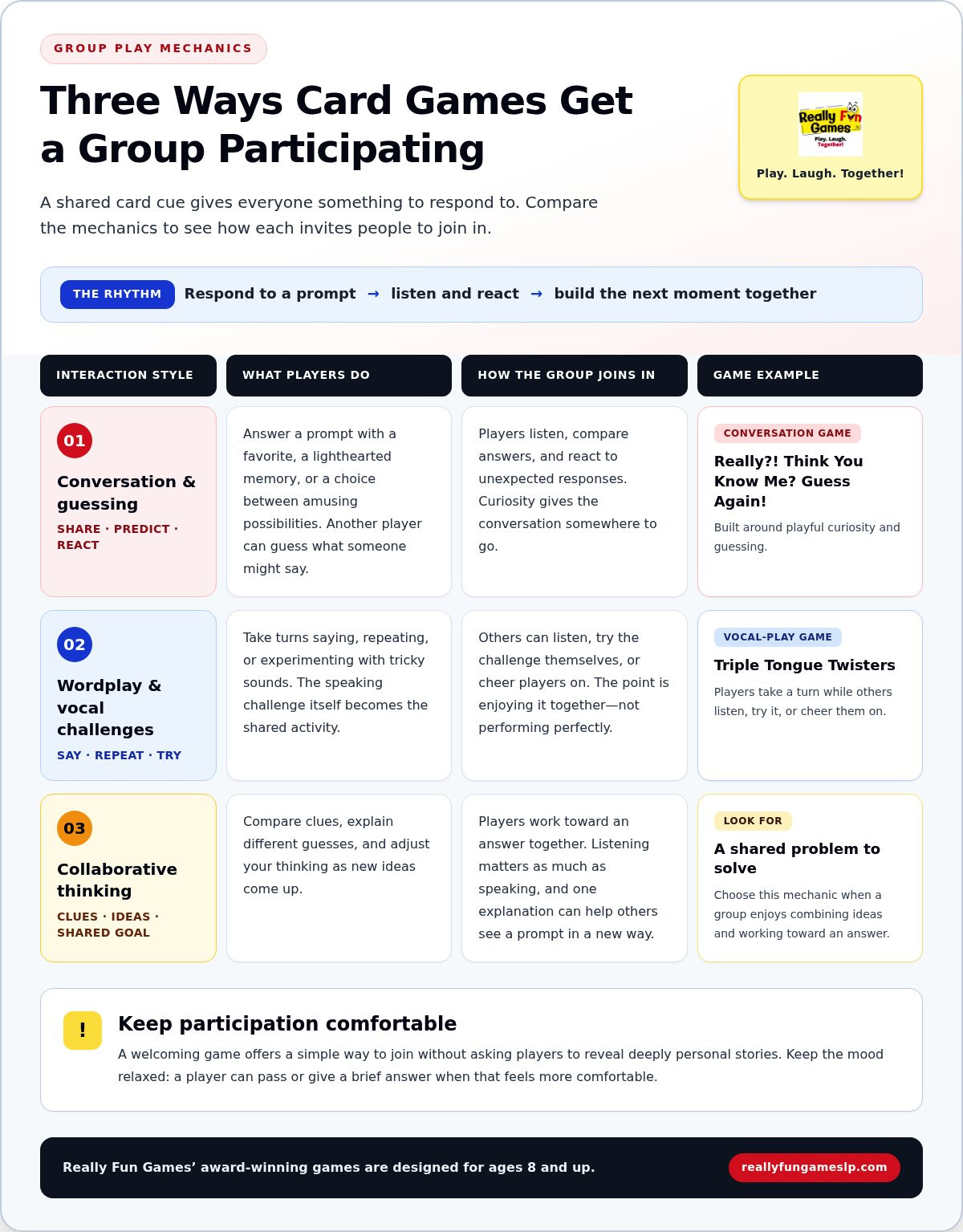
Conversation prompts can invite players to share a favorite, recall a lighthearted memory, or choose between two amusing possibilities. A guessing mechanic adds another layer: one person considers what someone else might say, then the group sees how close the guess comes. Really?! Think You Know Me? Guess Again! is a conversation-game example built around this kind of playful curiosity.
Even familiar groups can surprise one another. A sibling’s unexpected answer or a friend’s change of opinion gives everyone something new to react to. Quieter players can contribute at their own pace. Keep the mood relaxed by allowing a pass or a brief answer when that feels more comfortable.
Wordplay and vocal challenges for lively participation
Wordplay brings a different kind of energy. Players might say, repeat, or experiment with tricky sounds, turning speaking itself into the shared challenge. With Triple Tongue Twisters, players can take a turn while others listen, try it themselves, or cheer them on. The aim is to enjoy the challenge together, not to perform perfectly.
For more ideas in this playful style, explore tongue twister games for speech, confidence, and family fun alongside other conversation and card-game options.
Guessing and teamwork keep everyone involved
Some mechanics encourage players to work out an answer together. A group can compare clues, explain different guesses, and adjust its thinking as new ideas come up. This shared problem-solving makes listening as useful as speaking. In a guessing game, for instance, one player’s explanation may help the group see a prompt in a new way.
Think about which mechanics suit the people around the table. Conversation-led turns can work well for groups who enjoy exchanging opinions; wordplay offers a lively option for people who like speaking challenges; collaborative thinking gives players a shared goal. If you’re choosing a ready-to-play deck, explore conversation and vocal-play games from Really Fun Games to find an approach that fits your gathering.
How to choose interactive card games for your group and occasion
The right game depends on more than how many people are gathering. Consider what you want the activity to do, how comfortable players are with sharing, and whether the group would rather chat, laugh through a speaking challenge, or solve something together. Interactive card games for groups can suit family game night, a classroom activity, a youth gathering, or an organization’s event, but no single style fits every setting.
Match the game style to your group’s goal
Start with the kind of interaction you hope to encourage. Conversation-led games suit groups who want to learn more about one another. Wordplay brings lively vocal participation and laughter. Team-oriented play gives players a shared challenge, making cooperation and comparing ideas part of the fun.
| Group purpose | Game style | Typical interaction | Possible setting |
|---|---|---|---|
| Get people talking | Conversation-led | Share preferences, opinions, or light stories | Family gathering or social event |
| Bring playful energy | Wordplay | Say, repeat, or play with words aloud | Classroom, youth group, or family game night |
| Work toward something together | Team-oriented | Discuss clues, exchange ideas, and solve a challenge | Organization or group activity |
Use the table as a starting point, not a strict rule. A classroom may call for clear turns and a focused activity, while friends at a party may welcome a more spontaneous pace. Choose according to the group’s goal and how its members prefer to take part.
Choose for age, comfort, and setting
Before choosing, check the game’s stated age guidance and consider who will be playing. Really Fun Games’ games are designed for ages 8 and up, but that doesn’t mean every style suits every group. For people who are new to one another, low-pressure prompts can make it easier to participate without sharing deeply personal details. Familiar friends may enjoy a more energetic challenge.
Also consider how much explanation the group will welcome. If attention is limited or the gathering is already lively, a game that’s easy to introduce can help play get underway smoothly. For a quieter group, leave room to think and respond at each person’s pace. Teachers, families, youth leaders, and event hosts can use these questions to narrow their options without assuming one game fits every audience.
Once you know the kind of interaction you want, explore the Really Fun Games collection for a ready-to-play option that fits your group and occasion.
How to host interactive card games so everyone feels included
A welcoming host sets the tone before the first card is played. Keep the introduction friendly and brief, make it clear that participation can look different for different people, and let the group settle into the activity at its own pace. Interactive card games for groups work best as a shared experience, not a test of who’s quickest, funniest, or most talkative.
Comfort and shared enjoyment matter more than perfect rule-following. A few clear instructions and a relaxed first turn can help everyone feel ready to join.
- Introduce the activity. Explain its basic goal in everyday language. Tell the group whether they’ll be responding to prompts, guessing, or playing with words. Save less essential details until they’re useful.
- Demonstrate a sample turn. Show how a card or prompt works, including what a response might sound like. A quick example is easier to follow than a long explanation.
- Invite the group to play. Ask who’d like to take the first turn, or offer to go first yourself. Make it clear that people can participate in different ways, including listening before they’re ready to answer.
- Adjust the pace. Pause for questions, allow thinking time, and move along if energy dips. Let the group’s comfort guide the rhythm rather than rushing to finish every turn.
Start with clear rules and a low-pressure first turn
Give the group the goal, the basic turn pattern, and any key rule they need to begin. Then demonstrate one representative turn and invite questions. The first round can be a practice round, giving players space to learn by doing rather than worrying about getting everything right. A relaxed beginning builds confidence without putting anyone on the spot.
Adapt the pace while keeping participation welcoming
Let players answer at a comfortable pace and allow a moment of quiet after each prompt. Avoid calling on someone who hasn’t volunteered. Instead, offer a gentle opening such as, “Would you like to answer, pass, or listen this turn?” If a card feels too personal, let the player pass or choose another prompt without asking them to explain.
Watch the group, too. If people seem tired, distracted, or unsure, pause, restate the simple goal, or switch to a lighter prompt. In a classroom, family gathering, or youth group, a small reset can help bring attention back without making anyone feel at fault. For an organization’s event, the same flexibility can help different personalities take part in a comfortable way.
Hosting is less about managing every detail and more about making participation feel like an invitation. Explore Really Fun Games for a ready-to-play group activity that can bring conversation and playful interaction to your next gathering.
Bring your group together with Really Fun Games
Choosing a game gets easier when you start with four questions: What does the group hope to do together? What kind of interaction sounds fun? How comfortable are players with sharing or speaking up? What style will suit the occasion? The answers can point you toward conversation-led play, vocal wordplay, or another approach that feels right for your family, classroom, group, or event.
Really Fun Games creates award-winning, easy-to-learn games for families, friends, educators, therapists, and organizations. A ready-to-play deck can add an inviting activity to family game night or a lively group gathering. Choose the style that feels comfortable for the people around the table, rather than expecting one game to suit every occasion.
Choose a conversation game for shared discovery
If your group enjoys guessing what others might say and discovering unexpected answers, a conversation game can give everyone a playful way to share ideas. Really?! Think You Know Me? Guess Again! is one option for groups looking to spark conversation through play. It can suit family or friends who want to discover something new about one another without relying on formal introductions or serious questions.
Explore conversation and card games for groups to find a style that matches the interaction you have in mind. Consider who’ll be playing and whether they’d enjoy guessing, responding, and comparing answers together.
Choose wordplay when your group wants to play out loud
For a group drawn to lively speaking and playful challenges, Triple Tongue Twisters offers a different kind of shared interaction. Players can take turns saying tongue twisters while others listen, join in, and enjoy the sound of words getting tangled. It’s a lighthearted way to bring vocal play into a family gathering, classroom, or social event, without making the activity about perfect performance.
As you decide, picture the people who’ll be playing. Would they rather trade amusing guesses, try a speaking challenge, or take part in another kind of shared play? Keep their comfort and the occasion in mind. A game that suits the group’s energy can help the activity feel natural from the first turn.
Ready to choose a game for your next gathering? Explore the Really Fun Games collection and find an option to bring your group together through playful interaction.
Make Your Next Gathering a Moment to Remember
Before your next get-together, picture the feeling you’d like people to take home: a new shared joke, a surprising discovery about someone they know well, or the ease of having joined in. Let that intention guide your choice. Interactive card games for groups can give a gathering a playful focal point, while the best moments often come from answers and reactions no one could have planned.
Make game time part of an occasion you already enjoy, such as a family visit, classroom break, or team get-together. Keep the invitation simple: gather around, take a turn, and see where the cards lead. If the group’s mood changes, pause and pick things up another time. The aim isn’t to create a perfect game night. It’s to make room for shared fun.
Ready to find a game that fits your people and plans? Explore the Really Fun Games collection and choose a playful starting point for your next gathering. Here’s to more laughter, easy conversation, and moments your group will enjoy remembering.
Frequently Asked Questions
How many people can play an interactive card game?
The number depends on the specific game, so check its instructions before gathering everyone around one deck. For a larger event, you might set up separate play areas or take turns in smaller groups, depending on the game’s rules and your space. That can make it easier for each player to see the cards and hear responses. Avoid assuming one deck will suit every group size.
Can players pass on a question they do not want to answer?
Yes, a host can make passing a comfortable option, especially with conversation prompts. Explain before play that anyone can skip a question without giving a reason, then move on naturally. For example, a player might pass and invite the next person to take a turn. If the game has specific rules about passing, follow those while keeping the group’s comfort in mind.
Are Really Fun Games designed for children or adults?
Really Fun Games offers games for children, teens, and adults, so families and mixed-age groups can find options to enjoy together. The best fit depends on the players and the occasion. Before choosing, consider whether everyone will enjoy the game’s style of interaction and review its stated age guidance. A family gathering, for example, may call for an activity that feels engaging to both younger and older players.
Do you need a facilitator to play interactive card games?
No, a dedicated facilitator usually isn’t necessary. One person can read the game instructions and help the group get started, then everyone can take part as a player. In a classroom or organized group, a teacher or leader might keep an eye on turn-taking, but that doesn’t mean they need to run every move. Let the instructions guide play, and step in only if the group needs help.
What can a host do if a group gets stuck or loses momentum?
Give the group a small, clear choice rather than adding more explanation. You might ask whether players want to continue with the current card, try a different kind of prompt, or take a short break. If someone has a question about the game, clarify just that part and then resume. A quick change of pace can help the group re-engage without turning the game into a chore.
Can interactive card games work for people meeting for the first time?
Yes, interactive card games for groups can give new acquaintances a shared subject to respond to, rather than relying on introductions alone. Choose a game with prompts that feel easy to answer in a group setting, and let players keep responses brief if they prefer. A light opinion or playful guessing prompt can help people discover common interests without making the first meeting feel like an interview.