A quick team-building activity can turn a quiet room into a group swapping ideas and solving a challenge together. Quick team building activities for groups are short, structured exercises that help people communicate, think creatively, and build connection; this guide includes options ranging from five-minute icebreakers to 15-minute problem-solving challenges.
Whether you’re bringing coworkers together, welcoming a new group, or helping students get to know one another, the right activity can make it easier to join in. You don’t need elaborate supplies or complicated rules. Set a clear goal, offer a playful prompt, and give everyone a chance to listen and contribute.
Explore quick ideas for problem-solving, getting-to-know-you conversations, trust, and teamwork, along with tips for choosing an activity that suits your group. You’ll also find ways to keep instructions concise and make room for different personalities, so participation feels inviting rather than forced.
Key Takeaways
- Choose an activity to match your group’s goal, whether that’s improving communication, sparking ideas, or helping people feel at ease.
- Use simple problem-solving challenges to invite collaboration, creative thinking, and shared decision-making.
- Make icebreakers welcoming with easy prompts that help people find common ground and start conversations.
- Build trust through clear instructions, supportive teamwork, and activities that let participants join comfortably.
- Keep instructions short and visible so the group can get started quickly and focus on connecting.
1. What Are Team-Building Exercises?
Quick team building activities for groups turn a meeting into shared practice rather than another presentation. These exercises give people a clear task, a reason to collaborate, and a chance to listen. A new team can use them to establish communication norms and working relationships. Before a major project, a short activity can also help clarify goals, roles, and expectations.
Communication exercises make these skills visible. In a verbal challenge, one person explains a pattern while a partner recreates it; then they switch roles and discuss which instructions helped. Interpretation games add another layer: participants compare what they heard or understood and consider how a small wording change affected the result. These activities encourage careful listening and clear speaking.
For a ten-minute trust activity, try Minefield Navigation. It’s designed for pairs within groups of 4-20 people total. One person guides a partner through an imagined route using clear verbal directions, then they switch roles. Back-to-Back Drawing offers another communication practice: pairs describe and draw an image without looking at each other’s work. It takes 8-10 minutes.
How can you choose activities for different group sizes and personalities? For teams of two to 12, match the task to the group’s comfort and energy: pairs suit drawing or guided directions, while a group that enjoys speaking can try a shared discussion prompt. Offer roles that involve speaking, observing, or recording so participation has more than one form.
What are team-building activities for large groups? Use an activity with a shared rhythm, such as Pass the Clap, which takes 8 minutes and suits groups of 8-25 players. Participants pass a clap around the circle, paying attention to timing and one another. For a larger team, smaller circles let everyone take a turn without making instructions harder to hear.
What are team-building activities for small groups? In Common Ground Challenge, a small group has three minutes to find something unexpected they share. Teams of three to six can also try paired drawing or a quick round in which each person adds an idea. These formats make room for every voice and show how differently people can interpret the same prompt.
What team-building activities work for remote or hybrid teams? Choose a shared prompt people can answer aloud or in chat, then invite teammates to build on one another’s responses. For example, ask everyone to describe one useful approach to a project and identify a common theme together. This simple exercise helps remote and hybrid teams stay connected.
What are inclusive team-building activities for diverse groups? Give clear instructions, allow written or spoken responses, and don’t require personal disclosures. In a Trust Lean Circle, anyone who feels uncomfortable should be able to opt out. Before starting, explain the goal and steps, then let participants choose a comfortable way to contribute.
2. Problem-solving and strategic-thinking activities
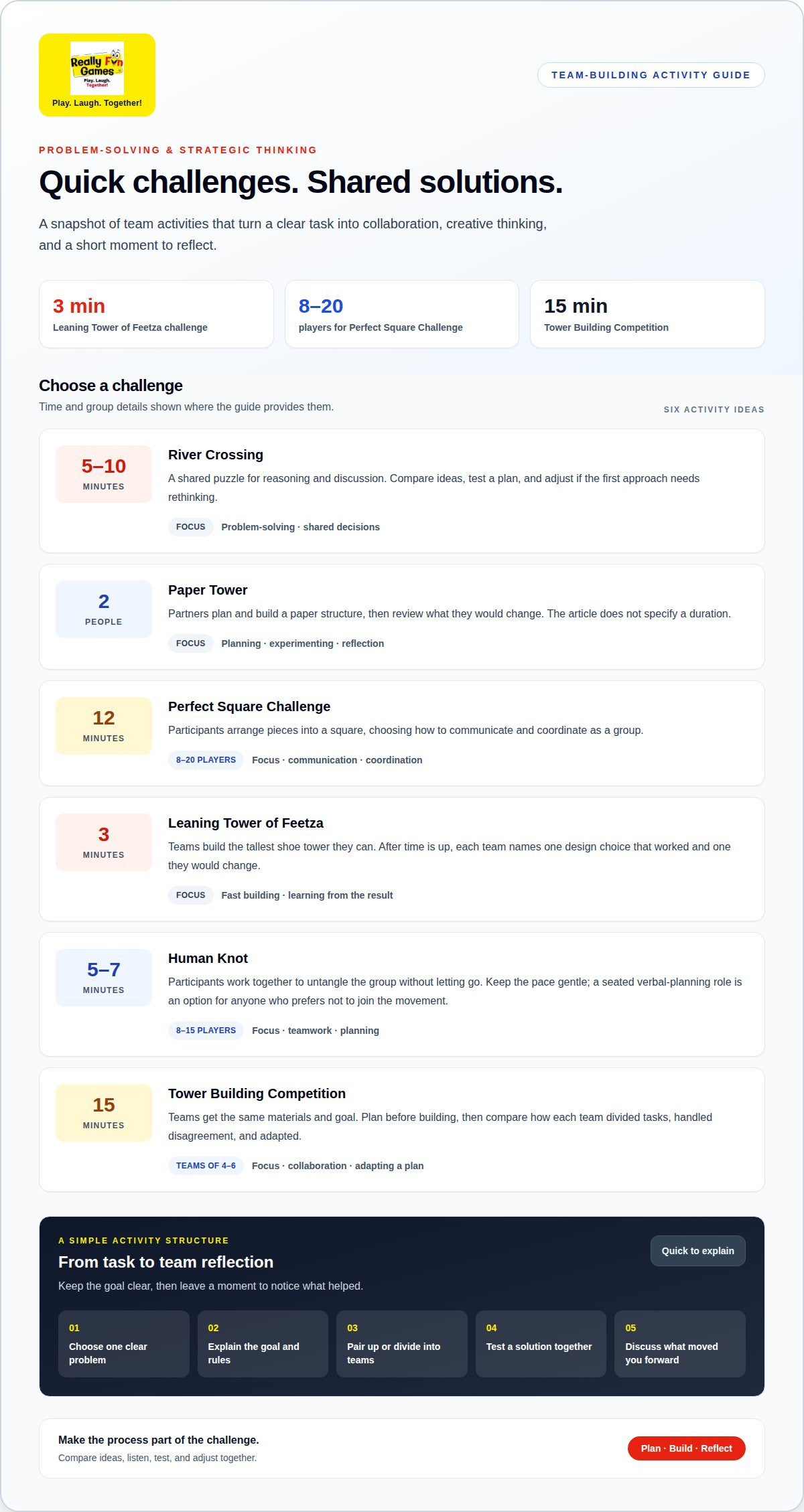
A focused challenge gives a team something concrete to solve together. The goal isn’t simply to finish first. It’s to compare ideas, test a plan, and notice how the group responds when its first approach needs adjusting. River Crossing, for example, takes 5-10 minutes and turns a shared puzzle into a quick exercise in reasoning and discussion.
Creativity challenges work best when the task is clear but the path to a solution is open. In Paper Tower, two people work together to build a structure from paper. Ask partners to sketch a plan, build, and then review what they would change. The thinking matters as much as the final tower: one person might suggest a wide base while another tests a folded-paper design.
For a larger group, try Perfect Square Challenge. It takes 12 minutes and is intended for groups of 8-20 players. Give everyone a role in arranging the pieces into a square, then let the group decide how to communicate and coordinate. This format makes collaboration visible: participants can share suggestions, listen for patterns, and adjust the plan together.
How do you run a quick team-building activity step by step? Choose one clear problem, explain the goal and rules, and pair participants or divide them into teams. Set the task, invite groups to test a solution, then wrap up with a short discussion about which idea helped them move forward.
For a fast build-and-improve challenge, use Leaning Tower of Feetza: teams try to build the tallest shoe tower in 3 minutes. Before starting, clarify the success measure, such as height while standing. After time is up, ask each team to name one design choice that worked and one they’d change. That brief conversation turns a playful contest into practical reflection.
The Human Knot adds movement to collaborative problem-solving. It takes 5-7 minutes and is intended for groups of 8-15 players. Participants form a circle, take hands across the group, then work together to untangle without letting go. Keep the pace slow and gentle, especially with children, and offer a seated verbal planning role for anyone who prefers not to join the physical activity.
For a more structured building task, Tower Building Competition takes 15 minutes and uses teams of 4-6 people. Give each team the same materials and goal, then ask them to plan before building. A quick comparison afterward can reveal how teams divide tasks, handle disagreement, and adapt when their first design doesn’t work. These small observations make problem-solving feel useful well beyond the challenge.
3. Icebreakers and get-to-know-you games
A good icebreaker gives team members an easy way to learn something specific about one another. Truth Or Lie takes about 15 minutes for participants to discuss each other’s statements. Each person shares two true statements and one false statement, then the group guesses which detail is made up. Keep the conversation playful by inviting people to share only what feels comfortable.
For creativity and innovation, try Passions Tic Tac Toe, which takes 15-30 minutes. Create a grid of interests, such as favorite foods, creative hobbies, or places people enjoy visiting. Participants mingle to find teammates who match each square, then compare discoveries. The activity encourages movement and conversation while helping people spot unexpected connections.
For a particularly quick option, try Common Ground Challenge: small groups have three minutes to find something unexpected they share. Ask them to skip obvious answers, such as working for the same organization. A shared love of baking, a favorite childhood game, or a knack for remembering song lyrics can prompt laughter and start a fresh conversation.
Salt and Pepper is another low-prep choice: pair participants and ask them to find three things they have in common or three interesting facts about each other. This simple exchange helps quieter team members join in without performing for the whole room. Partners can then introduce each other by sharing one detail they learned.
For an indoor game with a larger group, Four Corners Icebreaker takes 8-10 minutes and suits groups of 12-40 players. Label each corner with an answer to a light prompt, such as a preferred weekend activity. Participants move to their chosen corner, then talk with others who picked the same option. Offer a seated way to participate for anyone who can’t move between corners.
Commonalities Hunt suits small groups of 4-6 people and takes 10 minutes. Give each group a short prompt to discover shared interests, then invite them to report one surprising find. No special props are needed. For siblings, adapt Salt and Pepper by asking them to uncover three shared interests or family memories; the same format works indoors during a rainy afternoon.
Choose a format that suits the energy you want: Passions Tic Tac Toe gets people mingling, while Four Corners makes group choices visible. A short debrief can reinforce teamwork. Ask which answer surprised them and which follow-up question led to a meaningful conversation. This final step can turn a light icebreaker into a useful way to learn how people connect.
4. Icebreakers for quick group participation
A five-minute icebreaker can help a group switch gears before a meeting or shared task. Keep setup under 2 minutes, explain the activity in a few direct sentences, and start promptly. A clear first turn helps members understand what to do without a long introduction. For a quick warm-up, ask everyone to share one small thing that made them smile today.
Would You Rather (Team Edition) takes 5 minutes and works with groups of any size. Leaders read a choice, such as “plan a picnic or explore a new city?” Participants answer aloud, raise a hand, or use chat. Invite two people with different answers to explain their picks. The short conversation lets members learn how teammates make everyday choices.
Two Truths and a Lie (Sports Edition) also takes 5 minutes and suits groups of any size. Each participant shares two true sports-related statements and one false statement. Teammates guess the false detail, then the speaker reveals the answer. People who don’t follow sports can choose another shared theme, such as favorite foods or outdoor activities.
For a more active prompt, Group Order takes 5-10 minutes and is designed for groups of 5 or more. Ask participants to arrange themselves by a friendly category, such as favorite season, without speaking. Once they finish, let each person say their answer. This quick challenge encourages observation and nonverbal communication without putting anyone on the spot with a personal story.
Line Up Challenge takes 3-5 minutes and is intended for groups of 8-30 players. Ask everyone to form a line by a simple, non-sensitive category, such as the first letter of their first name. Afterward, participants can introduce themselves and compare the order. For seated or remote groups, have members type their answers and arrange names together on screen.
Sync Claps takes 5-10 minutes and gives a group a lively rhythm to share. One person starts a clap, and the next person repeats it before adding a new pattern. Keep the sequence simple at first, then let members take turns leading. Build-a-Shake also takes 5-10 minutes: each participant adds one movement, and everyone repeats the growing sequence.
Quick Trivia Round uses five to ten fun questions to give participants a shared topic without requiring personal disclosures. Try questions about movies, animals, or everyday objects, and let teams discuss before answering. Choose Would You Rather for conversation, Sync Claps for movement, or trivia for group thinking. Matching the activity to the room’s energy and available time helps it feel like a good fit.
5. Trust and connection-building exercises
Trust exercises work best when participants can communicate, make choices, and respect one another’s boundaries. Teams facing tension can use structured activities to rebuild trust, while cross-functional groups can use them to get comfortable working together. Start with a simple agreement: listen without interrupting, give directions clearly, and let each person choose how to participate. This gives the activity a practical purpose.
Minefield Navigation takes 10 minutes and is designed for pairs within groups of 4-20 people total. Set out imaginary obstacles, or use safe, visible markers in a clear space. One participant gives verbal directions while their partner follows a route, then they switch. Keep the route simple and let the listener pause or ask for directions again. The exercise shows how trust grows through clear communication and responsive guidance.
Blind Maze takes 20-30 minutes and puts communication at the center of a shared challenge. Before starting, explain the route and agree on the guide’s role. The person navigating can keep their eyes open while relying on a partner’s directions, making the activity an option for groups that don’t want blindfolds. Afterward, ask which words helped most and how the guide responded when the route changed.
A trust walk can be low-pressure, too: pair participants for a short walk along a familiar route. One partner chooses the pace and points out details while the other listens and asks questions, then they swap roles. Remote or hybrid teammates can have a similar exchange by describing a familiar place or sharing a brief guided tour on camera. The shared focus invites conversation without requiring personal disclosures.
Try a Trust Lean Circle only if everyone feels comfortable taking part. Explain the steps before forming a circle, and make opting out an ordinary choice rather than a special request. Participants can observe or help facilitate instead. This matters because connection comes from choice and mutual respect, not pressure. A brief check-in afterward can explore what made support feel dependable.
Close any trust activity with a specific reflection. Ask each pair to name one direction that was helpful, one moment they adjusted, and one behavior they’d carry into their next project. For Minefield Navigation, that might be shorter instructions or a clearer pause signal. To continue the conversation through play, explore conversation games for groups that invite people to listen, share, and learn about one another.
Really Fun Games: Really?! Think You Know Me? Guess Again
Really?! Think You Know Me? Guess Again gives groups a playful way to spark conversation and discover how well they know one another. It’s a natural next step when a team wants connection beyond a single activity, with questions that invite people to share, listen, and laugh together. Play it at a team gathering, family game night, or another get-together where people want to know each other better.
For a more vocal, laughter-filled change of pace, Triple Tongue Twisters offers a different kind of shared play. Really Fun Games also offers Tricky Tetra Tongue Twisters and Blooming Tongue Twisters. These games are designed for ages 8 and up and support communication, teamwork, and social skills through play. Visit Really Fun Games online to explore games for your group.
Make Your Next Group Moment Count
Quick team building activities for groups can be more than a break in the schedule. They can start better conversations, fresh ideas, and shared moments that carry into the next project or gathering. Choose an activity with a simple goal, then leave room for everyone’s humor and perspective. The best next step is one your group feels ready to enjoy together.
Keep the spirit of play going with a conversation game, a silly verbal challenge, or a prompt that helps people learn something new about one another. Whether you’re planning for colleagues, students, friends, or family, a welcoming activity gives everyone a way to join in and connect at their own pace.
Ready to find a playful fit for your group? Explore the Really Fun Games collection and choose a game for your group. Here’s to more laughter, conversation, and connection.
Frequently Asked Questions
What Are Team-Building Exercises?
Team-building exercises are structured group tasks that let people practise working toward a shared outcome. Use one in a meeting to explore how teammates share information, make decisions, or respond to different ideas. For example, ask a group to sort fictional project priorities and explain its choices. The goal isn’t a perfect ranking: it’s to make the reasoning visible and hear how colleagues approach the same problem.
What are quick team-building activities for groups?
Quick team-building activities are brief shared tasks that get people interacting without taking over the schedule. Rock, Paper, Scissors Tournament takes 5-10 minutes and can bring a playful burst of energy to a group gathering. Follow it with a simple prompt, such as asking what helped someone decide when to play. That small reflection connects a game’s quick choices to everyday collaboration without turning the activity into a formal meeting.
What are 5-minute team-building games for coworkers?
Speed Ball Name Game takes 5 minutes and is intended for groups of 10-25 players. Use it as a lively name-learning round: invite coworkers to say their names clearly as the game moves around the group. Then ask participants to share one work-related strength they appreciate in a teammate. The name activity gets people focused on one another, while the follow-up helps colleagues notice contributions they may not discuss during routine meetings.
What are low-cost or free team-building activities?
Conversation-based activities can bring coworkers together without special equipment. Invite each person to share a helpful work tip, a favorite way to organize tasks, or one skill they’d like to learn from a teammate. You could also brainstorm ways to improve a familiar process. Use a whiteboard if available, or collect ideas aloud. Keep the prompt specific so the discussion stays welcoming and useful.
What materials are needed for quick team-building games?
Materials depend on the activity. Conversation games may need nothing beyond a clear prompt and someone to guide the turns. For a drawing or idea-sharing exercise, set out paper and pens; a visual timer like Timeqube can help keep a short session on track without distracting participants. Movement games need enough clear space for everyone to participate comfortably. Prepare instructions in advance and gather only the materials the activity actually uses.