
The loudest laughter in your living room usually happens right after someone’s tongue gets completely tied in a knot. It’s that magical moment where a simple sentence turns into a hilarious jumble of sounds, breaking the ice and bringing everyone closer together. If you’ve been searching for a way to ditch the tablets and spark some genuine connection, our massive collection of silly tongue twisters is the perfect spark for your next family gathering. These playful verbal puzzles do more than just cause giggles; they’re powerful tools for building confidence and mastering the fine art of clear speech.
We know it’s tough to find activities that feel like pure fun while secretly helping your child develop vital communication skills. You want your kids to feel bold and articulate, but traditional speech practice often feels like a boring classroom chore. In this guide, we promise to show you how to turn vocal play into a high-energy event that everyone loves. We’ll provide a fresh list of funny phrases, expert game-night tips, and creative ways to use award-winning sets like Triple Tongue Twisters to create lasting memories. Get ready to transform your home into a hub of exuberant joy and clearer conversation.
Key Takeaways
- Discover how “vocal hurdles” build empathy and confidence by turning speech mistakes into moments of shared family laughter.
- Explore a fresh, categorized mega-list of silly tongue twisters designed to spark imagination with absurd imagery and tricky alliteration.
- Master the art of hosting a home “Twister Tournament” with practical tips on using timers to add a competitive edge to your next game night.
- Learn why speech therapists use these playful rhymes to help kids sharpen articulation and master difficult sounds like sibilants and plosives.
- See how award-winning card games like Triple Tongue Twisters offer a professional, screen-free upgrade for travel and social gatherings.
The Magic of Silly Tongue Twisters: Why We Love Verbal Chaos
Imagine a verbal obstacle course where the goal isn’t just to finish, but to trip over your own words with a massive smile. That’s the heart of silly tongue twisters. While a traditional Tongue twister is often seen as a dry exercise in diction, these modern, whimsical variations are deliberate vocal hurdles designed for pure joy. They replace boring repetition with absurd imagery, like llamas in pajamas or bears eating pears, making the act of speaking an adventurous game.
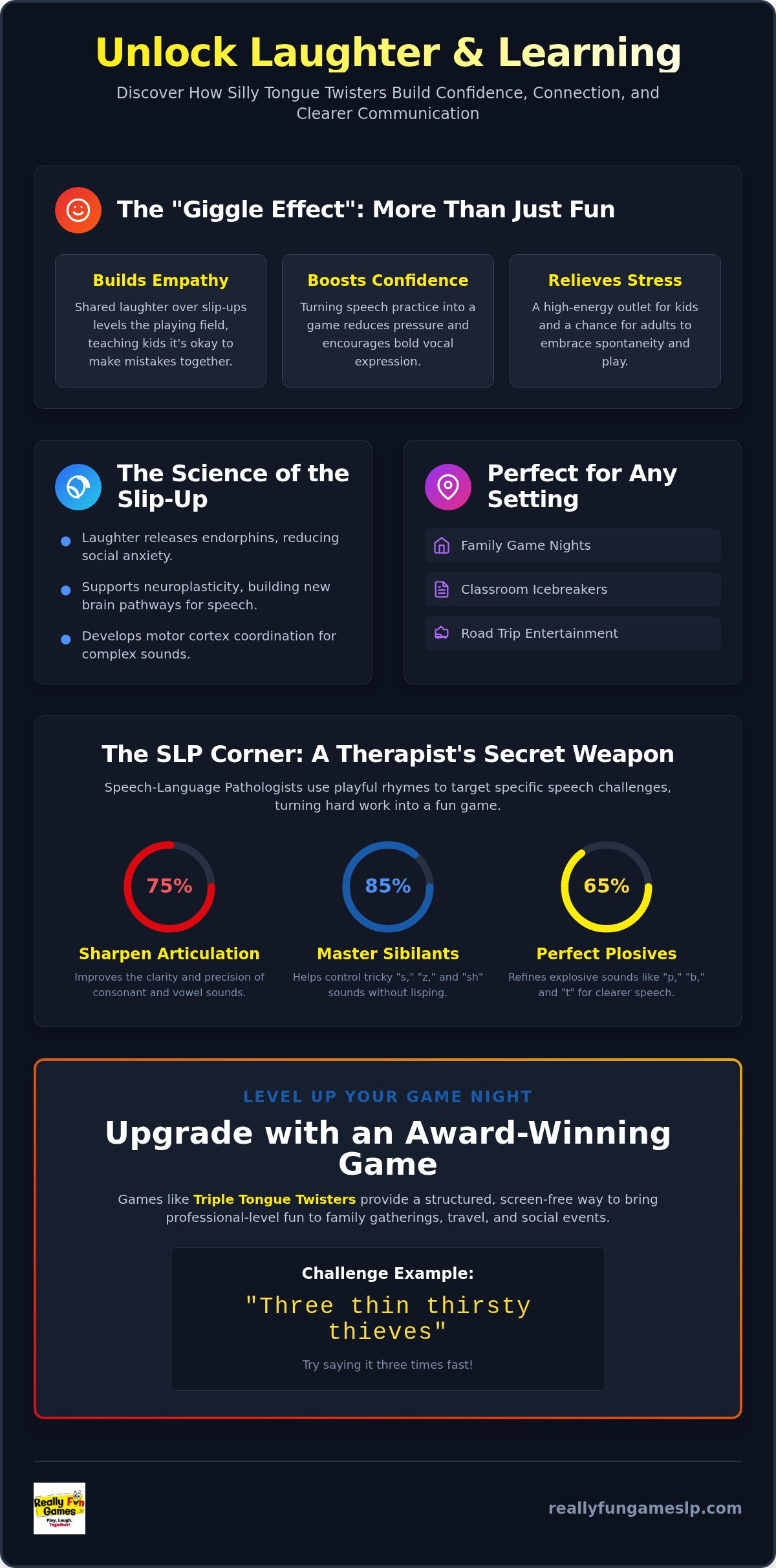
We call this the “Giggle Effect.” It’s that contagious burst of laughter that erupts when a confident speaker suddenly gets tangled in a jumble of sounds. This shared failure actually builds deep empathy between parents and children. When a child sees an adult struggle to say a phrase correctly, it levels the playing field and reduces the pressure to be perfect. It’s a celebratory moment of human connection that says it’s okay to make mistakes as long as we’re laughing together.
These rhymes have evolved significantly since their classic 19th-century origins. We’ve moved beyond simple alliteration to “vocal play,” which serves as a powerful stress-reliever for both kids and adults. For children, it’s an outlet for high-energy expression. For adults, it’s a chance to drop the serious facade and embrace spontaneity. This shift toward silliness ensures that speech practice never feels like a chore, but rather a highlight of the day.
The Science of the Slip-Up
Our brains process complex phonemic sequences by planning several sounds ahead. When we hit a “slip-up,” it’s often because our motor cortex is moving faster than our vocal cords can keep up. Interestingly, laughter during these errors releases endorphins that actively reduce social anxiety. This process also supports neuroplasticity, as the brain works to find new pathways for difficult sounds, turning a funny mistake into a building block for better speech development.
Tongue Twisters for Every Setting
You can bring this energy anywhere. Teachers use these as classroom icebreakers to wake up sleepy brains and build teamwork. Families find them to be the perfect screen-free activity for long road trips, turning miles of highway into a theater of laughter. Even speech-language pathologists (SLPs) use this silliness to mask the hard work of articulation therapy. By using award-winning tools like Triple Tongue Twisters, therapists can help kids master sibilants and plosives while the children think they’re just playing a fun card game.
A Mega-List of Silly Tongue Twisters for Kids and Families
Ready to dive into the verbal chaos we discussed earlier? This curated collection of silly tongue twisters moves beyond the dusty classics and into the realm of modern, absurd fun. We’ve organized these by difficulty so you can warm up your vocal cords before tackling the real brain-tanglers. Whether you’re at the dinner table or in the car, these phrases are guaranteed to spark a chain reaction of giggles.
Short and Silly: Quick Giggles for Beginners
Short phrases are the best way to build immediate confidence because they offer a quick win before the laughter takes over. These are perfect for younger children who are just starting to explore vocal play. Try these bite-sized challenges:
- Selfish shellfish.
- Toy boat, toy boat, toy boat.
- Happy hippo hopped.
- Fresh fried fish.
Animal Antics: Absurd Alliteration
Kids love imagery, and nothing sticks in the mind quite like a ridiculous animal scenario. When a child visualizes a snail sliding or a bear with no hair, they’re more likely to engage with the phonemes they’re practicing. This is one of the key educational benefits of tongue twisters, as it turns a speech exercise into a mental movie. Encourage your kids to act out the movements of the animals while they speak. It adds a layer of physical play that makes the learning stick.
- Six slippery snails slid slowly seaward.
- Funny fluffy finches flew fast.
- Precocious penguins popped purple popcorn.
- Triple Tongue Twister Challenge: Try saying “Three thin thirsty thieves” three times fast!
The “Impossible” Challenges: For Expert Twisters
Think you’re a pro? These complex sequences are designed to trip up even the most articulate adults. Use the “Repeat 5 Times” rule: if you can say these five times without a single stumble, you’ve earned your title as a Master Twister. These are the heavy hitters of silly tongue twisters that test your rhythm and pacing.
- Unique New York.
- Specific Pacific.
- The sixth sick sheik’s sixth sheep’s sick.
- Red lolly, yellow lolly.
- Triple Tongue Twister Challenge: Cooks cook cupcakes quickly!
Parents, don’t get too comfortable. You might find that your kids can out-twist you once they get into the rhythm. If you want to take this energy to the next level, our Triple Tongue Twisters game offers a professional upgrade to these lists. It provides endless variety for your next family game night and ensures your family games collection is always ready for a laugh.
Beyond the List: How to Host a Tongue Twister Challenge
Reading a list of phrases is a great start, but the real magic happens when you turn those words into a high-energy competition. We believe in moving beyond static reading and into a full-blown “Twister Tournament” right in your living room. Instead of just scrolling through silly tongue twisters, you can use them as the fuel for a vibrant family game night. This approach mirrors the social rewards found in our other award-winning games, like Really?! Think You Know Me? Guess Again!, where the goal isn’t just winning, but discovering something new about the people you love through shared laughter.
Setting the Stage for Success
To get started, you need to choose an environment that encourages spontaneity. Clear the dinner table, dim the harsh overhead lights, and get everyone’s energy up with a quick physical warm-up. If you’re looking for more ways to shake up your routine, check out these 5 Easy Family Game Night Ideas for Busy Weeknights. Every tournament needs a “Judge” to keep things moving. This person doesn’t just listen for mistakes; they look for the most enthusiastic effort and the boldest delivery. You can find excellent source material for your rounds by checking out tongue twisters for kids from Reader’s Digest, which features phrases that even professional speech experts enjoy using.
The “Twist and Shout” Game Rules
We recommend a three-round structure to keep the momentum building. Round 1 is the Warm-Up, where players choose an easy phrase and must say it clearly twice. Round 2 is the Speed Demon. Pull out a smartphone timer and see how many times a player can repeat a phrase in 15 seconds. This adds a competitive edge that keeps everyone on their toes and usually leads to the most hilarious verbal jumbles. Round 3 is the Triple Threat. This is where you bring out the complex, professional-level challenges found in games like Triple Tongue Twisters, forcing players to navigate multiple tricky sounds in a single breath.
Forget boring points for perfection. We suggest a creative scoring system that rewards the “Giggle Effect” over flawless articulation. Give extra “Harmony Points” for the funniest slip-up or the best recovery after a stumble. When you prioritize connection and confidence rather than the fear of making a mistake, you create a space where kids feel safe to be bold. It turns a simple speech exercise into a memory-making event that your family will ask for week after week.
The SLP Corner: Why Speech Therapists Love Silly Rhymes
Speech-language pathologists (SLPs) have a secret weapon in their toolkit, and it’s often hidden behind a fit of giggles. While we’ve explored how these phrases create family bonds, the professional benefits are equally transformative. Using silly tongue twisters in a therapeutic setting allows children to practice complex phonological patterns without the pressure of a clinical drill. It turns the hard work of mastering sibilants, plosives, and fricatives into a rewarding game of vocal dexterity. For many therapists, these rhymes are essential for building phonological awareness and improving overall speech clarity.
We know that repetition is the key to progress, but traditional drills can quickly become monotonous. By introducing a “fun-loving facilitator” energy into the session, therapists can keep engagement high. If you’re looking for professional resources, don’t miss our Best Educational Games for Speech Therapists: 2026 Guide to see how we’re changing the game in clinics and classrooms alike.
Targeting Specific Articulation Goals
Precision is everything in speech development. SLPs often select specific twisters to target problem sounds, such as using “S” heavy phrases for lisp correction or “R” sounds to improve rhoticity. Silliness bypasses the resistance some kids feel toward therapy. When a child is focused on the absurd image of a “red lolly” or a “yellow lolly,” they’re less likely to overthink their tongue placement. This makes silly tongue twisters an ideal addition to IEP goals or classroom literacy centers where kids can practice in a low-stakes, high-reward environment.
Confidence and Public Speaking
Vocal play does more than just sharpen sounds; it prepares kids for the real world. Mastering a difficult phrase builds a sense of pride that carries over into classroom presentations and social interactions. By reducing the fear of making mistakes in front of peers, kids learn that a slip-up isn’t a failure, it’s just part of the process. You can read more about this journey in our article on How Tongue Twister Games Improve Speech, Confidence, and Family Fun. This confidence is the foundation of effective communication and leadership skills.
Ready to bring these professional-grade benefits into your home or classroom? Explore our full collection of award-winning card games to find the perfect match for your next session or family game night. Whether you’re a parent or a professional, we’re here to help you make communication the most joyful part of your day.
Level Up with Triple Tongue Twisters: The Ultimate Card Game
Online lists are a fantastic starting point, but they’re really just a teaser for the main event. If you want to move from a quick vocal warm-up to a full-blown family tradition, it’s time for a professional upgrade. Triple Tongue Twisters takes the concept of silly tongue twisters and transforms it into a high-energy, high-stakes card game. It fits right in your pocket. It’s built for those who want more than just a random phrase; it’s for families who want a durable, replayable way to spark instant joy.
What Makes Triple Tongue Twisters Different?
Unlike a printed list that gets lost under the couch cushions, these cards are designed to survive years of enthusiastic play. The unique “Triple” mechanic challenges players to navigate three distinct vocal hurdles in a single breath, creating a level of replayability that static lists can’t match. It forces players to think on their feet, building the social connection that is the heart of the Really Fun Games philosophy. This isn’t just about saying words correctly; it’s about the exuberant excitement of a shared challenge. Our award-winning design is inclusive, making it accessible for kids as young as 8 and adults as wise as 108. It’s the perfect screen-free solution for travel, family reunions, or even as a quick icebreaker before dinner.
Expanding the Fun
Mastering the basics is only the beginning of your vocal journey. Once your family becomes a group of articulation experts, you can move on to even more complex titles like Tricky Tetra Tongue Twisters to keep the challenge alive. You can even bundle these games together to create the ultimate family communication toolkit. These sets make incredible gifts for speech-language pathologists, teachers, and any family looking to ditch the tablets for some genuine human connection. By choosing these tools, you’re not just buying a game; you’re investing in a catalyst for harmony and laughter. You’re giving your kids the gift of confidence through silly tongue twisters and playful competition.
Don’t let the verbal chaos stop here. You can Discover our full collection of award-winning games and find the perfect addition to your next game night. Whether you’re targeting specific speech goals or just want to see your grandfather get tongue-tied over a phrase about purple penguins, we have exactly what you need to make your next gathering unforgettable.
Ready to Ignite Instant Family Joy?
We’ve explored how verbal chaos isn’t just about the giggles; it’s a powerful way to build confidence and connection. Whether you’re using our mega-list for a quick laugh or hosting a full-blown living room tournament, you’re creating screen-free memories that last. You’ve seen how these vocal puzzles can bridge the gap between boring therapy and exuberant fun, making every slip-up a reason to smile. From targeting specific articulation goals in the clinic to sparking spontaneity at the dinner table, silly tongue twisters are the ultimate tool for joyful communication.
Our award-winning game series is trusted by professional SLPs and parents alike to turn speech practice into pure play. It’s time to bring everyone together for a game night that prioritizes laughter and human connection over perfection. Grab your copy of Triple Tongue Twisters and start the laughter today! Embrace the slip-ups, celebrate the stumbles, and let the joyful noise lead the way. Your next favorite family memory is just one tangled phrase away.
Frequently Asked Questions
What is the hardest silly tongue twister to say?
Many linguists and researchers point to “The sixth sick sheik’s sixth sheep’s sick” as one of the most difficult phrases in the English language. This particular phrase is a classic example of silly tongue twisters that challenge even professional speakers due to the rapid transition between “s” and “sh” sounds. While there are many contenders, this one consistently trips up the motor cortex, making it a favorite for those seeking an ultimate verbal challenge.
How do tongue twisters help with speech therapy?
Speech-Language Pathologists (SLPs) use these playful rhymes to target specific articulation goals, such as lisp correction or improving rhoticity. By focusing on difficult phonemes like sibilants and plosives within a fun context, children are more likely to engage in repetitive practice without feeling the pressure of a clinical drill. This low-stakes environment builds phonological awareness and strengthens the muscles used for clear speech, turning essential therapy work into high-energy silly tongue twisters play.
Are tongue twisters good for adults or just for kids?
These vocal hurdles are fantastic for all ages, from children to adults up to 108 years old. For adults, they serve as excellent icebreakers in professional settings and help maintain cognitive flexibility and speech clarity. They also act as a powerful stress-reliever, allowing grown-ups to embrace spontaneity and laughter during social gatherings. Whether you’re a parent playing with your kids or a professional warming up for a presentation, vocal play is universal.
How many times should you repeat a tongue twister for it to count?
While there’s no official rulebook, most enthusiasts follow the “Repeat 5 Times” rule to truly master a phrase. Saying it once is a great start, but repeating it five times at increasing speeds tests your rhythm and pacing. If you can complete the sequence without a single stumble, you’ve earned your title as a Master Twister. This repetition is key to building muscle memory and ensuring the sounds are articulated clearly every time.
What age are Really Fun Games tongue twister cards designed for?
Our collection, including Triple Tongue Twisters and Tricky Tetra Tongue Twisters, is specifically designed for players aged 8 to adult. This age range ensures that the vocabulary is accessible for young learners while remaining challenging enough for parents and grandparents. The award-winning design focuses on bringing generations together through play, making these cards a versatile tool for family game nights, classrooms, and professional speech therapy sessions across the country.
Can tongue twisters help with social anxiety in children?
Yes, they are a wonderful tool for reducing social anxiety by reframing “mistakes” as a source of shared laughter. When children see adults struggle and laugh at their own verbal slip-ups, it reduces the pressure to be perfect in group settings. This “Giggle Effect” builds empathy and confidence, helping kids feel more comfortable speaking in front of peers. It transforms the act of communication into a celebratory experience rather than a stressful one.
How do you win a tongue twister game night?
Winning is about more than just perfect articulation; it’s about enthusiasm and the spirit of play. In a Really Fun Games tournament, we suggest a scoring system that rewards the funniest slip-ups and the boldest delivery. You win by engaging with the group, recovering quickly after a stumble, and contributing to the high-energy atmosphere. The real victory is the deep connection and lasting memories built through shared laughter and screen-free interaction with your family.
Where can I buy Triple Tongue Twisters?
You can purchase Triple Tongue Twisters and our entire award-winning collection directly from the official Really Fun Games website. Our product line features a variety of titles like Blooming Tongue Twisters and Santa’s Tongue Twisters, which are perfect for any season or occasion. We serve customers nationally, ensuring that families, educators, and therapists across the United States have access to high-quality, durable card games that foster communication and joy through play.
