
What if the most profound conversation you have with your child this week doesn’t start with a serious talk, but with a fit of uncontrollable laughter? We’ve all experienced those quiet dinner nights where "fine" is the only answer you get and glowing screens seem more interesting than the person across the table. It’s tough to feel disconnected from your family, but using intentional games for better family communication can change everything. You aren’t alone in wanting something deeper than one-word answers. The solution is often found in simple, joyful play that invites everyone to the table—whether you’re exploring a creative kitchen hack from So Yummy or dealing a round of cards, these shared activities are the key to breaking the silence.
Discover how structured play and award-winning conversation games can transform your family’s dynamic from "okay" to truly meaningful. This guide explores how tools like Really?! Think You Know Me? Guess Again! and Triple Tongue Twisters build social confidence and spark those "I never knew that about you" moments. We’ll look at ways to improve articulation, boost critical thinking, and create laughter-filled nights that your kids will actually look forward to every single week. Get ready to turn screen time into team time and build bonds that last a lifetime.
Key Takeaways
- Learn how games create a safe “third space” where kids feel comfortable moving past one-word answers to share their real thoughts.
- Discover how to use games for better family communication to build your child’s articulation and public speaking confidence through lighthearted vocal play.
- Understand why structured card games offer deeper storytelling anchors than simple DIY icebreakers for families who want to bond.
- Find practical ways to integrate 15-minute play sessions so you don’t feel overwhelmed by a busy schedule.
- Explore the benefits of physical, award-winning games that prioritize eye-to-eye laughter over the isolation of digital screens.
The Power of Play: How Games Transform Family Communication
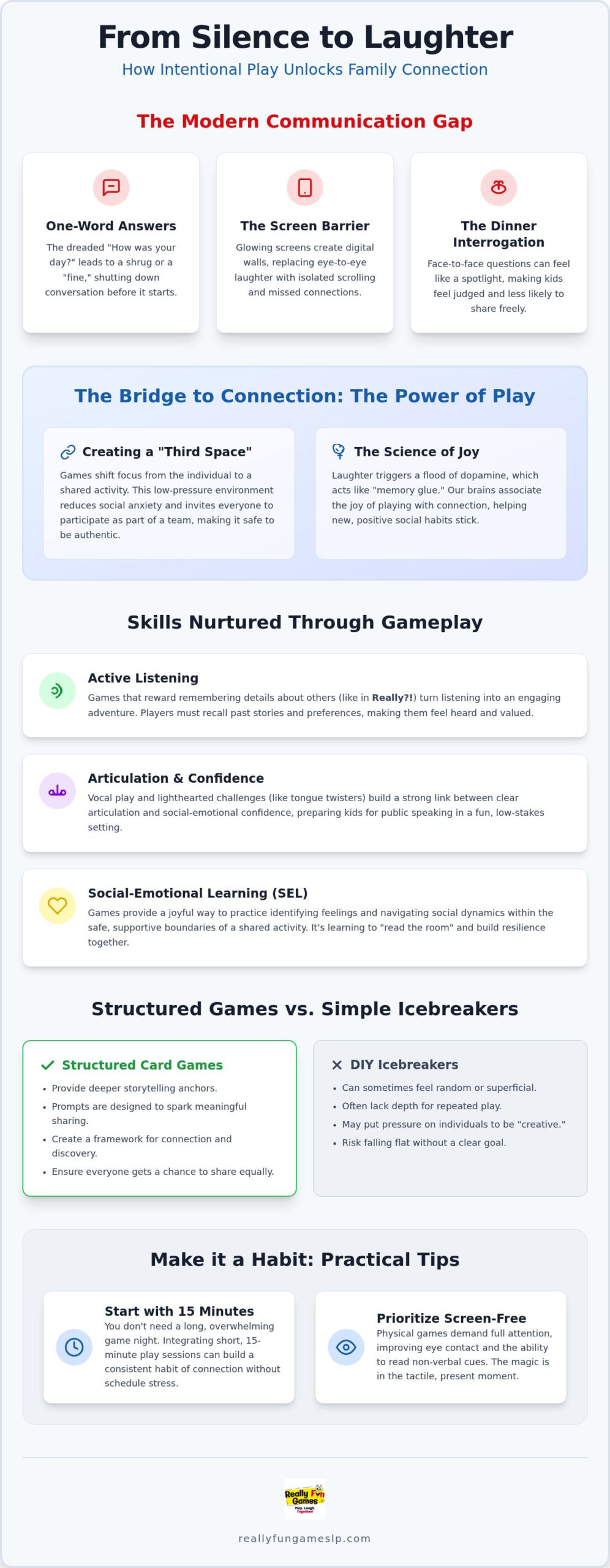
Connection isn’t something that just happens. It’s a skill we build together, one laugh at a time. For many families, finding the right games for better family communication is the missing piece to solving the puzzle of silence. Communication thrives in a low-pressure environment where everyone feels safe to be themselves. When we play, we enter a "third space." In this space, the focus shifts from the pressure of the individual to the excitement of the activity. This shift naturally reduces social anxiety because you aren’t on the spot; you’re just a valuable part of the fun.
Social-emotional learning (SEL) through family games is the joyful practice of identifying feelings and navigating social dynamics within the safe, supportive boundaries of a shared activity. It’s science in action. Laughter triggers a flood of dopamine, which acts like a "memory glue." This neurochemical reaction helps new social habits stick because our brains associate that connection with pure joy. Exploring various Conversation games can provide the perfect framework for this growth. Research shows that pairs who take turns answering increasingly personal questions report greater feelings of closeness than those engaging in ordinary small talk, proving that the right prompts can bridge any gap.
Why Traditional "Talks" Often Fail
We’ve all been there: the dreaded dinner table interrogation. Asking "How was your day?" often feels like a chore to a child, leading to the classic one-word shrug. This face-to-face pressure can shut down even the most talkative kids. They feel like they’re under a spotlight, being judged for their answers. Structured prompts are the secret sauce here. They provide a bridge between silence and storytelling, turning a forced interview into a natural discovery where everyone feels invited to share without the fear of getting it wrong. Research shows that when parents actively engage in these playful interactions, their children develop stronger social skills and emotional resilience.
The Benefits of Screen-Free Interaction
Putting down the phone is the first step toward real presence. In a world of constant notifications, physical card games demand our full attention and reward it with genuine warmth. This screen-free time improves eye contact and helps us pick up on subtle non-verbal cues we usually miss when staring at a glass rectangle. There’s a unique magic in tactile play. Holding physical cards, feeling the texture of the game pieces, and seeing the genuine expressions of your loved ones builds a sense of belonging that digital apps simply can’t replicate. If you’re ready to start, check out our games to find your next family favorite.
Active Listening and Articulation: The Building Blocks of Connection
Communication is a two-way street. It involves a delicate balance between expressing your own thoughts and truly absorbing what others are saying. While many focus on the "talking" part, the "listening" part is where the real connection happens. By choosing the right games for better family communication, you can help your children develop the patience to wait, the focus to listen, and the confidence to speak clearly. This isn’t just about following rules; it’s about learning to "read the room" and understand how tone of voice changes the meaning of a sentence.
Mastering the Art of Active Listening
Active listening is a superpower that kids can practice every single time they play. Games that reward players for remembering specific details about their family members are particularly effective. For example, Really?! Think You Know Me? Guess Again! turns listening into a high-stakes adventure. When players have to guess how a family member would answer a specific prompt, they are forced to recall past stories and preferences. This turns a simple guessing game into a deep listening exercise. To level up the experience, try the "Repeat and Reflect" method. During gameplay, ask players to briefly summarize what the previous person said before taking their own turn. This simple habit ensures everyone feels heard and valued. You can find more strategies for Practicing Social Skills During Family Game Night to help your family grow closer through intentional interaction.
Vocal Play and Speech Development
Confidence often starts with the voice. There is a strong link between clear articulation and social-emotional confidence. When a child knows they can be understood, they are more likely to speak up in class or share their feelings at home. Vocal play turns this development into a riot of laughter rather than a dry lesson. Tongue twisters are a staple in speech therapy because they challenge the mouth to move in precise ways, building muscle memory and clarity. Using a tool like Triple Tongue Twisters allows kids to master pronunciation without it ever feeling like "homework."
These activities help children understand the mechanics of their own voices. They learn how to control volume, pace, and clarity while they’re caught up in the excitement of a challenge. This kind of playful practice builds a foundation for public speaking and everyday social success. If you’re looking for ways to bring more of this energy into your home, you might want to explore our collection of award-winning games designed to spark these exact moments of growth. By focusing on both the ears and the voice, you’re giving your family the tools they need for a lifetime of meaningful connection.
Conversation Starters vs. Classic Card Games: Which Works Best?
Many people start their journey toward better connection with simple DIY games like Charades. These activities are fantastic for a quick laugh and require zero equipment, making the barrier to entry non-existent. However, families often find that these games lack the long-term depth needed to sustain a whole evening of interaction. While DIY options are great icebreakers, professional games for better family communication offer a more robust roadmap for discovery. These structured tools—ranging from card decks to themed experiences like Murder Mysteries Inc—provide physical "anchors" that ground the conversation, ensuring the momentum doesn’t fizzle out after the first ten minutes. The Power of a ‘Talking Game’ lies in its ability to turn a standard Tuesday night into a masterclass in empathy and shared history.
Structured prompts act as a gentle handrail for the heart, guiding family members through personal stories without the fear of falling into awkward silence.
The Problem with "Open-Ended" Questions
Asking a teenager to "Tell me a story" is often met with a blank stare. It’s simply too broad. Without a specific target, the brain often shuts down under the pressure to be interesting. A structured game format provides a crucial safety net for shy family members. Instead of being put on the spot, they’re simply responding to a card or a prompt. This shift makes sharing feel like a choice rather than an obligation. High-quality card games also offer superior re-playability. While a DIY game might get old after a single round, a well-designed deck with hundreds of unique prompts keeps the energy fresh every time you clear the table.
Finding the Right Balance of Fun and Depth
The best games for families hit a sweet spot between lighthearted humor and genuine insight. If a game is too serious, it feels like therapy; if it’s too silly, it doesn’t build lasting bonds. Really?! Think You Know Me? Guess Again! masters this balance for ages 8 and up. Its unique "Guess Again" mechanic is a game-changer because it challenges assumptions. You might think you know your dad’s texting style, but the game encourages you to dig deeper and actually listen to the real answer.
Choosing the right game depends on your family’s unique personality. Consider these factors when making your choice:
- The "Cringe" Factor: Does the game feel natural or forced?
- Player Count: Can it handle a small group or a full holiday gathering?
- Time Commitment: Can you play a quick 15-minute round before bed?
If you have a house full of jokers, you might lean toward vocal play like Triple Tongue Twisters. If you have deep thinkers, you’ll want prompts that spark storytelling. For a deeper look at how to choose the right options for younger players, our guide to conversation games for kids is an excellent resource for parents and educators alike. You can explore a variety of these options in our games collection to find the perfect fit for your next family game night.
Practical Tips for Implementing Game-Based Communication at Home
Consistency is the secret ingredient to building lasting bonds. You don’t need a four-hour marathon to make a real impact on your family’s dynamic. Just 15 minutes of intentional play can rewire the mood of an entire day. When you use games for better family communication, the goal isn’t to finish the whole deck; it’s to start a connection. This small window of time creates a predictable safe space where everyone knows they’ll be heard and valued.
Avoid the "lesson" trap. If you announce a mandatory "Family Bonding Session," you’re likely to get eye-rolls from your teens. Instead, try leaving a game like Triple Tongue Twisters on the kitchen island or the coffee table. Let curiosity do the heavy lifting. When play feels like a choice rather than a chore, reluctant communicators are much more likely to jump in and share. This approach also helps bridge the generation gap. Grandparents often have the most vibrant stories, and a simple prompt can be the bridge that connects their history with a grandchild’s curiosity. For inspiration on structuring these moments without the overwhelm, check out these easy family game night ideas that work beautifully for busy schedules.
Creating a Screen-Free Routine
Think in "Game Moments" rather than just "Game Nights." While a dedicated weekly event is great, the most meaningful interactions often happen in the gaps of our busy lives. Keep travel-friendly games in the car for long drives or restaurant waits. To transition smoothly from screen time to game time, try a five-minute countdown. Swap the digital distraction for a physical card to signal a shift in focus. It’s about building presence in a world that constantly tries to pull us away from each other. You can shop our full collection to find the perfect portable companion for your family’s next adventure.
Handling Competition and Conflict
Conflict during play isn’t a failure; it’s a practice round for real life. Teaching good sportsmanship is a vital communication skill that helps kids navigate difficult social situations. If tension rises, use "silly" challenges to de-escalate the mood. Have the winner do a victory dance or the "loser" recite a tongue twister. In games like Really?! Think You Know Me? Guess Again!, a "wrong guess" is actually a win. It’s a perfect opportunity to say, "I didn’t know that about you! Tell me more." This turns a competitive moment into a discovery that strengthens your bond. By setting ground rules for "Kind Communication" early on, you ensure that every game night remains a source of joy and social harmony. Explore our games to see how we design for these exact moments of connection.
Elevate Your Connection with Really Fun Games
Real connection doesn’t happen behind a glass screen. It happens in the shared space between us, where eye contact, laughter, and genuine presence take center stage. Really Fun Games creates tools for these exact moments, focusing on tangible, physical interactions that digital apps simply can’t replicate. While screens often isolate us, our games for better family communication act as a magnet, drawing everyone back to the table for experiences that feel both spontaneous and deeply meaningful. We believe that the simplest social interactions have the transformative power to build lifelong bonds.
Our award-winning titles aren’t just designed for entertainment. They’re crafted by experts in social interaction to foster the skills that matter most. This is why you’ll find our decks in the hands of speech-language pathologists (SLPs), classroom teachers, and professional counselors as often as you’ll find them at a family dinner. Whether you’re a parent trying to break through a teenager’s silence, a grandparent sharing legacy stories, or a youth leader building teamwork, these games provide a versatile foundation for growth. The centerpiece of this mission is Really?! Think You Know Me? Guess Again!. It’s more than a card game; it’s a catalyst for storytelling that challenges what we think we know about our loved ones and replaces assumptions with true understanding.
Explore the Full Collection
The beauty of play is that it should be immediate. There’s no need to spend an hour reading a manual when you’re ready to connect. Our easy-to-learn rules ensure that you can start playing in minutes, keeping the energy high from the very first card drawn. From the fast-paced vocal challenges of Triple Tongue Twisters to our festive holiday-themed editions, there is something for every occasion and every personality. You can browse the complete Really Fun Games collection to find the perfect match for your family’s age range. Each game is a new opportunity to spark confidence and articulation while making memories that stick for years to come.
Join the Community of Play
Families across the country are rediscovering the joy of simply being together. They’re finding that the "Really Fun" promise is real: our games are easy to learn and incredibly hard to put down. This is about more than just winning a round; it’s about joining a community that values laughter, critical thinking, and social harmony. We invite you to step away from the notifications and step into a world of vibrant discovery. Are you ready to start the conversation? Explore our games here and choose the title that will transform your next gathering into something truly extraordinary.
Start Building Your Legacy of Laughter
Meaningful connection doesn’t have to feel like work. By choosing intentional games for better family communication, you’re trading screen-time silence for vibrant stories and shared discovery. We’ve explored how structured play reduces social anxiety, helps kids master articulation, and turns "fine" into a window into your child’s world. Whether you’re navigating a busy school week or a large holiday gathering, these moments of play are the building blocks of emotional resilience and social confidence.
Our award-winning card games are designed for ages 8 to 108+, ensuring that no one is left out of the fun. Trusted by educators and therapists nationwide, these tools make it easy to prioritize presence over notifications. It’s time to clear the table, deal the cards, and see what you’ve been missing. Discover the "Really Fun Games" collection and start connecting today!
The next great family memory is just one card away. Grab a game, invite the grandparents, and let the laughter begin!
Frequently Asked Questions
What are the best games for improving family communication?
Structured conversation card games and cooperative activities are the most effective tools for building connection. These games provide clear, engaging prompts that remove the pressure of coming up with something to say on the spot. Really?! Think You Know Me? Guess Again! is a top choice because it encourages deep storytelling through its unique mechanics. By focusing on discovery rather than just winning, these games for better family communication create lasting emotional bonds.
Can games really help children with social anxiety?
Yes, games provide a "third space" that shifts the focus away from the child and onto the activity. This redirected attention lowers the stakes of social interaction and makes sharing feel much safer. When children are caught up in the fun of a challenge, they often speak more freely without the paralyzing fear of judgment. It’s a gentle way to practice vital social skills in a supportive, low-pressure environment.
How do conversation games work for different age groups?
The best conversation games are designed to be inclusive, often targeting players from ages 8 to 108. For younger children, prompts focus on simple preferences and silly scenarios that spark imagination. For teens and adults, those same prompts can lead to deeper reflections on life experiences and personal values. This versatility allows everyone to participate at their own comfort level, ensuring that grandparents and grandchildren can connect over the same deck. If you want to explore age-specific options, our comprehensive guide to conversation games for kids in 2026 offers detailed recommendations for parents and educators.
Are there specific games that help with speech therapy and articulation?
Vocal play games and tongue twisters are specifically designed to improve articulation and vocal confidence. Triple Tongue Twisters is an excellent example used by educators to help players master precise mouth movements and clarity. These activities turn speech practice into a riotous game rather than a dry lesson. By focusing on speed and rhythm, kids build muscle memory and vocal strength without even realizing they’re learning a new skill.
How often should we have a family game night to see results?
Consistency is more important than the length of the session when you’re building new habits. Aiming for a "Game Moment" of just 15 minutes a few times a week can be more effective than a monthly marathon. This regular rhythm keeps communication channels open and makes sharing a natural part of your daily routine. Over time, these small windows of connection build a strong foundation of trust and understanding within the home.
What if my teenager refuses to participate in communication games?
Start by making play a low-pressure choice rather than a mandatory requirement. Leave a game like Really?! Think You Know Me? Guess Again! on a common table and start playing with another family member. Often, the laughter and curiosity generated by the prompts will naturally draw a reluctant teen into the conversation. Focus on the humor first, and let the deeper connections happen organically as they feel more comfortable and less interrogated.
Are these games suitable for large family gatherings or reunions?
Absolutely, many card games are designed to scale easily for larger groups and diverse settings. They act as perfect icebreakers for relatives who haven’t seen each other in a while, helping to bridge the gap between different generations. Using games for better family communication during a reunion ensures that the conversation moves past basic small talk. It creates a shared, joyful experience that everyone can participate in, regardless of how often they see each other.
Where can I find award-winning games for family bonding?
You can find a curated collection of award-winning titles specifically designed for connection at the Really Fun Games website. Our games are built on the principles of social harmony and inclusive play for all ages. Whether you need something for a classroom, a therapy session, or a holiday dinner, these games are crafted to spark joy and meaningful dialogue. Visit our online shop to explore our full range of connection tools.