

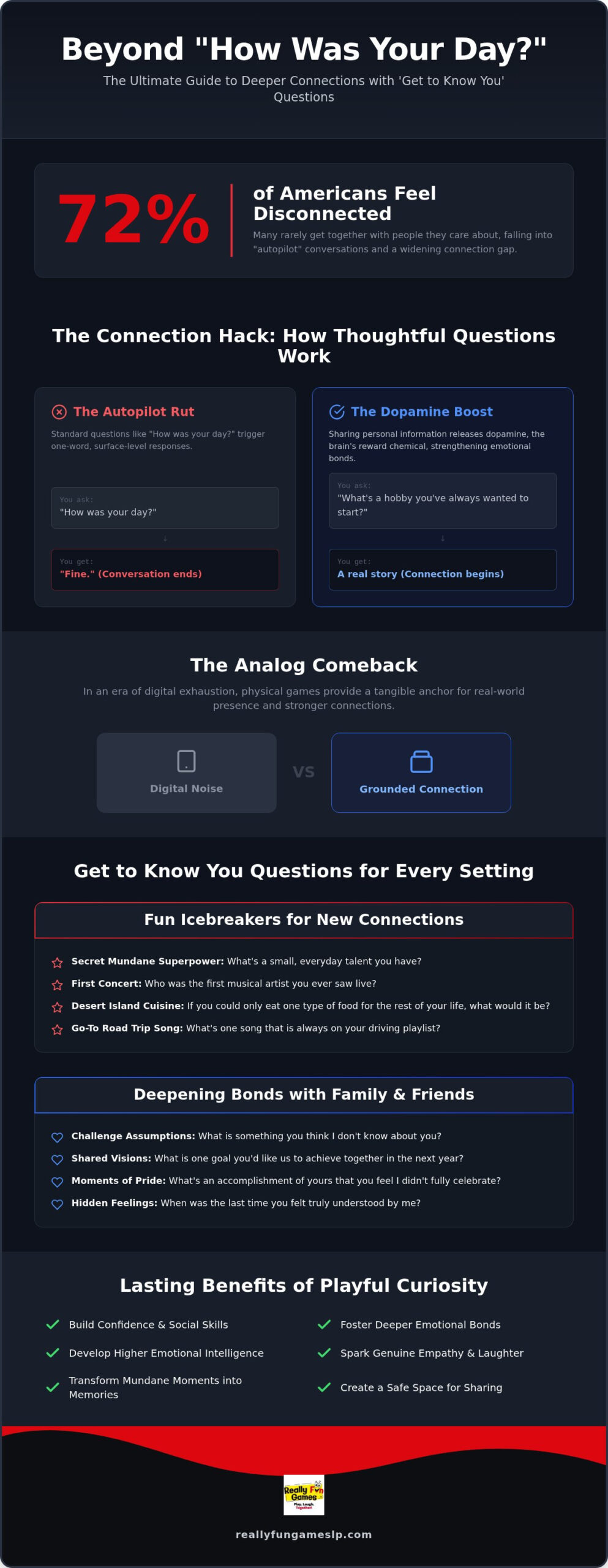
Did you know that 72% of Americans report they rarely get together with the people they care about? It is a startling reality in our fast-paced world, where we often find ourselves stuck in a "how was your day" rut or battling awkward silences during family dinners. You likely feel the weight of this disconnection, especially when trying to engage a quiet teenager or liven up a stagnant team meeting. Using the right get to know you questions can be the simple, powerful tool you need to break those barriers and start truly connecting again.
We believe that every interaction is an opportunity for joy and discovery. This guide offers a vibrant collection of 100 conversation starters with over 500 answers to guess from designed to turn mundane moments into meaningful memories for families, classrooms, and teams. You will learn how to bypass the boring stuff and dive straight into talk that builds confidence and fosters deep emotional bonds. We are going to explore creative prompts for every age group, practical tips for facilitators, and even some playful games that make connecting feel like the highlight of your week.
Key Takeaways
- Discover how the right prompts trigger dopamine and help you break out of the “autopilot” rut in your closest relationships.
- Access a diverse roundup of get to know you questions designed to spark life at family dinners, classrooms, and team-building events.
- Learn specific strategies for engaging kids and teens by tailoring your language to their unique developmental stages and interests.
- Transform standard conversations into competitive, laughter-filled activities using simple gamification techniques and phone-free zones.
- Understand the lasting benefits of physical game play for building real-world presence and stronger emotional bonds with those you love.
Why ‘Get to Know You’ Questions Are the Ultimate Connection Hack
Connection is a chemical reaction. It isn’t something that just happens by accident during a meal or a car ride. When we ask thoughtful get to know you questions, we trigger a neurological reward system. Neuroscientists have found that active listening and sharing personal information releases dopamine. This chemical creates a sense of pleasure and strengthens the bond between the speaker and the listener. It makes us want to repeat the experience. It makes us feel seen.
Most families and teams are currently living on autopilot. We fall into predictable routines where we assume we already know everything about our partners, children, or colleagues. This familiarity can lead to a connection gap where we stop being curious. Structured play acts as a hack to bypass this. It reduces the social cost of being vulnerable. When a question is part of a game, it doesn’t feel like an interrogation. It feels like an invitation to share a piece of yourself in a safe, joyful environment.
As we move through 2026, we are seeing a massive analog comeback. People are exhausted by digital noise and AI-generated interactions. After a 2026 report found that 72% of Americans rarely get together with the people they care about, families are looking for physical, screen-free ways to reconnect. Physical card games like "Really?! Think You Know Me? Guess Again!" provide a tactile anchor for these moments. They make the interaction feel more grounded and real than a list on a phone screen.
Moving Past the Small Talk Barrier
The standard "How was your day?" is a conversational dead end. It usually triggers a one-word response like "fine" because it doesn’t require any actual reflection. These closed-ended questions keep us stuck in a surface-level loop. By switching to open-ended get to know you questions, we encourage kids and adults to develop higher emotional intelligence. A high-quality prompt is a targeted invitation that bypasses the ego to spark genuine empathy and shared laughter.
The Power of Playful Curiosity
Humor is the ultimate social lubricant. It lowers our natural defenses and makes it safe to share things we might otherwise keep hidden. When we transition from an interrogation style of questioning to a spirit of discovery, the entire energy of the room shifts. You aren’t just looking for information; you are exploring another person’s world. This is especially effective in classrooms and therapy settings. Using games for better family communication helps maintain this lighthearted tone while doing the heavy lifting of relationship building.
The 2026 Roundup: Get to Know You Questions for Every Setting
One question can change the entire energy of a room. Whether you are meeting a new neighbor or sitting across from a spouse of twenty years, the right get to know you questions act as a bridge from surface-level chatter to genuine discovery. The magic lies in the intention behind the prompt. It is about creating a space where curiosity replaces judgment and laughter replaces tension.
In 2026, we are reclaiming the art of conversation. We are moving away from the "autopilot" responses that dominate our digital lives and leaning back into the warmth of real-time sharing. To help you lead the way, we have curated a collection of prompts that range from zany icebreakers to deep, reflective inquiries. These are designed to work in any environment, ensuring you are never left searching for something to say.
Fun Icebreakers for New Connections
First impressions don’t have to be stiff. When you are meeting new friends or hosting a social gathering, keep the stakes low and the rewards high. Focus on inclusive topics like food, travel, and fun questions that you don’t think to ask … that everyone can relate to. Here are some high-energy starters from the game ‘Really?! Think you know me? Guess again!’…all you have to do is guess the correct answer:
- These days, the superpower I’d love to possess is…
- invisibility
- superhuman strength
- healing power
- flying
- animal communication
- mind reading
- If I am alone and one of my favorite songs is playing, I …
- sing along
- sing & dance around
- silently enjoy
- recall pleasant memories
Deepening the Bond: Questions for Family and Old Friends
We often assume we know our closest friends and family members perfectly, but people are constantly evolving. There is a profound joy in re-discovering the people you have known for years. Use these prompts to challenge your assumptions and build shared visions for the future. For more inspiration, check out these easy family game night ideas to keep the momentum going.
- What is a goal I have that you think I will actually achieve this year?
- What is a memory of us that always makes you smile?
- If we could go on an adventure anywhere tomorrow, where would we go?
- What is one thing you have learned about yourself in the last year?
Classroom and Team Building Starters
In professional or educational settings, the goal is psychological safety. You want to foster a growth mindset where everyone feels comfortable contributing. Questions that focus on collaborative thinking and personal growth are incredibly effective here. Ask your team: "What is a mistake you are glad you made because of what it taught you?" or "What is one thing you are currently curious about?" These prompts turn a group of individuals into a cohesive, supportive team.
For managers leading remote groups, you can learn more about Jelly Donut Events to discover how virtual team-building experiences can bring these conversation-starting techniques to a digital environment.
If you want to take these lists to the next level, our award-winning game Really?! Think You Know Me? Guess Again! turns these moments of discovery into a fun card game with joyful challenge for everyone involved.
Tailoring Your Approach: Questions for Kids, Teens, and SLPs
Successful communication requires knowing your audience. If you ask a seven-year-old about their long-term career goals, you will likely get a blank stare. If you ask a teenager "how was school," you will probably get a one-word grunt. Effective get to know you questions must be tailored to the specific developmental stage and interests of the person you are talking to. This isn’t just about the vocabulary you choose; it is about the energy and respect you bring to the conversation.
For Speech-Language Pathologists (SLPs), educators, and counselors, these questions serve a dual purpose. They are clinical tools disguised as play. By incorporating "vocal play" through games like Triple Tongue Twisters, you can help children build confidence in their articulation and phonological awareness while they laugh. It turns a potentially stressful speech exercise into a social victory, which is especially helpful for bridging the generation gap during large holiday gatherings or family reunions.
Engaging the Youngest Minds (Ages 8-12)
At this age, imagination is the primary language of connection. You should use "silly" topics as a gateway to more meaningful communication. When a child feels safe being goofy, they are much more likely to share their real thoughts later on. Focus on imagination-based prompts that allow them to be the architect of their own world. Try asking these during your next car ride:
- If you could build a house out of any food, what would the roof be made of?
- What animal would be the funniest as your new school bus driver?
- If you were a superhero, what would your secret hideout look like?
- What is the best "first" you have ever experienced?
If you want to go deeper on this age group, explore our guide to the best conversation games for kids to find structured activities that turn these imaginative prompts into lasting learning moments.
Connecting with Teens and Young Adults
Teens value autonomy and authenticity. They can smell a forced "bonding moment" from a mile away, which often leads to the dreaded "cringe factor." To keep them engaged, your prompts must be relevant, fast-paced, and respectful of their opinions. Instead of asking them to report on their day, use questions that invite them to be the expert. Our award-winning game, Really?! Think You Know Me? Guess Again!, is a perfect solution for this age group. It makes teens feel heard and understood by shifting the focus from an interrogation to a challenge: how well do others actually know their thoughts? This competitive spark naturally leads to the deeper talk that builds lasting confidence.
From Lists to Laughter: How to Gamify Your Conversations
Static lists are just the start. To truly unlock the magic of get to know you questions, you need to turn the interaction into a game. This shift from passive listening to active participation is what creates those legendary "remember when" moments. By adding structure, you remove the awkwardness and replace it with a shared mission of discovery.
The "Guessing Game" format is the ultimate way to level up your talk. Instead of one person answering while everyone else waits their turn, have the group guess the answer first. This builds "competitive curiosity," a state where everyone is deeply invested in the speaker. It forces you to step into someone else’s shoes. Using tactile props like our Extra Number Dials adds a physical thrill that digital apps simply cannot match, building motor skills.
Engagement requires total presence. Create a strict "phone-free zone" before you start. Physical card games, like Really?! Think You Know Me? Guess Again!, act as a tactile anchor that keeps everyone’s attention on the people around them instead of a screen.
The ‘Think You Know Me?’ Challenge
The mechanic is simple: one person draws a card, reads it and everyone else uses a dial to guess their answer. When the reveal happens, the room usually erupts in either "I knew it!" or "Really?!" laughter. Scoring, even if it is just for bragging rights, increases focus and rewards those who truly pay attention to their loved ones throughout the year. Competitive curiosity strengthens social bonds by making the act of "knowing" someone a rewarding victory for the whole group.
Creating a Safe Space for Sharing
As the fun-loving facilitator, your job is to keep the energy light and inclusive. Always implement the "Pass" rule just in case. If a question feels too personal or someone just isn’t feeling it, they can pass without explanation. This safety net actually encourages more sharing because the social pressure is gone. If you hit a moment of silence or "crickets," don’t panic. Keep a few "silly" backup get to know you questions ready to reset the mood. A quick pivot to "What is the weirdest thing in your fridge right now?" can instantly bring the joy back.
Ready to transform your next gathering into a memory-making event? Discover the collection of award-winning conversation games and pick the perfect fit for your family.
Take the Guesswork Out of Fun with Really Fun Games
You have the strategy. You have the curiosity. Now you need the tools to bring it all to life. While digital lists of get to know you questions are a great starting point, they often lack the "spark" that turns a conversation into a shared adventure. This is where physical, award-winning card games step in to bridge the gap between just talking and truly connecting. We believe that the best memories aren’t made through a screen but through the joyful, tactile experience of playing together.
Our flagship game, "Really?! Think You Know Me? Guess Again!", is designed specifically to turn curiosity into a competitive sport. It isn’t just about the questions; it’s about the reveal. By using physical cards and number dials, players are forced to put down their phones and engage with the person right in front of them. This real-world presence is exactly what is missing from our screen-saturated lives. It turns a simple inquiry into a moment of genuine discovery that resonates long after the game is over.
For those who want to add a layer of high-energy vocal play, our "Triple Tongue Twisters" collection is a must-have. These games aren’t just for laughs, although there will be plenty of those. They serve as vital tools for teachers and speech-language pathologists (SLPs) to help students build confidence in their articulation and communication skills in a way that feels like pure entertainment. It is a celebratory approach to learning that makes every player feel like a winner.
Why Our Games Are Different
We believe that play should be accessible to everyone. That is why our games are built with a focus on ease of learning and high replayability. Whether you are eight or one hundred and eight, the mechanics are intuitive enough for anyone to join the circle. These are not games that sit on a shelf gathering dust. They are the "pro version" of your standard conversation starters, designed to be pulled out at every holiday gathering, classroom session, or family dinner. You can explore the full Really Fun Games collection to find the perfect fit for your specific group.
Ready to Start the Conversation?
The journey from awkward silence to unforgettable laughter starts with a single question. By embracing spontaneity and the power of play, you are doing more than just passing the time. You are building stronger emotional bonds and creating memories that will last far longer than any digital interaction. It’s time to stop overthinking and start discovering the wonderful, surprising things about the people you love most.
Don’t let your next family gathering fall into the autopilot trap. Visit our landing page today to choose the award-winning tools that will turn your next get to know you questions session into a night of pure, joyful connection. Let’s make every conversation a game worth playing!
Turn Small Talk Into Big Memories
The journey from surface-level chatter to deep connection starts with a single spark of curiosity. You now have the tools to break the autopilot cycle and use get to know you questions to trigger genuine joy and discovery in any setting. Whether you are tailoring prompts for a classroom, a therapy session, or a lively family dinner, the goal remains the same: building stronger emotional bonds through the simple power of play.
It’s time to move beyond static lists and embrace the magic of physical, screen-free interaction. Our award-winning family communication games are trusted by teachers and SLPs nationwide to facilitate laughter and critical thinking. By turning questions into greater communication, you create an environment where everyone feels heard and valued. Don’t let another gathering pass by in silence. Discover the Really Fun Games Collection and Start Connecting Today!
Step into your role as a fun-loving facilitator and watch as your next conversation transforms into a lasting memory. The world needs more laughter and less digital noise. Let’s start playing!
Frequently Asked Questions
What are some good icebreaker questions for a group that doesn’t know each other?
Focus on low-stakes shared experiences like travel, food, or "firsts" to build quick common ground. Start with something like "What is the most beautiful place you have ever visited?" or "What was your first ever concert?" These questions are inclusive and easy to answer without overthinking. They create a lighthearted atmosphere that allows people to find connections quickly without feeling pressured to share intimate details before they are ready.
How do you ask deep questions without making things awkward?
Use the "gradual reveal" method by starting with light topics and moving toward deeper ones once the group feels comfortable. Structured play is your secret weapon here because it lowers the social cost of being vulnerable. When a question is part of a game, the focus is on the challenge rather than the pressure of a serious conversation. This shift in perspective makes sharing feel natural, safe, and even joyful.
Can get to know you questions help with team building at work?
Yes, get to know you questions are highly effective for building psychological safety and collaborative thinking in professional settings. Focus on growth mindset prompts like "What is a mistake you are glad you made?" or "What is a skill you would love to master this year?" These starters help colleagues see each other as individuals with unique perspectives. It breaks down silos and fosters a more supportive, cohesive team environment.
What are the best conversation starters for kids and parents?
Imagination-based prompts are the most effective way to engage children and parents simultaneously. Ask things like "If we could build a house out of any food, what would the roof be made of?" or "What animal would be the funniest school bus driver?" These silly scenarios act as a gateway to more meaningful talk. They allow kids to lead the conversation with their creativity, which builds their confidence and strengthens the family bond.
How can speech therapists use conversation games in their sessions?
Speech-Language Pathologists (SLPs) use conversation games to turn clinical articulation and phonological awareness exercises into joyful social victories. By incorporating "vocal play" through games like Triple Tongue Twisters, therapists can help kids practice specific sounds without it feeling like work. This celebratory approach reduces anxiety and makes the therapy session feel like a fun social gathering. It is an excellent tool for improving communication skills while maintaining a high-energy environment.
Are there ‘get to know you’ questions specifically for long-term couples?
Re-discovery is the goal for long-term couples who might feel they have already heard every story. Focus on questions that challenge your assumptions, such as "What is a goal I have that you think I will actually achieve?" or "What is a new hobby you would love for us to try together?" These prompts break the autopilot cycle of daily life. They remind you that your partner is a constantly evolving person with new dreams to explore.
If that exploration leads you toward a shared interest in sports, you can check out Golf Ball Monkey for premium used balls and accessories to help you hit the links together.
What makes a ‘good’ get to know you question versus a ‘bad’ one?
A good question is open-ended and inclusive, while a bad one is narrow, judgmental, or leads to a dead end. Good get to know you questions invite a story or an opinion, such as "What is your secret mundane superpower?" Bad questions often lead to one-word answers like "fine" or "yes," or they might make someone feel like they are being interrogated. The best prompts are catalysts for empathy and laughter.
How do I encourage a shy person to participate in icebreaker games?
Implement the "Pass" rule to ensure everyone feels safe and in control of their participation. When the social pressure to perform is removed, shy individuals often feel more comfortable opening up at their own pace. You can also use tactile props like number dials to give them a physical action to take instead of just speaking. This provides a helpful buffer that makes the interaction feel less direct and much more approachable for everyone.