

What if the liveliest learning moment of the day starts with a shuffled deck instead of another worksheet? Homeschool card games can turn a short break into a chance to laugh, talk, and think together, without replacing your curriculum. If you’re juggling different ages and learning goals, finding a game that feels fun for everyone can take some thought.
The right game fits naturally into your routine: quick to learn, enjoyable to replay, and flexible enough for a relaxed afternoon or a focused language break. This guide will help you choose homeschool games that invite conversation, speaking practice, critical thinking, or teamwork, while keeping play from feeling like another lesson.
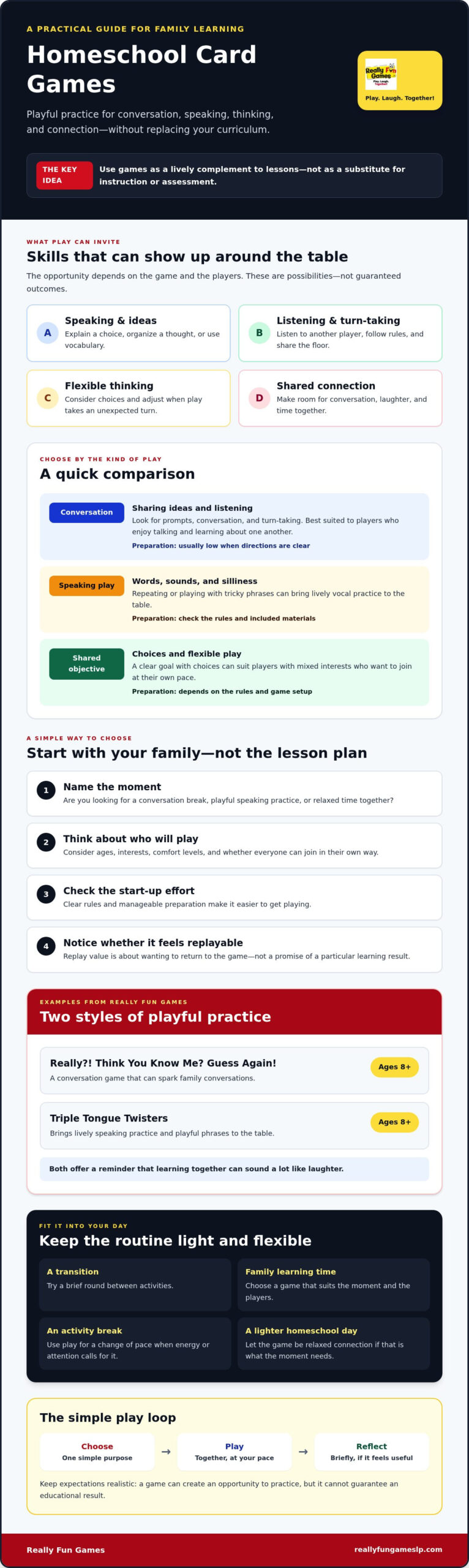
You’ll also find practical ways to match a game to your family’s ages, interests, and preferred style of play. Really Fun Games’ award-winning Really?! Think You Know Me? Guess Again! can spark family conversations, while Triple Tongue Twisters brings lively speaking practice to the table. Both are designed for ages 8 and up, and offer a cheerful reminder that learning together can sound a lot like laughter.
Key Takeaways
- Use homeschool card games as playful practice, not as a replacement for lessons or curriculum.
- Compare games by the skills they invite, their play style, who can join, and how much preparation they need.
- Choose one simple purpose for a game, play together, and briefly reflect if it feels useful.
- Fit a game into family learning time, a transition between activities, or a lighter homeschool day.
- Before choosing a game, consider family fit, clear rules, learning opportunities, and whether everyone will want to play again.
Why Add Homeschool Card Games to Your Learning Routine?
A deck of cards can create a lively change of pace without turning play into another assignment. Homeschool card games are activities families play together that may invite learning through conversation, choices, and shared rules. The goal doesn’t have to be a formal lesson every time. Sometimes it’s simply a chance to think aloud, listen closely, and enjoy a moment of connection.
Depending on the game, a round might encourage children to use new vocabulary, explain an idea, listen for details, wait for a turn, or adjust a plan when play takes an unexpected direction. These are possible opportunities, not automatic outcomes. An overview of educational games includes card games among the different ways play and learning can intersect. Families can decide how much learning intention to bring to the table.
A game can create an opportunity to practice a skill, but it can’t guarantee an educational result. Treat card play as a complement to your chosen curriculum, not a substitute for instruction or assessment. For structured academic practice, platforms like MathNexa offer interactive exercises and customizable worksheets that pair well with family games, while planned lessons and appropriate assessments continue to serve their own purposes.
What can children practice while playing cards?
When a child explains why they chose a card or made a move, they have a reason to organize their thoughts and communicate them clearly. Listening to another player’s explanation can invite careful attention; following the rules and waiting for a turn offer natural practice in sharing the floor. Depending on the game and the players, an unexpected play may also encourage flexible thinking. Keep it light: ask an open question, then let the conversation go where it goes.
When can a game fit into a homeschool day?
There’s no single schedule that works for every family. Try a brief round during a transition, as part of family learning time, or during an activity break when everyone could use a change of pace. Adjust who plays, how long you continue, or what you focus on according to energy, attention, and learning goals. If the moment calls for relaxed connection rather than a specific skill, let the game simply be play.
For a ready-to-play option, Really Fun Games offers card and conversation games designed for shared play. Browse the card and conversation games to explore options that may suit your family’s preferred style. A good fit can make it easier to bring playful interaction into the rhythm of homeschooling, without expecting every round to carry the weight of a lesson.
How to Choose Homeschool Card Games for Your Family
The best fit isn’t necessarily the game with the most obvious academic theme. Start with the kind of interaction your family wants, then consider who’ll be playing, what holds their interest, and how much setup feels manageable. Children in the same family may have different ages, preferences, and comfort levels, so look for a game everyone can approach in their own way.
Use this comparison as a starting point, not a promise of what a game will teach. The learning opportunity depends on the game and how your family plays.
| Learning opportunity | Play style | Group fit | Preparation needed |
|---|---|---|---|
| Sharing ideas and listening | Conversation prompts and turn-taking | Players who enjoy talking and learning about one another | Usually low if the directions are clear |
| Speaking practice and vocal play | Repeating or playing with tricky phrases | Players who enjoy words, sound, and silliness | Check the rules and any included materials |
| Flexible thinking and shared play | A clear objective with choices to make | Players with mixed interests who can join at their own pace | Depends on the rules and game setup |
Match the game to the learning moment
For conversation practice, look for prompts that invite players to share, listen, and take turns respectfully. For playful speaking practice, tongue-twister activities can bring repetition and vocal play into the room. These are different styles of play, not competing teaching methods. If interests vary, prioritize an objective that’s easy to explain. The research on the effectiveness of educational games is a useful reminder to consider evidence thoughtfully rather than assume every game produces the same learning result.
Look for replay value and an easy start
Straightforward rules make it easier to get playing without a lengthy setup or explanation. Replay value means your family enjoys returning to a game, not that every session guarantees a new skill or outcome. Really Fun Games’ Really?! Think You Know Me? Guess Again! is one conversation-game option. Really Fun Games describes its games as easy to learn and replay, and its products are designed for ages 8 and up. Check current product details before buying to confirm the rules, contents, and age guidance for the specific game.
To compare conversation and tongue-twister options, take a look at Really Fun Games’ card and conversation games and consider which play style best suits your family.
Do Homeschool Card Games Teach Real Skills or Just Add Fun?
Games can create practice opportunities, but they can’t guarantee learning outcomes. Think of a round as a chance to notice how your child approaches a moment, not as proof that a skill has been mastered.
What learning opportunities can a card game create?
Conversation play can invite children to share an idea, listen to another player’s response, and decide what to say next. A prompt might lead to a quick answer or a longer exchange. Either way, you can notice whether your child explains their thinking, asks a question, or responds to someone else’s point.
Tongue-twister play offers a different kind of speaking practice. Trying a phrase, hearing how it sounds, and giving it another go can make language play lively and low-pressure. For example, Triple Tongue Twisters from Really Fun Games brings tongue-twister play to the table. Keep your observations simple: “What helped you say that?” or “Want to try it again?” These questions invite reflection without turning a playful moment into a test.
Rather than correcting every answer or stumble, watch for choices and effort. A child might explain why they picked a response, pause to hear a sibling, or laugh and try a tricky phrase again. Those visible moments give you something specific to discuss. They don’t, on their own, show how a child will perform in another setting.
What should families not expect from a game?
A card game can’t replace your curriculum, individualized instruction, assessment, or professional support when those are needed. It may not address a subject in depth, and a game that clicks with one child may not suit another child’s age, personality, interests, or learning needs. Check the game’s purpose and current product details, then consider whether its style feels comfortable for the people playing.
Fun is a sound reason to choose a family game. So are lively conversation, shared laughter, and a format everyone can understand. If you’re exploring options, Really Fun Games’ card and conversation games include different styles of play. Pick a game that fits your family, and let learning be a welcome possibility rather than a promise.
Simple Ways to Use Homeschool Card Games During the Week
A game doesn’t need a complicated lesson plan to earn a place in your homeschool routine. Keep the process simple: choose a purpose, explain the rules, play together, then reflect briefly if it feels useful. Your purpose might be as light as sharing ideas or taking a screen-free break. The point is to make space for enjoyable interaction, not to turn every round into a scorecard.
- Choose a purpose: Pick one focus, such as listening, conversation, or simply having fun together.
- Explain the rules: Make sure players know how to begin and what to expect.
- Play together: Join in, model taking turns, and let the game unfold.
- Reflect briefly: Ask what stood out, or wrap up while everyone is still enjoying the moment.
This sequence can work during family learning time, between activities, or on a lighter homeschool day. Pairing interactive games with engaging reading material also helps keep daily learning well-rounded; for parents looking to introduce imaginative speculative fiction, you can explore Digital Ebook Sales from Jack to the Future. If you’re packing for an outing, a portable card game may also be a handy choice for screen-free travel games for kids. Keep participation and conversation at the center; scores and performance don’t have to measure whether a round was worthwhile.
Adapt one game for different ages and comfort levels
Not everyone needs to join in the same way. A younger or hesitant child might watch first, then take part alongside a supportive partner when ready. You can adjust the pace or how much you discuss while following the game’s stated rules. If someone gives a surprising answer or fumbles a phrase, make room for a laugh and another turn. There’s no need for perfect answers.
Turn play into a gentle learning reflection
Afterward, try one relaxed question: “What did you notice?” “Which part was fun?” or “What felt tricky?” Give children room to explain a choice or describe a new word in their own terms. A quick exchange is enough; skip the formal recap if the moment has run its course. For learning with a wider group, icebreaker games for groups may offer another way to get people talking and playing together.
Choose a game that fits your family’s preferred kind of play, then let the routine stay flexible. Really Fun Games creates card and conversation games designed for ages 8 and up, with opportunities for shared play. Explore the card and conversation games to find an option that could bring more laughter and connection to your homeschool day.
Find a Homeschool Card Game Your Family Will Want to Replay
A strong choice isn’t just one that sounds educational. It’s a game your family can understand, enjoy, and feel good about bringing back to the table. Before buying homeschool card games, use this quick checklist:
- Family fit: Consider players’ ages, interests, and comfort with the style of play.
- Learning opportunity: Decide whether you’re hoping to encourage conversation, playful speaking, or another kind of interaction.
- Understandable rules: Check that the instructions make sense for the people who’ll be playing.
- Replay appeal: Ask whether the game sounds enjoyable enough for another round, even when learning isn’t the focus.
Really Fun Games creates award-winning card and conversation games designed for ages 8 and up. Its range includes conversation and tongue-twister games, offering families different ways to bring shared play into homeschool life. Check current product details for the specific game you’re considering, including its rules, contents, and age guidance.
Choose conversation play or language play
If your family enjoys sharing ideas and learning about one another, a conversation game may be a natural fit. Really?! Think You Know Me? Guess Again! is a conversation-game option. For families drawn to playful speaking challenges, Triple Tongue Twisters brings tongue-twister play to the table. They offer different experiences, so choose according to the kind of interaction your family wants, not because one is a better teaching method.
For another perspective on language play, explore speech and confidence through tongue-twister games in a related article if available. Keep expectations grounded: a playful speaking challenge can invite participation, but it can’t promise a particular result.
Make choosing the next game feel easy
Think about the moment you want to create: a lively exchange, a chance to play with words, or simply an enjoyable break together. Then check the instructions and product details before deciding. Clear expectations can help everyone join in with confidence, while a game that suits your family’s interests is more likely to get another outing.
Ready to compare styles? Browse family and conversation games from Really Fun Games and choose one that fits the kind of play you’d love to share.
Make Room for More Playful Learning
The best homeschool card games aren’t miniature lessons. They’re enjoyable ways to bring people together, invite conversation or playful speaking practice, and add variety to the day. Choose a game that suits your family’s interests, feels easy to start, and earns a genuine “let’s play again.”
Really Fun Games creates award-winning games designed to be easy to learn and replay. Really?! Think You Know Me? Guess Again! offers conversation play, while Triple Tongue Twisters brings lively word play to the table. Use them for connection and practice, while keeping your family’s curriculum and learning needs in view.
Ready to find a game for your next shared moment? Explore the Really Fun Games collection and choose a style of play your family will enjoy. A little laughter can make the learning day feel brighter, one round at a time.
Frequently Asked Questions
Are card games educational for homeschool?
Card games can offer informal practice, depending on the game and how your family plays. Players might explain a choice, listen to another person, use new words, or take turns. These are opportunities to interact and think, not guaranteed educational outcomes. A game can add variety and connection to homeschool life, while your chosen curriculum, instruction, and assessment continue to guide formal learning.
What card games are good for homeschool?
Choose a game based on the kind of play your family enjoys and the moment you want to create. Conversation games invite sharing and listening; word-play games, such as tongue-twister games, make speaking playful. Really Fun Games creates award-winning options, including Really?! Think You Know Me? Guess Again! and Triple Tongue Twisters. Check current product information to make sure the rules and age guidance suit your players.
Can card games help with language development?
Some card games can create opportunities to use language in an enjoyable, social setting. Players may describe an idea, respond to a prompt, listen to another person, or try saying a tricky phrase. For instance, a tongue-twister game invites vocal play and repeated attempts. What a child practices depends on the game and the way they participate, so treat play as an engaging activity, not a guaranteed language outcome.
How do you use card games in a homeschool routine?
Choose a convenient moment, such as a transition between activities, family learning time, or a lighter day. Pick a simple intention, explain the rules, and play together. You can wrap up with a brief question about what players enjoyed or noticed, but a formal discussion isn’t necessary. Keep the routine flexible, and let the children’s energy and interest help guide whether you play, pause, or finish.
Are homeschool card games suitable for mixed ages?
Some may work for a mix of ages, but fit depends on the game, its rules, and the players’ interests. Check the listed age guidance and consider whether everyone can take part comfortably. A younger or hesitant child might prefer to watch first or play alongside someone supportive. Make space for different ways of participating, and don’t assume siblings will have the same skills, preferences, or attention for a game.
Can a card game replace homeschool lessons?
No. A card game can complement your homeschool plans with enjoyable interaction, but it shouldn’t be treated as a substitute for curriculum, instruction, assessment, or professional support when needed. A game may touch on a skill without teaching a subject in depth. Use it as one flexible activity among the learning experiences you choose, and keep expectations realistic: playing can provide practice, but it can’t guarantee mastery.
What should I look for when buying homeschool card games?
Start with family fit: consider player ages, interests, and preferred play style. Then look for a learning opportunity that feels relevant, rules your family can understand, and a game you’ll genuinely want to replay. Before purchasing, review current product details for the instructions, contents, and age guidance. Easy-to-learn games can help families get started with less fuss, but enjoyment and a comfortable group fit matter just as much.
