

What makes a speaking game enjoyable isn’t always the fastest answer. The best Games for verbal fluency practice match the task, whether that means finding words, describing an idea, or keeping a conversation moving. If you’re choosing an activity for home, a classroom, a group, or a professional session, look for one that feels playful rather than repetitive or test-like.
This guide compares game formats and offers ways to match a prompt to the player and setting. It also explains how word finding and organizing ideas differ from articulation practice, which focuses on producing speech sounds clearly. Tongue-twister games such as Really Fun Games’ Triple Tongue Twisters invite vocal play and pronunciation practice, while conversation activities encourage people to share and respond to ideas. These can be enjoyable ways to get talking, but they aren’t a substitute for therapy or individualized guidance from a speech-language pathologist. With a few adaptable ideas, practice can feel more like a shared laugh than a test.
Key Takeaways
- Choose Games for verbal fluency practice based on the speaking task, such as retrieving words, building a story, or sharing ideas.
- Compare prompt-based, storytelling, conversation, and tongue-twister activities to find a format that suits the player and setting.
- Keep play supportive by modeling a turn and celebrating ideas and effort rather than speed or perfect answers.
- Separate word-finding practice from articulation activities: tongue twisters invite vocal play, but they focus on a different speaking task.
- Conversation games and playful speaking activities can bring more laughter and connection to home, classroom, or group routines.
What Are Games for Verbal Fluency Practice, and What Skills Do They Use?
Verbal fluency practice means producing words in response to a prompt or rule. A player might name items in a category, think of words that start with a certain sound, or find a word that fits a clue. The focus is on finding and saying relevant words, not on delivering one “right” performance. Games for verbal fluency practice can make this word play feel social and relaxed, whether you’re sharing ideas around the kitchen table or adapting a prompt for a classroom.
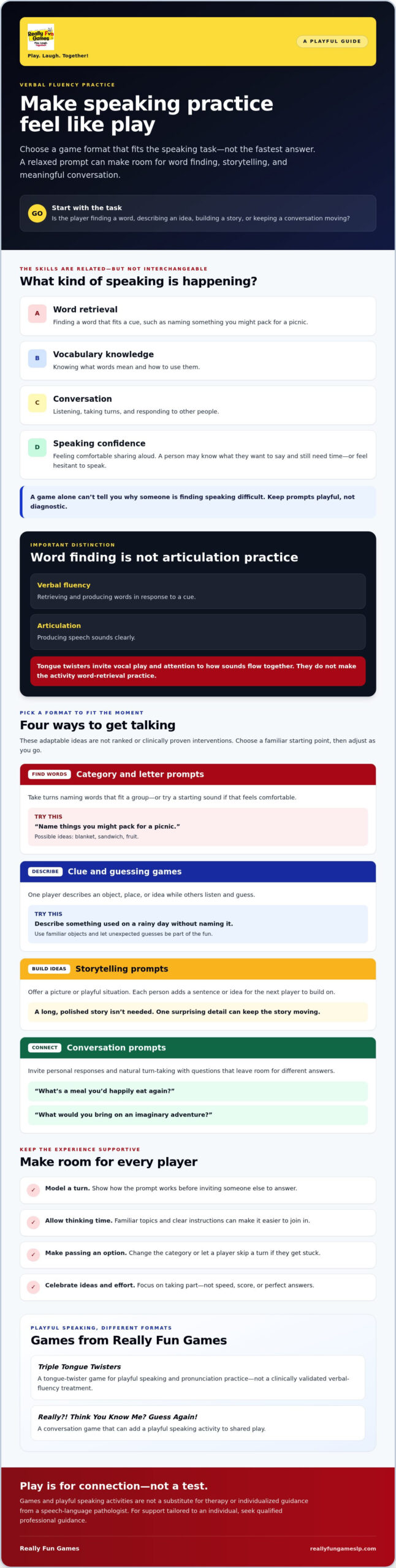
These activities can draw on related skills, but the skills aren’t interchangeable. Word retrieval means finding a word that fits a cue. Vocabulary knowledge means knowing what words mean and how to use them. Conversation involves listening, taking turns, and responding to others, while speaking confidence is about feeling comfortable sharing aloud. Someone may have plenty to say but need time to find a word, or know a word but feel hesitant about speaking. A game alone can’t tell you why.
Try an informal prompt such as, “Name things you might pack for a picnic.” A player could say “blanket,” then “sandwich,” or build on another person’s suggestion with “fruit.” Keep it relaxed: there’s no need to time answers, keep score, or treat the activity like an assessment. For background on structured semantic and phonemic tasks, see this overview of the Verbal fluency test. A playful prompt is not the same as a clinical test, and games don’t diagnose difficulties or replace advice from a qualified professional.
How Is Verbal Fluency Different from Articulation Practice?
Verbal fluency centers on retrieving and producing words in response to a cue. Articulation practice, by contrast, focuses on producing speech sounds clearly. A tongue twister invites vocal play and attention to how sounds flow together, but that doesn’t make it word-retrieval practice. Triple Tongue Twisters from Really Fun Games is a playful speaking activity, not a clinically validated verbal-fluency treatment.
Who Might Enjoy Playful Word-Finding Activities?
Families, teachers, homeschoolers, youth leaders, and speech-language professionals can adapt word prompts to a player’s interests and comfort. Try familiar themes such as favorite foods, animals, hobbies, or classroom topics. Allow extra thinking time and make passing an option. Age alone doesn’t determine readiness or support needs; choose a cue that feels inviting to the person playing. The Really Fun Games collection includes conversation and tongue-twister games for shared play.
Which Game Formats Can Make Verbal Fluency Practice More Engaging?
A useful format gives players a clear starting point without making every turn feel like a test. The activity ideas below are adaptable, not ranked or clinically proven interventions. Choose prompts and rules to suit the player’s comfort and communication goals, then adjust as you go. Familiar topics, clear instructions, and enough time to think can make it easier to join in.
Category and Letter Prompts for Quick Word Retrieval
Letter or sound prompts add another rule, such as thinking of words that begin with “b.” Use this format only when it feels comfortable for the player. There’s no need to race. Allow pauses, accept reasonable answers, and keep the focus on taking part rather than producing the most words.
Clues, Stories, and Conversation Prompts
In a describing-clue game, one player explains an object, place, or idea while others guess. For example, describe something used on a rainy day without naming it. Players find words to share useful clues, and the group listens and responds. Choose familiar objects and treat unexpected guesses as part of the fun.
Storytelling prompts invite connected speaking rather than a list of separate words. Offer a picture or playful situation, then let each person add a sentence or idea. There’s no need for a long or polished story. One surprising detail can give the next player something to build on.
Conversational prompts can invite personal responses and natural turn-taking: “What’s a meal you’d happily eat again?” or “What would you bring on an imaginary adventure?” For more social prompt ideas, explore group icebreaker games. A conversation game such as Really?! Think You Know Me? Guess Again! can also give people a playful way to share thoughts and learn about one another. It isn’t verbal-fluency treatment.
Match the Prompt to the Player
Start with a familiar category before adding a letter rule, or use a picture if open-ended questions feel difficult. If a prompt stalls, offer a choice, model an answer, or switch formats. For example, change “Name animals” to “Would you rather talk about pets or ocean animals?” The goal is a welcoming chance to speak, not a perfect response. The Really Fun Games collection features playful conversation and speaking games.
How Do Verbal Fluency Game Formats Compare for Different Players?
The best fit depends on what kind of speaking feels inviting and useful to the player. A focused prompt offers more structure; a story or conversation leaves more room to follow an idea. Use this comparison to choose a starting point, not to rank activities as proven treatments. Enjoyable games can create opportunities to practice speaking, but they aren’t clinical treatment.
| Format | Main speaking focus | Structure | Social interaction | Possible adaptation |
|---|---|---|---|---|
| Category or letter prompt | Retrieving words that fit a cue | High, with a clear rule | Low to moderate | Choose familiar categories, allow extra thinking time, or remove the letter rule |
| Storytelling | Connecting ideas into a sequence | Flexible | Moderate to high | Use a picture, offer a sentence starter, or let players contribute one idea at a time |
| Conversation prompt | Sharing ideas and responding to others | Low to moderate | High | Choose a familiar topic, invite brief answers, or let players pass |
| Tongue twister | Playing with speech sounds and articulation | High, with set words to say | Low to moderate | Repeat at a comfortable pace or take turns saying the phrase |
Which Format Fits a Family, Classroom, or One-to-One Session?
For a family or group that wants shared stories and relaxed discussion, try conversation prompts. For a player who prefers a clear, focused turn, a short category prompt may feel more manageable. In a classroom, a story can invite students to build on one another’s ideas; in a one-to-one session, the facilitator can adjust a cue in the moment. If activities need to align with individualized clinical goals, consult the player’s speech-language pathologist (SLP).
When Are Tongue Twisters a Good Fit?
Tongue twisters bring sound play, rhythm, and vocal coordination into a game. They can be lively when players want to experiment with saying a phrase, but that’s different from generating words within a category or retrieving them in response to a cue. Triple Tongue Twisters is a playful speaking activity, not a verbal-fluency treatment. The Really Fun Games collection includes tongue-twister and conversation games for shared play.
How Can You Make Verbal Fluency Practice Feel Supportive and Fun?
A little structure can make speaking games welcoming without turning them into a test. Set up an easy opening, share a few turns, and finish on a positive note. With Games for verbal fluency practice, the atmosphere matters as much as the prompt: players should feel free to think, try, laugh, or pass.
A Simple Routine for a Low-Pressure Practice Session
Start with a topic the player already enjoys, such as favorite animals, sports, foods, or hobbies. Explain the rule in plain language and let everyone know that passing is okay. Model a turn before inviting the player in. For “things you’d bring to the beach,” for instance, say “a towel” to show that a short answer is enough.
Take turns without rushing. Give each player time to think, and respond warmly to their ideas instead of judging how quickly they found them. Wrap up with a quick reflection: “Which prompt was easiest?” “Did anything surprise you?” or “What would you like to try next time?” The answers can help you choose a topic or format the group enjoyed for another session.
How to Adapt Prompts Without Making Play Feel Like a Test
Notice when a prompt feels too broad, too tricky, or simply uninteresting. Make it easier by offering a narrower category, or broaden it if the player has run out of ideas. Visual choices, such as a few pictures to choose from, can provide a helpful starting point. A partner can also model an answer, while leaving space for the player to respond in their own way.
Keep the focus on ideas and effort, not speed, points, or perfect answers. If you jot down notes, use them to remember which topics sparked interest, not to turn casual play into an assessment. Scores from a home or classroom game aren’t clinical results.
If a player repeatedly finds everyday speaking or word-finding activities difficult, or you have an ongoing concern about communication, consider discussing it with a qualified speech-language pathologist (SLP). An SLP can help determine whether an activity fits the person’s needs and goals. Play can offer a relaxed chance to connect, but it doesn’t diagnose difficulties or replace professional care.
For examples of playful speaking activities, see the games available from Really Fun Games.
Which Really Fun Games Can Add More Playful Speaking to Your Routine?
An enjoyable game can make it easier to invite people into a conversation. Really Fun Games offers award-winning card and conversation games for ages 8 and up, giving families, educators, and groups an option for shared play. These games can encourage people to talk, laugh, and connect, but they aren’t clinically validated treatments or substitutes for activities chosen with an SLP.
Where Triple Tongue Twisters Fit into Playful Speaking
Tongue twisters bring a lively kind of vocal word play to a game routine. Players can take turns saying a phrase, listen to how its sounds move together, and enjoy the inevitable mix-ups along the way. Triple Tongue Twisters is one option for this kind of lighthearted speaking activity.
Keep the goal clear: tongue-twister play draws attention to speech sounds and articulation. It’s different from naming items in a category or retrieving words to fit a prompt, so it shouldn’t be presented as verbal fluency practice by itself. For a professional session, an SLP can help decide whether sound play fits the player’s individualized goals.
Choosing a Conversation Game for Shared Play
If your group is more interested in sharing thoughts than repeating sound patterns, Really?! Think You Know Me? Guess Again! is a conversation-game option. A conversation game can give family members, friends, or classmates a playful reason to respond to one another and discover what they have in common. That’s meaningful speaking, but it isn’t a word-retrieval intervention or a clinical fluency tool.
Use Games for verbal fluency practice to describe activities that invite people to find and produce words under a prompt or rule. For a game night focused on connection, choose a format that makes it easy to join in, listen, and share. The best match depends on the group’s interests and the kind of speaking experience you want to create.
For an overview of the games available, visit the Really Fun Games collection.
Make Speaking Practice a Moment to Connect
The best Games for verbal fluency practice fit the speaking task and the player’s comfort. Category prompts invite word finding, while storytelling and conversation games encourage people to connect ideas and share them with others. Tongue twisters bring a different kind of play, with attention to sounds and articulation. Choose a format that feels inviting, allow time to think, and celebrate participation rather than speed or perfect answers.
Play can make speaking more enjoyable, but it isn’t a diagnosis or a substitute for individualized guidance from a qualified speech-language pathologist. Really Fun Games creates award-winning games for families, educators, and professionals. Triple Tongue Twisters offers vocal word play, while Really?! Think You Know Me? Guess Again! is a conversation game for sharing ideas and connecting.
Ready to bring more playful conversation to your next gathering? Explore the Really Fun Games collection and choose a game that suits your group.
Frequently Asked Questions
What is verbal fluency practice?
Verbal fluency practice involves producing words in response to a prompt or rule. For example, someone might name foods, animals, or words that start with a particular sound. The activity focuses on retrieving and saying words that fit the cue. It’s different from practicing clear speech sounds or simply chatting. A casual game can make word generation playful, but it isn’t a clinical assessment of communication skills.
What games help with verbal fluency?
Games for verbal fluency practice can use category prompts, optional letter cues, describing clues, or short storytelling turns. A category round might invite players to name animals, while a clue game asks them to describe an object for others to guess. Choose a format that suits the player’s comfort and the speaking task. Conversation prompts can encourage sharing, though they aren’t the same as focused word-retrieval activities.
Can board or card games help with verbal fluency?
Board and card games can create enjoyable opportunities to respond to prompts, retrieve words, or share ideas when their rules fit the intended activity. A conversation game such as Really?! Think You Know Me? Guess Again! encourages shared discussion, while Triple Tongue Twisters offers vocal word play. These are different speaking experiences, and neither should be described as a clinically validated verbal-fluency treatment.
How can I practise verbal fluency with a child without pressure?
Choose a familiar topic the child enjoys, explain the prompt simply, and model a turn before inviting them to play. Allow time to think, offer a visual cue or a narrower choice if helpful, and make passing okay. Celebrate ideas and effort instead of speed, points, or perfect answers. If the child loses interest or seems uncomfortable, switch topics or stop. Keep it playful, not like a test.
Are tongue twisters the same as verbal fluency activities?
No. Tongue twisters focus on saying a set phrase and playing with speech sounds, rhythm, and articulation. Verbal fluency activities invite someone to generate words that fit a cue, such as naming foods or things found at home. Both involve speaking, but they focus on different tasks. A tongue-twister game can bring laughter and vocal play without necessarily involving word retrieval.
When should someone talk to a speech-language pathologist about word-finding difficulty?
Consider speaking with a qualified speech-language pathologist (SLP) if word-finding difficulty happens repeatedly in everyday conversations, causes distress, or makes it harder to participate at home, school, or work. You don’t need to rely on game scores to decide whether to ask for guidance. An SLP can discuss your concerns and help determine whether further support or individualized goals may be appropriate.
