

What makes a good conversation game for friends? It’s not necessarily the boldest questions. It’s a format that helps everyone feel comfortable joining in. Conversation games for friends can move a gathering beyond familiar small talk, but a prompt that feels fun to one person may feel too personal to another. Start with your group’s comfort level, then let the conversation find its own pace.
You can make a get-together lively without putting anyone on the spot or turning game night into a complicated production. A little structure gives friends an easy way to share stories, laugh, and hear from quieter players while keeping the mood relaxed.
This guide compares conversation game styles and offers practical ways to choose one for your friends, whether they enjoy playful questions, light icebreakers, or more reflective conversation. For a ready-to-play option, Really Fun Games’ award-winning Really?! Think You Know Me? Guess Again! brings a conversation-focused experience, while Triple Tongue Twisters adds playful spoken-word fun. Pick a comfortable starting point and let the conversation take it from there.
Key Takeaways
- Match the game style to your group’s mood, preferred conversation depth, and energy level.
- Conversation games for friends can help move beyond small talk while keeping participation comfortable.
- Choose prompt-led play, playful guessing, spoken-word challenges, or a no-materials activity based on how much structure your group wants.
- Help everyone feel welcome by explaining the activity, sharing a brief example, and letting each person join at their own comfort level.
- Consider a ready-to-play option like Really?! Think You Know Me? Guess Again! when you want conversation prompts without preparing them yourself.
What Makes Conversation Games for Friends Fun and Easy to Join?
Conversation games are activities that use questions, prompts, or playful challenges to get people talking and responding to one another. With friends, the fun comes from hearing different answers, swapping stories, and laughing at unexpected responses, rather than proving who knows the most facts.
A shared activity can make talking feel less like a round of introductions. Instead of being asked to describe yourself to the whole group, you respond to a prompt everyone can take part in. One question might lead to a quick, silly answer; another might bring out a more thoughtful story. The Conversation games overview offers a broader look at the form and its examples.
Conversation games can overlap with icebreakers, but the terms aren’t interchangeable. An icebreaker usually helps a group get started. A conversation game can also suit friends who know one another and want a fresh way to interact. General party games may focus on competition or performance, while trivia centers on recalling facts. In conversation-led play, people’s ideas and responses are the main event.
How are conversation games different from ordinary party games?
Conversation and interaction take priority over scorekeeping or trivia knowledge. A shared prompt can spark a funny disagreement, an unexpected detail, or a story someone hasn’t told before. Some games keep things light and playful; others invite more reflection. That range lets friends choose the mood instead of assuming every conversation game needs to get personal.
When do conversation games for friends work best?
For a structured activity to bring to the table, explore Really Fun Games’ conversation and card games. Choose a style that lets everyone find their way into the fun, whether that means sharing a story or simply enjoying the laughter.
Which Conversation Game Style Fits Your Friends?
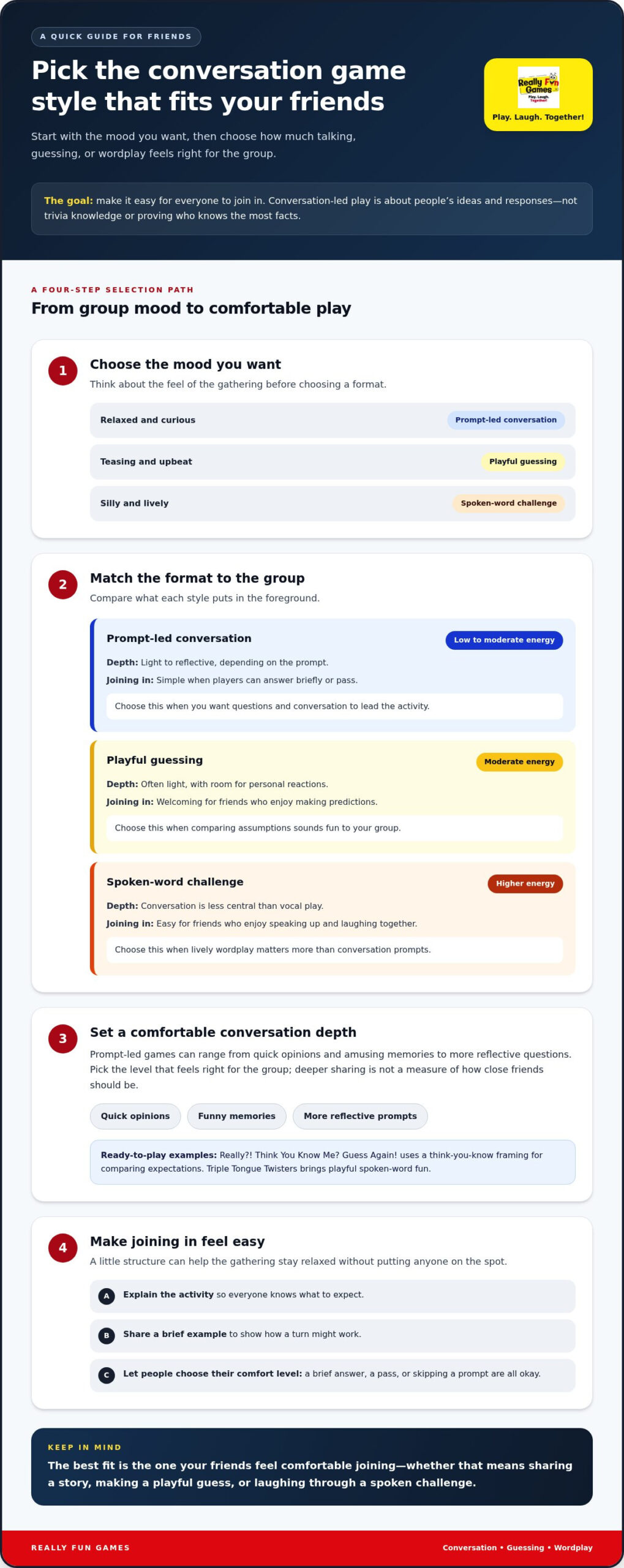
The best format depends on the mood your friends want, not on one rule for every group. Some people like a question to get them talking; others would rather laugh through a guessing game or spoken challenge. Compare the styles by how much conversation, energy, and structure they invite.
| Style | Group mood | Conversation depth | Energy | Ease of joining |
|---|---|---|---|---|
| Prompt-led conversation | Relaxed, curious | Light to reflective, depending on the prompt | Low to moderate | Simple if players can answer briefly or pass |
| Playful guessing | Teasing, upbeat | Often light, with room for personal reactions | Moderate | Welcoming for friends who enjoy making predictions |
| Spoken-word challenge | Silly, lively | Conversation is less central than vocal play | Higher | Easy to join for friends who enjoy speaking up and laughing together |
Are prompt-led conversation card games right for your group?
Choose question-led play when you want conversation to lead the activity. Lighter prompts can invite quick opinions or amusing memories; more reflective ones may encourage friends to share a little more. These are different styles, not a measure of how close a group should be. Pick a comfortable depth and move on whenever a prompt doesn’t feel right.
For a ready-to-play example, Really Fun Games’ award-winning Really?! Think You Know Me? Guess Again! is a conversation-game option. Its think-you-know framing may suit friends who enjoy comparing what they expect about one another, without needing to invent prompts for the gathering.
When do guessing games or spoken challenges make sense?
Guessing-style play may suit friends who enjoy playful predictions and comparing their assumptions. Spoken-word challenges bring a different kind of energy: vocal play and laughter take the foreground rather than conversation prompts. Triple Tongue Twisters is one spoken-game option from Really Fun Games.
The American Psychological Association discusses ways video games can boost children’s learning, health and social skills. That article focuses on video games, not conversation card games, so it isn’t evidence about a particular conversation-game format. For this choice, start with what your group enjoys: talking, guessing, or playing with words.
Conversation games for friends work best when the style feels comfortable to the people around the table. To explore a ready-to-play option, browse Really Fun Games’ conversation and card games.
How to Compare Conversation Games for Friends Before Choosing
Start with the evening you want, not just the game’s label. Before choosing among conversation games for friends, consider three things: the mood, how personal the group wants to get, and how much structure will make play feel easy.
- Mood: Do you want a mellow chat, playful guesses, or lively spoken-word fun?
- Comfort: Will everyone enjoy sharing personal stories, or would lighter opinions and funny answers feel better?
- Structure: Would a clear turn or prompt help the group get started, or would you rather let the conversation wander?
There’s no better or worse level of depth. A light question can keep the evening breezy, while a thoughtful prompt may suit friends who already enjoy sharing more. Either way, choose a format that doesn’t require anyone to explain a private experience to take part. Passing, giving a brief answer, or changing the subject can all be normal parts of comfortable play.
What level of conversation feels right for the group?
Think about who’s around the table and what they’d enjoy tonight, not what they ought to reveal. For a mixed group or casual gathering, choose prompts that allow quick, playful responses. If everyone wants a more reflective conversation, lean in that direction while keeping the option to pass. Comfort makes it easier for friends to stay engaged without feeling put on the spot.
Should you choose a ready-to-play card game or make up prompts?
Making up prompts together requires no setup and lets the group shape the tone as it goes. It’s flexible, but someone has to get the ideas flowing. A prepared card game provides shared structure and ready-made conversation starters, so the host doesn’t have to invent every prompt. Consider whether your group would enjoy that convenience or prefers creating the activity together.
Replayability matters, too. If the appeal is a one-time novelty, a spontaneous round of improvised questions may be enough. If you’d like a game to bring out at different gatherings, consider whether you enjoy hearing varied responses and discovering new angles in familiar company. A ready-to-play option can make it easy to begin without preparing fresh prompts each time.
For a physical option, browse Really Fun Games’ conversation card games. Choose the format that fits your friends’ mood and comfort, then explore games for connection to find a play-ready addition to your next get-together.
How to Keep a Friends’ Conversation Game Comfortable and Lively
A welcoming host sets the tone: this is shared fun, not a test of friendship or a demand for personal stories. Conversation games for friends can bring out easy laughs and thoughtful answers, but the group should decide how much to share and how quickly the activity moves.
Try this simple sequence:
- Explain the activity. Give a quick overview and say that short answers are welcome. Make it clear that anyone can pass or choose another prompt.
- Invite, don’t single out. Let friends join at their own pace rather than putting one person on the spot. The host can go first with a brief, light answer to show what participation might look like.
- Keep the mood flexible. Start with accessible, playful conversation. If the energy dips or a topic feels too serious, switch prompts, pause, or let the group move on.
How can a host prevent conversation games from feeling awkward?
Introduce the game as an optional activity everyone can enjoy together, not a way to prove how well friends know one another. Begin with a funny preference or low-stakes memory before moving to more reflective conversation. Join in yourself, too. When the host answers alongside everyone else, the exchange feels mutual rather than like an interview.
How can you adapt the game to different personalities?
Give quieter friends a moment to think instead of expecting instant answers. More energetic players can help keep things lively, while a simple turn-taking rhythm gives everyone room to speak. Agree on friendly ground rules: skipping is fine, no one has to explain a pass, and changing the subject is always an option. These small adjustments let people with different personalities enjoy the same activity.
Follow the group, not a fixed pace. If friends are laughing and chatting, leave space for the conversation to wander. If attention starts to fade, try a lighter prompt or take a break. The aim is a relaxed shared experience, not finishing every question or reaching a particular level of depth.
For a ready-to-play option that gives the group a shared starting point, explore Really Fun Games and find a game that suits your next get-together.
Bring Friends Together with a Ready-to-Play Conversation Game
Once you’ve considered your group’s mood, preferred conversation depth, and energy, choosing a game gets easier. A ready-to-play card game gives everyone a shared starting point without asking the host to prepare questions or steer every moment. The cards provide structure; friends bring their own stories, reactions, and laughter.
That simple setup can be welcome at a casual dinner or game night. Instead of wondering what to talk about next, the group has an activity to gather around. Conversation games for friends don’t have to make every answer deep or memorable. Sometimes a playful exchange is exactly what makes an evening feel more connected.
Why choose a card game for your next get-together?
A prepared game makes it easy to begin: bring it to the table and invite friends to join. Unlike making up prompts on the spot, a ready-to-play format gives the group shared structure while leaving room for conversation to unfold naturally. That might mean funny reactions, thoughtful answers, or simply enjoying time together. Really Fun Games creates award-winning games for ages 8 and up, designed to bring people together through communication, teamwork, and play.
Which Really Fun Games option should friends explore?
Really?! Think You Know Me? Guess Again! is a conversation-game option for friends looking for a ready-to-play activity. It gives the host a structured choice without having to invent prompts for each gathering. Consider whether a conversation-focused activity fits the kind of get-together your group wants, and keep passing or moving on easy so everyone can participate comfortably.
For a different kind of shared play, Triple Tongue Twisters is a spoken-game option. It differs from a conversation-prompt game, making it a fit to consider if your friends would rather enjoy vocal play than focus on personal questions. The formats offer different experiences, so choose based on the mood you hope to create, not on an assumption that one style suits every group.
Ready for an easy way to bring play and conversation to your next get-together? Explore the Really Fun Games collection and choose an option that feels right for your friends.
Make Your Next Get-Together a Little More Connected
The best conversation games for friends match the group’s mood, comfort with sharing, and appetite for structure. Prompt-led cards, playful guessing, and spoken challenges offer different ways to get everyone involved, but no one needs to answer every prompt. Let friends pass, keep things light, and follow the energy in the room.
A ready-to-play game can make choosing an activity simple, without requiring the host to prepare conversation starters. Really Fun Games creates award-winning games designed to bring people together through play, with options for players aged 8 and up. Really?! Think You Know Me? Guess Again! is a conversation-game choice, while Triple Tongue Twisters offers a different spoken-play option.
Pick the experience that feels right for your friends, whether you’re hoping for thoughtful conversation, easy laughs, or lively word play. Explore the Really Fun Games collection and find a game for your next get-together. Here’s to more shared stories, spontaneous laughter, and time well spent together.
Frequently Asked Questions
What are the best conversation games for friends?
The best choice depends on whether your friends want prompts, playful predictions, or spoken-word fun. Really?! Think You Know Me? Guess Again! is a conversation-game option from Really Fun Games, while Triple Tongue Twisters offers a different kind of spoken play. Consider the group’s mood and comfort with sharing first. A good fit gives everyone a way to join without making personal answers feel like a requirement.
How do you play a conversation game without making it awkward?
Set a relaxed tone before you begin: explain the activity, answer a prompt yourself, and make passing an ordinary option. Start with light topics, such as favorite snacks or a funny everyday habit, rather than asking for personal stories right away. Don’t treat the game as a test of friendship. If a question lands poorly, skip it, choose another, or pause and let the conversation move on.
Can conversation games help friends get to know each other?
Conversation games give friends a shared activity and a natural reason to exchange opinions, stories, and laughs. A prompt may reveal a small preference or lead someone to share a memory, but nobody needs to disclose more than they want. Friends can keep answers light, ask a follow-up, or pass. The game creates an opening for conversation; how far it goes depends on the people playing.
What conversation games can friends play without cards?
Friends can take turns answering a spoken prompt without any materials. Try “Would you rather…?” questions, naming a small everyday pleasure, or recalling a funny shared moment. Keep prompts easy to answer and let anyone pass or suggest a new topic. This no-cards approach is flexible and needs no preparation, though the group will need to come up with prompts as they go or choose a theme beforehand.
Are conversation card games good for a friends’ game night?
Yes. Conversation card games can make a game night more interactive by giving friends a ready-made activity and prompts to respond to. They’re useful when the host would rather not invent questions or restart small talk. Choose a style that fits the group, from playful to more reflective, and agree that skipping is fine. The cards provide structure while the friends set the tone.
How do you choose a conversation game for different personalities?
Look for a format with more than one comfortable way to participate. Quieter friends may appreciate time to think or the option to give a short answer, while outgoing players may enjoy lively prompts or spoken challenges. Consider how personal the questions feel and whether the group wants clear structure. Explain that passing is welcome, so nobody has to match another player’s energy or share at the same depth.
What is a good conversation game for a small group of friends?
For a small group, choose a game that keeps conversation central and lets everyone take part at a comfortable pace. Really Fun Games’ Really?! Think You Know Me? Guess Again! is a conversation-game option to consider. Choose it if its conversational style suits your friends’ mood, and make it easy to pass or move on from a prompt. The aim is an enjoyable shared activity, not making every person answer every question.
