
The best social-skills game may be the one that doesn’t feel like practice. Card games for building social skills give families, classrooms, and groups a natural reason to take turns, listen, laugh, and talk while keeping the fun front and center.
The right format depends on the players. A question-based game that gets one family chatting might feel uncomfortable in a quiet classroom, while a lively speaking game may energize one group and overwhelm another. Look for a game that suits the players’ ages, personalities, and comfort with conversation, and that lets everyone join in at their own pace.
This guide compares conversation, guessing, wordplay, and team-oriented formats so you can match the activity to your group’s interests and goals. You’ll also find practical ways to make play feel welcoming at family game night, in a classroom, during a therapy session, or at a group gathering. Really Fun Games’ award-winning games, including Really?! Think You Know Me? Guess Again! and Triple Tongue Twisters, offer examples of playful conversation and speaking activities for ages 8 and up. Choose a format your players will enjoy, and let connection grow through shared turns.
Key Takeaways
- Card games for building social skills create playful opportunities to interact, but they don’t guarantee results or replace clinical support.
- Compare conversation, guessing, wordplay, and team-oriented formats to find the kind of interaction your group enjoys.
- Consider players’ ages, familiarity, comfort with conversation, and preference for quick turns or vocal play.
- A simple, welcoming introduction can help players feel comfortable participating in different ways.
- Match the game to your setting and the interaction you want to invite, so shared play feels natural and enjoyable.
How Card Games Can Make Social-Skills Practice Feel Natural
A shared game gives everyone something to focus on besides finding the perfect thing to say. Players follow rules, take turns, and respond to one another while enjoying the activity. Card games for building social skills create a playful structure for interaction, with clear moments to speak, listen, wait, and join in.
Depending on the game, players may get opportunities to practise listening, turn-taking, clear communication, and confidence. A game can’t guarantee social-skills improvement or replace clinical care. Instead, treat play as one way to invite everyday interactions: waiting until someone finishes speaking, considering another player’s answer, or choosing how much to share.
Which social skills can players practise through card games?
Even a quick round can make room for small, meaningful social moments. Waiting for a turn involves noticing whose turn it is and leaving space for others. A shared prompt gives players a reason to listen to an answer, then respond or ask a follow-up question rather than rushing ahead.
Speaking games can make participation feel lighter, too. A funny prompt or tricky phrase gives players a shared focus and a reason to speak without making conversation feel like a test. Groups that prefer working together can also explore cooperative games, where players pursue a common goal rather than compete against one another.
Who can enjoy social-skills card games together?
Families, grandparents, teachers, homeschoolers, therapists, and youth leaders can use shared play to bring people into the same conversation. The right choice depends on the players, the setting, and how comfortable the group feels with different kinds of interaction. Some players enjoy personal questions; others prefer short turns, a shared goal, or playful speaking.
Players don’t have to participate in exactly the same way. Let someone pass, give a brief answer, or listen until they feel ready to join in. That flexibility can make family game night, a classroom activity, or a group gathering more welcoming without taking away the fun.
Really Fun Games creates award-winning card and conversation games for ages 8 and up, including Really?! Think You Know Me? Guess Again! and Triple Tongue Twisters. Browse the card and conversation games to compare playful options for shared interaction. Choose a format your players are likely to enjoy, then let the conversation unfold at its own pace.
Compare Card Game Formats by the Social Skills They Invite
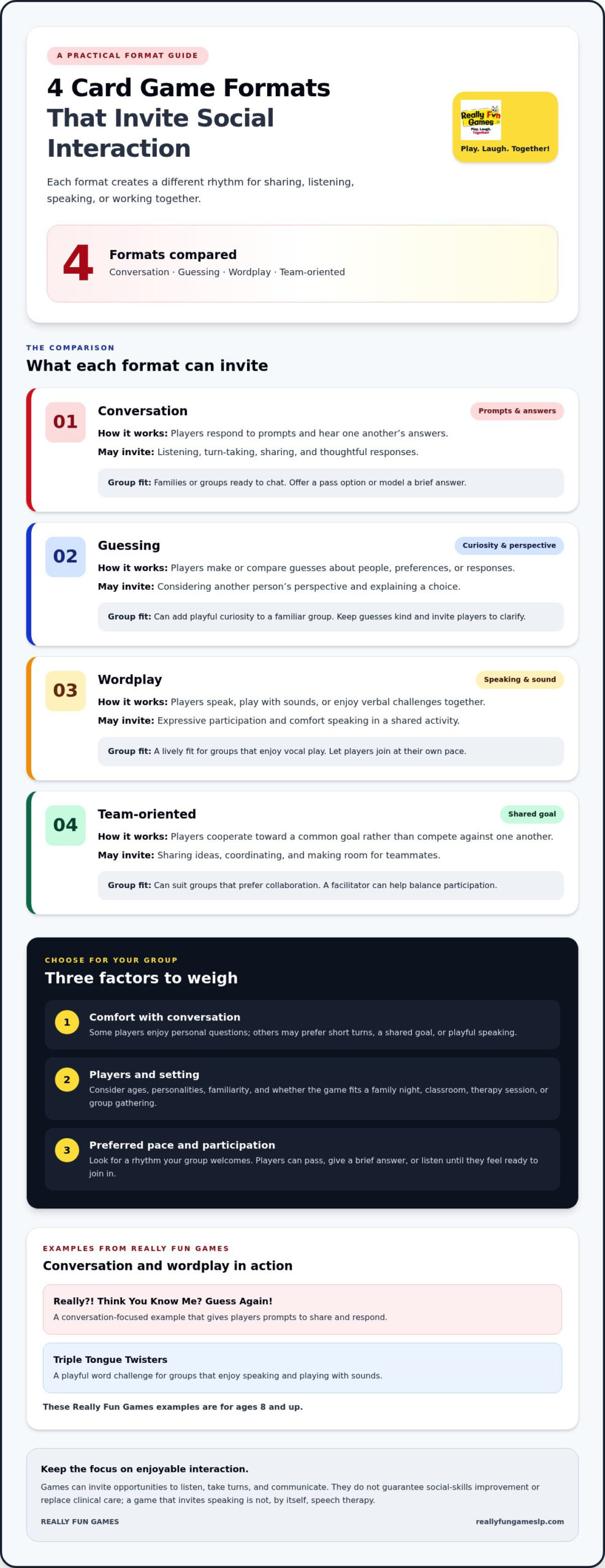
The format shapes the kind of interaction players are invited to have. A game’s format sets the rhythm, from sharing thoughts to playing with words or working toward a shared goal. When choosing card games for building social skills, start with the kind of interaction your group enjoys, then look for a format that makes taking part comfortable.
| Format | Interaction style | Possible practice | Group fit and facilitation |
|---|---|---|---|
| Conversation | Players respond to prompts and hear one another’s answers. | Listening, turn-taking, sharing, and thoughtful responses. | Useful for families or groups ready to chat. Offer a pass option or model a brief answer. |
| Guessing | Players make or compare guesses about people, preferences, or responses. | Considering another person’s perspective and explaining a choice. | Can add playful curiosity to a familiar group. Keep guesses kind and invite players to clarify. |
| Wordplay | Players speak, play with sounds, or enjoy verbal challenges together. | Expressive participation and comfort speaking in a shared activity. | A lively fit for groups that enjoy vocal play. Let players join at their own pace. |
| Team-oriented | Players cooperate toward a common goal rather than compete against one another. | Sharing ideas, coordinating, and making room for teammates. | Can suit groups that prefer collaboration. A facilitator can help balance participation. |
These opportunities aren’t the same as a clinical outcome. Social interaction goals, such as listening and responding, differ from speech or language practice goals, such as clear expression. A game may invite speaking, but that alone doesn’t make it speech therapy. Research on game-based social-emotional learning examines a game-based intervention, but its findings should not be taken as a promise about every game or player.
Conversation and guessing games for listening and connection
Prompt-based play gives players a shared starting point: answer, listen, and respond. A prompt can help get conversation moving when players aren’t sure what to say. Really Fun Games’ Really?! Think You Know Me? Guess Again! is a conversation-focused example. For more ideas for group settings, explore icebreaker games for groups.
Wordplay games for expressive participation
Wordplay makes speaking part of the activity, so players can focus on a shared challenge and enjoy the funny slips and surprising sounds along the way. Triple Tongue Twisters is a playful example from Really Fun Games. It offers a lively way to play with words, without treating a round as therapy or promising a particular result. Read more about tongue twister games for speech and confidence.
Choose based on the interaction your group welcomes, not the skill label alone. If conversation sounds like a good fit, browse Really Fun Games for more ideas for shared play.
How to Choose Social-Skills Card Games for Your Group
A good match starts with the players, not a promise about what a game will achieve. Consider their ages, how well they know one another, and whether they enjoy sharing thoughts, taking quick turns, or playing with words. Then think about the interaction you want to invite: listening, taking turns, exchanging ideas, or getting comfortable speaking together.
The best game match fits the players’ ages, setting, comfort level, and preferred way of joining in. Clear instructions help everyone settle into play. Flexible participation lets people answer briefly, listen first, or pass when they’d rather not share. A game creates opportunities for interaction, but it can’t guarantee a particular social-skills outcome.
Choosing games for family, classroom, or therapy settings
For family game night, look for a format that gives everyone a chance to contribute. One player might enjoy telling a story, while another prefers a short response. In a classroom, clear turns and a steady pace can help students participate without competing to be heard. SLPs and therapists can choose play that connects with session goals and use their professional judgment to decide how it fits.
Really Fun Games creates award-winning games for ages 8 and up, including Really?! Think You Know Me? Guess Again! and Triple Tongue Twisters. Their conversation and speaking formats can help you decide which style may suit the players and setting. Browse the card and conversation games to explore the options.
Questions to ask before choosing a card game
- Will players enjoy the format? Consider whether they’re comfortable with personal conversation, prefer short turns, or like playful speaking challenges.
- Does it invite the interaction you want? Choose prompts, wordplay, or collaborative play based on what the group wants to do together.
- Can everyone take part comfortably? Make room to listen, respond briefly, or pass without pressure to share more.
- Can you adjust the pace? Consider whether you can pause to explain a turn, model an answer, or give quieter players time.
Before opening the cards, picture one round with your actual group. Check that the instructions seem manageable and that players can participate in different ways. That simple preview can help you start with less confusion and more time for enjoyable play.
Ways to Keep Social-Skills Card Games Welcoming and Low-Pressure
A warm introduction can shape the whole game. Before the first card, explain that the goal is to enjoy playing together, not to give perfect answers or perform for the group. With Card games for building social skills, a little flexibility lets players join in at a pace that feels right.
A simple start-to-finish routine for inclusive play
- Set a friendly purpose. Explain what you’ll play and remind everyone that participation can look different. Players might answer, listen, or pass.
- Model a turn. Take the first turn yourself. Keep your response simple and show how to listen while someone else speaks.
- Make room for different styles. Welcome a short answer, a longer story, a laugh, or a quiet turn. Don’t put anyone on the spot to explain why they passed.
- Pause if needed. If a prompt feels uncomfortable or doesn’t suit the group, skip it, rephrase it, or take a quick break. The game should serve the players, not the other way around.
- Close with a light reflection. Ask what made the game enjoyable or helped everyone feel included. Keep it brief, and let players share only if they want to.
Adapting play for children, teens, and mixed groups
Give players time to think before expecting an answer. Children may appreciate a clear example, while teens might prefer space to respond in their own way. In a mixed-age group, model a range of answers so nobody feels they need to match the longest or funniest response.
Facilitators can adjust the flow, too. If a prompt doesn’t feel right for the room, move on without making it a big moment. Teachers, SLPs, and therapists can use their professional judgment to decide how a game’s format fits an activity or session. For more ideas, see card games for families and groups.
These small choices can keep play lively without making participation feel compulsory. Let players know they can listen, take a turn, or pass, then follow the group’s energy. For a playful option at home, in a classroom, or with a group, explore card games for families and groups.
Explore Really Fun Games for Shared Conversation and Play
The best choice suits the people around the table. Think about players’ ages, the setting, how comfortable they feel with conversation, and the kind of interaction they enjoy. A family gathering may call for easygoing conversation, while a group that loves speaking challenges might enjoy wordplay.
Really Fun Games creates award-winning card and conversation games for ages 8 and up, designed for families, educators, therapists, and groups. The games are easy to learn and highly replayable, making them practical options for shared play. The aim isn’t to get perfect answers or make everyone participate in the same way. It’s to find a format that makes joining in enjoyable.
Matching Really Fun Games examples to your gathering
Really?! Think You Know Me? Guess Again! is a conversation-game option for a gathering where players want to share and connect. Triple Tongue Twisters offers wordplay for groups drawn to vocal fun. Both fit within the wider range of Card games for building social skills that invite interaction through play, without promising a particular result.
As you compare options, picture the feel you want at the table. Do players enjoy conversation, or would they rather focus on playful speaking? Is the setting a family get-together, classroom, or group activity? Consider comfort, too. A format that welcomes different response styles can help players take part without pressure.
Choose a game that makes connection part of the fun
Before choosing, revisit the factors that matter most: age suitability, familiarity among players, pace, and the kind of interaction the group wants. Consider whether the instructions will be straightforward to introduce and whether players can participate comfortably. A thoughtful match doesn’t need to turn the game into a lesson. Listening, laughing, sharing a response, or enjoying someone else’s turn can all make play meaningful.
For families, educators, therapists, and groups, a game can give everyone a shared focus and a reason to connect. Let curiosity and enjoyment guide the choice, and remember that a brief answer or a listening turn is still participation. Explore the Really Fun Games collection to find a playful fit for your family, classroom, or group.
Make Your Next Game a Chance to Connect
The right Card games for building social skills fit the players, the setting, and the kind of interaction they enjoy. Conversation games can open the door to sharing and listening, while wordplay offers a playful way to join in. Clear expectations, flexible participation, and a welcoming pace help keep the experience low-pressure.
There’s no need for perfect answers or identical participation. A thoughtful response, a laugh, or simply listening can all be part of a shared moment. Choose a format that feels inviting, then let connection grow through play.
Really Fun Games creates award-winning family, conversation, and educational games designed for ages 8 and up. Find a playful fit for your family, classroom, or group when you discover the Really Fun Games collection. Here’s to more laughter, meaningful conversations, and time together around the table.
Frequently Asked Questions
Can card games help build social skills?
Card games can create opportunities to practise social interaction in a playful, structured setting. Taking turns, listening to others, sharing a response, and following shared rules are part of many games. These opportunities can support practice, but a game can’t guarantee social-skills improvements or replace clinical care. Choose a format that feels comfortable for the players, and let the enjoyment of playing together lead.
What social skills can children practise while playing card games?
Children can practise waiting for a turn, noticing when someone else is speaking, listening to responses, and expressing their own ideas. Some games invite players to answer a prompt, while wordplay games offer a playful reason to speak aloud. Card games for building social skills can make these moments feel like part of shared play rather than a formal exercise. Keep participation flexible so children can respond in ways that suit them.
Which card games encourage conversation and listening?
Conversation games with shared prompts give players a starting point for speaking and listening. Guessing games may invite players to consider what someone else might say while keeping the exchange playful. Really Fun Games’ Really?! Think You Know Me? Guess Again! is one conversation-game option. The best fit depends on whether your group enjoys personal sharing, lighthearted guesses, or shorter, lower-pressure turns.
Are social-skills card games suitable for classrooms and therapy sessions?
They can be used in classrooms and therapy sessions as shared activities when the format suits the players and purpose. Really Fun Games creates games for families, educators, therapists, and groups, designed for ages 8 and up. Teachers and clinicians can use their professional judgment to decide how a game fits an activity or session. Games create opportunities to interact, but they don’t guarantee clinical or educational outcomes.
How do I choose a social-skills game for different ages?
Start with the players’ ages and comfort levels, then consider how familiar they are with one another and what kind of play they enjoy. Look for clear instructions and a pace that gives everyone time to respond. Some groups prefer conversation prompts; others feel more at ease with quick turns or vocal play. Really Fun Games’ offerings are designed for ages 8 and up, so keep that age guidance in mind when choosing a game.
Can card games help shy children feel more comfortable speaking?
A game may offer shy children a shared focus and a predictable turn, which can make speaking feel less spontaneous. Every child is different, though, and no game can promise that someone will feel more comfortable. Model a brief response, allow time to think, and make listening or passing acceptable options. The aim is to offer a welcoming chance to participate, not pressure to speak or share more than feels right.
What makes a card game a good fit for a family or group?
A good fit matches the group’s ages, setting, familiarity, and preferred style of interaction. Think about whether players want conversation, wordplay, teamwork, or quick turns, and whether everyone can join in comfortably. Easy-to-learn rules and room for different response styles can help play flow. Really Fun Games creates award-winning family, conversation, and educational games designed for ages 8 and up. Discover the Really Fun Games collection and find a playful fit for your group.