

What if practising social skills felt less like a lesson and more like a game everyone wants to play? Teens may be keen to connect, but activities that feel childish or put one person in the spotlight can make joining in uncomfortable. Games for social skills development teens enjoy create a relaxed opening: a shared laugh, a playful question, or a team challenge can make conversation feel more natural. Face-to-face play also gives players a chance to notice expressions, tone, and reactions that quick messages can miss.
The right game isn’t about making anyone perform. It’s about offering choice, room to pass, and low-pressure ways to practise listening, empathy, teamwork, and confidence. This guide explains how to choose activities that suit your group and run them so everyone feels welcome, whether you’re gathering at home, in a classroom, or with a youth group. You’ll find practical ideas, ways to adapt play to different comfort levels, and examples of how conversation games such as Really?! Think You Know Me? Guess Again! can spark connection.
Key Takeaways
- Match games for social skills development teens enjoy to the group’s goals, interests, and comfort with different kinds of participation.
- Use conversation cards, cooperative challenges, role-play, or wordplay to create natural opportunities to listen, respond, and coordinate.
- Set a welcoming tone by explaining the purpose, offering choices, modelling a turn, and respecting passes and personal boundaries.
- Keep reflection brief and positive. Invite teens to notice what helped the group communicate or work together.
- Families, educators, SLPs, therapists, and youth leaders can use shared play to make connection and communication enjoyable, without treating a game as a guaranteed intervention.
What Social Skills Can Games Help Teens Practise?
Social skills are the behaviours people use to communicate, cooperate, and navigate situations with others. They include more than speaking confidently: noticing a teammate’s idea, waiting for a turn, reading a room, and responding with care all help a group interact. For families and educators choosing games for social skills development teens can enjoy, start with a familiar activity that gives players a reason to interact.
Social-skills games are shared activities that give players chances to practise communicating, cooperating, and considering one another’s perspectives. A game can create a moment to try a response or listen closely, but it can’t guarantee a change in someone’s skills or replace individualized support from a qualified professional when that support is needed.
Everyday social skills teens can practise through play
In a conversation game, active listening might mean remembering a detail another player shared and asking a related follow-up instead of quickly changing the subject. A perspective-taking prompt can invite players to consider how two people might react differently to the same situation, without implying there is only one right answer.
Turn-taking and collaboration show up in practical choices: making space for someone who hasn’t spoken, building on another player’s suggestion, or agreeing on a group decision. These moments let teens see how their contributions shape the activity.
Why age-appropriate play matters during adolescence
Teens are more likely to feel respected when activities offer choice, humor, and room for their interests. Avoid games that feel designed for much younger children or treat participation as a performance. Familiar group play can encourage connection without asking anyone to reveal private feelings or personal experiences.
Comfort levels vary. A teen might enjoy a lively word challenge but prefer to listen during a personal conversation prompt. Quietness, taking time to respond, or communicating differently doesn’t automatically signal a social-skills deficit. Make participation flexible and let players choose how much they share.
Really Fun Games’ Really?! Think You Know Me? Guess Again! gives a group a shared focus, while Triple Tongue Twisters brings verbal play into the mix. Explore card and conversation games for options designed to bring people together. For a foundational overview, see this explanation of social skills.
How Do Social Skills Games Create Practice Without Feeling Like a Lesson?
A game gives interaction a shared purpose. Players follow the same rules, wait for turns, respond to what others do, and adjust when a round takes an unexpected turn. Those mechanics make communication part of the activity, rather than a separate skill teens are being asked to demonstrate. The focus stays on playing together, not on getting a social interaction “right.”
A turn-taking rule invites players to practise patience and attention; a shared goal creates chances to plan, listen, and coordinate. That’s the useful link between game design and social practice. Keep the invitation low-pressure: a game isn’t a test, and nobody should have to perform, disclose personal information, or explain their reactions to earn a place at the table.
Conversation and question games for listening and perspective-taking
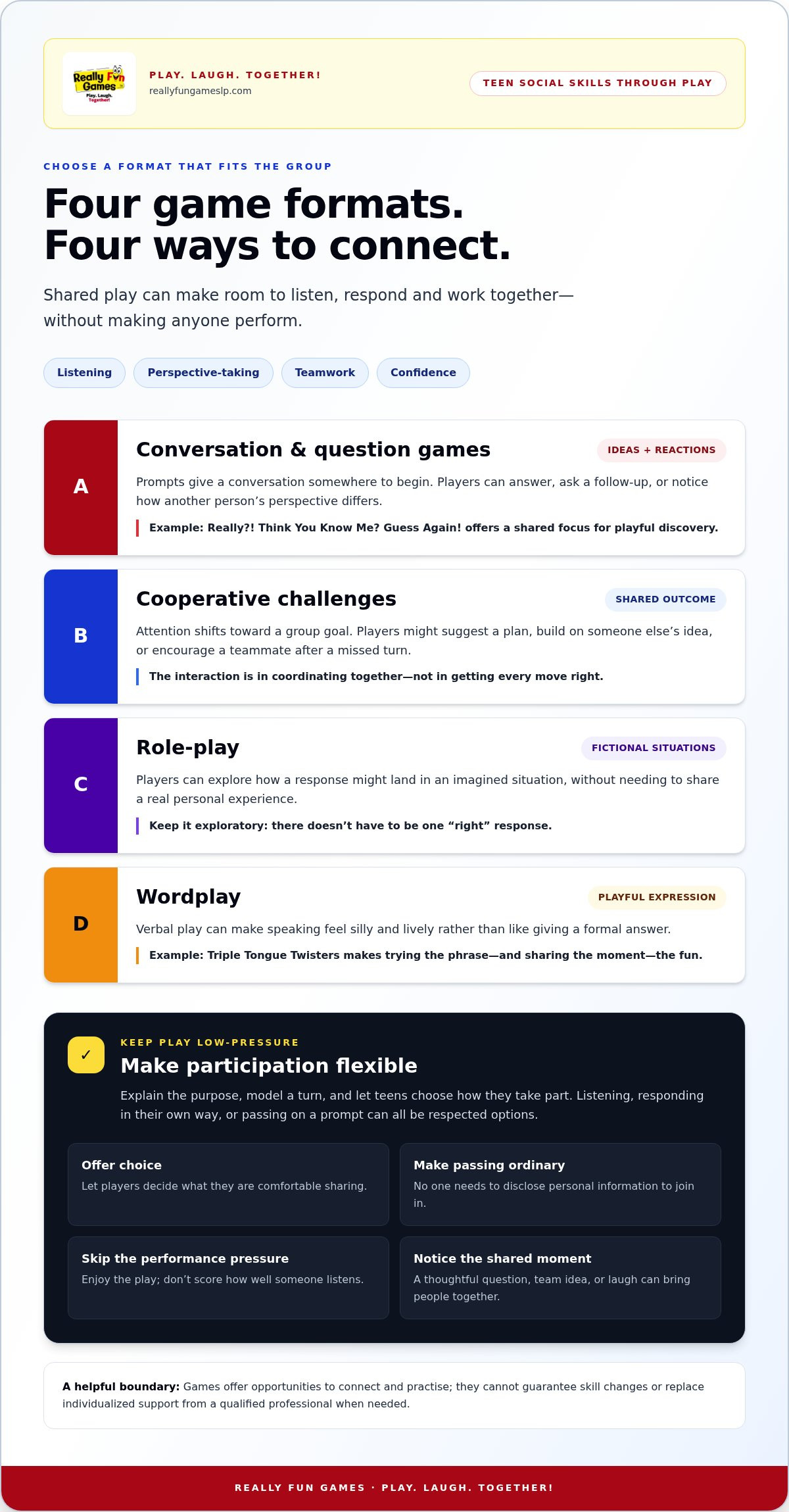
Prompts give a conversation somewhere to begin. A player can answer, ask a follow-up, or notice how another person’s perspective differs from their own. Really?! Think You Know Me? Guess Again! is a conversation-game option for playful discovery. Keep participation flexible: players can choose what to share, respond in their own way, or pass on a prompt that feels too personal.
Cooperative and wordplay games for teamwork and confidence
Cooperative challenges shift attention toward a shared outcome. Players might suggest a plan, build on someone else’s idea, or encourage a teammate after a missed turn. Wordplay offers a different kind of invitation: speaking can feel silly and lively rather than like giving a formal answer. Triple Tongue Twisters brings verbal play to the table, where the fun is in trying the phrase and sharing the moment, not delivering a perfect performance.
These formats offer different kinds of participation, not a universal ranking. A conversation game puts ideas and reactions at the centre; a cooperative challenge emphasizes coordination; role-play lets players explore how a response might land in a fictional situation; and wordplay makes verbal expression playful. Match the format to the group’s interests and comfort, then explain that joining in can look different for each person.
To keep practice from turning into pressure, avoid scoring how well someone listens or asking players to share a real experience after every turn. Instead, model curiosity, make passing an ordinary option, and enjoy the shared moment: a thoughtful question, a surprising team solution, or laughter after a tongue twister goes hilariously sideways. These are opportunities to connect, not proof of improvement.
For shared-play options, explore conversation and wordplay games from Really Fun Games. Choose a format that feels inviting for the teens around your table, or discover Really Fun Games for more ways to bring playful conversation into a group.
How to Choose Teen Social Skills Games for Different Goals and Groups
The best choice depends on what the group enjoys, how well players know one another, and what kind of interaction feels comfortable. Start with a practical question: should the activity invite conversation, shared problem-solving, imaginative responses, or lighthearted speaking? Games for social skills development teens find welcoming fit the group, rather than asking everyone to participate in the same way.
| Practice goal | Game format | Participation style and setting |
|---|---|---|
| Listening and learning about others | Conversation cards | Take turns responding to prompts; useful for family gatherings or a small group. |
| Coordination and shared decisions | Cooperative challenge | Discuss ideas and work toward a common outcome; a natural fit for classrooms or youth groups. |
| Considering different responses | Role-play | Explore a fictional situation from different viewpoints; works well when players are comfortable imagining scenarios. |
| Spontaneous verbal participation | Wordplay | Join in with playful language and humor; suits groups looking for a lively, low-pressure activity. |
Match the game format to the social skill
For listening, turn-taking, and learning about one another, choose conversation formats that make space for each person’s answer without demanding a long personal story. Cooperative games suit goals such as coordinating plans or deciding as a team. Notice whether players build on one another’s suggestions and make room for different ideas. If the group wants a burst of laughter, wordplay offers an easy way to join in. Role-play can suit groups ready to explore fictional situations and consider how different responses might land.
Adapt your choice to the setting and comfort level
For family play, look for simple rules that grandparents, parents, and teens can learn together. In a classroom or youth group, clear turns and options to answer, observe, or pass can make participation feel manageable. For one-to-one or small-group use, a conversation format can leave more room for relaxed follow-up and unhurried responses.
Worried a game will feel childish? Give teens a say. Offer a choice of formats, invite them to suggest a theme or house rule, and choose humor that feels natural to the group. Avoid framing the activity as a test of their social skills. At larger gatherings, icebreaker games can offer an easy first point of connection before people settle into smaller conversations.
Choose one goal and one format to start, then pay attention to how the group responds. If conversation feels forced, switch to a team challenge; if the energy dips, try a livelier verbal activity. For playful options that bring people together, explore Really Fun Games.
How to Facilitate Social Skills Games for Teens
A welcoming setup can make the difference between a game that feels like a group activity and one that feels like an assignment. Keep the aim simple: create a shared experience where teens can choose how they take part. Games for social skills development teens enjoy work best as invitations to connect, not tests of who communicates “correctly.”
Teen-centred facilitation offers meaningful choices without asking anyone to disclose more than they want to. Set that expectation before the first turn, then focus on the game rather than evaluating individual players.
Try this sequence:
- Explain the purpose. Say what the group will do together, such as solve a challenge or explore playful prompts. Keep the explanation brief and don’t present the activity as a test.
- Offer a choice. Let teens choose between suitable games, themes, or ways to participate. A genuine choice gives the group a sense of ownership.
- Model a turn. Demonstrate the rules and show that a short answer, a different perspective, or a pass can all be acceptable.
- Play. Follow the game’s structure, leave time for responses, and step in when a rule needs clarification or someone needs support.
- Reflect briefly. Invite a comment about what felt fun, surprising, or easy to share. Keep reflection optional and open-ended.
Set up a welcoming game before the first turn
Make the rules easy to follow, then demonstrate one turn so everyone can see how to join in. Invite teens to help select the game or adapt a prompt to a shared interest, such as music, hobbies, or fictional characters. Explain that players can answer generally, choose another prompt, or pass. That clarity supports personal boundaries without singling anyone out.
Keep the focus on shared play, not perfect answers
Adults set the tone through their own turns. Show curiosity by asking a friendly follow-up, listen without interrupting, and respond warmly to different opinions. Give teens a moment to think instead of filling every pause. Differences in wording, eye contact, or response style don’t need correction; the aim is comfortable participation, not one “right” way to communicate.
At the end, try one optional question: “What part was fun?” or “Was anything unexpected?” Teens can answer aloud, share a quick reaction, or pass. Avoid rating who listened best or asking players to explain personal feelings. A brief reflection can help the group notice what made the activity enjoyable while keeping the mood relaxed.
For a simple start, choose an easy-to-learn shared game and let teens shape how the group plays. Explore Really Fun Games for conversation and wordplay options to bring to your next gathering.
Bring Teen Social Skills Practice to Life with Shared Games
Shared play gives teens, families, and groups a reason to gather around the same table, focus on the same activity, and enjoy one another’s company. Families might use a conversation game to bring different generations together; educators and youth leaders can use a group game to invite participation; SLPs and therapists may use shared play to create opportunities for communication and teamwork within an activity. In every setting, the game is an invitation, not a guaranteed intervention or a substitute for individualized support.
Choose replayable games that invite people to connect
Simple-to-learn games make it easier to get started, so players can spend less time sorting out instructions and more time enjoying the activity. Really?! Think You Know Me? Guess Again! is a conversation-game option for sharing ideas and discovering how players see one another. Replayability gives a group the option to return to an activity it enjoys, perhaps with different players or a fresh round of conversation. It doesn’t prove that anyone’s social skills have improved. The value is in making another enjoyable opportunity to connect easy to imagine.
Look for a format that offers a comfortable way into the activity. Some teens may like answering a prompt, while others may engage more readily through a shared challenge or playful word game. A familiar structure can help a group settle in, but the people playing bring the fun: an unexpected answer, a teammate’s clever idea, or a shared laugh. Keep the focus there.
Make the next game night easy to start
Skip the elaborate plan. Choose one social goal, such as making space for everyone’s ideas, then pick a game format that naturally fits it. Ask teens what sounds appealing and let them help set the mood, whether that means choosing a theme, inviting family members to join, or keeping the gathering casual. A little ownership can make the activity feel like something the group is doing together.
Really Fun Games creates easy-to-learn, replayable card and conversation games designed to bring people together. For families, educators, SLPs, therapists, and youth leaders choosing a shared activity, the Really Fun Games collection offers conversation and playful participation options to explore. Let the game support the gathering while the group decides how it wants to join in.
Start with a game that feels enjoyable for the teens in front of you. When the rules are approachable and the atmosphere is relaxed, play can make room for laughter, conversation, and meaningful time together. Explore the collection and choose a game that fits your group.
Make Your Next Gathering a Moment to Connect
Treat the next game night as a small experiment in togetherness. Pick a moment that already brings people into the same space, then invite teens to choose what sounds fun. Let the conversation wander, allow quiet moments, and don’t turn every turn into a teaching point. Sometimes a shared joke or an unexpected answer is reason enough to keep playing.
Games for social skills development teens can enjoy should fit the people around the table, not ask them to fit a rigid idea of participation. Choose an activity that welcomes different ages and ways of joining in. Really Fun Games offers award-winning games designed for ages 8 and up, including conversation and wordplay options for shared play.
Ready to find a game for your family, classroom, or group? Explore the Really Fun Games collection and choose an activity that feels right for your next gathering. A little play can make room for laughter, fresh conversations, and time together worth repeating.
Frequently Asked Questions
What are the best games for social skills development for teens?
The best choice is a game teens are genuinely willing to play, not simply one labelled educational. Notice what they already enjoy: quick humor, clever word challenges, guessing what others might say, or working toward a shared result. Games for social skills development teens find engaging are more likely to become part of ordinary time together. If you’re unsure where to start, let teens choose between a couple of formats and see which one sparks interest.
Can games help teens practise social skills without making them feel awkward?
Yes. A casual setting can make a game feel like a pastime rather than a spotlight. Try playing while sharing a snack or during a relaxed family get-together, instead of announcing a special “social skills activity.” Keep reactions genuine: laugh at a funny answer, show interest in an unexpected one, and let the conversation move on. That helps the game blend into time spent together.
How can parents encourage a shy teen to join a social game?
Give a shy teen a private, low-key invitation instead of asking in front of a group. Mention the game ahead of time, explain why you think they might enjoy it, and let them decide whether to join. Avoid recruiting siblings or relatives to persuade them. If they’re interested but uncertain, offer to try it together another day, without making participation a measure of confidence or progress.
Are conversation card games suitable for teenagers?
Yes, conversation card games can work well for teens when the language and topics respect their age and sense of humor. They can also suit mixed-age gatherings, where a prompt gives relatives of different generations a common starting point. Pay attention to how the group responds: if a question gets blank stares or feels out of step, skip it and move on. The cards should support conversation, not dictate it.
Can teachers use social skills games in a classroom?
Yes. A teacher might use a game as a change of pace after a demanding lesson or as a way for classmates to reconnect after working independently. Consider how the activity will fit the room: where students will sit, how materials will be shared, and how the group will know when play is finished. A predictable setup can make the activity smoother and preserve time for the rest of the class.
Do social skills games replace therapy or professional support?
No. A game can’t assess a teen’s needs or take the place of individualized guidance from a qualified professional. It’s best understood as recreation that may offer ordinary opportunities to interact, not as treatment or a measure of progress. If a teen already receives professional support, keep that relationship and any existing care plan central. Use games for enjoyment, and leave assessment and individualized recommendations to the professional.
How can a family make a social skills game feel fun instead of instructional?
Let the game be the main event instead of turning each answer into a family discussion. Connect play to something the household already enjoys, such as a relaxed weekend meal or a visit with relatives. Keep competition friendly and don’t make winning the only source of excitement. A silly response, an amusing disagreement, or a surprising family story can become the moment everyone remembers.