

What if the best first game feels more like a conversation than a test? If rules-heavy rounds, fierce competition, or being put on the spot have made game night feel awkward, you’re not alone. The right games for people who don’t like games make it easy to join in, with room to laugh, listen, and take part at your own pace.
You don’t need to persuade a reluctant player to love complicated rules or winning. You need a format that fits the people around the table. This guide compares low-pressure options and offers practical ways to choose an easygoing first game for a mixed-age family, a gathering of friends, or a classroom group.
We’ll look at conversation games, playful word games, and cooperative activities, along with simple ways to make a first round feel welcoming. Really Fun Games creates award-winning games in approachable styles: Really?! Think You Know Me? Guess Again! invites conversation, while Triple Tongue Twisters brings vocal play and laughter into the mix. The goal isn’t to turn everyone into a game enthusiast. It’s to find a fun way to connect.
Key Takeaways
- Games for people who don’t like games feel more inviting when the rules are simple and participation is flexible.
- Compare conversation cards, wordplay, party games, and tabletop games by rules, attention, interaction, and competitive pressure.
- Match the game style to your group’s comfort with spontaneity, conversation, and friendly competition.
- Help hesitant players ease in by explaining the activity briefly, demonstrating an example, and inviting volunteers to start.
- Explore easy-to-learn card and conversation games designed to bring different ages and personalities together.
Why games for people who don’t like games need a different starting point
“I don’t like games” can sound like a firm no, but it may really mean “I don’t enjoy being tested in front of everyone.” A long rules explanation can make a casual evening feel like homework. Scorekeeping can turn friendly play into pressure, while performance-based prompts may leave quieter guests wondering whether they have to be funny, quick, or personal to belong.
An approachable game gives people a clear way in without asking them to master a system first. A useful distinction is this: A low-pressure game is easy to join, comfortable to play socially, and enjoyable without studying rules or proving you’re the best. Some qualities associated with a casual game, such as simple rules and less emphasis on learned skill, can make play feel more accessible.
That doesn’t mean every activity needs to be quiet or have no structure. It means the group can focus on the shared moment rather than worry about getting every move right. A conversation game gives people a prompt to react to, while wordplay can spark laughter without requiring a strategic plan. One person might happily swap stories but prefer to skip scorekeeping; another may enjoy clear turn-taking but feel uneasy improvising in front of the room.
Disliking one style doesn’t mean disliking every playful group activity. Before choosing, try to identify what feels uncomfortable. Is it the number of rules, the competitive edge, attention from the group, or not knowing how everyone else will behave? The answer can point you toward a better fit.
What might someone mean when they say they don’t like games?
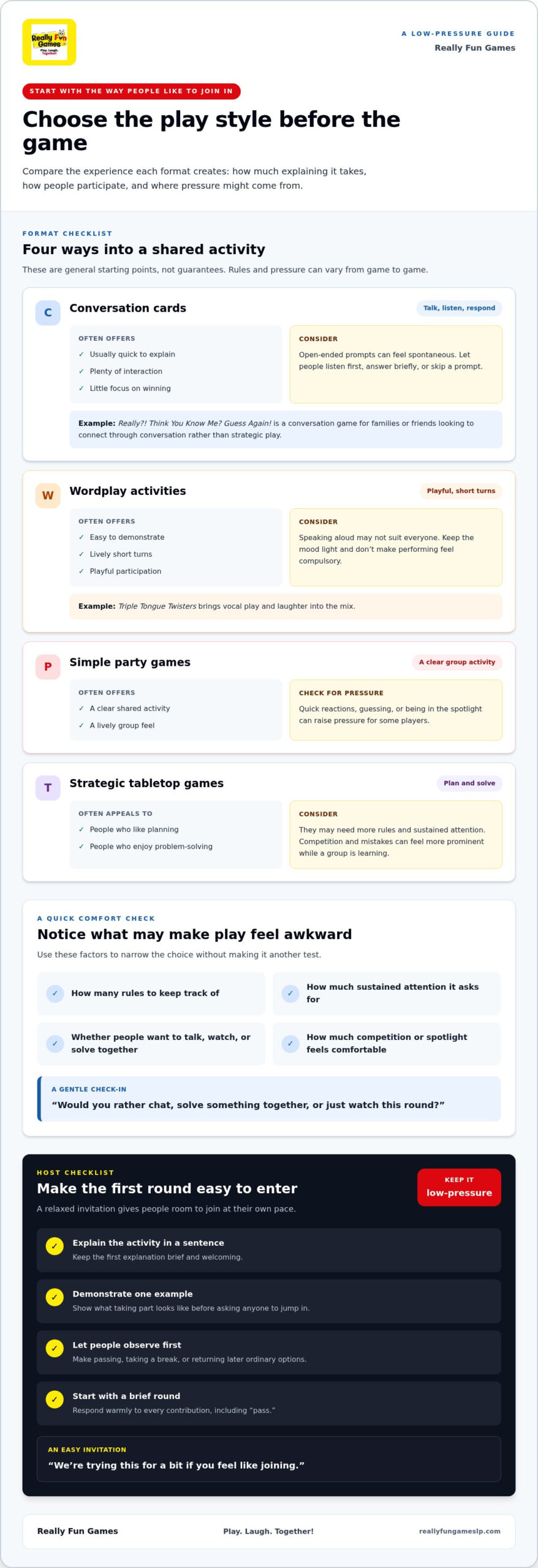
People may be reacting to very different parts of play: keeping track of rules, losing, speaking in front of others, or joining a group with unfamiliar expectations. Ask an easy, specific question rather than guessing: “Would you rather chat, solve something together, or just watch this round?” Their answer helps you choose a comfortable format without making them explain or defend their preferences.
For families, teachers, or group hosts, this small check-in can make game night feel more considerate. If conversation sounds appealing but strategic play doesn’t, consider a format built around prompts rather than complicated turns. Browse card and conversation games for options that put interaction at the center.
How to make a first invitation feel welcoming
Keep the invitation light: explain the activity in a sentence, demonstrate one example, and let the person observe before joining. Make passing, taking a break, or returning later ordinary options, not a spotlight moment. “We’re trying this for a bit if you feel like joining” sounds warmer than “Come on, you have to try.” A relaxed invitation leaves room for curiosity to grow.
Hosts can lower the stakes by starting with a brief round and responding warmly to every contribution, including “pass.” Avoid teasing someone for hesitating or presenting participation as a challenge to overcome. The aim isn’t to persuade a reluctant guest that they’re wrong about games. It’s to offer a comfortable opening where they can connect with the group in their own way.
Which easygoing game styles work best for reluctant players?
The best starting format depends on what your group enjoys doing together. Some people warm up through conversation, others through a silly word challenge, and some prefer a familiar party activity with clear turn-taking. When choosing games for people who don’t like games, compare the experience players will have, not just the theme on the box.
Use this quick guide to narrow the options. Rules and pressure vary from game to game, so treat these as general starting points, not guarantees that everyone will enjoy a particular style.
- Conversation cards: Usually quick to explain, with plenty of interaction and little focus on winning. They suit people who enjoy talking, though open-ended prompts may feel too spontaneous for guests who prefer to listen first.
- Wordplay activities: Often easy to demonstrate and lively in short turns. They invite playful participation, but speaking aloud may not suit everyone. Keep the mood light and avoid making performance feel compulsory.
- Simple party games: Often offer a clear shared activity and a lively group feel. Check how much they rely on quick reactions, guessing, or being in the spotlight, since those elements can raise pressure for some players.
- Strategic tabletop games: Can appeal to people who like planning and problem-solving, but may need more rules and sustained attention. Competition and mistakes can feel more prominent, especially for a group still learning.
Conversation games for people who prefer talking
Conversation prompts make sharing part of the activity, giving a gathering an easy topic to pick up and pass around. For a group still getting comfortable, choose light questions and let players skip a prompt or answer briefly. Really?! Think You Know Me? Guess Again! is a conversation game from Really Fun Games. It’s an option for a family or friend group looking to connect through conversation rather than strategic play.
Wordplay and quick-turn activities for playful energy
Short turns can bring laughter without asking everyone to learn a long sequence of rules. Tongue-twister play offers a distinct kind of group fun: participants try words aloud, and the humor can come from the playful challenge itself. Triple Tongue Twisters is a wordplay game from Really Fun Games. It suits groups who enjoy vocal play, while others can enjoy the silliness as they watch.
Use your group’s preferences as the deciding clue: conversation for people who like sharing, wordplay for those who enjoy trying things aloud, and structured tabletop play for players who welcome planning. To explore more approachable card and conversation options, browse Really Fun Games’ card games and choose a format that feels inviting to your group.
How to compare games without making the choice feel like another test
Choosing a game doesn’t have to become another decision everyone must get “right.” Think of the options as different kinds of social experiences, then consider what would feel comfortable for this particular group. A useful comparison looks at four things: rules, attention, interaction, and competitive feel.
- Rules: Can someone explain the basic idea in a few sentences, or does play depend on remembering several steps? A simple start makes it easier for newcomers to follow along.
- Attention: Does everyone need to focus continuously, or can players listen, pause, and rejoin without losing the thread? A flexible pace may suit a relaxed family gathering better than constant concentration.
- Interaction: Does the game invite conversation, teamwork, wordplay, or individual turns? Choose the kind of participation your group tends to enjoy.
- Competitive feel: Is the fun mostly in sharing the activity, or does it center on winning, speed, elimination, or keeping score? Consider whether those elements will energize the group or make someone self-conscious.
Choose for social comfort as well as play style: the best fit lets people join in without feeling watched, rushed, or judged. Short explanations can help, as can flexible participation. A player might answer briefly, take a turn later, or enjoy listening before joining. These choices let the group discover whether the format feels right without turning the first round into a pass-or-fail moment.
Match the format to the group’s comfort level
For conversation-focused groups, look for prompts that allow a one-line answer or a longer story, so each person can choose how much to share. Shy players may prefer shared responses or group discussion over a turn that puts one person on display. With mixed ages, favor an activity built around familiar experiences or playful ideas rather than specialist knowledge only a few people have.
It can help to describe the feel of the game before bringing it out: “This one gives us a question to talk about,” or “We’ll try some playful word challenges.” That gives people a clearer sense of what participation involves. If you’re comparing approachable card formats for a family or group, browse these card and conversation games with the group’s preferred style in mind.
Spot signs that a game may feel too demanding
Pay attention to the room as well as the rules. If the explanation takes longer than people want to listen, pause and simplify it to the essentials. Consider whether scoring, elimination, or speed could add pressure for this group. If players seem more concerned about making mistakes than enjoying the activity, switch formats or take a break.
A change of plan isn’t a failure. It’s useful feedback. You might move from a fast-paced activity to conversation, or choose a shared challenge instead of asking one person to perform alone. The aim is to make the gathering feel connected, not to finish a game at all costs.
How to introduce a game so hesitant players can join at their own pace
A gentle introduction can shape the whole experience. With games for people who don’t like games, the goal isn’t to deliver a perfect rules lecture. It’s to make the first step clear, let people see how play feels, and leave room for them to join when they’re ready. This approach works for a family gathering, a classroom activity, or a group meeting new people.
Try this simple sequence:
- Describe the activity. Explain the basic idea in one plain-language sentence.
- Show an example. Demonstrate a turn so players can see what they’ll actually do.
- Invite volunteers. Let someone try first without calling on a hesitant guest.
- Begin simply. Keep early turns brief, then add details only if the group needs them.
For group introductions, this low-pressure approach can help icebreaker games feel more like a shared welcome than a performance. The host sets the tone: curiosity is welcome, and nobody needs to prove they’re good at playing.
A simple way to explain the activity
Use a sentence that tells people what to do, not every rule they might need later. For example: “We’ll take turns answering a light question.” Then demonstrate one response, pause for questions, and start once everyone understands the first step. If a rule becomes relevant during play, explain it then. A short, useful introduction is easier to follow than a full list of possibilities.
Choose a first example that shows the intended mood. If the activity is about conversation, demonstrate a light response rather than a deeply personal one. If it involves playful words, show that stumbling can be funny and ordinary. A quick example answers the unspoken question, “What am I expected to do?” without putting anyone on the spot.
Keep participation flexible and the mood light
Some people will answer with a story; others may offer a few words, laugh along, or pass. Make all of these ordinary ways to take part. In games that bring people together, a surprising answer or a tongue-tied moment can become part of the shared fun, not a mistake to correct. Give people permission to watch, step away, or rejoin without explaining themselves.
Pay attention to the group’s energy as you go. If attention dips, finish at a natural stopping point rather than pressing on to complete every round. A flexible host can switch activities, take a break, or simply let the conversation continue. That sense of choice makes play more welcoming for children, teens, and adults with different comfort levels.
For approachable ideas to spark conversation and laughter, explore Really Fun Games.
Find a welcoming first game with Really Fun Games
The choice comes down to what your group would enjoy doing together: talking, playing with words, or following a more structured challenge. Really Fun Games creates award-winning card, conversation, and educational games designed for ages 8 and up. The games are easy to learn and highly replayable, making them a good option when a group wants an inviting activity without a steep learning curve.
For a first pick, think about the group’s comfort with speaking, spontaneity, and friendly competition. A conversation-led format puts interaction at the center, while wordplay offers a livelier way to share a laugh. Neither style has to suit everyone. Choose an option that feels like a natural fit for the people gathered, not another test they need to pass.
Choose a conversation-led option
Conversation games shift attention away from complex strategy and toward what people think, remember, or want to share. That can make them a comfortable choice for family game night, a gathering of friends, or a group looking for conversation starters. Players connect through the exchange itself, rather than focusing only on who wins.
Really?! Think You Know Me? Guess Again! is a conversation game from Really Fun Games. Explore the Really Fun Games collection to find a conversation-centered game or another style that matches your group. Consider who’s playing and what kind of interaction feels welcoming, especially if some guests would rather listen before sharing.
Choose wordplay when the group wants to laugh together
For a group that enjoys saying things aloud and being a little silly, tongue-twister play offers a different route into shared fun. The focus is on playful spoken challenges, not perfect delivery. A stumble can become a moment to laugh together, and people can enjoy the vocal play in their own way.
Triple Tongue Twisters is a wordplay game from Really Fun Games. It’s an option for a family, classroom, or group of friends who want a lively change from conversation prompts. Introduce it casually and leave room for people to watch or join at their comfort level.
Whether your group is drawn to conversation or wordplay, an easy-to-learn card game can give everyone a clear way to take part. Explore the Really Fun Games collection and choose a comfortable first pick for your family, classroom, or gathering.
Make room for a more relaxed kind of game night
The first game doesn’t need to change anyone’s mind. It only needs to create a moment the group enjoys: a shared laugh, an unexpected story, or an easy reason to keep talking. That’s a lovely place to start with games for people who don’t like games. Let the group’s response guide what you try next, and remember that watching or passing can be part of a good evening, too.
For your next family gathering, classroom activity, or get-together with friends, choose a first pick that fits the mood you want to create. Keep the invitation casual, make space for different comfort levels, and let connection matter more than keeping score.
Explore the Really Fun Games collection and find a welcoming first pick for your group. A little laughter can be the start of a new favorite tradition.
Frequently Asked Questions
Can someone who dislikes games still enjoy a conversation card game?
Yes, especially if they enjoy chatting but dislike keeping score or planning moves. A conversation card game can give the group a shared topic to react to, rather than asking anyone to master a strategy. With games for people who don’t like games, fit is what matters: someone who loves telling family stories may enjoy a prompt about favorite memories, while someone more reserved might prefer listening or offering a short reply.
What makes a game feel too complicated for a beginner?
A game may feel complicated if a new player must remember several exceptions, interpret unfamiliar symbols, or make choices before understanding what those choices do. Watch for repeated pauses to ask, “What happens now?” or “Did I do that right?” Those are cues to recap the current step in plain language. If the group still feels stuck, choose a format with fewer decisions or a more familiar activity.
Is a noncompetitive game always better for people who don’t like games?
No. Some reluctant players enjoy a friendly score if the rules are clear and losing carries no sting. Others prefer working toward a shared goal or playing without a winner. Think about the person, not the label: does a little challenge energize them, or do comparisons make them withdraw? You can also make the score optional, so the group can enjoy the activity without making winning the point.
How can I invite a shy person to play without putting them on the spot?
Invite them one-on-one before the group starts, so they don’t have to answer in front of everyone. Briefly describe what the activity involves, then let them decide without asking for a reason. You might offer a quieter role, such as helping choose a prompt or sitting beside someone they know. Avoid announcing their decision to the group; a discreet invitation makes participation feel like a choice, not a performance.
Are card games a good choice for a family with different ages?
They can be, if the activity gives everyone a way to contribute without relying on knowledge only one age group has. Before starting, consider whether younger players can follow the wording and whether older relatives will enjoy the pace. A shared prompt can invite different kinds of answers, from a child’s imaginative take to a grandparent’s memory. If reading is a hurdle, another player can read the card aloud.
What should I do if someone loses interest halfway through a game?
Check in quietly rather than asking them to explain themselves in front of the group. They may be tired, confused, or simply ready for a different activity. Offer a simple choice, such as finishing the current round or switching to conversation. If they leave the game, keep the group moving without treating it as a disruption. Their response can help you choose a better fit next time.
Ready to find an easygoing idea for your group? Explore the Really Fun Games collection and choose a playful fit for your next gathering.