
What makes a useful game for a speech session? Often, it’s not flashy pieces but the chances it creates for a learner to communicate. Choosing games for speech language pathologists means finding activities that hold attention and make room to speak, listen, take turns, or practise a sound. The right game can help those moments feel like play, not another drill.
For an SLP, a game is a tool, not the goal. Its value depends on how well the play supports an individual communication target and how easily the activity can be adapted to the learner, skill level, and session setting.
This guide shows how to match game mechanics to communication goals, adjust prompts to invite participation, and reuse familiar play with individuals, pairs, or groups. It also offers examples of physical games that can prompt purposeful practice, including Really Fun Games’ Triple Tongue Twisters for playful articulation activities and Really?! Think You Know Me? Guess Again! for conversation. Use these ideas to make choosing a session game simpler, more intentional, and more fun.
Key Takeaways
- Choose games for speech language pathologists by the communication opportunities their mechanics create, not just by how entertaining they look.
- Connect articulation, language, vocabulary, and pragmatic goals with prompts that feel natural during play.
- Compare card, tabletop, and digital formats according to the learner and session context rather than assuming one format suits everyone.
- Use a simple four-step plan to turn a game into purposeful practice, then reflect on what encouraged participation.
- When choosing materials, consider age fit, adaptable play, meaningful communication, and whether players will want to return to the game.
What Makes a Game Useful for Speech-Language Pathology Sessions?
A therapy game is useful when an SLP can adapt it to create relevant communication opportunities while keeping the learner’s goals at the center. Speech-language pathology supports communication and related needs. A game can add a lively context for practice, but it doesn’t replace an SLP’s professional judgment or individualized therapy.
A game’s entertainment value can help hold attention; its session value depends on whether its play creates opportunities to work toward a chosen communication goal. The same activity may suit one session and not another. Before choosing, consider what the learner can do during play, what support might help, and whether the activity fits the session’s purpose.
Different mechanics create different openings. Predictable turns help players anticipate when to speak or listen. Choices can invite a player to select, request, or explain. A shared card or playful surprise gives the group a common topic. These features don’t guarantee a particular response or skill gain. They give the SLP opportunities to shape the interaction around the learner.
What communication opportunities can gameplay create?
A turn might invite a player to request a card, describe a picture, answer a question, listen to someone else, or wait for a chance to speak. The SLP can observe how the learner communicates in ordinary play, then offer a prompt or model when it supports the goal. There’s no need to interrupt every turn. Let the game’s rhythm continue and step in when a useful opportunity arises.
For example, if a player reaches for a card, the SLP might pause to allow time for a request, then acknowledge a gesture, word, or other communication attempt as appropriate. During a description, the SLP can listen for the targeted skill without turning every move into a test. The game creates the moment; the SLP decides how to respond and what to observe.
Which learners and settings can benefit from game-based activities?
SLPs can adapt play to individualized communication goals. Educators may use structured activities to support classroom participation, while caregivers and families can enjoy shared play and everyday conversation. Each role has a different purpose: clinical decisions differ from classroom aims or a family’s home routine.
Start with the learner, not the game box. Age, interests, communication profile, and individual goals all affect whether an activity feels inviting and manageable. One learner may enjoy lively wordplay, while another may prefer a clear turn-taking routine or conversation prompts.
Really Fun Games creates physical card and conversation games designed for ages 8 and up. For learners within that age guidance, an SLP can adapt an activity to encourage speaking and listening opportunities while keeping the learner’s goals in view. Explore physical card and conversation games as materials for purposeful play.
Match Speech and Language Goals to the Right Game Mechanics
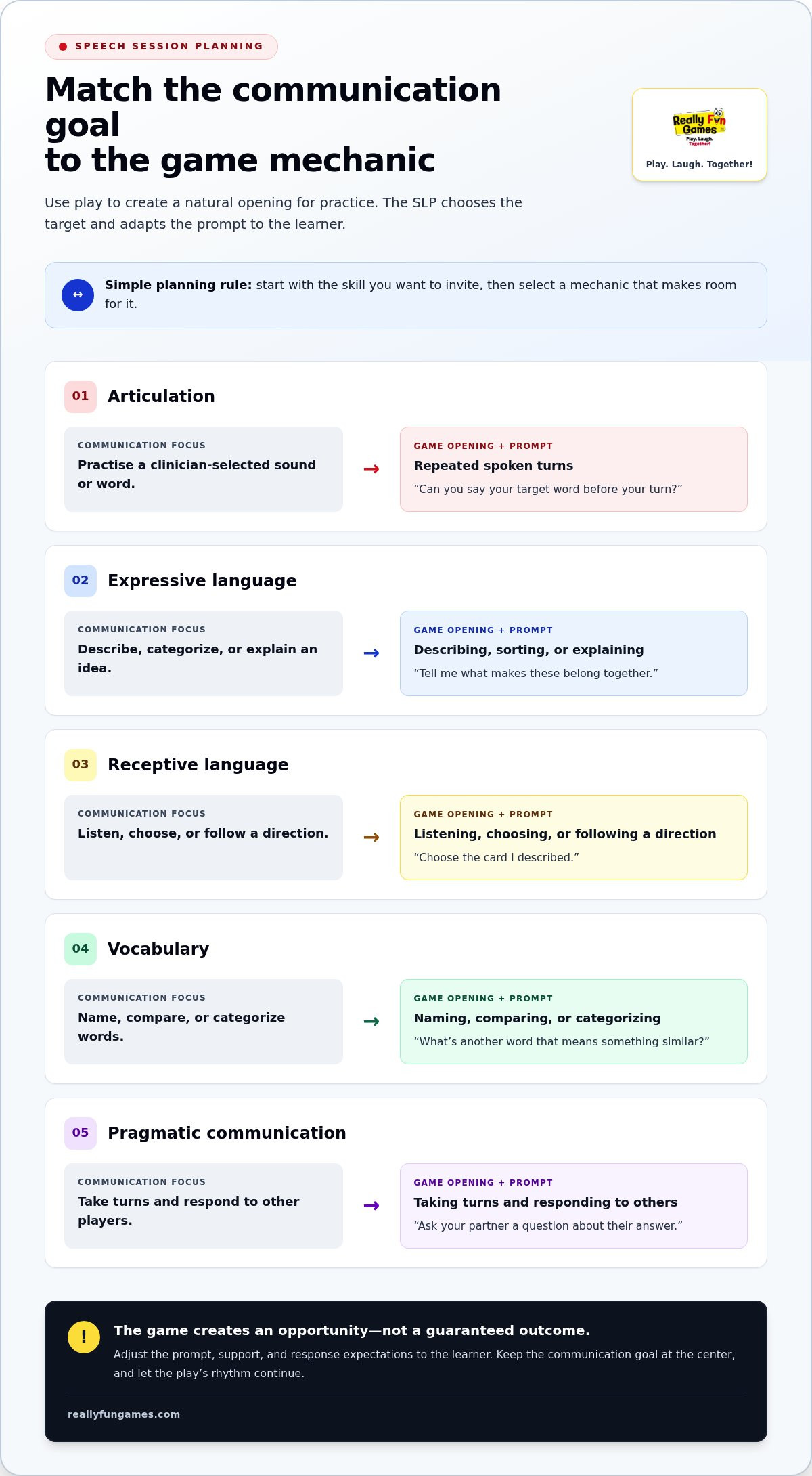
Start with the skill you want to invite, then choose a game mechanic that naturally makes room for it. A quick turn can create a chance to say a target sound; a choice can prompt a description; a shared question can open a back-and-forth exchange. The clinician selects the target and adjusts prompts to suit the learner. The game provides structure, not a preset therapy plan.
Game mechanics create opportunities for practice, not guaranteed clinical outcomes. Use the examples below as starting points, then tailor the prompt, level of support, and response expectations to the person in front of you.
| Communication focus | Helpful game mechanic | Possible prompt |
|---|---|---|
| Articulation | Repeated spoken turns | “Can you say your target word before your turn?” |
| Expressive language | Describing, sorting, or explaining | “Tell me what makes these belong together.” |
| Receptive language | Listening, choosing, or following a direction | “Choose the card I described.” |
| Vocabulary | Naming, comparing, or categorizing | “What’s another word that means something similar?” |
| Pragmatic communication | Taking turns and responding to others | “Ask your partner a question about their answer.” |
Which mechanics can support articulation and language practice?
Repeated turns can offer natural chances to practise a clinician-selected sound or word without making every move a drill. For example, an SLP might use a tongue-twister activity to invite playful sound practice, then adjust the spoken target or level of support to suit the learner. Really Fun Games’ Triple Tongue Twisters is a physical card game an SLP can adapt for articulation activities.
For expressive language, look for mechanics that invite describing, categorizing, or explaining. To create a receptive-language opportunity, an SLP might give a short direction, offer a small set of choices, or ask the learner to listen for a clue before acting. Simplify or expand the prompt as needed instead of assuming one version will work for everyone.
How can play invite social communication?
Shared play makes interaction part of the activity: players take turns, listen, stay with a topic, and respond to someone else’s ideas. Conversation prompts can give learners a starting point for sharing opinions or asking a follow-up question. Really?! Think You Know Me? Guess Again! is a conversation game an SLP can adapt for speaking and listening practice.
For more ideas on choosing materials around learning goals, explore this guide to educational games for speech therapists. If you’re looking for physical games to adapt, browse the Really Fun Games collection and consider which mechanics fit your session’s communication target.
Compare Game Formats Before Choosing Materials for an SLP Session
The best format is the one that fits the learner, communication goal, and realities of the session. A stack of cards can be easy to bring out and pause. A familiar tabletop game can provide a shared structure. A digital activity may suit a session where a screen is already part of the plan. No format is automatically right for every learner.
When comparing games for speech language pathologists, look beyond the format label. Consider setup, how players interact, and how easily you can adapt the activity while keeping the learner involved.
| Format | Portability | Turn structure | Flexibility | Adult facilitation |
|---|---|---|---|---|
| Physical card game | Often easy to carry | Turns can be brief and paused | Prompts can be added or adjusted | Adult can guide the pace and discussion |
| Familiar tabletop game | Depends on the materials | May have a clear shared sequence | Existing play can be adapted with prompts | Adult may explain or support the rules |
| Digital resource | Depends on the session setup | Interaction follows the activity’s design | Options vary by resource | Adult can guide participation and responses |
When might a physical card game fit the session?
Card games can be convenient when you want materials that are easy to carry and bring to a table. Face-to-face play gives the SLP and learner a shared focus. The rhythm of taking turns also makes it natural to pause, model a response, or allow extra time. The cards don’t need built-in therapy features; the clinician can add a relevant prompt in their own words.
For example, Really Fun Games’ Triple Tongue Twisters is a physical card-game option an SLP can adapt for playful articulation practice. The clinician can decide whether its wordplay and format suit the learner and session context.
When might a board game or digital activity be a better fit?
A familiar tabletop game may work well when its shared sequence helps players take turns, attend to the same activity, and anticipate what happens next. An SLP can use moments in the game to invite communication while keeping the rules manageable. A digital activity may also suit a learner or session format when screen-based interaction fits the plan and available setup.
Compare the format with the person and context in mind. Does it support participation, let you guide the interaction, and make it practical to observe communication? For another physical-play option, browse communication and card games and consider which activity could fit your session.
Plan a Playful Speech Therapy Activity in Four Practical Steps
A little planning can keep a game lively while giving the activity a clear purpose. Use these four steps to connect a communication goal with a simple play routine, then adjust as you observe the learner. Participation can mean watching, choosing, speaking, or taking a supported turn, depending on the person and moment.
- Choose a goal. Identify the communication skill you want to create an opportunity for, such as practising a selected sound, describing an item, following a direction, or responding to a partner. Keep the focus specific enough to guide your prompts.
- Select a mechanic. Look for a natural fit between the goal and the way the game works. Repeated turns may invite spoken practice; choices can prompt naming or requesting; shared questions may encourage listening and conversation.
- Set a prompt. Prepare an open prompt and an easier entry point. For example, “Tell me about it” can become “Is it big or small?” or a choice between two descriptions. Model a response if it helps the learner understand what you’re inviting.
- Reflect. After the activity, consider what drew the learner in, what support helped, and whether the mechanic created useful communication moments. Use those observations to guide future choices rather than assuming a particular outcome.
How can an SLP adjust prompts and participation?
Offer a prompt that allows a longer answer when it fits the learner, then add support if needed. You might model a short response, pause to allow processing time, or reduce the number of choices. Keep turns brief if a longer response feels demanding. A learner can also watch, point to a choice, or take a supported turn. These are ways to participate, not reasons to pressure someone to speak.
Small adjustments can keep the activity enjoyable and make it more accessible in that moment. Follow the individual goal and your professional judgment, and let the game continue when extra prompting isn’t useful.
How can tongue-twister games add playful speaking practice?
Tongue twisters bring rhythm, repetition, and silliness to spoken play. An SLP can decide whether to model a phrase, invite the learner to try it at a comfortable pace, or simply enjoy the wordplay together. The clinician might pause between attempts, adjust the prompt, or move on if the activity doesn’t suit the learner’s goal. Tongue twisters are playful speaking activities, not a guaranteed treatment method.
For ideas on bringing this kind of play into shared activities, explore tongue-twister games for speech and confidence. You can also explore playful card and conversation games and consider which materials could work with your session plan.
Bring Communication-Focused Play into Your SLP Toolkit
Look beyond whether a game seems fun when choosing materials. Consider four practical points: whether it fits the learner’s age, what communication opportunities it offers, how easily you can adapt it, and whether players may enjoy returning to it. These checks help narrow your options to materials suited to the learner and setting.
Which Really Fun Games titles fit communication-focused play?
Really Fun Games creates award-winning physical card and conversation games. The collection includes conversation-focused options and playful word activities, giving SLPs different kinds of materials to consider for their toolkit. Instead of expecting a game to do the clinical work, consider whether its format and content provide a useful starting point for interaction.
What should SLPs keep in mind when adding games to their toolkit?
Let each learner’s goals guide your choice and any changes you make during play. A material that works well in one setting may need a different prompt, pace, or level of support in another. Keep expectations realistic: a game can invite communication, but it doesn’t promise a particular result. The SLP’s judgment keeps the activity purposeful and responsive.
Explore physical games for communication-focused play to find materials to consider for your toolkit. Discover the Really Fun Games collection and choose a playful option for your learners and setting.
Make Your Next Session a Little More Playful
A well-chosen game can bring fresh energy to a session, but what matters is making space for each learner to join in. Notice which kinds of play invite a response, which supports feel comfortable, and whether a small change could make participation easier. That attention keeps games for speech language pathologists connected to individual goals and real people, rather than turning play into a one-size-fits-all routine.
You don’t need to transform every session. Start with one engaging activity, adapt it thoughtfully, and let the learner’s participation shape what comes next. A shared laugh, a brave attempt, or a thoughtful response can make the room feel more connected.
Ready to find a new playful option for your toolkit? Explore the Really Fun Games collection and choose a game that fits your learners and setting. Bring more curiosity, communication, and joy to your next session.
Frequently Asked Questions
Can games replace speech-language therapy?
No. Games for speech language pathologists are materials an SLP may use within a broader, individualized therapy plan, not a replacement for professional care. A game might provide a playful setting to practise a skill, while the SLP decides whether the activity fits the learner’s needs and how to respond. If play isn’t serving the session’s purpose, the clinician can change the activity or move on.
Are speech therapy games only for young children?
No. Playful activities can suit learners of different ages when the content and expectations fit the person. An SLP might choose a lighthearted word activity for one learner and a conversation-based game for a teen or adult. Consider the player’s interests, communication profile, and comfort with the activity rather than assuming a game is suitable just because it’s labeled educational or fun.
Can a card game be used in a one-on-one speech session?
Yes. In a one-on-one session, an SLP can play alongside the learner, take turns, or use a card as a shared topic for conversation. If an activity usually involves several players, simplify the routine for two people. For example, alternate responses or take turns choosing a prompt, depending on what best supports the learner’s session goals.
How do SLPs keep a game from distracting from the session goal?
Choose one communication focus before play begins and keep a simple reminder nearby. If the focus is describing, for instance, the SLP might invite the learner to add one detail about a selected item before continuing. If excitement takes over, pause for a quick reset, simplify the next turn, or switch activities. The goal is purposeful play, not finishing the game.
Are tongue twisters useful activities for speech-language pathologists?
They can be a playful speaking activity when an SLP decides they fit the learner and session purpose. A clinician might model a phrase or invite the learner to try it at a comfortable pace, keeping the activity light rather than treating a tricky phrase as a test. Tongue twisters won’t suit every communication goal, so the SLP’s judgment should guide whether and how to use them.
Can families use communication games at home between sessions?
Yes. Families can use a communication game as a relaxed way to share ideas, listen, and enjoy time together. Keep the focus on connection rather than trying to run a therapy session at home. If the SLP has suggested a particular way to support communication, families can follow that guidance during play. A warm conversation and a laugh are valuable parts of the experience, too.