
The most decorated card game isn’t automatically the one your family, classroom, or group will love playing together. Award winning card games can offer a useful quality signal, but an award alone won’t tell you whether the rules feel approachable, the style suits your players, or everyone will want to play again.
When so many games promise a memorable game night, recognition can help you build a shortlist. Then match each game’s style to the people around your table. A conversation game, a playful word challenge, and a strategy game create different kinds of fun, so start with the experience you want to share.
In this guide, you’ll learn what awards can and can’t tell you, how to compare game styles, and what to consider for mixed ages, classrooms, and other groups. You’ll also find practical ways to assess replayability, communication, and group fit. Really Fun Games creates award-winning card and conversation games for ages 8 and up, including Really?! Think You Know Me? Guess Again! and Triple Tongue Twisters. These easy-to-learn, highly replayable games offer different ways to spark conversation, enjoy playful word challenges, and connect through play.
Key Takeaways
- Use award recognition as a useful clue, not a guarantee that a game will suit every player.
- When comparing Award winning card games, look at the award source and category alongside the intended audience and style of play.
- Choose the experience first: conversation, wordplay, strategy, or familiar card mechanics each brings a different feel to the table.
- For a better fit, identify who’ll play, decide what kind of interaction you want, then consider how easy the game is to learn and replay.
- For conversation-led play, consider Really?! Think You Know Me? Guess Again!, an example from Really Fun Games.
What Makes Award-Winning Card Games Stand Out?
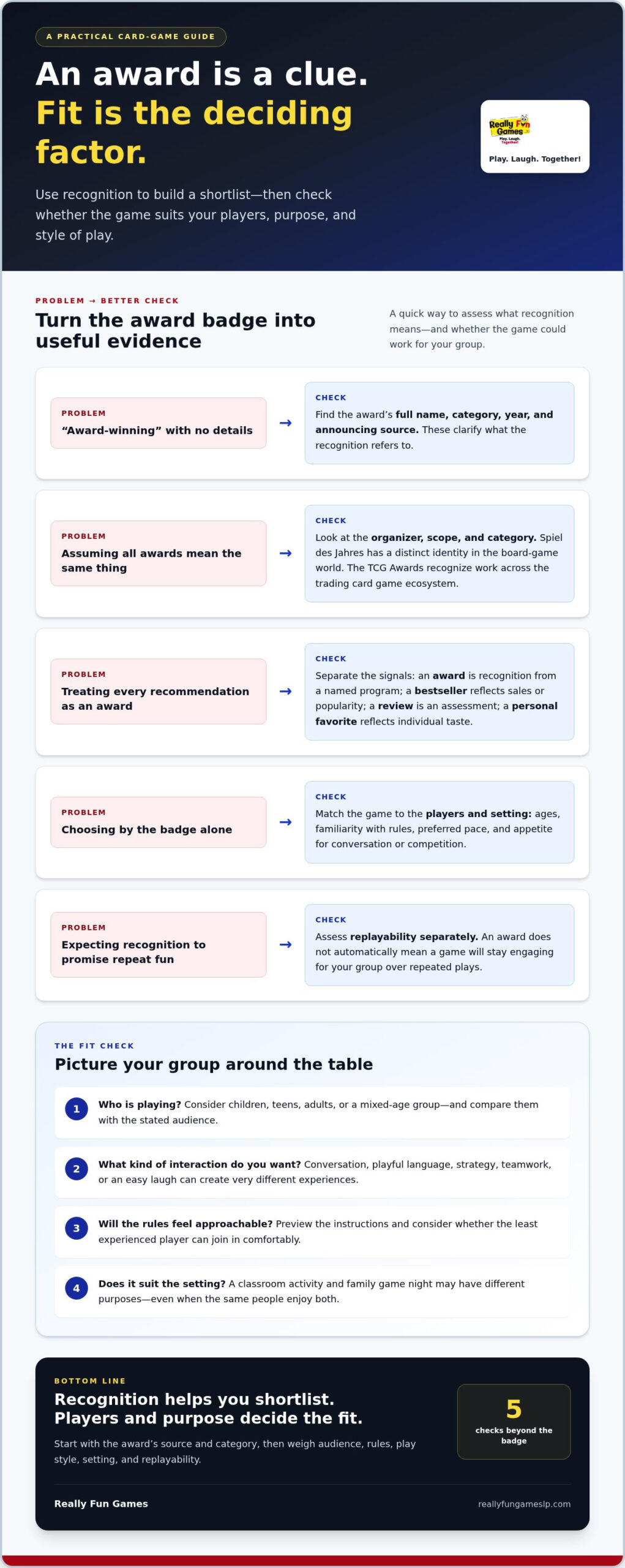
An award badge can catch your eye, but it needs context. Award-winning card games are games that have received recognition from a named award program. That recognition is a clue, not a promise that every group will enjoy them. This distinction matters when you’re choosing a game for family night, a classroom, or a group with varied tastes.
Awards and categories aren’t interchangeable. Each program has its own organizer, scope, and way of recognizing games. For instance, the Spiel des Jahres award has a distinct identity in the board-game world. Knowing which award a game received gives you something specific to look up, rather than relying on a vague “award-winning” label.
What an award can tell you about a card game
Recognition gives you one reference point alongside the game’s style, intended audience, and the kind of interaction you want. Before giving a badge much weight, look for the award’s full name, category, year, and the source announcing the result. These details clarify what the recognition refers to and help you avoid treating awards from different programs as equivalent.
Keep different kinds of recommendations separate, too:
- Award recognition means a game received a distinction from a named program.
- Bestseller rankings reflect sales or popularity, not necessarily an award decision.
- Reviewer recommendations express a writer’s or publication’s assessment.
- Personal favorites reflect individual taste and experience.
Each can help you discover games, but each answers a different question. A popularity list may show what people are buying, while a review can explain why one person enjoyed a game. An award claim should point to a specific recognition you can identify and investigate.
Why an award does not guarantee the right fit
A well-regarded game can still miss the mark for your table. Players’ ages, comfort with the rules, preferred pace, and appetite for conversation or competition all shape the experience. A lively word-play game may suit one group, while another prefers a relaxed way to share stories and laugh together. A classroom activity also has a different purpose from family game night, even if the same people enjoy both.
Consider the setting as well as the players. Will the group have time to learn a new style of play? Are you hoping to encourage conversation, playful language, teamwork, or simply a cheerful break? Those questions reveal more about fit than a badge alone. To explore conversation-led and word-play options, browse the Really Fun Games card and conversation games.
A game’s fit depends on its players and purpose, not just its awards. Use recognition to make a shortlist, then consider how the game might feel around your own table.
How to Evaluate an Award-Winning Card Game Before Choosing
A useful choice starts with two questions: what does the recognition refer to, and will the game suit the people who’ll play it? A badge can help you build a shortlist, but the best decision connects the award information to your group’s needs. Recognition is most useful when you can identify its source and category.
Use this checklist to compare options:
- Find the original award source. Look for the award’s full name and the organizer’s announcement, rather than relying on a product description that only says “award-winning.”
- Identify the category. A program may recognize different kinds of games or contributions. Read the category instead of assuming every award reflects the same qualities.
- Check the intended audience. Compare the stated age range and audience with your players, including children, teens, adults, or a mixed-age group.
- Preview the rules and experience. Consider whether the instructions seem approachable for the least experienced player and whether the play style fits your setting.
- Assess replayability separately. An award doesn’t automatically mean a game will stay engaging for your group over repeated plays.
Check the recognition and the game’s audience
Separate what you can verify from what reflects someone’s judgment. An award announcement is a sourced fact; a reviewer’s explanation of why a game works is an opinion informed by experience; a brand description tells you how the creator presents the game. All can be useful, but they aren’t the same kind of evidence. Don’t assume every award uses identical measures or that one category speaks to every player.
For example, The TCG Awards recognize work across the trading card game ecosystem, so their scope differs from an award focused on another type of game. Check who granted the recognition and what it covers, then compare the game’s audience with your group. A title designed for ages 8 and up may suit some family or learning settings, but age alone can’t tell you whether its style will appeal to those players.
Look beyond the badge to the playing experience
Picture your group around the table. Are players hoping to swap stories, find the funniest words, plan their moves, build teamwork, or share an easy laugh? These experiences can feel very different, even among highly regarded games. Consider whether players can understand the instructions without one person having to carry the whole explanation. A clear first round can help everyone join in with confidence.
For a practical reference point, compare your group’s priorities with the styles of card and conversation games, then consider which sounds inviting. If shared conversation or playful language is the goal, you can also explore Really Fun Games as you weigh the kind of experience you want.
Compare Card Game Styles by the Experience You Want
Game labels can help you browse, but the experience around the table is what players remember. Before choosing among Award winning card games, decide whether you want a lively exchange of stories, a burst of silly wordplay, a tactical challenge, or familiar card mechanics. Then think about who’s playing and what you hope the group will enjoy together.
Use this comparison to focus on the feel of play, rather than treating categories as ratings:
- Conversation-led games: Players respond to prompts or share answers. This style can suit family, friends, classmates, or a facilitated group looking to connect.
- Wordplay games: Players experiment with sounds, phrases, or language challenges. Choose this style when the group enjoys speaking aloud, playful mistakes, and laughter.
- Strategy-focused games: Players weigh options and make plans. This can suit groups who enjoy thoughtful decisions and seeing how choices shape what happens next.
- Traditional card mechanics: Players use familiar patterns such as matching, collecting, or taking turns according to a defined structure. This style may appeal to groups who want clear, recognizable play.
These styles can overlap. A party game may spark conversation, an educational game may include wordplay, and a family game can still offer strategic choices. The labels aren’t interchangeable: “family” describes a possible audience, “party” suggests a social setting, and “educational” points toward a learning purpose. Look at what players actually do to see whether the game suits your group.
Conversation and connection games
In conversation-led play, the exchange between players is central. Prompts invite people to share ideas, compare answers, or discover something new about one another. This can make conversation games a natural choice for family game night, a classroom community activity, or a gathering where people are still getting to know one another. Really?! Think You Know Me? Guess Again! is a conversation game from Really Fun Games. For more conversation and wordplay options, browse the card and conversation games collection.
Wordplay, articulation, and strategy games
Wordplay shifts attention from what players know about one another to the fun of saying, shaping, or untangling language. Triple Tongue Twisters offers a tongue-twister example, while strategy games put more emphasis on planning and tactical choices. The right fit depends on your purpose: a teacher or speech-language pathologist may value playful opportunities to use spoken language, while a family group may simply want a shared challenge. Choose based on the interaction you want, not the label alone.
Choose Award-Winning Card Games for Your Family, Class, or Group
An award can help you discover promising games, but it can’t know the people around your table. Award winning card games still need to suit your players, setting, and reason for gathering. A family hoping to share stories may want something different from a class practising communication or a group looking for an easy way to get acquainted.
Use this sequence to move from a broad shortlist to a more confident choice:
- Identify the players. Consider ages, how comfortable people feel speaking or competing, and whether they’ve played similar games before. For mixed-experience groups, think about what will help newcomers feel included.
- Choose the experience. Decide whether your aim is conversation, laughter, wordplay, teamwork, learning, or an icebreaker. A clear goal helps you look past broad labels like “family” or “party.”
- Compare ease and replayability. Look for instructions the least experienced player can follow, then consider whether the game offers enough variety or interaction for your group to want to return to it.
An award is a starting point, not a substitute for fit. The most useful choice is the one your players can enjoy together, whether or not its recognition first caught your attention.
Match the game to players and setting
Every group brings its own mix of ages, confidence, and energy. Parents planning family game night might prioritize a warm shared activity; teachers and homeschoolers may look for a playful way to support participation; therapists may consider communication practice; and group facilitators may want an easy opening activity. Keep the setting in view, too. A game that sparks comfortable conversation at home may have a different feel in a classroom or organization.
Picture the actual moment: Are players ready to tell stories, laugh aloud, or think through a challenge? That small mental preview can make the choice clearer. For a family gathering, shared conversation might be the goal. In a classroom, a teacher might choose a communication game to encourage participation. At a group event, an icebreaker can offer newcomers a relaxed way to join in.
Balance easy-to-learn rules with replayability
Approachable instructions can help a mixed-experience group settle in without leaving one person to explain every move. Look for a game whose central idea is easy to describe and whose turns make sense to the people playing. Then consider replayability separately: would players enjoy exploring new answers, trying another challenge, or seeing how the group responds next time? No award can answer that for your particular table.
Really Fun Games creates easy-to-learn, highly replayable games for ages 8 and up, designed to bring people together through communication, team building, and social skills. Once you know your group’s age range, preferred experience, and comfort with the rules, compare games with those priorities in mind. Explore games for your group and find a playful way to connect.
Discover Really Fun Games’ Award-Winning Card Games
Once you’ve thought about who’s playing and what kind of interaction you want, choosing a game becomes less about the label and more about the moment you hope to create. Really Fun Games offers conversation games and tongue-twister titles for families, educators, therapists, and groups. Consider whether your players would rather share thoughts, play with spoken language, or enjoy both kinds of interaction.
For a family gathering, a conversation game can get people sharing ideas. For a classroom or group activity, a playful speaking challenge may be a better match. Think about what will make participation comfortable and enjoyable for the people in the room.
Conversation and shared discovery
A conversation game makes listening and exchanging ideas part of the fun. Players can share their perspectives, hear how others think, and find points of connection along the way. This style may suit a family looking to make room for meaningful chats or a group hoping to build a welcoming atmosphere through play.
As you consider this kind of activity, think about the mood you want: light and silly, reflective, or somewhere in between. A good fit gives people room to take part in a way that feels natural, whether they’re quick to speak or prefer to listen before sharing. Really?! Think You Know Me? Guess Again! is one conversation-led option from Really Fun Games.
Playful speaking challenges with tongue twisters
If spoken wordplay sounds more appealing, Tricky Tetra Tongue Twisters and Blooming Tongue Twisters are other Really Fun Games titles to explore. They offer a different kind of group energy from conversation-led play. Families may enjoy the shared silliness, while educators and therapists can consider how tongue twisters fit into their communication-focused activities.
Choose based on what your group is eager to do together, not on a title’s label alone. To compare conversation and wordplay options, browse the Really Fun Games collection. Find a style that feels right for your family, classroom, or group, then make room for laughter and connection.
Make Your Next Game Night a Moment to Remember
Before your next gathering, picture the moment after the cards are put away. Are people still laughing about an answer, repeating a funny phrase, or making plans to play again? That feeling can be a helpful compass as you choose. Award winning card games aren’t just about recognition; the right game creates space for everyone’s voice and turns an ordinary evening into a shared experience.
Let the group help set the mood. Invite players to choose whether they’re in the mood to chat, laugh, or stretch their thinking. That simple choice can help everyone feel involved in the plan, not just the play.
Ready to find a fresh fit for your table? Explore the Really Fun Games collection and choose a game that brings your people together.
Frequently Asked Questions
Are award-winning card games always the best choice?
No. Award winning card games can be worth exploring, but “best” depends on who’s playing and what they enjoy. A lively speaking challenge might suit one group, while another prefers relaxed conversation or thoughtful choices. Before choosing a title, picture it in a real setting: will players feel comfortable taking part, and does the activity match the mood you want? Those answers can help narrow your options.
Are award-winning card games good for family game night?
They can be a good fit if the game’s style works for your family. Think about what different relatives enjoy: swapping stories, playing with words, or making strategic decisions. If some players are quieter or less familiar with games, consider whether they’ll have an easy way to join in. A shared activity that suits the family’s personalities can turn game night into a chance to laugh, connect, and enjoy one another’s company.
Can conversation card games be educational?
They can create an enjoyable opportunity to listen, express ideas, and respond to other players, though play doesn’t guarantee a particular learning outcome. At home, a parent might invite a child to explain an answer or ask a follow-up question. In a classroom, a teacher could use a prompt to practise taking turns in discussion. Keep the activity comfortable and engaging, and let learning happen naturally through the exchange.
What age is appropriate for card games?
The right age depends on the game’s guidance, content, and how comfortable players are with its style. Read the age recommendation, then consider whether the players can follow the instructions and enjoy the activity. For mixed-age groups, think about whether the game lets people participate in different ways, such as answering, listening, or helping explain a turn. A suitable age range is a helpful starting point, not the only measure of fit.
Are card games useful for classrooms and group activities?
They can give students or group members a shared activity for practising turn-taking, collaboration, conversation, or playful thinking. A facilitator welcoming new members might choose a low-pressure conversation game; a group exploring spoken language may prefer wordplay. Set expectations in a friendly way and make room for people who want to listen before joining in. The format works best when it supports the group’s purpose without making participation feel like a test.
How do I choose an award-winning card game as a gift?
Start with the recipient’s interests and the people they’re likely to play with. Someone who enjoys lively conversation may appreciate a different kind of game than a person who likes word challenges or strategic decisions. Think about where they might play it, such as at family gatherings or with friends. A clear description of the game’s audience and style can help you choose a thoughtful gift they’ll be excited to bring to the table.