Educational games for adults can make learning active: players weigh clues, test ideas, recall information, and explain their choices. A 2020 meta-analysis of gamification in education reported a positive cognitive learning effect size of g = 0.49. The benefit comes from the thinking and interaction a game invites, not simply from keeping score.
Educational games for adults don’t have to feel like lessons. A lively challenge can get people thinking, talking, and laughing together. The right game can encourage critical thinking and mental agility while creating opportunities to practise language and explore general knowledge.
This guide explains how different game formats can support learning, what to consider when choosing a game, and how to bring educational play into family gatherings, classrooms, therapy sessions, and group activities. Some games challenge players to solve a problem; others turn conversation or a tongue twister into a playful test of focus.
Key Takeaways
- Choose games that ask players to explain their reasoning, compare clues, or solve a challenge together.
- Match the format to your goal: wordplay can spark language practice, while trivia invites players to explore what they know.
- Make play more engaging by choosing a level of challenge that leaves room for discussion, discovery, and laughter.
- Use a few simple questions after a round to help players reflect on their strategies and share different perspectives.
- Explore conversation and tongue-twister games for playful ways to bring communication and quick thinking into group activities.
Benefits for critical thinking
A well-chosen game gives adults a reason to pause, notice details, and decide how to respond. In a deduction game, players might compare clues, rule out possibilities, and explain their answer. That sequence makes problem-solving an interactive challenge rather than a quick guess.
A 2020 meta-analysis of gamification in education reported a positive cognitive learning effect size of g = 0.49. The finding supports the value of game-based learning, though it doesn’t mean every game develops every skill. The useful question is what thinking the activity asks players to practise.
Look for rounds that invite players to:
- Compare clues and decide which details matter most.
- Explain why one answer fits better than another.
- Adjust a strategy when new information changes the situation.
- Listen to another player’s reasoning before making a final choice.
For example, a group solving a mystery can list what they know, separate evidence from assumptions, and discuss conflicting clues. Trivia can prompt similar thinking when players explain how they reached an answer instead of simply calling it out. These habits make the thinking process visible and give everyone a chance to contribute.
Conversation games offer another way to practise thinking. In a prompt-based round, players interpret a question, recall relevant experiences, and consider how others might respond. A question such as “Which skill would help most in a difficult situation?” invites comparison and explanation. The discussion can reveal different perspectives without turning play into a formal debate.
To encourage deeper thinking, try a simple sequence: ask players to make a choice, give one reason, then reconsider after hearing another viewpoint. For instance, a family choosing a rainy-day plan might weigh time, interests, and available supplies. The goal isn’t to force agreement, but to practise making a clear case and responding thoughtfully.
Really?! Think You Know Me? Guess Again can bring this kind of reasoning into group play by inviting players to consider what they know about one another. Explore interactive conversation games for a playful way to spark predictions and discussion. The value lies in the exchange: players make a guess, explain their thinking, and hear how someone else sees the question.
Choose a challenge that allows more than one attempt. If a first answer misses the mark, ask which clue or assumption might change the decision. This follow-up encourages reflection, flexible thinking, and respectful disagreement, skills that can also help in everyday conversations and problem-solving.
Game types and formats
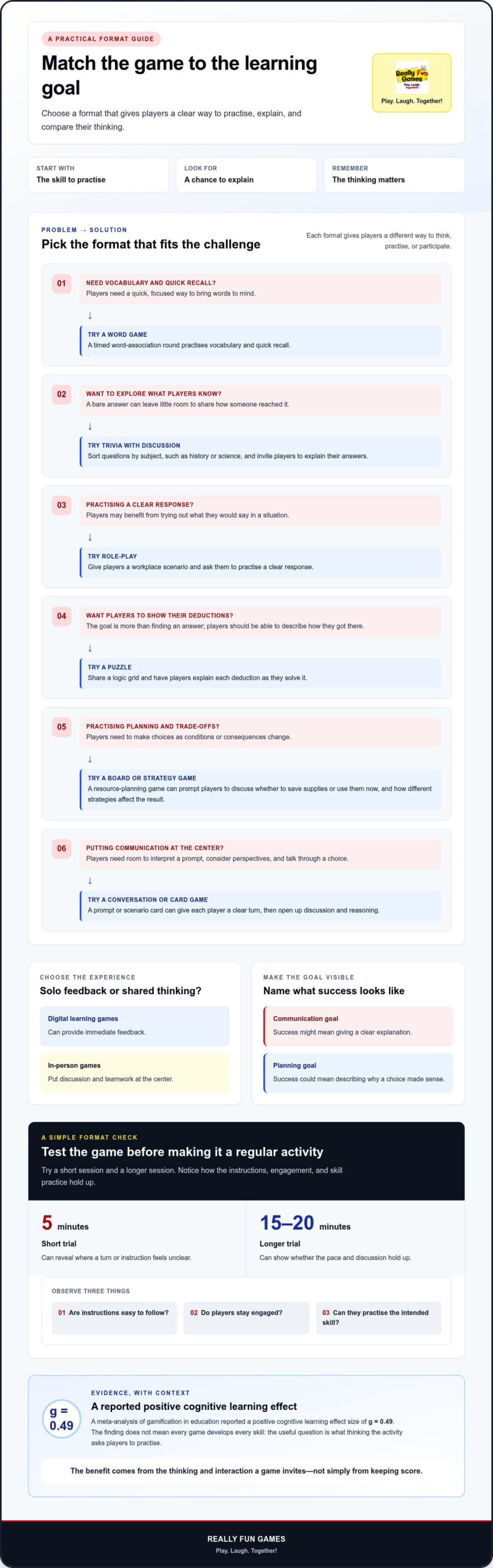
Start by identifying the skill you want to practise, then match the game format to that goal. Choose a word game for vocabulary, a strategy challenge for planning, or a conversation game for communication.
Card games keep turns clear and prompts easy to manage around a table. A player might draw a scenario card, choose a response, and explain their reasoning. This format can work for a family game night, a small group, or a classroom discussion where taking turns helps everyone participate.
Board and strategy games add shared goals, changing conditions, and decisions with consequences. In a resource-planning game, players might decide whether to save supplies or use them now. The choice gives a facilitator a natural opening to discuss planning, trade-offs, and how different strategies affect the result.
Other formats serve different learning goals:
- Word games: Use a timed word association round to practise vocabulary and quick recall.
- Trivia games: Sort questions by subject, such as history or science, to build general knowledge.
- Role-play games: Give players a workplace scenario and ask them to practise a clear response.
- Puzzles: Share a logic grid and have players explain each deduction as they solve it.
Digital learning games can provide immediate feedback, while in-person games put discussion and teamwork at the center. An individual quiz, for example, can help someone review geography facts, while a group puzzle lets players compare how they reached an answer. Choose according to whether solo practice or shared conversation matters more.
Adults can also adapt familiar games into short learning activities. A teacher might turn a vocabulary list into a matching challenge, then ask learners to use each word in a sentence. At home, players can create a themed trivia round based on a book or documentary they’ve discussed. A familiar structure leaves more attention for the subject.
Before playing, name the learning goal and agree on what success looks like. For a communication goal, success might mean giving a clear explanation. For planning, it could mean describing why a choice made sense. Afterward, ask which part felt useful and what players would try differently next time.
Keep the format accessible to the group. A class may need turns that are easy to follow, while adult learners may enjoy open-ended prompts with several possible answers. If players are new to a game, demonstrate a sample turn first. This makes the rules clearer and helps everyone join in confidently.
To see whether a format fits, test the learning game in a five-minute session and a 15-20-minute session. Notice whether the instructions are easy to follow, whether players stay engaged, and whether the activity gives them a chance to practise the intended skill. A shorter trial can reveal where a turn feels unclear; a longer one can show whether the pace and discussion hold up. Use what players notice to adjust the prompts or format before making it part of a regular lesson or game night.
Mental agility and language games
Short challenges can encourage players to switch strategies, recall words, and respond with focus. The best fit depends on the skill you want to practise and how you prefer to learn.
Mental agility game options
Try pattern games, memory challenges, and puzzles that ask players to sort clues or change plans. In a sequence puzzle, for example, players identify a pattern, explain their choice, then revise it when a new clue appears. Look for clear rules and adjustable difficulty so the challenge stays engaging without making turns feel rushed.
Compared with courses, games make practice interactive and give players repeated turns to apply what they’re learning. Apps can offer solo exercises and immediate feedback, while tabletop games bring conversation and shared problem-solving into the room. Choose based on whether you need structured instruction, individual practice, or interaction with other learners.
Language game options
Word association, storytelling prompts, and tongue twisters invite players to listen, recall vocabulary, and shape a response. For example, ask each person to add a sentence to a shared story using a chosen word. Look for opportunities to speak, listen, and try new language, rather than focusing only on speed or spelling.
For accessibility, check that the rules are clear, the text is comfortable to read, and players have time to respond. The group can read prompts aloud, explain unfamiliar words, or play cooperatively instead of emphasizing competition. These adjustments can help adults with different language, reading, or processing preferences participate.
Small changes can make a familiar format more useful. In a word-chain challenge, players name a word connected to the previous one, then explain the link. In a memory game, they can group items by category before recalling them. Each variation offers a clear way to practise flexible thinking and language.
For a lively group activity, choose prompts that encourage complete answers, not just single words. A question about describing a favorite place, for instance, can invite sensory details, sequencing, and follow-up questions. In a classroom, a facilitator can model a response, then invite learners to build on one another’s ideas.
Keep the pace comfortable by letting players pass, ask for a prompt to be repeated, or take another turn after hearing an example. A speech-language pathologist might focus on clear articulation, while friends might use the same word game for spontaneous conversation. Let the group’s goal shape the challenge and choose activities that support the kind of language practice they want.
After a round, ask players to name a word, strategy, or expression they enjoyed using. This quick reflection can connect playful practice with everyday conversation, from telling a story at dinner to choosing precise words in a meeting.
Trivia and general knowledge
Trivia rounds turn facts into lively recall practice, while themed puzzles connect details to broader concepts. Choose questions that match the subject you want to explore, such as math, science, or history.
Trivia-based learning
Trivia works well when questions invite more than a quick guess. A math round might ask players to estimate a result, then explain their method. A science prompt could ask which observation supports a claim. For a useful discussion, choose clear questions with explanations or follow-up prompts, so players can connect an answer to the concept behind it.
For math, try number puzzles that ask players to spot patterns or compare possible solutions. A group could examine a sequence such as 3, 6, 12, then explain its rule before suggesting the next value. The discussion matters as much as the answer: players can compare multiplication, addition, or other patterns and show how they reached their conclusions.
Science games can turn familiar topics into challenges based on evidence. For example, ask players to match an animal with its habitat, then discuss which traits support the match. A question about the water cycle can prompt players to arrange evaporation, condensation, and precipitation in order. These activities connect recalled facts with processes players can describe.
General knowledge games
General knowledge games bring together subjects from geography and art to everyday science. A map-based round might ask players to identify a state by its shape or location. Look for varied questions and a range of difficulty, so beginners can join while experienced players still have ideas to explore and discuss.
History games become more memorable when players connect names, events, and causes. Try a timeline challenge with event cards, then ask the group to explain why one event came before another. Players can also compare two historical figures by their actions or ideas. This format turns dates into relationships rather than isolated facts.
- Math: Use estimation questions, number patterns, or logic puzzles.
- Science: Match evidence with explanations, or sequence a process.
- History: Arrange events, connect causes, and compare perspectives.
- General knowledge: Mix geography, culture, nature, and arts questions.
After a correct answer, ask players which clue helped them. If someone misses a question about a planet, for instance, invite the group to recall its position or a distinctive feature. This extra step turns scoring into explanation and gives players a reason to remember the fact.
For a relaxed game night, let each player choose a category before play begins. One person might pick inventions, another nature, and someone else a history question. Switching topics keeps the round varied and gives everyone a chance to share an area of interest.
Keep the mood curious rather than test-like. If a question sparks debate, pause to separate what players know from what they’re guessing. Then use the answer to start a short conversation about the related idea, such as how a scientific observation differs from an assumption.
What are the best educational games for adults?
The best choice pairs a clear learning goal with a format adults enjoy. Use a strategy game to practise planning, a word challenge for language, or trivia to explore history and science. Choose a game that invites players to participate, explain their choices, and learn from each round.
Start by deciding what players should be able to do after playing. A group hoping to strengthen communication might choose prompts that invite discussion. Adults reviewing biology concepts could use matching cards to connect terms with explanations. For mental agility, select puzzles that ask players to spot patterns or change strategies.
Next, compare the game’s style with the group and setting. A classroom may benefit from clear instructions and simple turns. A family gathering could suit a conversation game that is simple to learn, while a workplace group might prefer a shared challenge with room to collaborate. Choose a format that fits the environment and keeps the activity practical.
Use these criteria to narrow the options:
- Learning goal: Match the activity to a specific skill, such as recall, vocabulary, or teamwork.
- Participation: Look for turns that give each player a way to contribute.
- Challenge: Choose questions or tasks that encourage effort without relying only on speed.
- Discussion: Favor formats that let players explain answers and compare approaches.
- Accessibility: Check that instructions, text, and turn-taking work for the people playing.
For example, a history group could arrange event cards into a timeline. Players can explain each choice, turning recall into a discussion about cause and sequence. A science group might match a concept with an example, then describe how the example demonstrates that idea. These formats make the learning goal part of play.
Consider how much guidance players need. A facilitator can demonstrate a sample turn before starting a new game. For independent play, choose instructions that explain the objective and scoring clearly. If adults have different experience levels, cooperative rules can help newcomers contribute alongside more confident players.
Finish with a short review. Ask each player to name an idea they remembered, a strategy they used, or a question they still have. For instance, a trivia round about U.S. geography can lead to a conversation about how players recalled a state’s location. Reflection helps connect the game with a learning takeaway.
Really Fun Games: Really?! Think You Know Me? Guess Again
Really Fun Games’ Really?! Think You Know Me? Guess Again brings playful guessing and conversation to group activities. It’s a social and educational card game for adults who want to share a game that encourages communication, thoughtful predictions, and laughter.
For language-focused play, Triple Tongue Twisters, Tricky Tetra Tongue Twisters, and Blooming Tongue Twisters offer lively verbal challenges. These games can suit family gatherings, classrooms, and groups looking for an engaging way to practise speaking together.
Choose the format that fits your group’s goal: conversation to get to know one another, or tongue twisters for playful language practice. Visit Really Fun Games at reallyfungameslp.com to explore the games and choose one for your group.
Make Play Part of the Way You Learn
Make a game a starting point, not a one-time activity. After a round, notice which questions sparked the richest discussion, then carry that curiosity into a family dinner, classroom conversation, or team gathering. Invite different players to choose the next theme so everyone can bring their interests into the experience.
The most useful educational games for adults fit naturally into a group’s routine and leave people eager to share ideas. Keep the focus on participation: thoughtful guesses, unexpected connections, and the pleasure of learning from one another. A lively game can open the door to conversations that continue after play ends.
Ready to choose a playful way to bring people together? Explore the Really Fun Games collection and choose a game for your gathering. Let curiosity lead, make room for laughter, and enjoy learning together.
Frequently Asked Questions
What are the positive effects of learning games?
Learning games can support motivation, participation, and cognitive engagement by giving players an active role. A 2020 meta-analysis reported positive motivational and behavioral learning effect sizes of g = 0.36 and g = 0.25, respectively. In practice, a team challenge might encourage adults to contribute ideas, listen to teammates, and stay involved with a topic. Add a brief discussion afterward to help players connect the experience with what they learned.
What are the best educational board games for adults?
The best board game depends on what adults want to practise. For collaboration, choose a game where players plan together toward a shared goal; for strategy, look for meaningful choices and changing conditions. A group studying environmental science, for example, could use a cooperative challenge about balancing competing needs. Check that the rules are clear and players can explain their decisions, not just move pieces.
Are educational games effective for adult learning?
They can be effective when the game activity matches the learning goal and includes time to apply or discuss what happened. A 2020 meta-analysis found positive effects across cognitive, motivational, and behavioral learning outcomes. For a practical follow-through, ask players to name one idea they’ll use in a real setting, such as applying a planning strategy during a work project. Games complement other learning methods rather than replacing focused instruction.