

The best conversation starter game is one that suits the people around the table. Conversation starter games for adults can help couples move beyond routine check-ins, give friends an easy way to share stories, and bring fresh energy to parties, road trips, and holidays. Choose playful prompts for a lively group or reflective questions when you want a deeper conversation.
Conversation can stall, even among people who enjoy spending time together. A good prompt gives everyone a simple way into the discussion without making the moment feel like an interview or putting anyone on the spot.
This guide covers conversation games and question categories for couples, friends, families, parties, trips, and holiday gatherings. You’ll also learn how to match the group and mood to a style of play, making it easier to spark laughter, swap memorable stories, and have meaningful conversations.
Key Takeaways
- Match the prompt style to the group: playful questions can loosen up a party, while reflective ones may suit a quieter conversation.
- Choose question categories that fit your relationship, from shared memories with family to hopes and plans with a partner.
- For gatherings, try the thoughtful prompt recommended by the National Institute of Standards and Technology: “What kind of impact do you want to have on the world?”
- On trips and holidays, use the setting to spark stories, favorite traditions, and easy group participation.
- For a ready-to-play option, consider Really?! Think You Know Me? Guess Again! or a tongue-twister game for a livelier mix of conversation and laughter.
Conversation starter card sets for different audiences
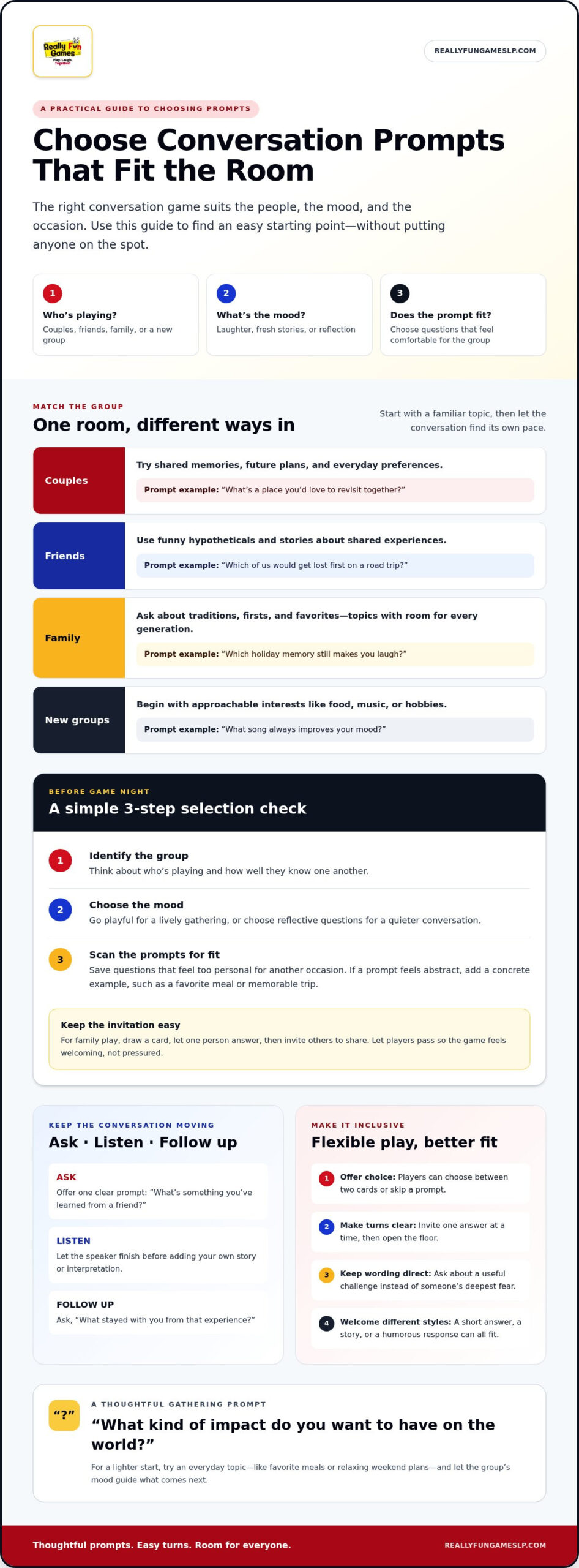
A useful conversation card game suits both the group and the occasion. A quiet dinner with a partner calls for different prompts than a lively reunion with friends. Before choosing a set, consider who’s playing, how well they know one another, and whether you’re after laughter, fresh stories, or thoughtful reflection. For example, “What small thing made you smile today?” feels lighter than a question about life’s biggest turning point.
For couples, choose prompts that invite personal stories without demanding a serious answer. “What’s a place you’d love to revisit together?” can bring up favorite travel memories or spark new plans. Close friends may enjoy playful questions about shared experiences, such as “Which of us would get lost first on a road trip?” With newer acquaintances, start with interests, food, music, or hobbies. These familiar subjects make it easy for everyone to join in.
For family gatherings, choose questions that give different generations room to contribute. “What game did you love as a child?” lets grandparents, parents, and younger relatives compare experiences. A family conversation game can follow a simple format: draw a card, let one person answer, then invite others to share. Keep prompts open-ended and let players pass. Being able to skip a question helps the game feel welcoming, not pressured.
- Couples: Try shared memories, future plans, and everyday preferences. Example: “What meal would you happily eat again?”
- Friends: Use funny hypotheticals and stories. Example: “What skill would you learn instantly if you could?”
- Family: Ask about traditions, firsts, and favorites. Example: “Which holiday memory still makes you laugh?”
- New groups: Start with approachable interests. Example: “What song always improves your mood?”
For people who feel unsure about speaking, a short role-play can make an exchange more comfortable. The Peace Corps describes role-play as a way to practice appropriate greetings, behavior, leave-taking, and gestures. Try a simple scenario: greet another player, ask about a favorite weekend activity, listen, then end the chat warmly. This gives everyone a clear starting point without requiring a polished or personal answer.
Use this three-step selection check before game night: identify the group, choose the mood, then scan the prompts for fit. If a card feels too personal for a work gathering, save it for close friends. If a prompt seems abstract, add an example, such as naming a favorite meal or memorable trip. You can browse conversation and party games for options that suit different groups and occasions.
Conversation starters as a way to encourage meaningful connection
A thoughtful prompt can move a chat beyond routine updates. Ask a follow-up, then make room for everyone’s answer.
Deepening Connections
To deepen a conversation, pick an answer and invite a little more detail. If someone mentions a favorite family tradition, ask what makes it memorable, then share a related experience of your own. This simple exchange builds on the original prompt instead of jumping to another topic. Choose questions that welcome stories, values, and viewpoints without asking for private information.
Use this three-step rhythm during a conversation game:
- Ask: Offer one clear prompt, such as “What’s something you’ve learned from a friend?”
- Listen: Let the speaker finish before adding your own story or interpretation.
- Follow up: Ask, “What stayed with you from that experience?”
Specific follow-ups show you’re listening. “What happened next?” can open up a story, while “How did you decide?” invites reflection. Avoid turning an answer into a debate or immediately comparing it with your own experience. In a group, let the first speaker finish before inviting someone else to respond. That small pause helps the conversation feel shared, not rushed.
Comfortable and Inclusive Play
Adults feel more comfortable when participation is flexible. To keep conversation games inclusive, explain that anyone may pass, answer briefly, or choose a lighter prompt. Start with everyday topics, such as favorite meals or relaxing weekend plans, before offering more personal questions. This lets each player decide how much to share.
Try these practical adjustments for a mixed group:
- Offer choice: Let players select between two cards or skip a prompt.
- Make turns clear: Invite one answer at a time, then open the floor.
- Keep wording direct: Replace “Describe your deepest fear” with “What challenge taught you something useful?”
- Welcome different styles: Accept a short answer, a story, or a humorous response.
For example, at dinner with new friends, begin with “What’s a small skill you enjoy using?” Someone might mention baking, fixing bikes, or remembering song lyrics. Each answer offers a comfortable path into a longer chat. If the group prefers playful conversation, start with light prompts and let the mood guide the next round.
For a ready-to-play option that supports easy turn-taking, explore conversation game options and choose prompts suited to your group.
Question categories for couples, friends, and family
Funny questions can spark laughter, while thoughtful prompts invite personal stories. For adults, choose questions that suit the relationship and the mood of the evening.
Funny, Meaningful, and Thoughtful Questions
For a date night, mix playful questions with prompts about shared hopes. Ask, “Which fictional couple would make the worst neighbors?” Then try, “What’s something you hope we experience together?” A light opening can make a more reflective question feel natural. Let each person answer, then decide whether to discuss the response or draw another card.
- Funny: “What would your completely unnecessary talent be?”
- Meaningful: “Who helped you feel understood recently?”
- Thoughtful: “What belief have you changed your mind about?”
Keep questions specific and open-ended. “What made you laugh this week?” leaves more room than “Was your week good?” For couples, questions about everyday choices can reveal preferences without turning date night into a serious interview. Ask, “Would you rather plan a surprise outing or choose together?” Then share why.
For a livelier round, invite everyone to invent a follow-up. If someone picks the fictional-neighbor question, ask what the neighbor would do. That playful detail can spark a story you build together.
Question Categories for Friends and Family
Friends can explore shared interests, unexpected opinions, and humorous what-if scenarios. Try, “Which movie could you quote from memory?” or “What would you name a restaurant serving only your favorite food?” For family gatherings, choose questions that welcome different ages and experiences. “What invention would make your daily routine easier?” lets everyone answer from their own perspective.
- Friends: Favorite music, amusing mishaps, dream skills, and bold opinions.
- Family: Childhood games, first jobs, treasured objects, and family recipes.
- Mixed groups: Travel wishes, food discoveries, and imaginary talents.
At family game night, sort cards into light, reflective, and imaginative categories. Let the group choose a category before each round. Giving players a say in the tone helps keep questions suitable for everyone present. A younger relative might answer “What skill would you learn overnight?” with skateboarding; an older relative might choose a language or instrument.
Try a simple sequence: start with an amusing question, follow with an interest-based prompt, then offer a thoughtful option. For friends, that could move from “What would your entrance song be?” to “What hobby surprised you?” For family, begin with favorite foods, then ask about a skill someone learned from another relative. This order adds variety without locking the conversation into one mood.
Conversation starters for parties and entertaining
At a party, prompts work best when guests can answer quickly or add a story. In a small group, take turns; at a larger gathering, use pairs or table teams.
Party Conversation Starters
Choose questions that feel inviting, not like a quiz. Try “What kind of impact do you want to have on the world?”, a thoughtful starter from the National Institute of Standards and Technology. For a lighter opening, ask, “What song would play during your entrance?” Both prompts give guests room to share a quick answer or tell a longer story.
Match the prompt to the event. At a birthday party, ask guests to share a favorite celebration memory. At a work reception, stick to neutral topics such as travel, food, or hobbies. For a holiday gathering, invite people to name a tradition they enjoy. Keep a few playful prompts ready, too, such as “Which fictional character would you invite to dinner?”
A simple host routine helps the game flow:
- Set the tone: Explain that answers can be brief, funny, or thoughtful.
- Model a response: Answer the first prompt yourself, such as naming a memorable meal.
- Pass the turn: Invite another guest to draw or choose the next question.
- Follow the energy: Use a lighter prompt if the conversation slows.
At a gathering, conversation starter games for adults can break the ice between courses or during a lull. Keep cards near the snacks or seating area so guests can pick one up naturally. A question about favorite comfort food may lead to a recipe story; a playful hypothetical can quickly bring laughter around the table.
Adapting for Group Size
At a small gathering, let each person answer the same prompt, then invite one follow-up. Close friends might compare their ideal weekend plans. At a larger party, divide guests by table or pair them briefly, then share a standout answer with everyone. This keeps turns moving and gives quieter guests an easier way in.
Choose a format that suits the room. A seated dinner works well with one shared question at a time. At a busy birthday party, guests might pick up prompt cards between activities. For mixed groups, offer a choice between a playful and a reflective question. That small choice helps everyone join at their own comfort level.
Keep instructions short: draw a card, answer if you like, and pass it along. For more party conversation games, choose a format that fits the gathering and lets guests connect at their own pace.
Conversation starters for road trips and holidays
A trip or holiday gives a group shared sights, traditions, and surprises to discuss. Choose prompts that connect to the moment, then let passengers take turns answering.
On a road trip, use questions that turn passing scenery into conversation. Ask, “Which place along this route would you explore?” or “What would you name a roadside café here?” A passenger can read cards aloud while the driver focuses on driving. Leave card handling to a passenger or save it for a stopped break.
Build a travel round around different themes. A landscape prompt might ask, “Which view would you photograph?” A food prompt could be, “What local dish would you try?” For a longer journey, invite everyone to invent a fictional town based on something outside. One player names it; another adds its signature snack or unusual landmark.
- Scenery: “Which mountain, bridge, or beach would you revisit?”
- Travel memories: “What small detail do you remember from a favorite trip?”
- Imaginary stops: “What would your dream roadside attraction feature?”
- Holiday traditions: “Which seasonal ritual would you keep anywhere?”
Holiday gatherings offer ready-made themes. At Thanksgiving, ask about a dish with a family story behind it. For Christmas, invite everyone to describe a favorite seasonal sound, smell, or decoration. At Halloween, try a playful prompt: “Which costume would you wear again?” These questions make room for memories without expecting every relative to share the same tradition.
For mixed-age groups, choose prompts that allow different kinds of answers. “What makes a celebration feel special?” could bring a grandparent’s story, a teen’s favorite activity, or a friend’s food choice. Let players answer briefly, tell a longer story, or pass. At a family reunion, invite everyone to name a tradition they’d like to start.
Use a simple sequence to keep travel and holiday play moving:
- Pick a theme: Choose scenery, food, traditions, or memories.
- Ask one prompt: Keep the wording clear and specific.
- Share the turn: Invite another person to answer or add a detail.
- Switch themes: Move from travel stories to imaginative questions.
Conversation starter games for adults can make quiet stretches feel more lively, especially when prompts suit the group’s mood. For a ready-to-play option for family trips and gatherings, explore conversation games.
Really Fun Games: Really?! Think You Know Me? Guess Again
Really?! Think You Know Me? Guess Again gives couples, friends, and families a playful way to compare what they know about one another. It’s a good fit when you want conversation prompts with a game structure for a gathering, trip, or family game night. Really Fun Games also offers tongue-twister titles, including Triple Tongue Twisters, Tricky Tetra Tongue Twisters, and Blooming Tongue Twisters, for groups ready to add spoken play and laughter.
Choose a conversation game when you want shared stories and lively discussion; choose tongue twisters when you want a vocal challenge. These games are designed for ages 8+, making them an option for groups that include adults and younger family members.
Visit reallyfungameslp.com to explore the games and find one for your next gathering.
Make Your Next Gathering More Memorable
Choose a prompt that suits the people in the room, then let the conversation find its own direction. The right conversation starter games for adults can provide an easy opening, whether you’re planning a date night, hosting friends, or sharing a long trip. Keep the mood relaxed: answer the question yourself, listen with curiosity, and let anyone pass or choose another prompt.
A good game gives your gathering a playful starting point and lets guests connect in their own way. Choose a style of play that suits your group, with room for laughter as well as conversation.
Explore the Really Fun Games collection and find a game for your next gathering. A thoughtful question can be the start of a great shared moment.
Frequently Asked Questions
What are the best conversation starter games for adults?
The best conversation starter games for adults suit the group’s comfort level and the energy you want. For conversation-led play, choose prompts that invite opinions or personal stories. For a playful change of pace, Really?! Think You Know Me? Guess Again offers a card-game format. Look for clear instructions and questions that allow brief answers. That flexibility can suit couples, close friends, or a relaxed gathering.
What are fun conversation games for adult parties and gatherings?
Try a prompt relay: one guest chooses a question, answers it, then invites someone else to pick the next card. For a playful twist, the next person can guess how the first guest might answer before hearing the response. Keep guesses light, then let the person share their real answer. This format gives guests a simple way to join without requiring everyone to speak at once.
What conversation starter games work best for couples?
Couples often enjoy games that mix light prompts with questions about preferences, memories, and shared plans. Take turns choosing a card, then have both people answer the same question. For a fresh date-night format, sort prompts into “something new,” “something familiar,” and “something silly.” Choose a category together, and let either partner change it if the mood shifts. Making the choice together keeps play relaxed and collaborative.
What are good conversation games for adults who just met?
For people meeting for the first time, choose low-pressure prompts about everyday tastes, memorable experiences, or harmless hypotheticals. “What’s a small purchase you use all the time?” can reveal interests without asking for private details. Avoid questions that assume shared history or call for deeply personal answers. A simple pass option also lets guests participate at their own pace and keeps introductions comfortable.
How do you play popular adult conversation starter games?
For a basic prompt-card game, shuffle the deck, take turns drawing a card, and read the question aloud. The player answers while others listen and may ask a relevant follow-up. Agree on a pass option before starting, and decide whether everyone answers each prompt or only the cardholder. For a guessing-style game, explain the turn-taking rules first, keep guesses playful, and let the person respond in their own words.
What are free conversation starter games adults can play without supplies?
Take turns answering a prompt, such as “What made you laugh this week?”, then ask a follow-up and share a related story. You can also try a simple role-play: greet someone, ask about a favorite weekend activity, listen, and end the chat warmly.
