

The best card games for friends fit the group, not just the deck. Choose Crazy Eights for a straightforward start, Go Fish for collecting sets, or President when you have at least three players and want a more competitive game. In Crazy Eights, each player gets five cards, so you can get the first round underway quickly.
A great game night also depends on how your friends like to play. Some groups want simple rules and quick turns; others enjoy strategy, playful bluffing, or plenty of conversation. A game that suits the group helps everyone join in, whether you’re having a relaxed hangout or a lively party.
Here, you’ll find practical ways to pick card games for friends by setup, group size, rules, and party style, with tips for deciding whether bluffing suits your crowd. You’ll also see how to match a game to the mood you want, so it’s easier to deal the cards and get the laughs started.
Key Takeaways
- Choose a game with a setup and learning curve that suit how quickly your group wants to get started.
- Match the game to your group size so everyone has a chance to join in and stay involved.
- Pick party card games by the mood you want, from easygoing conversation to lively competition.
- Look for clear turn rules and winning goals to keep the game moving and avoid confusion.
- Decide whether playful bluffing will bring out laughs and suspense or feel less comfortable for your group.
1. Game setup and ease of learning
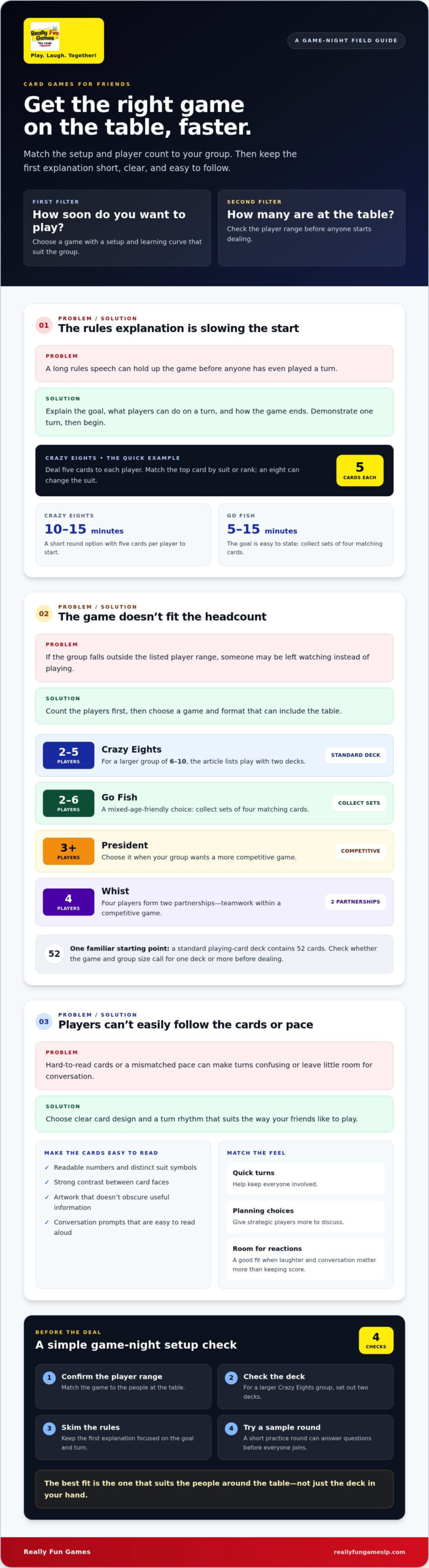
For friends who want quick, easy-to-learn games, try Crazy Eights or Go Fish. Crazy Eights takes 10-15 minutes and starts with five cards per player. Go Fish takes 5-15 minutes, making either a practical choice for a short game night round.
Setup affects how quickly a group gets from chatting to playing. A standard playing-card deck contains 52 cards, so a classic game can be ready with a familiar deck. Crazy Eights is listed for 2-5 players, while Go Fish suits 2-6. Match the game’s player range to the people around the table before dealing.
Keep the first explanation focused: share the goal, what players can do on a turn, and how the game ends. In Crazy Eights, players match the top card by suit or rank, and an eight can change the suit. Demonstrate one turn, then start playing. Friends can pick up the rhythm as they go, without a long rules speech.
Clear card design can make a game easier to follow. Look for readable numbers, distinct suit symbols, and strong contrast between card faces. Familiar playing-card designs help players spot matches. Themed artwork can add personality, as long as it doesn’t obscure information needed during a turn. For conversation card games, check that prompts are easy to read and understand aloud.
Think about the feel of the whole game, not just its rules. Quick turns keep everyone involved, while choices that require planning give strategic friends more to discuss. If your group enjoys laughter and lively conversation more than keeping score, choose a format that leaves room for reactions between turns. The best card games for friends make the next move clear without making the game feel rushed.
Price and availability matter when choosing a game to buy. Compare the listed price and availability for the specific title and edition you’re considering, and check what comes in the box. A classic deck offers a familiar starting point; a dedicated game may include its own cards or instructions. Browse the card and conversation games to compare options designed for shared play.
Before game night, confirm the player range, skim the rules, and set out the cards. A short sample round can answer questions before everyone joins. For a lively group, choose a game with fast turns; for new players, look for clear symbols and one simple objective. A little preparation helps friends get into the fun sooner.
For a different kind of setup, consider how the deal shapes the start of play. In Whist, each player is dealt 13 cards, while Nertz players are dealt 13 cards each. Knowing the deal in advance can help friends prepare the cards before explaining the first turn.
Solitaire offers another setup to have ready: the Solitaire setup described uses 7 face-down piles. Laying those piles out before beginning gives players a clear starting arrangement. These examples can help a group choose a game based on the kind of preparation they want to do together.
2. Card games for different group sizes
For mixed ages and families, Go Fish is a friendly pick because its goal is easy to explain: collect sets of four matching cards. It accommodates 2-6 players, so children and adults can join the same round.
For friends using a standard deck, choose by headcount: Crazy Eights suits 2-5 players, or 6-10 with two decks. President works for 3+ players, while Whist is designed for 4 players in two partnerships.
Those ranges help narrow the choice, but the group’s shape matters too. With two players, Rummy offers a direct head-to-head game. For a gathering of six, Go Fish or Rummy fits its listed player range; a game outside that range may leave someone watching instead of playing.
A larger party needs a clear way to keep everyone involved. Crazy Eights can accommodate 6-10 players when played with two decks. Before dealing, decide whether the table will play together or split into smaller groups. For example, two tables can each play a separate round, then share the funniest moment afterward.
For a cooperative card game, look for rules that give the group one shared objective rather than individual winners. Players can discuss choices and work toward that common goal. Whist partnerships encourage teamwork, but the two sides compete, so the game isn’t fully cooperative.
Use this quick selection check before game night:
- Count the players. Compare the headcount with the listed range for Go Fish, Rummy, President, or Whist.
- Check the deck. Crazy Eights needs two decks for its larger listed group.
- Choose the social feel. Pick individual play for friendly rivalry, partnerships for shared decisions, or cooperative rules for one group goal.
- Plan for arrivals. For a changing group, choose a game whose player range can accommodate the expected table.
These steps help match the game to the people present, not just the cards on hand. For a group that prefers conversation and shared play, explore the card and conversation games collection for another game-night option.
3. Adult party games
For a game night with friends, choose strategy card games that reward decisions without slowing conversation. Rummy gives players a clear aim: form sets or runs, then decide when to play them. For a sharper scoring challenge, 500 ends when a player reaches 500 points.
Adult party games can be strategic without feeling like a tournament. Before choosing, decide whether your group wants quiet planning, lively rivalry, or a mix. Rummy suits friends who enjoy tracking useful cards and watching patterns. 500 adds a score target, so each hand can build toward a shared finish line.
Make the first round welcoming with a quick rules walkthrough. For Rummy, explain the goal, show a set and a run, then play one open practice turn. Save detailed strategy for later. New players can follow along while experienced friends still have choices to weigh.
For a party, the pace matters as much as the rules. A game with decisions on every turn gives friends something to discuss, while long pauses can pull attention away from the table. With 500, keep the score visible and announce it after each hand. That simple step helps everyone follow the changing contest.
Use these checks to match a game to your gathering:
- For thoughtful play: Choose Rummy and encourage players to watch which cards have already appeared.
- For a shared finish line: Try 500, where the first player to reach 500 points wins.
- For a casual party: Explain the goal first, then let a sample turn demonstrate the choices.
- For mixed experience: Pair a new player with someone who can explain a move without taking over.
Strategy also comes from the group’s decisions, not complicated rules. In Rummy, players can weigh whether to keep a card for a possible set or play it sooner. In 500, the score gives each hand context, so friends can talk through the stakes as play unfolds. These choices make the game night feel engaging while keeping everyone focused on the same table.
Choose party card games that match your friends’ preferred energy. If conversation should stay central, keep explanations brief and celebrate clever plays, not just wins. If your group loves competition, make scoring easy to follow and let each hand matter. A clear objective and friendly table talk can turn a familiar deck into a lively evening.
4. Basic rules and winning objectives
A satisfying game has a recognizable goal and a finish players can see coming. Before you begin, explain what progress looks like, which choices move players forward, and how the winner is determined. If a game rewards collecting symbols, for example, show which symbols count and where to keep them. That demonstration gives everyone a shared reference point.
Objectives shape the mood. A race-style goal creates urgency, while a shared challenge encourages players to discuss their choices. Some games reward planning; others favor noticing patterns or taking a calculated risk. Match the objective to your group’s appetite for competition, conversation, or teamwork, and make sure everyone understands what success means.
Use this short checklist when reading a new rule sheet:
- Find the goal. Identify the action or achievement players are working toward.
- Look for progress. Check how players can tell whether they’re getting closer.
- Confirm the finish. Learn what event ends the game and how the winner is decided.
- Check for ties. Find the rule for matching scores or simultaneous achievements.
- Explain exceptions. Mention special actions only when they affect the goal or finish.
Teach an objective by describing a sample turn aloud. Point to the current game state, name a possible move, and explain how it changes progress. For example, say, “This choice earns progress, but that choice keeps an option open.” This helps players understand the decision behind the move, not just a list of rules.
If the game uses tokens, markers, or a score track, make progress visible. Place the pieces where everyone can see them and update them immediately after a qualifying move. If the objective relies on hidden information, explain what stays private and what players may discuss. Clear boundaries prevent confusion without revealing anyone’s strategy.
House rules can affect objectives, too. If your group wants to change a scoring detail or tie-breaker, agree on the change before the first turn and apply it consistently. Keep it easy to remember. A quick agreement helps friends focus on decisions instead of debating a new interpretation midway through the game.
When choosing among the best card games for friends, consider the kind of shared moment the objective creates. A visible finish can energize competitive players; a common goal can encourage quieter friends to contribute. Read the winning condition aloud, invite questions, and start once everyone knows what they’re trying to achieve.
5. Bluffing games
Bluffing games build suspense by asking players to judge whether a claim matches the cards played. In Cheat, also called I Doubt It, a player puts cards face down and announces their rank. The others decide whether to trust the claim or challenge it.
That choice creates lively table talk: a confident announcement might be honest, or it might invite a challenge. Play Cheat if your friends enjoy reading reactions, taking playful risks, and laughing at a bold bluff. If your group prefers open information and predictable decisions, a strategy game without hidden claims may be a better fit.
Before you start, explain what a challenge does and how to resolve one. In a common version of Cheat, a caught bluff means the bluffer takes the played pile; an incorrect challenge means the challenger takes it. Agree on the consequences first, since they affect how much risk players are willing to take.
Keep the mood friendly with a few ground rules. Challenge the claim, not the person. A successful bluff is part of the game, not a reason to tease someone afterward. With a mixed group, demonstrate a turn and let new players watch how a challenge works before making their own choice.
Use these cues to decide whether bluffing suits your gathering:
- Choose hidden information if friends enjoy suspense and guessing what others might be holding.
- Favor lighthearted stakes if the group wants playful surprises rather than serious competition.
- Explain challenges clearly before cards are played, so everyone understands the consequence.
- Offer a different style if a player would rather make decisions using open information.
Bluffing also contrasts with games built around collecting or scoring. A round of Cheat centers on reading claims, while Go Fish asks players to gather matching cards. Choose based on the conversation you want around the table: dramatic calls and challenges, or a calmer focus on each player’s next move.
For a lively party, keep the rules briefing short, agree on challenge outcomes, and let the first turns show the rhythm. Notice whether friends enjoy the uncertainty or prefer a clearer path to victory. Their reaction can guide future game-night picks, including whether to play another round of bluffing.
Explore conversation and party games for more ways to bring friends together around the table.
Really Fun Games: Really?! Think You Know Me? Guess Again
Really?! Think You Know Me? Guess Again is a natural choice when your group wants conversation alongside card play. Its guessing theme invites friends and family to share what they know about one another, compare answers, and enjoy the surprises that come up around the table.
For groups who prefer speaking games, Triple Tongue Twisters, Tricky Tetra Tongue Twisters, and Blooming Tongue Twisters bring playful vocal challenges to a gathering. They can suit family game night, a classroom, or a social group looking for laughter and communication through play.
Choose a conversation-focused game for shared stories, or a tongue-twister title for lively verbal play. Visit reallyfungameslp.com to explore the games and find one for your group.
Make your next game night a shared tradition
The best card games for friends do more than fill an evening. They give everyone a reason to put phones aside, trade stories, and enjoy one another’s company. Make choosing part of the fun: let one friend pick the mood and another choose the game, then switch roles next time.
That small ritual can make game night welcoming to different personalities. One gathering might call for lively conversation; another might suit a playful challenge or a fresh way to laugh together. Focus on enjoying time around the table, rather than finding one perfect game for every group.
For another shared-play option, Really Fun Games offers titles including Really?! Think You Know Me? Guess Again, Triple Tongue Twisters, and Tricky Tetra Tongue Twisters. Choose the kind of connection you want to spark, then invite your friends to join in.
Contact Really Fun Games for recommendations and discover a joyful next pick for your group.
Frequently Asked Questions
What are the best card games for friends in 2026?
The best pick depends on what your friends want to share: conversation, competition, or a playful challenge. Before choosing, ask whether the group wants to learn about one another or focus on game decisions. For a conversation-first gathering, Really?! Think You Know Me? Guess Again invites friends to compare what they think they know about each other. Choose a different style if your group would rather focus on strategy.
What are the best card games for 2, 3, 4, 5, or more players?
Start with the actual headcount, then check the game’s player range and whether it supports teams or individual turns. If friends may arrive at different times, choose flexible play or prepare a second table. In a small group, give everyone room to think aloud; in a larger gathering, choose a format with clear turns that keeps players involved between them.
What are the best funny and party card games for adults?
Choose a game based on the kind of laughter your group enjoys. Friends who like personal stories may prefer conversation prompts, while those who enjoy speaking aloud could try Triple Tongue Twisters. Keep the mood comfortable by letting players pass on a prompt or take a moment before answering. That courtesy helps make a party game welcoming to friends with different comfort levels.
How long do popular card games take to play?
Play time depends on the rules, how quickly players take turns, and whether the group plays one round or continues. If your gathering has a firm end time, agree on when to stop before starting. If friends want to fill more of the evening, decide whether to replay, switch games, or take a relaxed conversation break between rounds.
How do you play popular card games for groups, including rules and setup?
Give the group a clear starting point: choose someone to read the rules, set out any pieces, and make sure everyone can see the play area. Ask players to hold questions until the example turn, then clarify any disputed rule before continuing. For a recurring game night, keep a brief note of agreed house rules so returning friends can join without a long recap.
What are the best card games for travel and small groups?
For travel, prioritize a game your group already understands and components that are easy to keep together. A small table, picnic spot, or quiet waiting area can work if everyone can see the cards. Store the deck in its case between rounds, and choose a game that can pause smoothly if plans or travel schedules interrupt.
Ready to bring more laughter and conversation to your next gathering? Explore the Really Fun Games collection and choose a game that suits your group.