Games for therapists’ communication work with adults offer practical ways to practise listening, responding, summarizing, and connecting with others. They can help explore functional skills and tailor activities to therapy goals while keeping participation playful. Games support therapy; they don’t replace care from a licensed provider.
Communication can be challenging to practise when every conversation feels high-stakes. A game adds structure and a shared focus, making space to try a new response, notice nonverbal cues, or listen without rushing to reply. Laughter can also help people feel more at ease.
This guide explores how communication games can support adult functional skills, active listening, and connection, with ideas for individual, group, and family therapy settings. You’ll also find ways to adapt activities to different needs and goals, so play feels purposeful, welcoming, and genuinely enjoyable.
Key Takeaways
- Use games to give adults a relaxed way to practise listening, responding, and noticing nonverbal cues.
- Choose activities around a clear therapy goal, then adjust prompts and rules to suit each person’s needs.
- In family sessions, collaborative games can create opportunities to practise negotiating, sharing instructions, and working through different communication styles.
- Role-play and listening activities can help participants try out responses and give others their full attention.
- Match the activity to participants’ ages, comfort, and goals so play feels inviting and purposeful.
3. Listening and connection
Communication games give adults a shared task for practising listening, responding, summarizing, and staying engaged. In a “listen and retell” round, one person describes a recent meal while a partner summarizes the details before responding. The speaker can then clarify what the listener understood. This simple exchange makes listening visible and gives each person a clear turn.
Active listening means giving someone your full attention and listening with all your senses. During a card prompt, a therapist might invite the listener to notice the speaker’s words, tone, facial expression, and pauses. Afterward, the listener can reflect back one detail and ask whether they understood correctly. This check-in helps distinguish what someone said from what another person assumed.
Nonverbal cues can add meaning to spoken communication. For example, a participant might draw a prompt about a time they felt proud, then describe the moment while the listener notices their posture and expression. The therapist can ask, “What did you notice before you heard the explanation?” This keeps attention on observable cues rather than treating a gesture as proof of someone’s feelings.
Communication games give therapists a playful way to practise respectful, assertive expression. Ask each person to complete a prompt such as, “I feel included when…” or “I’d like more time to…” The speaker states a need; the listener repeats the main point without arguing or interrupting. Then they switch roles. This models how to express preferences while considering another person’s feelings.
For a group, try a collaborative storytelling game. One participant begins with a sentence, and each person adds a detail that builds on the previous contribution. The group practises waiting, tracking the shared idea, and responding in a way that keeps the story moving. If someone loses the thread, another player can summarize the last contribution before continuing.
After each round, ask participants to name one listening behavior they noticed, such as eye contact, a follow-up question, or a patient pause. A specific observation gives the group something concrete to discuss and helps distinguish effort from guessing how another person feels.
Conversation games create a structured way to explore these skills, and the communication and conversation games page offers options to consider. Use prompts that suit the group’s comfort and goals; participants can pass, choose another prompt, or respond briefly. Games support practice, but they don’t replace therapy with a licensed provider.
Nonverbal communication can clarify or add to spoken communication and help people share and interpret emotions. Therapy and coaching communication activities can support therapeutic bonds. Couples therapy communication activities can help partners practise avoiding or recovering from hurt and anger and rebuilding closeness.
Practising respectful expression and attentive listening can complement that work, giving partners a shared way to communicate needs and respond to one another.
4. Personalizing games to therapy goals
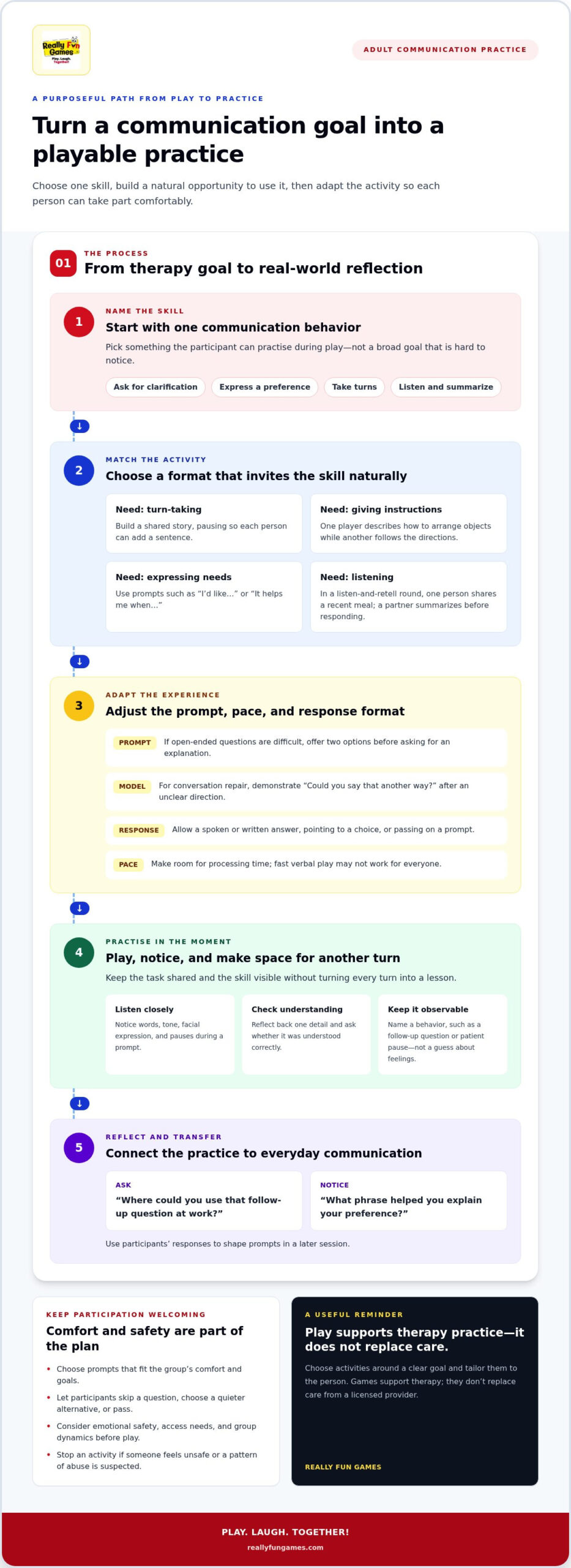
Start with a communication behavior the participant can practise during play. If the goal is asking for clarification, for example, choose a game with directions that invite questions. If the goal is expressing preferences, use prompts such as, “Would you rather plan a picnic or a movie night?” The activity should create a natural opportunity to practise, rather than interrupting play with a lesson after every turn.
Adjust the prompt, pace, and response format to the person’s needs. A participant who finds open-ended questions difficult might choose between two options before explaining their choice. Someone practising conversation repair could try, “Could you say that another way?” after a deliberately unclear direction. A therapist can model the skill first, then invite the participant to use it in the next round.
- For turn-taking: Use a shared storytelling game and pause so each person can add a sentence.
- For giving instructions: Have one player describe how to arrange objects while another follows the directions.
- For expressing needs: Ask players to complete, “I’d like…” or “It helps me when…” during a prompt round.
Keep the rules flexible. A person may answer aloud, write a response, point to a choice, or pass on a prompt. For example, a participant working on confidence can rehearse an answer with the therapist, then share it with the group if comfortable. These options preserve the communication goal while reducing unnecessary pressure.
Yes, you can create free communication activities from spoken prompts, role-play scenarios, or a homemade reflection sheet. For example, write “ask a follow-up question” on paper and use it as a turn-taking challenge. You can also create printable worksheets around a specific therapy goal.
Consider emotional safety, access needs, and group dynamics before choosing a game. A prompt about conflict may feel too personal, while fast verbal play may exclude someone who needs more processing time. Let participants skip a question, offer a quieter alternative, and stop an activity if someone feels unsafe or a pattern of abuse is suspected.
After play, connect the activity to a real-world moment. Ask, “Where could you use that follow-up question at work?” or “What phrase helped you explain your preference?” A brief reflection makes the practice specific without turning the game into a test. The therapist can adapt the next session’s prompts based on participants’ responses.
5. What communication games work well in family therapy?
Choose family therapy games that give everyone a shared task, rather than a winner to blame. A cooperative story-building activity can ask each person to add a detail connected to the previous one. The family tracks the same idea, makes room for different contributions, and decides together where the story goes next. The therapist can observe how relatives invite, interrupt, or respond to one another.
Games involving negotiation let family members practise explaining preferences and finding a workable choice. For example, ask the group to plan an imaginary family outing with limited time and different interests. One person may prefer a quiet park, while another suggests a busy festival. Players can practise naming what matters to them, asking about others’ priorities, and combining ideas into a shared plan.
- Shared drawing: One person describes a scene while another draws it, then they compare the picture with the original idea.
- Team instruction challenge: Family members guide a partner through arranging objects, practising clear directions and questions.
- Choice-and-reason prompts: Each person chooses between two options and explains their preference in their own words.
Instruction games can be especially useful when family members communicate differently. In a simple building challenge, one person explains how to arrange blocks while another follows the directions. The therapist can invite the pair to switch roles, then discuss which instructions felt clear. Families can also practise checking their understanding with phrases such as, “Do you mean the red block beside the book?”
Make room for cultural and personal differences. One family member may show respect by pausing before answering, while someone else expects quick verbal responses. During a collaborative puzzle, the therapist can ask what helps each person contribute, rather than treating one communication style as the standard. This keeps the focus on shared understanding, not judging who speaks most.
Set a clear, manageable goal before choosing the game. If the family wants to practise negotiation, pause the outing-planning activity when opinions differ and invite each person to summarize another person’s viewpoint. If the goal is giving and receiving instructions, notice whether directions include useful details and whether the listener asks for clarification. The therapist can adjust prompts, pace, or roles as the family plays.
Close with a practical question tied to the activity: “Where might this kind of clear request help at home?” A family could identify a familiar moment, such as choosing a meal or dividing a shared task. The game becomes a rehearsal space for cooperation, while the therapist guides discussion toward communication habits the family wants to practise beyond the session.
4. How do therapists use role-play and active listening games?
Role-play lets adults rehearse a conversation before using similar words in daily life. A therapist might set up a familiar workplace scenario: one person needs to ask a colleague for clarification about a task. The participant can practise opening the conversation, stating the need, and responding to the colleague’s reply. Then they can switch roles and notice which language felt clear.
Active listening activities focus on giving the speaker full attention and listening with all the senses. In a “tell and reflect” round, one person describes a recent challenge while the listener avoids interrupting. The listener then summarizes the main point and asks whether they understood correctly. The speaker can add a detail or gently correct the summary.
A therapist can guide the practice with clear turns. First, the speaker chooses a comfortable topic, such as a favorite meal or recent success. Next, the listener tracks the speaker’s words, tone, expression, and pauses. Finally, the listener reflects back one detail and asks a relevant follow-up question. This gives participants specific actions to try instead of a broad instruction to “listen better.”
- Practise clarification: In a role-play about planning a shared meal, ask, “Which day works best for you?”
- Try a calm response: In a pretend disagreement about a film, say, “I see it differently. Can I explain why?”
- Reflect meaning: After a story about a busy commute, summarize the speaker’s main concern before replying.
Keep scenarios familiar and low-pressure. A participant who wants to practise social conversation could role-play greeting a neighbor, asking an open question, and responding to the answer. Someone working on assertive communication might practise requesting a quieter space. The therapist can demonstrate a sample line, invite the participant to adapt it, then replay the scene with a different response.
Nonverbal cues add another layer to the exercise. After a short role-play, ask what the listener noticed in the speaker’s facial expression, posture, or pauses. Then ask which details were observed directly and which were interpretations. A pause is observable, for example; assuming someone is annoyed requires checking with a respectful question.
Close with a brief reflection tied to the scene. Ask the participant to name one phrase they would keep and one they might change next time. A therapist can also invite the listener to identify when they felt most understood. These concrete observations can shape the next practice scenario while keeping the focus on communication, not performance.
5. What communication games are appropriate for different ages and therapy goals?
Choose an activity by matching its language, pace, and social demands to the players. For adults practising conversation, use open-ended prompts about daily routines, preferences, or shared interests. A participant who benefits from extra structure can choose between two answers before explaining one. For younger players, simpler prompts and short turns can support practice of the same skill.
Age matters, but comfort and communication goals matter too. Couples’ game suggestions are intended for adults aged 18 and older. For partners practising repair after misunderstandings, use a neutral scenario, such as choosing a weekend activity. Each person names a preference, reflects the other person’s view, and suggests a shared option.
Match the game mechanic to the skill being practised. A turn-taking activity can support waiting and responding, while a describing game encourages clear wording. For example, one player describes a familiar object without naming it, and the listener asks questions before guessing. Therapists can adapt the challenge by changing the clues or inviting longer descriptions.
- For listening: Use a short story prompt, then ask the listener to summarize one key detail.
- For confidence: Let a participant select a prompt and decide whether to answer aloud or pass.
- For articulation: Try a playful phrase that invites careful pronunciation, then repeat it at a comfortable pace.
- For social interaction: Use a shared-choice challenge where players ask questions before agreeing on an option.
For adults with different communication preferences, offer more than one way to participate. A person might speak, write a response, point to a choice, or ask for more thinking time. During a “describe and draw” activity, the speaker can give instructions verbally while the listener asks for clarification. This keeps the goal accessible without requiring everyone to communicate in the same way.
Keep prompts relevant to the people playing. A workplace group might practise asking for clarification about a shared task, while family members could discuss how they prefer to spend a quiet evening. Don’t turn personal questions into demands. A pass option and a less personal prompt let participants stay engaged without disclosing more than they want.
After choosing an activity, set one observable goal: ask a follow-up question, summarize a partner’s point, or state a preference respectfully. Notice that behavior during play, then ask where it might help outside the session. For therapists, communication games can make goal-focused practice more engaging. Explore communication games for different groups for lively shared activities.
Really Fun Games: Really?! Think You Know Me? Guess Again
Really?! Think You Know Me? Guess Again gives adults, families, and groups a playful way to explore how well they know one another. Use its guessing format as a relaxed conversation starter, then invite players to share the reasoning behind their answers. Those explanations can spark stories, reveal different perspectives, and bring laughter to a group activity.
For sessions focused on vocal play, Triple Tongue Twisters, Tricky Tetra Tongue Twisters, and Blooming Tongue Twisters offer tongue-twister activities. A therapist can choose a game that suits the group’s interest in conversation or playful speech practice, then adapt participation to the session’s goals.
Explore these games when you want a ready-to-play activity that makes shared conversation more engaging. Visit reallyfungameslp.com to discover the games and choose one for your group.
Bring the next conversation into play
Choose one communication goal for your next session, then let it shape the activity. A small adjustment, such as inviting a participant to ask a follow-up question, can give play direction without taking away its spontaneity. The best games for therapists’ communication goals leave room for each person to participate in a way that feels comfortable and meaningful.
Think about the group you’re gathering: a family seeking easier conversations, adults practising social interaction, or players who enjoy a lively word challenge. Pick an activity that suits their interests, make space for different ways to join, and let curiosity guide what happens next. Shared play can open a fresh path to talking, listening, and connecting.
Ready to find a game for your group? Explore Really Fun Games and choose an activity that brings a little more laughter and connection to your next gathering.
Frequently Asked Questions
Why Use Communication Games & Activities?
Communication games turn everyday skills into something participants can practise together. A “message relay,” for example, asks one person to describe a simple plan and another to repeat its key details. The group can compare what was heard with what was intended, then discuss which words made the message clearer. This gives therapists a concrete activity to shape around a session’s purpose.
What Are Some Engaging Speech Therapy Games?
Try sound hunts, category challenges, or playful tongue-twister practice, choosing words that suit the participant’s current goals. For a sound hunt, players name objects they can see that begin with a chosen sound. Really Fun Games offers Triple Tongue Twisters, Tricky Tetra Tongue Twisters, and Blooming Tongue Twisters. These games provide tongue-twister material for a lively activity, while the therapist guides how it fits the session.
What communication games do therapists use with clients?
Therapists may use prompt cards, storytelling challenges, or structured scenario games, depending on the skill they want to explore. A “choose a response” activity can present a situation, such as an unexpected change of plans, and invite the client to compare possible replies. The therapist can discuss which response feels clear, respectful, and suitable for that setting.
What communication activities help children in speech or play therapy?
Children can practise communication through pretend play, picture choices, and simple describing games. In a pretend toy shop, one child can ask for an item while another plays the shopkeeper and responds. A therapist can adapt the activity with pictures, gestures, or spoken words, depending on the child’s participation style. Keeping the scenario familiar can help children focus on taking part.
What are effective communication exercises for group therapy?
A “common ground” activity gives group members a friendly way to discover shared interests. The facilitator offers a topic, such as favorite ways to relax, and participants share a preference before finding something in common. For a more collaborative challenge, ask the group to create a short story using one idea from each person. Both formats invite contribution without requiring lengthy personal disclosures.