

Public-speaking practice games can suit teens from middle-school age through adulthood. In the United States, middle school typically covers Grades 6-8, ages 11-14, and high school covers Grades 9-12, ages 14-18. Activities can meet students where they are, from sharing an idea with a partner to speaking before a group.
Speaking in front of others can feel intimidating, so a playful prompt or short challenge can offer teens a clear way to begin. Games for public speaking practice teens can complement instruction by giving teens an engaging way to practice communication, build confidence, and think on their feet. Explore activities for different comfort levels, impromptu speaking ideas, and practical ways to pair games with focused teaching.
Key Takeaways
- Match each activity to teens’ comfort level, then let them build toward speaking to a larger group.
- Use word prompts and shared storytelling to give students a playful way to practice quick thinking.
- Turn speaking practice into a chance to strengthen listening, clear expression, confidence, and critical thinking.
- Teach one speaking skill first, then choose a game that lets students put it into practice.
- Make impromptu challenges feel manageable with a clear prompt, a little thinking time, and a simple speaking structure.
1. Who Can Use These Public Speaking Activities?
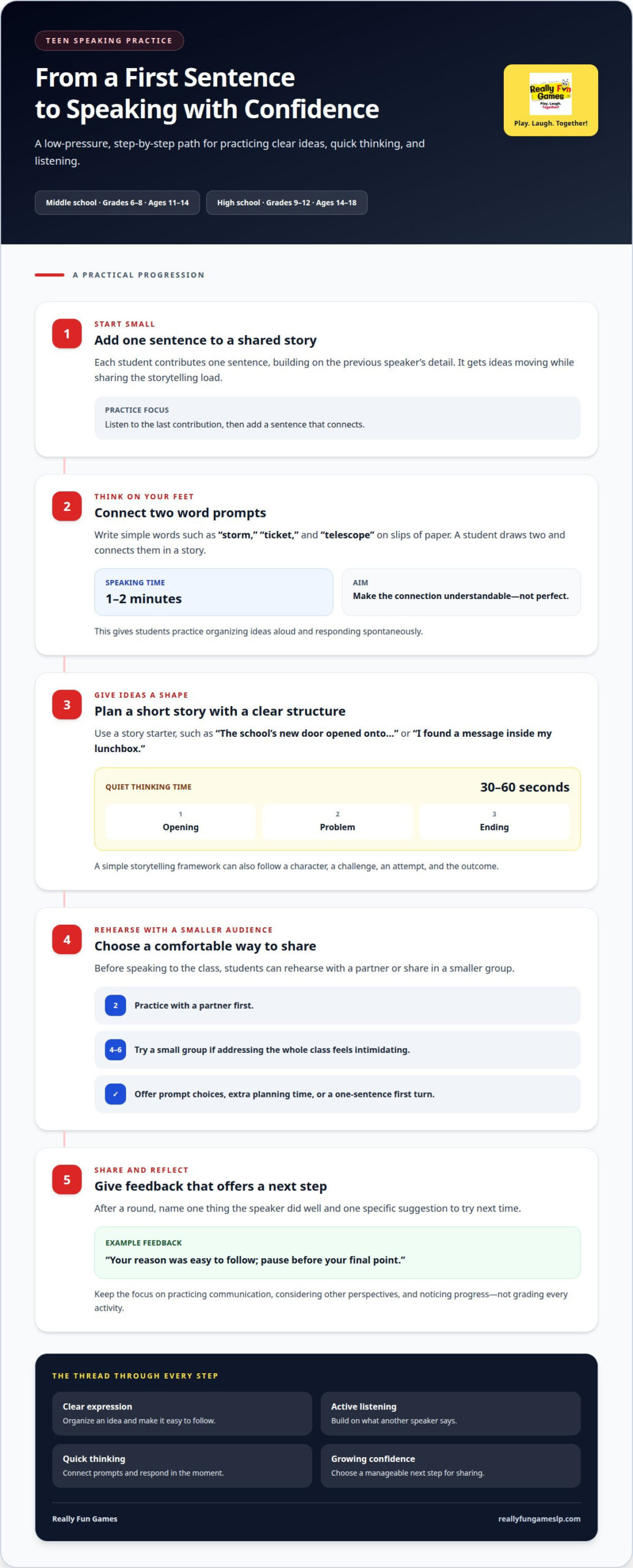
Storytelling games work for middle school and high school classrooms, with prompts adjusted to students’ experience. Middle school students are typically in Grades 6-8, ages 11-14; high school students are in Grades 9-12, ages 14-18. For a quick warm-up, invite each student to draw a word and add one sentence to a group story. It gets thoughts moving before a longer speech.
Quick-thinking storytelling with word prompts gives teens a clear starting point. Write simple words such as “storm,” “ticket,” and “telescope” on slips of paper. A student draws two and connects them in a story lasting one to two minutes. The goal is to make the connection understandable, not to invent a perfect plot. This format gives students practice organizing ideas aloud and responding spontaneously.
Story starters can make improvised speaking feel more focused. Try “The school’s new door opened onto…” or “I found a message inside my lunchbox.” Give students 30 to 60 seconds of silent thinking time, then invite them to share an opening, a problem, and an ending. A printable resource with 80 story starters offers varied prompts; teachers can also write their own for current class topics.
For middle school storytelling, keep the first turn small and specific. Ask a student to describe a memorable school event, a favorite place, or an object they use each day. A story chain adds collaboration: each person contributes one sentence, building on the previous speaker’s detail. This shared structure encourages listening, quick thinking, and creativity without asking one teen to carry the whole story.
Storytelling frameworks help speakers shape scattered ideas. Teach a simple sequence: introduce a character, name a challenge, describe an attempt, and share the outcome. For example, a student might explain how a lost library book led to a search involving classmates. Ask listeners to notice one clear detail and one moment when body language supported the speaker’s meaning.
What are quick public speaking warm-up games for teens? Try a word-prompt story chain, “Connect the Dots,” or a short show-and-tell about a favorite object. Each activity gives students a specific speaking task and a clear first step.
How can teachers adapt speaking games for shy teens or different skill levels? Let students rehearse with a partner or in groups of 4-6 before sharing with the class. A teacher can offer a choice of prompts, allow extra planning, or invite a student to contribute one sentence first.
What free or low-cost materials are needed for public speaking games for teens? Use paper slips, pencils, a board, or everyday classroom objects. Students can also create prompts from a current learning topic, then take turns choosing and connecting words.
For another source of conversation prompts, teachers can browse this conversation game collection and pair spoken questions with the story activities above.
2. Communication, confidence, and critical thinking
A strong speaking game asks teens to think, express an idea, and listen. Try a simple debate: “Should school start later?” Students choose a side, offer one reason, then respond to a classmate’s point. This format practices clear speech and organized thinking without requiring a formal speech. Switching sides in a later round encourages students to consider evidence beyond their initial opinion.
Back-to-back drawing makes listening visible. Pair students, give one person a simple picture, and ask them to describe it using words only. Their partner draws without seeing the original. Then compare the pictures and discuss which directions helped most. “Put the small circle above the door” gives clearer guidance than “draw something near the top.” The activity highlights precise language, patience, and how speakers can adjust when listeners seem confused.
Improv games add a playful challenge. Ask students to act as a news anchor reporting on an ordinary school event, such as a missing lunchbox. Or invite them to speak as a superhero explaining how they would solve a classroom problem. A role gives teens a starting point and lets them explore different tones, gestures, and body language. These speaking games encourage participation and give students a chance to build confidence through practice.
Keep the first turn manageable. Students can rehearse an answer with a partner before sharing it with the middle of the class, or speak from their seats instead of standing at the front. Groups of 4-6 players offer another smaller audience when addressing the whole class feels intimidating. Offer a choice between two prompts, such as describing a favorite app or defending a school rule. Choice helps teens express themselves with more ownership.
After each round, make feedback specific and kind. Name one thing the speaker did well, such as giving a clear example or keeping a steady pace, then offer one suggestion for next time. “Your reason was easy to follow; pause before your final point” gives a student something concrete to try. Avoid turning every activity into a grade. The aim is to practice communication, consider other perspectives, and notice progress from one speech to the next.
For a quick confidence-building routine, give students 30 to 60 seconds of quiet planning time. Ask them to prepare an opening sentence, one supporting idea, and a closing thought. Then let them share with a partner before inviting volunteers to speak to the class. This small sequence connects preparation with performance, while letting each teen choose a comfortable next step.
Try a story chain: each student adds a sentence to a shared story, practicing quick thinking and creativity. Show-and-tell lets students speak about something they love, which can give them a comfortable way to express themselves. These activities offer more ways to practice speaking than responding to a prompt or taking a side in a debate.
Public-speaking games can improve children’s creativity and thinking skills. They can help children build confidence naturally. Simple debates can help children organize their thoughts and present arguments clearly. Let students try these formats as they practice expressing ideas aloud, adding to a shared story, or talking about something they love.
3. Combining games with structured instruction
Start with a speaking objective, then choose an activity that makes it visible. For example, teach students to use signposting phrases such as “first,” “because,” and “as a result.” A game can then ask them to explain a process using those transitions. Teach the skill first; the playful task gives students a reason to use it aloud.
Show what success sounds like before students begin. A teacher might compare two short explanations of a science experiment: one jumps between ideas, while the other uses clear transitions. Ask the class which version was easier to follow and identify the words that helped. This quick comparison makes an abstract lesson something students can hear and recognize.
Make the target observable. In a lesson on persuasive speaking, students might state a claim and support it with relevant evidence. For vocal delivery, they can practice changing pace to emphasize an important point. Write the target where everyone can see it, then invite students to notice how the activity lets them practice that skill.
A classroom routine can keep instruction and play connected. Try daily five-minute speaking practice or a ten-minute warm-up two to three times per week. Focus each session on one goal, such as using transitions or emphasizing key words. Revisit the same goal in a different activity later so students can apply the skill beyond one game.
Give each participant a role that supports the lesson. During a short explanation game, one student speaks, another listens for the target phrase, and a third notes where the explanation was clearest. Rotate roles in the next round. This approach gives every student a reason to pay attention, even when they are not addressing the audience.
Keep reflection tied to the stated objective. After a round focused on transitions, ask students to name one phrase they used and explain where it helped. A brief written note can help them choose a goal for the next activity. This makes learning visible without turning a lively classroom game into a lengthy assessment.
How can adults give teens constructive feedback during public speaking games? Connect comments to the lesson target: recognize one successful choice, then suggest one specific adjustment. For example, praise a clear transition and recommend using a stronger concluding phrase next time.
Use games for practice, not as a substitute for teaching. A clear objective, a model, and a focused activity help students understand what they are trying and why. Teachers can vary the prompts while keeping the skill target steady, giving teens fresh ways to apply what they have learned.
This sequence helps students practice communication and build confidence step by step: teach a specific speaking skill, then use an activity to put it into practice.
4. Impromptu speaking games
Impromptu speaking games help teens organize thoughts and speak without a prepared script. Start with a familiar topic, such as a favorite meal or school subject. Give students 30 to 60 seconds of quiet thinking time before they begin. That brief pause creates a manageable bridge between planning and speaking, without removing the spontaneous challenge.
For a quick round, use a random-topic prompt. A student draws “rainy day,” “teamwork,” or “the best invention,” then speaks for 45 seconds without preparation. Listeners can name one clear idea they heard afterward. Keep the focus on sharing a thought, not delivering a polished speech. This simple rule lowers pressure while giving every speaker a clear finish line.
What classroom games help teenagers organize and deliver a short speech? Try The 10-Second Think: students silently plan an opening sentence, one supporting idea, and a final sentence. Then they speak for 30 to 60 seconds. One-Minute Expert offers another structure, with 30 seconds to prepare and one minute to explain a topic.
For small groups, divide the class into groups of 4-6 players. Connect the Dots asks a speaker to link two random words in a one-to-two-minute story. In Pause, Point, Proof, a student pauses for three seconds, states an answer, gives one reason, and adds a short example. These clear turns help children practice listening as well as speaking.
What are public speaking games for teens to play online or remotely? Use a video call for Mystery Box: the teacher names a household object, and a student gives a 45-second description or pitch. For a low-tech option, send each participant a prompt beforehand, then take turns speaking and responding aloud. Agree on turn order and a listening signal before starting.
Popular speaking games work best with simple, consistent rules. In One-Minute Expert, choose a topic, allow 30 seconds to prepare, then speak for one minute. For Tell Us the History Of, each story lasts 1-2 minutes and explains how an everyday object or place came to be. A clear time limit keeps turns fair and the activity moving.
Reading aloud can also warm up speech and vocal pacing. Invite students to choose a short poem, mark pauses, and read it with a feeling such as excitement or curiosity. Choral speaking offers a gentler variation: the group reads a short text together in unison. Both options let teens hear rhythm and language before taking an individual turn.
After each round, ask the audience to share one specific observation, such as “Your opening sentence made the topic clear.” Keep feedback kind and brief. If a teen feels uncomfortable speaking to the whole class, have them try the same prompt with a partner first. Practice stays purposeful, and the audience grows only as the speaker is ready.
5. What are fun public speaking games for teenagers?
Teenagers often enjoy speaking challenges with a clear twist. In Interview Chair, one student answers a question, gives a reason, adds an example, and closes with a final thought. Try prompts such as “What makes a great school event?” or “Which invention would you keep?” The structure gives each answer a beginning and an ending.
Explain It Three Ways puts audience awareness into play. Ask a student to explain one idea to a younger child, a teacher, and a friend. For instance, they might describe how a phone camera works, changing their word choice and details for each listener. Classmates can identify which version felt clearest and why.
End Lines turns storytelling into a playful puzzle. Each speaker chooses a closing line, then creates a story lasting 1-2 minutes that ends with it. A line such as “That’s when the parrot called my name” can send a story in a surprising direction. Listeners hear how a speaker builds toward a planned ending.
Try a comic strip description for teamwork and clear directions. Give partners different images from a comic strip, then let them talk through the likely order before revealing their pictures. They can spend about 10 minutes arranging the sequence. The activity rewards careful listening and specific descriptions, rather than guessing what another person sees.
Who’s Telling the Truth? combines personal storytelling with audience questions. Each student writes three facts about themselves that classmates do not know, then shares the statements while the audience decides which one is invented. Let students ask one question to one of the three classmates being questioned. The format encourages concise answers and attentive follow-up.
For imaginative teamwork, use Story Dice to inspire a 90-second mini-narrative. Students roll or select images, then weave them into a beginning, middle, and ending. Another option is a 30-second commercial for a real or imagined product. Ask each speaker to name one benefit and finish with a memorable pitch.
Older students may like the Hero’s Journey Pitch, a 2-minute personal speech shaped around a challenge, an important choice, and a lesson learned. Team Pitch Tank gives groups of 4-5 students 15-20 minutes to develop and present an idea. Each activity adds a different speaking experience, from solo storytelling to shared planning and delivery.
Choose a prompt that suits the group, explain the rules, and give listeners one clear job. They might notice a strong closing, a useful example, or an engaging opening. For more playful ways to spark communication, explore conversation and communication games that can bring laughter and lively discussion to a group.
Really Fun Games: Really?! Think You Know Me? Guess Again
Really?! Think You Know Me? Guess Again can bring lively conversation and listening practice to a teen group. Use it when students are ready to move from solo speaking prompts to shared exchanges, where they can explain opinions, respond to others, and enjoy unexpected answers. It complements classroom instruction rather than replacing focused speech practice.
For a playful vocal warm-up, Triple Tongue Twisters, Tricky Tetra Tongue Twisters, and Blooming Tongue Twisters invite players to practice clear, expressive speech. A teacher can pair a round with a lesson on articulation or pacing, then invite students to notice which sounds take extra care. Choose an activity that suits the group’s goal, whether that is conversation, vocal play, or both.
Explore Really Fun Games’ collection to find a conversation or tongue-twister game for your classroom or group.
Keep the Conversation Going
Public speaking develops through practice that feels purposeful and welcoming. Choose a small goal for the next classroom session, such as opening clearly, explaining one idea, or speaking with expression. Then pick an activity that gives teens a chance to try that skill in their own way. The best games for public speaking practice for teens make room for thoughtful instruction and the lively surprises of play.
For another playful option, Really Fun Games offers Really?! Think You Know Me? Guess Again, Triple Tongue Twisters, and Tricky Tetra Tongue Twisters. These games can add conversation or vocal play to a classroom, family gathering, or youth group. Let the group’s learning goal guide your choice, keeping the focus on participation, connection, and enjoyment.
Ready to explore games that can bring communication and laughter to your group? Contact Really Fun Games and take the next step toward a more engaging practice session. Every new speaking turn is a fresh chance to share an idea.
Frequently Asked Questions
Who Can Use These Public Speaking Activities?
Teachers, homeschoolers, youth leaders, and families can use these activities with teens in class or small groups. A parent or counselor can model a real-life conversation, then ask a teen to notice calm wording, listening, and respectful responses. For students with limited or no vision, make participation verbal by using names when addressing speakers. Choose prompts that connect to the group’s interests and setting.
What improv games help teens practice speaking confidently?
Try an emotion ball: write feeling words on a softball, then have the catcher share a time they felt the word nearest their hand. For a perspective-taking challenge, use a hot-seat role-play, where a teen answers questions in character as a coach, journalist, or community helper. Keep questions friendly and let participants choose a character so spontaneous replies feel playful rather than personal or pressuring.