

Games for social-emotional learning help teens practise recognizing feelings, understanding others’ perspectives, communicating, and making thoughtful choices through play. These activities can support five core SEL areas: self-awareness, self-management, social awareness, relationship skills, and decision-making. The goal isn’t to force a serious conversation, but to make room for one to happen naturally.
Teens may find it easier to learn when they can join in, laugh, and share ideas instead of sitting through a lecture. A quick guessing game, playful challenge, or group activity can open the door to empathy and connection. This guide offers practical SEL game ideas for school and after-school settings, with ways to practise perspective-taking, recognize emotions, notice nonverbal cues, and compromise. You’ll also find ways to adapt activities so teens have a voice and can participate at their own pace.
Key Takeaways
- Choose activities that give teens a lively way to notice their feelings and consider how others see a situation.
- Use playful perspective-taking to open conversations about empathy without making participation feel like a lecture.
- Adapt games for school and after-school groups by making space for teen choice, listening, and positive connection.
- Try emotion-guessing activities to practise reading facial expressions, gestures, and other nonverbal cues.
- Make compromise tangible by letting teens take turns sharing ideas and shaping a group decision together.
1. Social awareness
Social awareness helps teens understand other people’s perspectives and respond with empathy. In a classroom, a student might notice a classmate sitting alone and invite them to join a group activity. That choice begins with observing someone else, then considering what they might be feeling. Games for social emotional learning teens provide a playful setting to practise these skills.
Games can help teens practise emotional skills such as self-awareness, self-management, social awareness, relationship skills, and decision-making. These are CASEL’s five core competency areas. A game might invite a teen to describe a reaction, listen to a peer’s point of view, or consider how their response affects the group.
Classroom SEL game and activity-kit costs depend on materials, reusability, and how well the activities fit a particular group. Teachers can weigh these factors against their needs, including whether activities encourage discussion, reflection, or teamwork.
Self-awareness means identifying feelings and noticing how thoughts and emotions can influence actions. Try a check-in before a group task: each teen names a feeling, considers what may have prompted it, and chooses one strength to draw on. A teen who feels nervous, for example, could use their curiosity to ask a partner a question.
Strength-spotting makes reflection more concrete. After a shared activity, ask each student to name a strength they used, such as patience, humor, or careful listening. A partner can share an example they noticed. This helps teens connect a quality to an action instead of treating strengths as vague labels.
Diversity and cultural awareness grow through thoughtful listening. Use a fictional scenario, such as classmates disagreeing about what makes a greeting respectful. Invite teens to discuss how family, community, or personal preferences might shape their answers. Set a discussion norm: listen without interrupting, ask before assuming, and don’t treat one person’s experience as everyone’s.
Try a three-step self-awareness activity after a game: “What did I feel? What did I do? What might I try next time?” A student who felt frustrated after losing might notice they interrupted, then plan to pause before speaking next time. This reflection helps teens recognize patterns and consider a different response.
For educators choosing games for social emotional learning teens, conversation-based activities can make these reflections feel natural. A prompt about what makes a group welcoming can connect personal experiences with different perspectives. Explore conversation and educational games to bring shared discussion into group activities.
Social and emotional learning is a student-centered approach. It builds on students’ strengths, develops skills through hands-on learning, gives young people a voice, and supports them through positive, ongoing relationships with adults. Self-awareness can help children build self-regulation, which supports managing emotions and body movements during tough situations. Self-management means managing feelings, thoughts, and behaviors in different contexts.
A self-guided activity on the page states that 93% of women with ADHD report mood struggles. The page also recommends preschool SEL activities for children ages 4-5. These details can remind educators to match activities to learners’ ages and needs, while making room for students to reflect and participate.
2. Empathy and perspective-taking
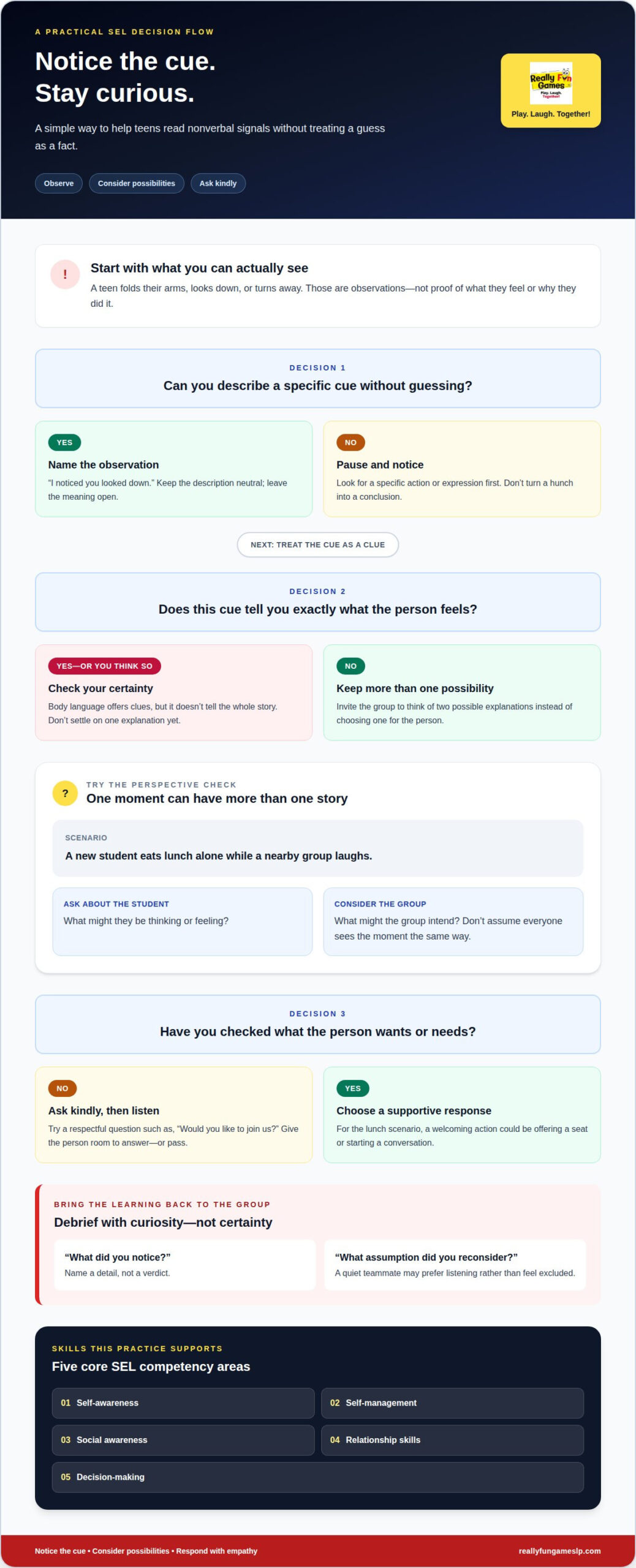
Perspective-taking gives teens a chance to pause before deciding what another person thinks or feels. During a group game, one student might lose a turn and go quiet. Rather than assuming they’re angry, invite teammates to name two possible explanations, then ask what supportive response might help. This separates observation from assumption and gives empathy a practical starting point.
Try a “switch the story” activity with a fictional disagreement. One friend wants to work alone on a class project; another wants to divide every task together. Ask each teen to explain both viewpoints, including what each person might value. Then invite them to suggest a response that acknowledges both needs. This role-play helps teens consider another perspective without pretending they have to agree.
Body language can offer clues, but it doesn’t tell the whole story. During a short scene, a volunteer might fold their arms, look down, or turn away. Ask the group what they notice, then invite several possible interpretations instead of one certain answer. A follow-up question such as “What could you ask kindly?” shows how observation and respectful conversation work together.
Kindness Tower, played with Jenga, is intended to help teens develop empathy and social awareness. As the tower grows, a facilitator can invite players to share a kind action they noticed at school, such as saving a seat or thanking a teammate. Keep sharing optional, and let teens pass without explaining. The familiar physical challenge creates a relaxed setting for noticing considerate choices.
For a low-prep perspective game, give pairs a scenario: a new student eats lunch alone while a group nearby laughs. One teen describes what the student might be thinking; the other imagines what the group might intend. Switch roles, then identify one welcoming action, such as offering a seat or starting a conversation. Comparing interpretations helps teens see how the same moment can feel different to each person.
After playing, ask each teen to name one detail they noticed and one assumption they reconsidered. A quiet teammate, for example, may prefer listening rather than feel excluded. This brief debrief connects the game to real relationships and reminds the group that curiosity is more useful than guessing. Adults can model the same skill by asking, “What else might be happening?” before offering advice.
Choose activities where listening, kindness, and shared conversation matter as much as winning. Explore conversation games for groups for another playful way to bring teens together and encourage thoughtful exchanges.
3. SEL in school and after-school settings
Games for social emotional learning teens can give students a lively way to practise listening, cooperation, and thoughtful choices. Emotion charades, paired activities, and group problem-solving suit different settings, from middle school students ages 11-13 to high school students ages 14-18.
Social and emotional learning activities are commonly used in schools and after-school settings. A teacher might open class with a brief activity about feelings, then encourage respectful discussion during a group challenge. An after-school leader could use a cooperative game to help a new group connect before planning a shared project.
Educators looking for SEL resources can explore toolkits that include manuals, activities, fact sheets, videos, and websites. One toolkit was assembled by the Risk and Thriving in Adolescence Program Work Team, a collaboration involving Cornell University, Cornell Cooperative Extension, New York State 4-H Youth Development, and stakeholders.
To make progress visible, connect each activity to a clear skill and practical goal. Before a listening game, students might aim to let a partner finish speaking before responding. Afterwards, ask what helped them meet the goal and what they want to practise next. Teachers can note observable actions, such as inviting someone into a discussion or accurately summarizing a classmate’s idea.
Focus goals on behaviors students can control, not popularity or always feeling calm. A teen who finds group work stressful might aim to share one idea or ask a clarifying question. A short reflection can link feelings with actions: “I felt annoyed, so I paused before answering.” This gives students language to notice progress without judging their emotions.
Personal boundaries matter in classroom activities, too. Before role-play, teachers can explain that students may pass, choose another scenario, or ask for a pause. If a prompt feels too personal, a teen can respond as a fictional character instead. Practising phrases such as “I’d rather not share that” or “Can we try another example?” makes respectful boundaries part of communication.
One approachable social goal is to speak with one new person each day. Students might practise by asking a classmate about a shared activity, then listening without rushing to respond. Teachers can keep the goal flexible: a greeting, a question, or a short exchange can all offer practice, depending on the student and setting.
Teachers choosing games for social emotional learning teens can match each activity to a learning goal, group dynamic, and comfort level. Look for clear turns, accessible prompts, and time to reflect. The best fit is an activity students can join meaningfully and connect to everyday situations.
4. Emotion recognition and nonverbal communication
No-prep SEL games for teens include Emotion Charades, partner listening challenges, and scenario-based discussions. In Emotion Charades, one player silently acts out an emotion while others guess, then explain which facial or body cues they noticed. This quick activity lets teens practise recognizing emotions without printed materials.
For clear instructions, agree on a set of emotions, choose one actor, and have them communicate without speaking. The group guesses, then names visible clues, such as tense posture or a broad smile. Rotate roles so each teen practises acting, observing, and listening. Emotion Charades can help teenagers recognize emotions and practise nonverbal communication.
Free online SEL activities can include browser-based emotion-matching games, interactive scenarios, or video-call versions of charades. Choose an activity with clear instructions, teen-appropriate situations, and a discussion prompt. For example, ask which clues support an emotion guess. A screen-based game works best as a starting point for conversation, not a substitute for listening to classmates.
Teachers can adapt an activity by changing its prompts, response options, and participation style. Younger students might match a face to a basic emotion, while older teens discuss mixed feelings in a fictional scene. A student who prefers not to perform can observe, describe a cue, or write an answer. These options make the same skill accessible across different ages and abilities.
Games can offer practice with social skills, emotional intelligence, and communication, but one round can’t demonstrate lasting progress. Connect play to a real-life example: after charades, students might discuss how asking “Are you okay?” can clarify a classmate’s expression. Teachers can notice whether students use respectful questions and listen during later group work.
SEL games have limits, too. A guessed expression may not match someone’s actual feelings, and public role-play can feel uncomfortable for a teen. Don’t treat body language as proof; encourage players to ask instead of assume. Offer a pass option, use fictional situations, and never require students to share personal thoughts to participate.
For a communication and cooperation game, pair students for a silent drawing challenge. One teen describes a simple picture without naming it while their partner listens and draws. Then they compare the result and switch roles. Ask which directions helped and which were confusing. This low-pressure activity practises precise speaking, active listening, patience, and coping with mistakes.
Ask which directions were easiest to follow and where partners needed clarification. Relationship skills are the ability to communicate and connect with different people in a healthy way. Invite each partner to describe what helped them understand the message, then let the speaker explain what they intended. Keep feedback focused on the directions and drawing, not on judging either person. Partners can switch roles and try another simple picture, focusing on clear wording, patient listening, and respectful questions. To wrap up, have each pair name one communication choice they want to use in another shared task.
5. Compromise and perspective-taking
Compromise helps teens work through conflict without turning every disagreement into a contest. Use a familiar choice, such as deciding whether a group project should include a video or a poster. Each student explains their preference and the reason behind it. Then the group looks for an option that respects both ideas, such as a poster with a short video presentation.
Taking turns planning a family activity can become a weekly tradition, with one night set aside for a different person’s choice. A teen might choose a movie, while someone else prefers a walk or a game. Before deciding, ask each person to explain what matters most to them. The planner listens, then looks for something everyone can share, such as choosing a movie the whole family can enjoy.
Conflict resolution can follow six stages to help reach an agreement. A practical game can guide teens to identify the disagreement, hear each perspective, name the underlying needs, brainstorm options, compare possible solutions, and agree on a next step. For example, two students sharing a presentation might disagree about who speaks first. They can describe the problem, listen, identify fairness as a shared need, and decide how to divide speaking time.
Focus on the problem, not on labeling a person. If one teammate misses a planning meeting, another might say, “I felt stuck finishing the slides alone,” rather than “You’re selfish.” The first statement describes an impact without assigning a motive. Invite the other teen to share their perspective, then ask what would make the next planning session work better.
A cooperative challenge can make compromise visible. Give a group a fictional task, such as planning a welcoming event with limited time and several different preferences. Ask each person to contribute one idea, then have the group combine ideas into a plan. Teens practise sharing, taking turns, and explaining trade-offs, such as choosing an activity that includes both quieter and more energetic options.
After the activity, use a short debrief: What did the group agree on? Which idea changed after someone listened? What could each person do next time? A teen might notice that taking turns speaking helped a quieter classmate contribute. This reflection connects the game to relationships beyond the activity, where respectful disagreement and clear requests matter.
Give the group permission to pause if a disagreement gets heated, then return to the steps when everyone can listen. For more playful ways to build connection through conversation, explore games that bring people together.
Really Fun Games: Really?! Think You Know Me? Guess Again
Really?! Think You Know Me? Guess Again gives teens a playful way to compare how they see themselves with how their friends see them. The guessing-and-sharing format can spark conversation, laughter, and new discoveries about the people around the table. It’s a natural fit for family game night, a youth group, or a classroom activity focused on connection.
For a different kind of group energy, Triple Tongue Twisters, Tricky Tetra Tongue Twisters, and Blooming Tongue Twisters invite playful speaking and shared laughter. These games are designed for ages 8+ and support communication and social skills through play. Choose a conversation game when the group is ready to share ideas, or a tongue-twister game when a lively speaking challenge fits the moment.
Explore the Really Fun Games collection at reallyfungameslp.com and find a game for your group.
Make the Next Conversation Count
A useful next step is to choose one social skill your group wants to practise, then make room for it in an enjoyable shared activity. Games for social-emotional learning teens can create small moments of connection, such as listening before responding or making room for another perspective.
For a playful starting point, Really Fun Games offers Really?! Think You Know Me? Guess Again, Triple Tongue Twisters, and Tricky Tetra Tongue Twisters. Choose the kind of play that suits your group, from conversation to a lively speaking challenge.
Explore the Really Fun Games collection and choose a game that suits your family, classroom, or group. Here’s to more laughter, listening, and connection.
Frequently Asked Questions
What are SEL Games?
SEL games are structured activities that let players practise social and emotional skills while interacting with others. Their purpose goes beyond entertainment: a prompt, shared challenge, or brief reflection connects play with everyday choices. After a team puzzle, for example, players might discuss how they handled disagreement or included different ideas. Choose an activity that feels age-appropriate and welcoming, with participation options that respect each teen’s comfort.
What are engaging SEL games for teens to play in small groups?
Try a “common ground” challenge: each person shares a favorite way to relax, then the group finds one activity everyone could enjoy. Another option is collaborative storytelling, where each teen adds a sentence and the group decides together how the characters solve a problem. These formats encourage listening and cooperation without putting one player on the spot. Invite teens to pass, contribute in writing, or suggest a new direction.
Where can educators find evidence-based SEL games for teens?
Educators can explore the SEL toolkit, which includes manuals, activities, fact sheets, videos, and websites. The Risk and Thriving in Adolescence Program Work Team and its collaborators assembled it.