

Shared play turns everyday moments into chances to listen, laugh, and understand one another. Games for fostering deeper connections invite people to take turns, share stories, tackle small challenges, and communicate in a relaxed setting. The goal isn’t to win every round; it’s to make room for genuine conversation and memorable moments together.
Whether you’re planning a family game night, helping a classroom feel more connected, or bringing friends together, the right game can make it easier for everyone to join in. Play gives people a natural reason to speak up, notice different perspectives, and encourage one another, without making connection feel like a formal exercise.
Here are practical ways to use games to build communication, empathy, confidence, and teamwork, along with ideas for choosing activities that suit your group. From conversation prompts to playful word challenges, a shared game can open the door to meaningful connection, one turn at a time.
Key Takeaways
- Choose play that makes it easy for everyone to participate, communicate, and enjoy the moment together.
- Use shared challenges and conversation prompts to invite new perspectives and practice empathy.
- Make room for laughter and follow-up conversations so a fun activity can become meaningful quality time.
- Look for signs of connection in how players listen, encourage one another, and share their thoughts.
- Match the game to your group’s interests and goals, whether you’re gathering family, friends, or a classroom.
1. Family play as a way to build skills and work through feelings
A family game night can make communication feel natural: players listen, take turns, follow rules, and respond to wins and setbacks together. Games give children a low-pressure opportunity to practice patience, cooperation, and managing frustration. Adults can model encouragement and adjust their support as children gain confidence.
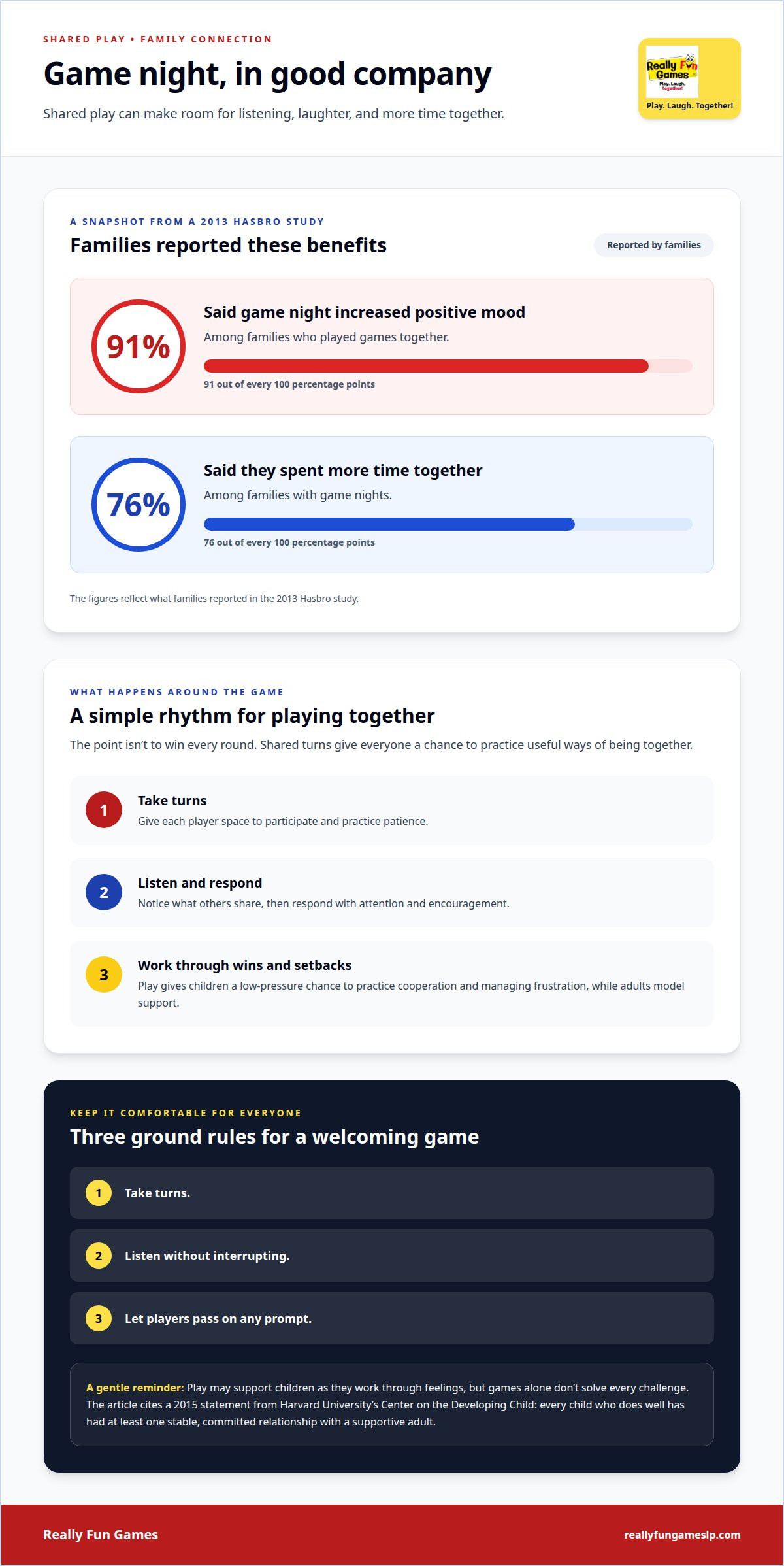
A 2013 Hasbro study found that 91% of families who played games together said game night increased their positive mood, while 76% of families with game nights said they spent more time together. Those shared moments can help build trust and relationships through steady, enjoyable interaction. Play may support children working through feelings, but games alone don’t solve every challenge. A 2015 study at Harvard University’s Center on the Developing Child stated that every child who does well has had at least one stable, committed relationship with a supportive adult.
What are the best conversation games for couples, friends, or family? Choose a game that encourages sharing and listening without demanding intimate disclosures. For families, a simple prompt such as “What made you laugh today?” can open a genuine conversation.
What are the best connection games for groups who have just met? Start with light icebreakers that let people share preferences, funny answers, or short stories. Charades Relay can also encourage easy teamwork without asking anyone to reveal personal details.
How can you choose a connection game for different ages and relationships? Match the language, challenge, and personal depth to the youngest players and the group’s comfort level. For grandparents and children, familiar topics and flexible answers can help everyone join in.
Are there free games or conversation prompts for fostering deeper connections? Yes. Take turns naming a favorite memory, asking an open-ended question, or inventing a story together. Keep every prompt optional.
What are the rules for popular relationship-building games? Agree on simple ground rules first: take turns, listen without interrupting, and let players pass on any prompt. In Charades Relay, players act out clues for teammates to guess.
How long do connection-building games take, and how many people can play? It depends on the game and group. Choose a format that fits the time available and gives everyone a chance to participate. A short round can work before dinner or as part of a longer family game night.
What are good virtual games for building deeper connections online? Try charades over a video call, shared storytelling, or turn-taking conversation prompts. Keep the rules simple so everyone can follow along on screen.
What boundaries or risks should you consider when playing emotionally intimate games? Make passing acceptable, avoid pressuring anyone to explain an answer, and pause if a player seems uncomfortable. After a family game night, adults can check in and give children space to name their feelings.
For more ideas suited to shared play, explore family and conversation games and choose a style that fits your group.
2. Perspective-taking and empathy through gameplay
Perspective-taking grows when players hear experiences different from their own. For a school-friendly activity, start with a scenario, such as a new student eating lunch alone. Invite children to imagine how the student might feel and what could help. They can practice noticing emotions, considering another person’s needs, and expressing ideas without rushing to judge.
Try a three-step routine: listen to a story, name the feeling you heard, then ask a gentle follow-up. If a player describes feeling left out of a team, someone might say, “You felt disappointed when no one passed you the ball.” That response shows attention without trying to solve the problem right away. Then discuss what support could look like, such as inviting them into the next round.
Games make perspective-taking playful. In charades, one person acts out an everyday moment while teammates guess what is happening. Players watch gestures and consider different interpretations. In a story-building game, each person adds a sentence from a character’s point of view. A character who seems angry might actually feel embarrassed, worried, or misunderstood.
In the classroom, teachers can connect play to a social skill. Before a group activity, set a goal: notice when someone hasn’t spoken and invite them in. Afterward, ask students to share a moment when a teammate helped the group feel included. This reflection turns “be kind” into something children can identify and practice. Adults can model phrases such as, “Would you like a turn?”
Question-card games vary in their prompts, tone, and level of personal depth. Choose cards that suit the group, from light topics such as favorite ways to relax to more reflective questions for close friends. Let players pass, choose a lighter prompt, or answer generally. These options invite meaningful conversation without making personal disclosure a test.
At a family, school, or group gathering, try asking, “What would help you feel welcome on your first day?” Give everyone time to answer before anyone responds. This simple structure encourages curiosity and respectful listening. In a new group, start with easy questions; closer friends may enjoy prompts about memories or shared experiences.
Playful challenges and thoughtful prompts can both help people share perspectives. Choose a format that suits your group’s comfort and gives everyone a way to participate. Conversation games for shared play can offer prompts and lighthearted activities to help get everyone talking.
These interactive activities help children engage with one another. Therapeutic games can help foster children build skills and work through feelings, but they will not solve all of their problems. Playing games gives children opportunities to practice following rules, taking turns, communicating, managing frustration, celebrating successes, and coping with disappointment. These experiences make play useful without expecting it to replace other support.
Adults can follow up with young people who are going through something instead of waiting for them to raise it again. A gentle check-in can leave room for a conversation when they are ready. Dr. Michelle Bengtson’s Your Hope-Filled Perspective podcast discusses building meaningful connections to combat loneliness in Episode 234.
3. Quality time and shared experiences
A shared game gives people something to do together, not just something to talk about. In one study, 24 family pairs played a commercial game for an average of 30-35 minutes, then discussed memories and feelings about its scenes for 20-25 minutes. The two parts mattered: the game created a shared experience, and the conversation gave each person room to reflect.
You can adapt this pattern at home. Choose a game with moments players can describe, then leave a little space afterward for stories. A grandparent might recall a childhood celebration; a grandchild might connect a scene to a recent school event. Adults can encourage the exchange by listening first instead of turning every answer into advice.
Caregivers can follow up on a child’s comment with one question. If a child says a character seemed lonely, a parent might ask, “What do you think would help them feel included?” One thoughtful prompt can invite a child to explain their perspective; a string of questions can make the moment feel like an interview.
Not every shared activity needs a complicated setup. Write personal questions on Jenga blocks, and invite players to answer the question on the block they pull. Keep prompts light enough for the group, such as “What’s a meal you’d happily eat again?” or “Which family outing made you laugh?” The familiar game gives conversation a natural starting point.
Adults can strengthen relationships by joining the play, not just organizing it. Parents who share their own funny answers show children that everyone can participate. At a family gathering, a relative might tell a short story, then invite someone else to add a detail or remember the moment differently. The aim is shared attention, not a perfect account.
Try this simple rhythm after a game: name a favorite moment, invite someone to explain why it stood out, and give another player room to respond. If the activity brings up a difficult feeling, pause rather than pushing for more. A calm break can help participants gather their thoughts and express what they need.
Quality time can fit into ordinary routines. Set aside a moment after dinner for a quick card game, or bring a travel game along for a family visit. Since everyone has 24 hours in a day, choosing a shared activity means deliberately making room for the relationships that matter. A small ritual can give families a reliable opportunity to reconnect, laugh, and learn something new about one another.
Prioritizing quality time and shared activities can help build meaningful relationships, even when time is brief. Face-to-face interactions make it easier to notice one another’s reactions and respond with care; a game can make that attention feel natural rather than formal.
After a child shares an experience, caregivers can ask a follow-up question and listen to the answer. Alongside practical tasks, make room for humor, fun, and laughter. Sharing stories and listening can help young people build resilience and imagine a positive future.
Perceived closeness
Closeness can shift during a shared activity, even when players already know one another well. In one study, participants rated perceived closeness on a 7-point scale before and after playing. Younger participants’ average rating rose from 4.083 to 5.750 points. Older participants’ average moved from 5.246 to 6.283 points. These results describe participants’ impressions after gameplay, not a guarantee that every game changes every relationship.
The study paired younger adults aged 18-26 with older adults aged 61-80. It included 19 grandparent-grandchild pairs and five maternal grandparent-grandchild pairs. Those age and relationship differences matter: the same game can feel different depending on what players have experienced together. A grandchild might interpret a scene through school memories, while a grandparent connects it to family history.
Shared play can create opportunities for learning because players respond to the same prompts or scenes. One person may notice a funny detail; another may focus on a character’s feelings. To make those differences productive, pause after a turn and invite each player to explain what stood out. Listen for the reason behind an answer rather than treating agreement as a measure of closeness.
Notice small behaviors during and after a game to see how players connect. They might ask one another questions, remember a detail from an earlier answer, or laugh about the same unexpected moment. These are signs of attention and shared enjoyment. There’s no need to score or compare them; noticing them can help a family decide which activities they enjoy playing together.
Games can engage mental and cognitive skills, too. Remembering clues, interpreting a scene, and choosing a response give players something to work through together. A cooperative format can encourage shared problem-solving, while a conversation game gives each person a turn to speak. The right format depends on whether the group wants lively teamwork, personal stories, or a mix of both.
Try a brief check-in after a game: ask, “What was your favorite moment?” and “Did anything surprise you about someone’s answer?” These questions invite reflection without demanding a deep confession. For younger players, offer choices such as “Was the funniest part the acting or the guessing?” For adults, a memory-based prompt may open a richer discussion.
Perceived closeness is personal, so don’t treat a rating or a single conversation as proof of lasting change. Before-and-after scores can describe participants’ immediate impressions. In everyday play, focus instead on whether people feel heard, share attention, and want to continue the conversation. Those moments give families a practical way to see how shared games fit their relationships.
5. What games help people build deeper connections?
The best choice depends on what the group needs: an easy introduction, shared laughter, or a reason to tell stories. For new acquaintances, choose a light icebreaker with simple prompts. For relatives who know one another well, try conversation cards that invite memories or opinions. Games for fostering deeper connections work best when players can participate comfortably, listen, and enjoy the activity without pressure.
I Love My Neighbor can help a group discover common ground through lighthearted sharing. Keep the focus on preferences and everyday experiences, such as favorite foods, hobbies, or ideal weekend plans. Players learn small details about one another and may find unexpected similarities. In a classroom, a facilitator can invite students to share only what feels comfortable, then notice common interests together.
Charades Relay brings people together through movement, observation, and teamwork. Players communicate with gestures while teammates interpret the action. Use familiar topics, such as animals, hobbies, or household routines, to keep the focus on lively collaboration. A family can choose clues together, then switch who acts and guesses. A shared joke can become part of the group’s own story.
Story-based games offer another way to connect. One player begins with a sentence, such as “The picnic basket started to glow,” and each person adds a detail. The group listens closely, builds on earlier ideas, and makes room for surprising contributions. This works for friends, families, or youth groups because no one needs a perfect answer. A quieter player can add a small detail, while an enthusiastic storyteller can set an imaginative direction.
For a gathering with mixed ages, choose rules that are easy to explain and answers that can be adapted. A child might name a favorite game, while an adult shares a memory connected to it. With a new group, start with playful prompts before trying personal topics. If players seem unsure, demonstrate a turn yourself and make passing an option.
Choose a format that suits the group’s energy. A lively birthday gathering may suit charades or quick team challenges; a relaxed family evening may be better for conversation cards. After a round, ask which moment made people laugh or surprised them. That small reflection helps you see whether the game encouraged connection, rather than simply keeping everyone occupied.
Try a different style at your next gathering: select an icebreaker for new faces, a story prompt for a familiar group, or a team game when people need to collaborate. Find a game for your next shared-play gathering and make room for another round of conversation, creativity, and laughter.
Really Fun Games: Really Fun Custom Games Bundle
Really Fun Custom Games Bundle is a natural next step when you want shared play to spark more conversation and laughter. Really Fun Games offers games designed for ages 8 and up, with options for families, friends, teachers, and groups.
For conversation-focused gatherings, Really?! Think You Know Me? Guess Again! offers a playful way to learn more about one another. Triple Tongue Twisters, Tricky Tetra Tongue Twisters, and Blooming Tongue Twisters bring vocal play to a gathering, giving players another way to laugh and connect. Choose the style that suits your group’s mood and make room for everyone to join in.
Contact Really Fun Games to explore which option suits your next shared-play gathering.
Make your next gathering a moment to connect
Choose one intention for your next game night: invite a quieter player to join in, make room for a new story, or share a laugh. Games for fostering deeper connections give a group an easy starting point, while the players shape what the moment becomes. Let the conversation continue naturally, whether that means another round or a relaxed chat afterward.
As you plan, consider who’s gathering and what would help them feel included. A lively group might enjoy a playful challenge, while a quieter gathering may welcome prompts that make conversation easy. The right fit is the one that helps your family, classroom, or group enjoy playing together.
Ready to plan your next shared-play gathering? Explore the Really Fun Games collection, choose a game for your group, and contact Really Fun Games. Bring your people together and make room for a little more laughter.