

What if the secret to professional-level diction wasn’t found in a sterile clinic, but in a room full of laughter and friends? Most of us know that sinking feeling when you’re asked to repeat yourself for the third time during a high-stakes meeting. It’s genuinely frustrating to feel like your best ideas are getting lost in a mumble or a quiet stutter. You’ve likely tried traditional articulation exercises for adults and found them about as exciting as reading a dictionary. It’s hard to stay motivated when practice feels like a lonely chore instead of a step toward genuine connection.
This guide is here to flip the script and bring the joy back to your voice. You’ll discover how to transform those tedious vocal drills into high-energy social games that build undeniable confidence and crisp, clear speech. We’re exploring vibrant, playful techniques that turn every practice session into a celebration. We will look at how award-winning tools like Triple Tongue Twisters can help you master every tricky syllable while having the time of your life. Get ready to find your most resonant voice through the power of play and shared discovery.
Key Takeaways
- Understand how clear diction opens doors for career advancement and deeper social connection.
- Discover the “articulators” behind your voice and how proper breath support acts as your engine for clarity.
- Learn why gamified articulation exercises for adults are more effective than traditional drills for long-term improvement.
- Implement a simple, 10-minute daily routine designed to fit into a busy professional’s schedule.
- Explore how playing games like Triple Tongue Twisters can turn speech practice into a joyful social event.
Beyond the Basics: Why Articulation Exercises for Adults Are Essential
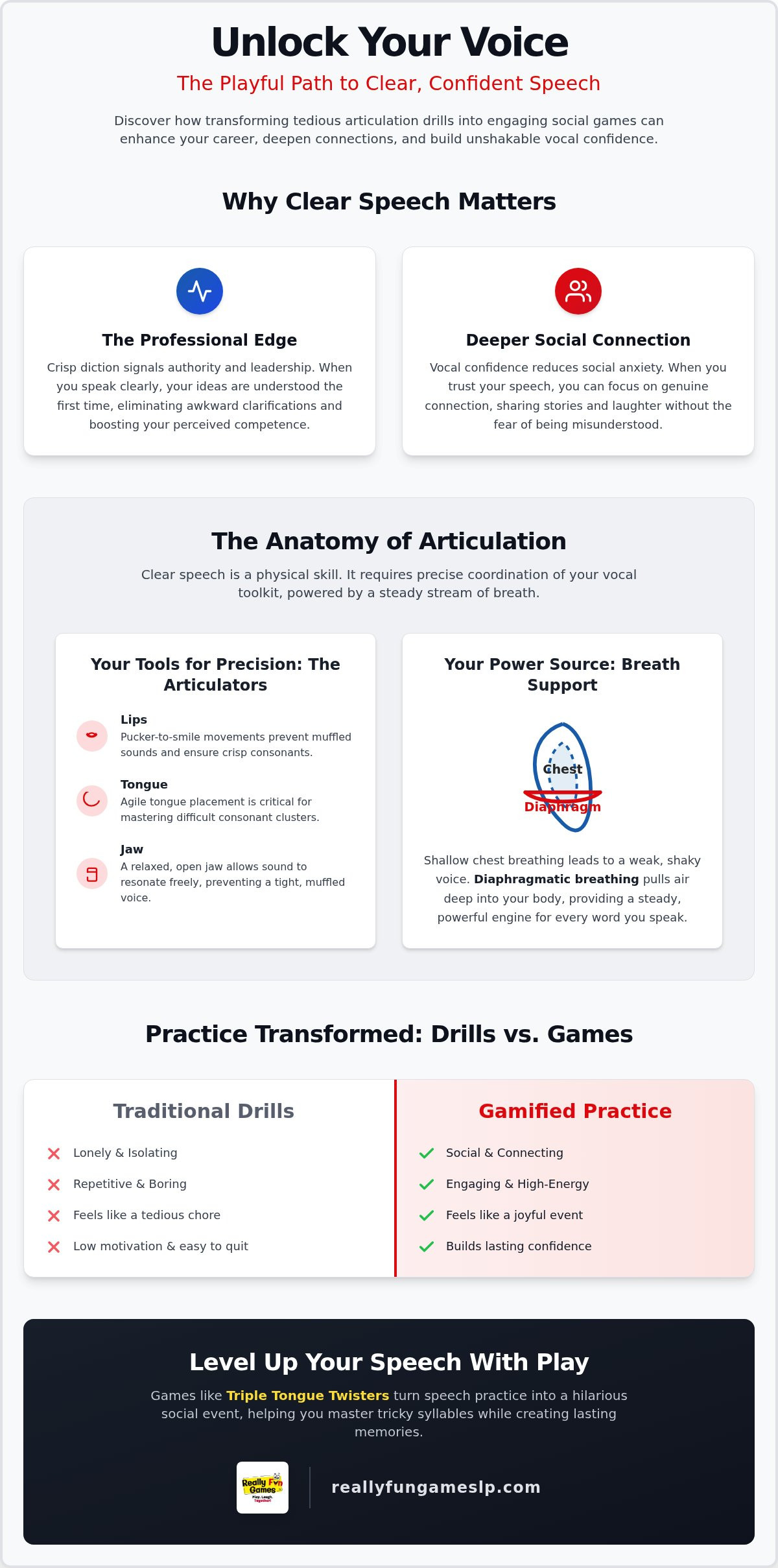
Articulation is the physical art of shaping sound. It’s the precise coordination of your tongue, teeth, and lips to create distinct, crisp language. While we often think of speech work as something for children in classrooms, articulation exercises for adults have become a cornerstone of modern self-improvement. In 2026, we’re seeing a massive shift toward “vocal fitness.” People are realizing that communication isn’t just about the words you choose, but how clearly those words land. It’s the difference between a message that lands with a punch and one that simply drifts away in a mumble.
Many adults seek these exercises to sharpen their professional edge or reclaim their social confidence. Unlike traditional clinical therapy, which often focuses on correcting disorders, vocal fitness is about optimization. It’s about training your speech muscles to be as agile as an athlete’s. We’re moving away from dry, repetitive drills and embracing gamified learning. Why settle for boring drills when you can turn your practice into a high-energy social game with tools like Triple Tongue Twisters? This modern approach makes the process as enjoyable as the result.
The Professional Edge: Clarity in the Workplace
In a world of virtual meetings and rapid-fire presentations, your voice is your most powerful tool. Crisp diction signals authority and leadership. When you speak clearly, you reduce the “cognitive load” on your listeners. This means your colleagues don’t have to work hard to understand you; they can focus entirely on your brilliant ideas. Clear speech ensures your contributions are recognized the first time you speak, eliminating the need for awkward clarifications that can stall a meeting’s momentum. It’s an investment in your perceived competence and professional presence.
Social Connection: Reducing Anxiety through Confident Speech
The Science of Sound: Understanding the Mechanics of Clear Diction
Every time you speak, you’re conducting a miniature orchestra. Your brain sends rapid signals to a specialized group of muscles to produce specific sounds called phonemes. For many, certain sounds like the sharp “s” or the rolling “r” remain tricky because they require extreme muscle coordination. This is where articulation exercises for adults step in. By treating your mouth like a musical instrument, you can refine your output through “Vocal Play.” This approach turns clinical study into an exploration of what your voice can actually do when the tension melts away. It’s about finding the joy in the vibration and movement of speech.
The Articulators: Your Tools for Precision
Think of your articulators as the fine-tuning knobs on a high-end radio. Your lips, tongue, teeth, jaw, and palate must all be in the right place at the right time to create clarity. When one part is “lazy,” the whole signal gets fuzzy.
- Lip Exercises: Simple pucker-to-smile movements prevent muffled speech by waking up the muscles around your mouth.
- Tongue Placement: Mastering difficult consonant clusters requires your tongue to be agile enough to strike different spots on the palate in milliseconds.
- Jaw Relaxation: A tight jaw acts like a muffler on your voice. Gentle massages or “yawn-sigh” exercises help open the space for sound to travel.
When these physical tools move freely, you’ll find that even the most complex Triple Tongue Twisters become an exciting challenge rather than a stumbling block.
Breath Support: The Hidden Engine of Speech
If the articulators are the steering wheel, breath is the fuel. Many adults speak from the upper chest, which leads to a thin, shaky sound that fades out at the end of a sentence. Diaphragmatic breathing allows you to pull air deep into your body, providing a steady stream of power for every word. The goal is to match your breath to your sentence length. You wouldn’t try to drive across town on a tablespoon of gas. Don’t try to finish a long professional pitch on a tiny sip of air. Vocal resonance is the rich quality of sound that allows your voice to vibrate through your chest and head, ensuring you are heard clearly without straining.
The Ultimate Comparison: Dry Drills vs. Fun Articulation Practice
Imagine standing in front of a mirror, repeating the same three syllables for twenty minutes. It’s quiet, it’s clinical, and honestly, it’s a little bit soul-crushing. This is the reality of many traditional articulation exercises for adults. While these drills focus on the mechanics, they often ignore the human element of communication. Speech doesn’t happen in a vacuum; it happens in the heat of a conversation, over a shared meal, or during a lively team meeting. If your practice doesn’t mimic those high-energy environments, your progress might stall when you step out of the bathroom and into the real world.
Why Traditional Drills Often Feel Like a Chore
Clinical “repeat after me” exercises frequently suffer from a lack of emotional engagement. When there’s no joy or connection attached to the sound, your brain treats the task like a grocery list rather than a skill to master. This leads to high abandonment rates. Many adults experience “therapy fatigue,” where the sheer boredom of the routine outweighs the desire for improvement. Solo practice lacks the immediate feedback and spontaneity that make human speech so vibrant. Without a social spark, it’s hard to maintain the motivation needed for long-term change.
The Power of Gamification in Speech Training
Gamification changes everything by introducing dopamine and social connection into the mix. Laughter is one of the best tools for speech because it naturally relaxes the vocal tract and reduces the physical tension that often leads to mumbling. When you play a game from the Really Fun Games collection, you aren’t just doing drills. You’re engaging in a low-stakes, high-reward social experience. This turns your practice into something you actually look forward to.
Using Triple Tongue Twisters turns a difficult phoneme into a punchline. This social feedback loop acts as a powerful “stress test” for your new habits. It forces your brain to maintain clarity while managing the distractions of a social setting. Group games offer several advantages over solo mirror work:
- Immediate Feedback: You know instantly if you’ve been understood by the reactions of your friends.
- Emotional Anchoring: You’re more likely to remember a sound when it’s tied to a funny memory.
- Sustainable Habits: It’s much easier to stick to a routine when it feels like a party instead of a chore.
By choosing interactive play over dry drills, you’re training your voice for the world it actually lives in. You’re building the muscle memory required to stay crisp and confident even when the pressure is on. If you have younger learners at home, you’ll find that the same principles apply — explore how tongue twister challenges for kids use these same gamified techniques to build articulation skills through joyful, competitive play.
Your Daily Eloquence Routine: 5 Steps to Better Articulation
Consistency is the secret sauce for changing how you speak. You don’t need hours of clinical study to see a difference; you just need ten minutes of focused, joyful practice every day. By weaving articulation exercises for adults into your existing schedule, you build the muscle memory required for lasting clarity. Think of it as a quick workout for your voice that leaves you feeling energized and ready to connect. This routine focuses on small, sustainable wins that lead to professional-level diction over time.
Morning Warm-ups: The P-T-K Method
Start your day by waking up your “plosives.” These are the sounds that require a quick burst of air, like “p,” “t,” and “k.” They give your speech its rhythm and energy. To master the P-T-K drill, follow these simple steps:
- Inhale deeply through your nose.
- Whisper “p-t-k, p-t-k, p-t-k” rapidly five times, focusing on the crispness of each consonant.
- Repeat the sequence out loud, increasing your volume slightly each time.
- Finish by saying the sounds as quickly as possible without losing the distinct shape of each letter.
Mid-Day Maintenance: Jaw and Palate Relaxation
Stress often lives in the jaw, leading to tight, muffled speech by lunchtime. Take a moment at your desk or in your car to reset. Gently drop your jaw and massage the muscles just below your ears. Next, try a soft palate lift by imagining you’re about to yawn. This creates space in the back of your throat, giving your voice a “brighter” and more resonant quality. These quick resets are perfect for maintaining your edge before a big meeting. Discover games for better family communication to keep these skills sharp even after you clock out.
Evening Fun: The Tongue Twister Challenge
End your day by turning your practice into a social event. Grab a set of Triple Tongue Twisters and invite your family or friends to join in. Start with easy phrases and work your way up to complex “tetra” challenges. The most important part of this step is the “laughter rule.” If you trip over a syllable, laugh it off and try again. Mistakes aren’t failures; they’re evidence that your brain is learning to navigate new vocal patterns. This playful environment makes articulation exercises for adults feel like a game night rather than a chore. If you’re looking to make your next family game night unforgettable, check out the best funny tongue twister cards for hilarious family game nights in 2026 to find the perfect deck for every age and skill level. Ready to transform your speech through play? Explore the full collection at Really Fun Games and find your perfect match.
Level Up Your Speech with Really Fun Games: The Best Tools for Adults
Really Fun Games serves as the vital bridge between clinical articulation exercises for adults and the fluid, effortless speech you need in the real world. While medical drills focus on the “how” of speech, our award-winning games focus on the “why.” We believe that communication is at its best when it’s fueled by joy, curiosity, and genuine human connection. By moving away from the sterile environment of a clinic and into the lively atmosphere of a game night, you allow your brain to map new vocal patterns in a space where you feel safe, supported, and completely yourself.
Triple Tongue Twisters: The Gold Standard for Clarity
If you’re looking for the ultimate tool for vocal fitness, the Triple Tongue Twister series is your answer. Unlike boring flashcards that feel like a school assignment, these cards are designed to spark a party. The collection includes several specialized decks to keep your practice fresh and challenging:
- Triple Tongue Twisters: The core deck that builds foundational agility and speed.
- Tricky Tetra Tongue Twisters: A step up in complexity for those who want to master dense consonant clusters.
- Blooming Tongue Twisters: A vibrant, sensory-focused deck that adds an extra layer of creative fun to your practice.
Building Connection Through Play
Mumbling and quiet speech are often symptoms of social anxiety rather than a lack of physical ability. This is where Really?! Think You Know Me? Guess Again! becomes a game-changer for your diction. By focusing on the excitement of guessing facts about your friends and family, you naturally lose the self-consciousness that causes your voice to tighten. You’ll find yourself speaking with more volume and clarity because you’re genuinely invested in the conversation.
For those looking to bring this energy into the workplace, the Really Fun Custom Games Bundle is an incredible asset for corporate team building. It helps professional teams break down communication barriers and build the kind of vocal confidence that leads to better leadership and collaboration. These tools are easy to learn and highly replayable, making them perfect for busy adults who want results without the burnout of traditional therapy. Explore the full Really Fun Games collection and start your journey to clearer speech today!
Step Into Your Most Confident Voice Today
Your journey to crystal-clear speech doesn’t have to be a lonely climb through dry textbooks. Learning about your articulators and committing to a vibrant daily routine can transform your professional presence and social ease. By choosing articulation exercises for adults that prioritize laughter and connection, you’re training your brain to stay crisp even when the pressure is on. The secret to lasting eloquence is simple: consistency fueled by joy is always more effective than sterile, repetitive drills.
Our award-winning games are designed for everyone from ages 8 to 108. They are trusted by speech therapists and corporate teams nationwide because they focus entirely on building communication through joyful play. It’s time to let your personality shine through every syllable. You deserve to be heard clearly the first time, every time. Master your speech while having a blast. Shop Triple Tongue Twisters now!
Go ahead and embrace the spontaneity of vocal play. Your most resonant, confident voice is just a game away. We’re so excited to see you connect with the world with newfound clarity and joy.
Frequently Asked Questions
Is it too late for an adult to start articulation exercises?
It’s absolutely never too late to start articulation exercises for adults. Your brain remains remarkably plastic throughout your life, meaning you can always retrain your speech muscles for better precision. Whether you’re 25 or 75, consistent practice helps you overcome lifelong habits like mumbling or slurring. You aren’t just learning to talk; you’re refining a physical skill that builds confidence at any age.
How long does it take to see results from daily articulation practice?
You’ll often notice a difference in your vocal energy within just two weeks of daily practice. However, building permanent muscle memory typically takes about three to six months of steady effort. The key is to focus on short, high-quality sessions rather than long, occasional drills. Over time, these new patterns become your default way of speaking, allowing you to stay crisp even when you’re tired.
Can playing card games really help with my speech clarity?
Card games are actually one of the most effective tools for building real-world fluency. Games like Triple Tongue Twisters force you to maintain clarity while navigating the distractions of a social setting. This “stress test” is much more valuable than practicing alone in a quiet room. It turns a clinical task into a joyful challenge, ensuring you stay engaged long enough to see genuine results.
What is the best way to practice articulation without a therapist?
The best way to practice on your own is to combine physical warm-ups with interactive play. Use your phone to record yourself speaking and listen for specific sounds that need sharpening. Incorporating articulation exercises for adults into your social life through games is also vital. This provides the external feedback you’d usually get from a therapist, helping you correct errors in a low-pressure, fun environment.
How do I stop mumbling when I am nervous in social situations?
Mumbling often happens because your breath support fails when you’re anxious. To stop this, focus on taking deep, diaphragmatic breaths before you start a sentence. Give your consonants extra “pop” by engaging your lips and tongue more intentionally than usual. When you focus on the physical act of shaping your words, it often distracts your brain from the social nerves that cause you to quiet down.
Are tongue twisters actually effective for professional diction?
Tongue twisters are incredibly effective because they isolate the very sounds that cause the most trouble in professional diction. They act like a “gym” for your articulators, forcing them to move with extreme speed and accuracy. By mastering complex phrases, you make normal, everyday speech feel effortless. This is why many news anchors and public speakers use these drills as their go-to warm-up before going live.
What are the most common articulation errors for adults?
Most adults struggle with “lazy speech,” which involves slurring consonants or dropping the endings of words. Common errors include turning “th” sounds into “d” or “t” sounds and failing to fully pronounce the “t” at the end of words like “light.” These small slips can make your speech sound muffled. Focused practice on these specific phonemes quickly improves how clearly your message is perceived by others.
How can I incorporate speech practice into my busy work schedule?
You can easily fit speech practice into “dead time” throughout your day. Try doing your P-T-K drills during your morning commute or while waiting for your coffee to brew. Even a two-minute lip warm-up before a virtual meeting can significantly improve your clarity. By breaking your practice into tiny, manageable chunks, you ensure that your busy schedule never stands in the way of your vocal progress. If you’re also looking to make speech practice a family affair, check out these tongue twister challenges for kids that bring the same energy and results to younger learners.