

What if the best way to break the ice is to stop trying so hard to make conversation? Games for building rapport give people a shared focus, so a shy guest, new classmate, or unfamiliar teammate can join in without being put on the spot. The right activity makes room for easy laughs and natural conversation, not forced introductions.
If you’ve ever worried that an icebreaker might feel too personal, childish, or awkward, you’re not alone. A game that suits one group may not work for another. Comfort level, purpose, and available time all matter. Letting players choose how they participate can help everyone feel more welcome.
This guide compares seven playful approaches, from lighthearted wordplay to conversation games that invite people to share a little more. You’ll see what each format can encourage, who it may suit, and how to choose one that feels right for your group. We’ll also look at examples from Really Fun Games, including Really?! Think You Know Me? Guess Again! and Triple Tongue Twisters, to show how different kinds of play can spark connection.
Key Takeaways
- Match the game format to your group’s familiarity, comfort level, and reason for gathering.
- Games for building rapport range from low-disclosure wordplay to prompts that invite more personal conversation.
- Compare activities by how much sharing they ask for and how much guidance the facilitator needs to provide.
- Make participation easier by modeling a turn and letting people pass, listen, or choose a less personal response.
- Use a simple selection checklist to find a game that feels welcoming and has replay potential for your group.
Games for Building Rapport: Why Play Can Make First Connections Easier
First conversations can feel like hard work. A playful activity gives people something to focus on together, easing the pressure to come up with the perfect question or keep a conversation moving. Games for building rapport invite interaction, shared attention, and small moments of understanding. They can open a door to connection, but they can’t make everyone feel close right away.
Rapport is a growing sense of ease and understanding between people, not instant friendship. The idea is often described as being “in sync,” with people responding to one another in a comfortable, harmonious way. For a fuller explanation of what rapport is, consider how trust and connection develop through repeated, respectful interactions. One game may offer a warm first step; familiarity usually takes time.
Play can make that first step less intimidating than unstructured introductions. Instead of facing a broad prompt like “Tell us about yourself,” participants can follow a clear turn, solve something together, or react to a funny word challenge. The activity supplies a shared focus and a simple reason to speak. People can join through a short answer, a laugh, a gesture, or attentive listening.
What makes a game useful for building rapport?
Look for simple rules, shared participation, and room for different communication styles. A game works best as a welcoming invitation, not a test of confidence or openness. Curiosity can lead to a follow-up question; a silly moment can give the group a common reference point. Neither guarantees trust, but both can make conversation feel more natural. Choose prompts and play styles that let people engage without disclosing more than they want.
Who can use rapport-building games?
Families can use games to bring different generations into the same conversation. Teachers and homeschoolers may use them to help a group warm up, while counselors, therapists, youth leaders, and team facilitators can use play to create a shared activity in an appropriate setting. The facilitator’s first job is to match the game to participants’ ages, relationships, and context.
Keep choice visible. Explain that anyone can pass, listen for a turn, or answer in a less personal way. A younger group may respond to playful wordplay, while familiar adults may enjoy prompts that invite more reflection. If you’re comparing conversation and vocal-play options from Really Fun Games, explore the card and conversation games and consider which format fits your group. The aim isn’t to force a breakthrough. It’s to make room for a comfortable first exchange.
7 Types of Games for Building Rapport, from Light Play to Conversation
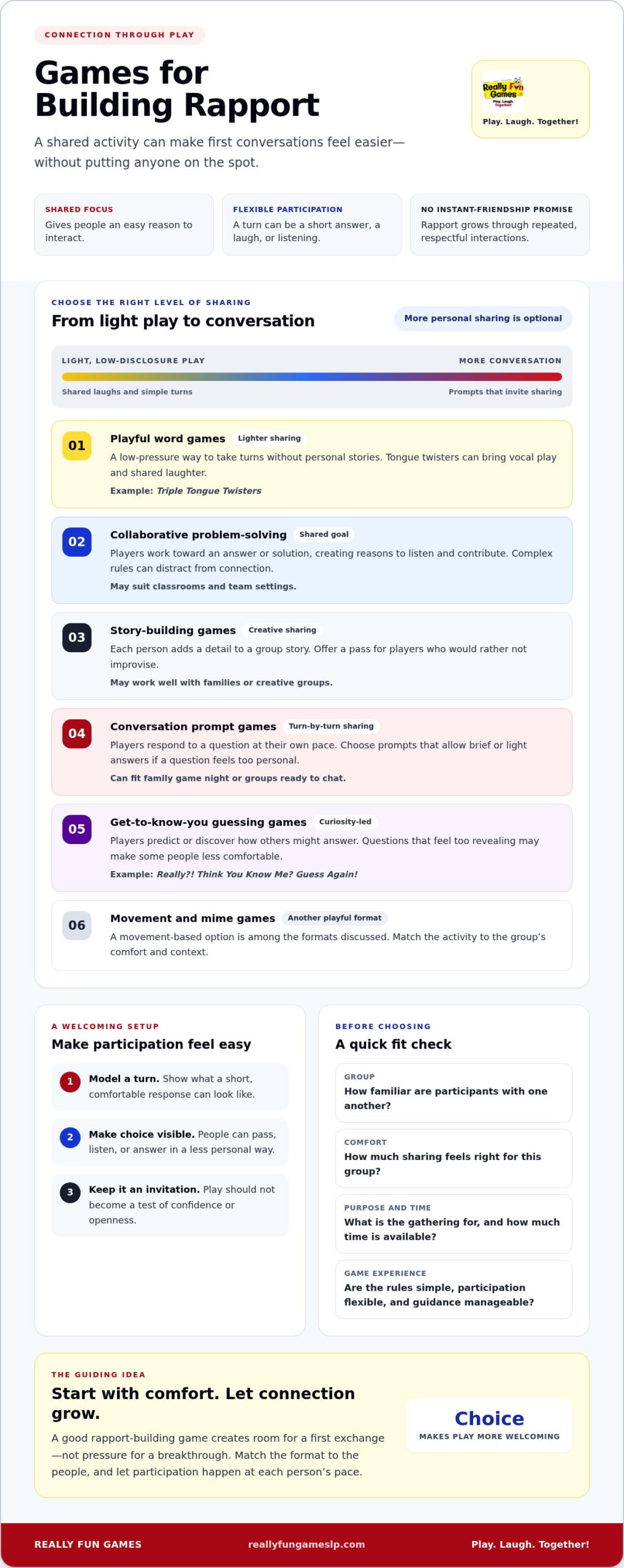
The best format depends on how well people know one another and how much energy or sharing feels comfortable. These games for building rapport range from quick, low-disclosure play to activities that encourage more conversation. Each can create an opening, but none needs to suit every group.
- Conversation prompt games: Players take turns responding to a question, making it easier to share at their own pace. Try them at family game night or with a group ready to chat. If a prompt feels too personal, some players may hesitate, so choose questions that leave room for brief or light answers.
- Get-to-know-you guessing games: Participants predict or learn how others might answer, making curiosity part of the fun. Really?! Think You Know Me? Guess Again! is a conversation-game example from Really Fun Games. It can suit families or familiar groups, though players may feel less at ease if the questions seem too revealing.
- Playful word games: Wordplay offers a lighter way to take turns without sharing personal stories. Tongue twisters can bring vocal play and shared laughter to a warm-up; they may be less suited to a group seeking deeper conversation. Triple Tongue Twisters is one example.
- Collaborative problem-solving games: Players work toward a shared answer or solution, giving them a common goal and reasons to listen and contribute. These can fit classrooms or team settings, but complex rules may take attention away from connection. Asana’s guide to team-building games offers further activity ideas.
- Story-building games: Each person adds a detail to a group story, creating a playful chain of ideas. This can work well with families or creative groups; people who prefer not to improvise may want the option to pass.
- Movement and mime games: Players communicate through gestures or actions rather than relying on conversation alone. They can bring lively energy to groups that enjoy moving, but may not suit every setting or participant.
- Cooperative challenges: The group completes a task together, emphasizing encouragement and shared effort over individual performance. They can help teams or youth groups engage side by side, though a competitive twist may not feel welcoming to everyone.
Choose a format that fits the group
Start with the interaction you want: a few easy turns, a burst of laughter, or conversation that unfolds through prompts. For conversation and wordplay options from Really Fun Games, browse the card and conversation games. Pick an activity that leaves room for different comfort levels, and treat participation as an invitation, not a requirement.
How to Compare Rapport-Building Games Without Making Anyone Uncomfortable
The best choice isn’t the game with the deepest questions or the biggest laughs. It’s the one that fits this group, in this setting, today. Compare how much sharing it invites, how familiar players should be with one another, and how much guidance you’ll need to offer. Use the table as a starting point, not a universal ranking.
| Format | Disclosure level | Group familiarity | Facilitator effort |
|---|---|---|---|
| Conversation prompts | Low to higher, depending on the questions | Works with new or familiar groups if prompts suit the relationship | Moderate: explain how turns work and offer choices |
| Movement or teamwork activities | Usually low; interaction centers on shared action | Can suit groups still getting comfortable, if everyone can take part | Moderate to high: clarify the task, space, and participation options |
| Playful word-based games | Low: focus stays on words and vocal play | Often a gentle warm-up for unfamiliar groups or mixed comfort levels | Low to moderate: demonstrate a turn and keep the pace relaxed |
Match the game to the group’s comfort level
For a new group, start with a low-disclosure activity, such as wordplay or a light prompt about favorite foods. Save reflective questions for people who know one another and want that kind of conversation. Consider participants’ ages, familiarity, communication preferences, and the gathering’s purpose. Avoid putting one person on the spot or asking anyone to share a personal story. Passing, observing, or choosing an easier prompt should always be acceptable.
Choose a format for the setting
Check the practical fit, too. Does the activity need open space, or can everyone play around a table? Will the instructions be easy to follow, and does the group have the attention for the format? These small checks can prevent a fun idea from feeling like an awkward assignment. If you’re comparing purchasable conversation games, explore the card and conversation game options alongside your group’s needs.
Use games for building rapport as a way to offer connection, not demand it. When players can choose how much to participate, the game has a better chance of feeling welcoming, whatever format you choose.
How to Use Games for Building Rapport: A Simple Facilitation Plan
A thoughtful introduction can make a good game feel even more welcoming. Games for building rapport work best when everyone knows what to expect and has room to participate in their own way. Keep this principle in mind: invite connection without demanding disclosure.
Set expectations before the first turn
Start with a brief explanation of why you’re playing: “We’re here to have a little fun and get comfortable together.” Describe the rules plainly, then model a sample turn so nobody has to guess what to do. If the game includes questions, show how someone can answer lightly or pass. Set the tone for respectful listening, too: let each person finish without teasing or pressuring them to say more.
Keep the activity inclusive as it unfolds
Pay attention to the room. Long pauses, confused looks, or a drop in participation may mean the prompt needs explaining, the topic feels too personal, or the format isn’t working for this group. Offer an easier question, let people observe for a turn, or switch to a lighter activity. Adjusting isn’t a failure. It’s good facilitation.
Use these steps to guide the game:
- Explain the purpose: Frame the activity as a shared experience, not a test of confidence or a demand to reveal personal details.
- Model a turn: Give a simple example answer or demonstrate the action, including a way to pass.
- Invite participation: Offer choices such as answering, listening, or responding in a less personal way. Avoid calling on someone who hasn’t volunteered.
- Close with reflection: Invite brief observations, such as “What was fun?” or “What surprised you?” Keep the focus on the activity, not on evaluating another player.
Adapt the approach to the setting. At a family gathering, let relatives choose whether to answer a prompt or simply enjoy the turns. In a classroom, demonstrate instructions and offer clear ways to join in. For counseling groups, follow the facilitator’s goals and keep sharing optional. At a team gathering, explain how the game relates to the group’s purpose without requiring personal stories.
End on a comfortable note. A quick “Thanks for playing” may be all that’s needed; reflection should feel like an open door, not another round of pressure. To find a conversation or wordplay format you can use with your group, explore Really Fun Games’ card and conversation games.
Choose a Rapport-Building Game That Fits Your Group
The right pick isn’t necessarily the most popular or the most talkative game. It’s the one people can comfortably join, in a format that suits the reason you’ve gathered. Before choosing among games for building rapport, run through this quick checklist:
- Audience: Are you choosing for family, students, colleagues, or another group? Check that the game suits their ages and setting.
- Comfort: Would players enjoy sharing light preferences, or feel more at ease with wordplay that doesn’t ask for personal answers?
- Purpose: Are you hoping to spark conversation, add laughter, or give people a shared activity?
- Format: Consider whether players prefer taking turns answering, guessing, speaking, or joining a playful challenge.
- Replay potential: Could the game work for another family game night or group gathering, with enough variety to keep it enjoyable?
When a conversation game may be the better fit
Prompt-based play can suit a group that’s ready to exchange light preferences, opinions, or everyday experiences. A well-chosen question gives everyone something to respond to, while players can decide how much detail to share. Really?! Think You Know Me? Guess Again! is a conversation-game example from Really Fun Games. Designed for ages 8 and up, it may be worth considering for families or groups looking for a shared conversation activity. Educators and speech-language pathologists seeking learning-focused options may also want to explore educational games, while matching any activity to their own goals and participants.
When playful word games may feel easier
If the group is still warming up, wordplay can offer a lighter entry point. Players can take part through vocal play without being asked to share personal details, and a tricky phrase can give everyone a reason to laugh together. Triple Tongue Twisters is one example from Really Fun Games. Rather than assuming one format will work for every group, compare the kind of interaction each encourages and choose what feels inviting in your setting.
Really Fun Games creates award-winning card and conversation games for families, educators, therapists, and groups. Explore the card and conversation game collection to compare available options, then choose a game that matches your audience, comfort level, purpose, and preferred style of play. A good fit gives people room to connect at their own pace.
Make Room for a Little More Connection
Games for building rapport work best when the activity fits the people in the room. Choose a format that matches your group’s comfort level, whether that means easygoing wordplay, a shared challenge, or prompts that invite conversation. A clear example, respectful listening, and permission to pass help participation feel like an invitation rather than a demand.
Rapport grows through small moments, not a single perfect game. A shared laugh, a thoughtful answer, or simply taking part can make it easier to connect again. Keep the group’s age, purpose, and preferred style of play in mind as you choose.
Really Fun Games creates award-winning games for ages 8 and up, including Really?! Think You Know Me? Guess Again! for conversation and Triple Tongue Twisters for playful word practice. Ready to find a fit for family game night, a classroom, or your next group gathering? Explore the Really Fun Games collection and choose a game that makes connection feel natural. A little play can be a lovely place to begin.
Frequently Asked Questions
What are games for building rapport?
Games for building rapport are shared activities that give people a comfortable way to interact, listen, and discover common ground. They might use conversation prompts, wordplay, or a cooperative task. The game creates an opportunity to connect, not a guarantee of trust or instant friendship. Choose a format that suits the group, and make it clear that players can participate, observe, or pass.
How do games help people build rapport?
Games give participants a shared focus, which can make it easier to start talking than an open-ended introduction. Taking turns, reacting to an answer, or laughing at a playful challenge creates natural openings for listening and conversation. A game can help people feel more at ease in the moment, but connection develops at different speeds. Keep the activity low-pressure and let relationships grow beyond the game.
What is a good game for getting to know a group?
A good choice depends on how familiar the group is and how much sharing feels comfortable. For a new group, try light preference questions or playful word-based turns before using more reflective prompts. Really?! Think You Know Me? Guess Again! is a conversation-game example from Really Fun Games. It’s designed for ages 8 and up, making it an option to consider for age-appropriate family or group play.
Can games help shy people feel more comfortable?
Games can offer shy participants a clear structure and a shared topic, which may make joining in feel easier than starting a conversation from scratch. Keep turns brief, model a response, and avoid putting anyone on the spot. Let players pass, listen, or give a simple answer. A welcoming game creates an opening, but each person should decide how much they want to participate.
How do you choose a rapport-building game for a classroom or family?
Start with the players’ ages, familiarity, comfort, and reason for gathering. For a classroom, consider whether the rules are easy to explain and the activity suits the available space and attention. For a family, look for a format that different generations can enjoy together. Choose between conversation, teamwork, or wordplay, and make passing or choosing a lighter response acceptable.
What games can build rapport without asking personal questions?
Word games, tongue twisters, and collaborative challenges let people participate without sharing personal stories. Players can focus on saying a tricky phrase, solving a task together, or adding to a silly group idea. Triple Tongue Twisters is a wordplay example from Really Fun Games. These formats can be a comfortable warm-up, especially when participants are new to one another or prefer less personal conversation.
Are conversation card games suitable for adults as well as kids?
Yes, conversation card games can work for adults and kids when the prompts and play style suit the players. Really Fun Games designs its games for ages 8 and up, so adults can join children in shared play while keeping the group’s comfort in mind. For mixed-age gatherings, choose questions that invite different kinds of answers, and allow players to skip anything they’d rather not discuss.
Ready to find a playful fit for your next gathering? Explore the Really Fun Games collection and choose a game that suits your group.
