

What if the best way to get relatives talking isn’t asking everyone to catch up, but giving them something fun to do together? Games for family gatherings adults will love can turn a quiet pause into a burst of laughter, a friendly challenge, or a conversation that keeps going after the round ends.
Finding a game that feels grown-up without being complicated or overly competitive can take some thought. And when relatives haven’t seen each other in a while, nobody should feel pressured to perform or share more than they want. Look for easy-to-start options that let people join at their own pace.
Here are eight lively game styles to help you choose the right fit, from conversation-led play to playful challenges and teamwork. Each offers a way to spark connection, whether your group is ready to laugh loudly, reminisce, or ease into a relaxed family game night.
Key Takeaways
- Choose Games for family gatherings adults by considering the group’s mood, comfort level, and time available.
- Compare eight formats, from conversation and trivia to wordplay, cooperative puzzles, and classic card games.
- Match the activity to your guests: quieter games leave room to chat, while performance and team formats bring more energy.
- Make play easier to join by explaining the goal and basic rules, then keeping a fallback option ready.
- Consider Really?! Think You Know Me? Guess Again! when relatives would enjoy a conversation game that invites them to discover what they know about one another.
Games for family gatherings adults: start with the group’s mood
Every host knows the moment: relatives have arrived, the food is ready, and the conversation hasn’t quite found its rhythm. A game can offer a shared activity without turning the gathering into a round of forced introductions. Choose for the people in the room, rather than expecting one game to suit everyone.
Before choosing Games for family gatherings adults, consider the group’s energy, how comfortable guests feel with one another, and how much time you have. A relaxed conversation game can help relatives ease in; a lively guessing or wordplay challenge may suit a group already swapping jokes. If guests will arrive or leave at different times, favor an activity that is easy to join between rounds.
This roundup compares eight game styles, from conversation and trivia to cooperative puzzles and classic card games. Treat them as options to mix and match, not a ranking with one perfect pick. Some games and formats are intended for adults; others can work for mixed-age gatherings. Really Fun Games creates games for ages 8 and up, including Really?! Think You Know Me? Guess Again! and Triple Tongue Twisters. For a broad overview of the category, Wikipedia explains how party games are designed for social groups and shared play.
How to read the room before choosing a game
Think about whether guests know one another well or are catching up after time apart. Then consider what kind of participation feels natural: chatting, guessing answers, performing, or solving a challenge together. Quieter relatives may prefer to take a turn when they’re ready rather than being singled out to tell a story or act something out. Offer participation as an invitation, not a test.
Time matters, too. A short, simple activity can create an easy opening between dinner and dessert, while a longer game needs guests who are happy to settle in. If you’re unsure, start with one round and keep an alternative ready in case the group’s mood shifts.
What makes an adult family gathering game feel welcoming?
Look for instructions you can explain clearly before play begins, without a long setup or specialist knowledge. A welcoming game lets guests join at their comfort level and keeps the focus on shared amusement, not elimination or proving who’s best. Conversation, silly word challenges, and collaborative formats can all work, depending on your family’s style.
To compare options, explore the Really Fun Games collection and consider which style matches your gathering. A good choice leaves room for both the game and the conversations that grow around it.
Compare eight game styles for adult family gatherings
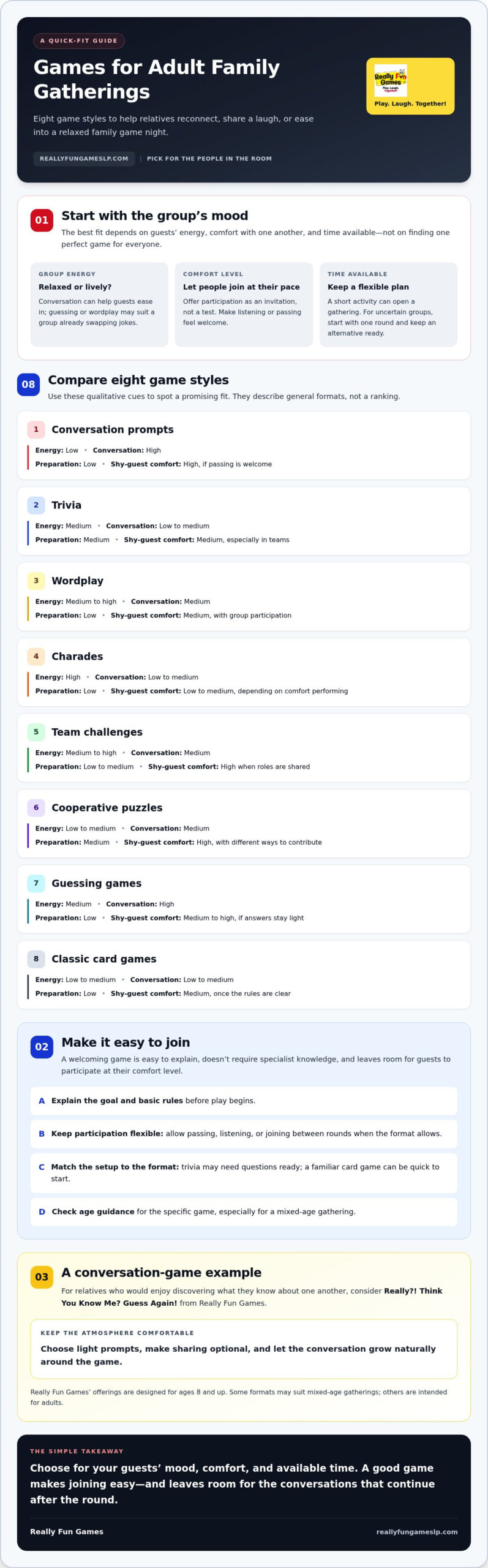
The right format can shift a gathering from polite small talk to easy laughter. This comparison of Games for family gatherings adults covers general game styles, not a claim that every option suits every group or describes the mechanics of a specific product. Use the table to identify a promising fit, then adjust for your guests’ comfort and energy.
| Game style | Energy | Conversation | Preparation | Shy-guest comfort |
|---|---|---|---|---|
| Conversation prompts | Low | High | Low | High, if passing is welcome |
| Trivia | Medium | Low to medium | Medium | Medium, especially in teams |
| Wordplay | Medium to high | Medium | Low | Medium, with group participation |
| Charades | High | Low to medium | Low | Low to medium, depending on comfort performing |
| Team challenges | Medium to high | Medium | Low to medium | High when roles are shared |
| Cooperative puzzles | Low to medium | Medium | Medium | High, with different ways to contribute |
| Guessing games | Medium | High | Low | Medium to high, if answers stay light |
| Classic card games | Low to medium | Low to medium | Low | Medium, once the rules are clear |
Preparation depends on the version you choose. Trivia may need questions ready, while a familiar card game can be quick to start. For a mixed-age gathering, check the age guidance for the specific game. Really Fun Games’ offerings are designed for ages 8 and up, though adult-only activities may suit a different guest list.
Conversation and guessing games for reconnecting relatives
Prompt-led games give relatives a natural topic, while guessing formats can spark friendly discoveries about what family members know of one another. Keep prompts light, avoid making personal disclosure a requirement, and let anyone pass or simply listen. Really?! Think You Know Me? Guess Again! is a confirmed conversation-game example from Really Fun Games. HelpGuide also describes play as beneficial for people of all ages, including adults.
Wordplay and team games for a livelier group
Tongue twisters add a playful vocal challenge: a stumble can get everyone laughing without requiring anyone to share a personal story. Triple Tongue Twisters is a confirmed Really Fun Games example. Trivia, charades, and team challenges are general formats, not descriptions of that product’s rules. Teams can soften the spotlight by letting guests contribute together.
For a closer look at the confirmed game options, browse the Really Fun Games card games and compare their styles with your gathering’s mood.
Which family gathering games suit your guests best?
The best fit depends on who’s around the table, not on a universal winner. A relaxed group catching up may enjoy a low-key conversation game, while relatives who already feel at ease together might prefer a lively team challenge. Match the format to your guests’ personalities, the room’s energy, and whether people want to talk while they play.
Conversation games create natural openings for stories and can be played at a gentle pace, but some guests may prefer not to answer personal prompts. Performance games such as charades bring energy and laughter, though they can feel exposing to anyone who dislikes the spotlight. Team formats spread attention across the group and encourage collaboration, but may need more explaining or preparation. Consider the noise level, too: an animated guessing game can fill a busy room, while a quieter format leaves space for catching up.
Choosing games for a mixed-age family group
For gatherings with younger relatives, check the game’s age guidance and whether adults will still find it engaging. Really Fun Games products are designed for ages 8 and up. Pairs or mixed-generation teams can help everyone contribute: one person might remember a detail, another spot a clue, and someone else bring a fresh perspective. Choose a format where guests can take part in different ways instead of relying on one person’s knowledge or speed.
For more ideas suited to varied groups and occasions, explore this guide to icebreaker games for groups and social gatherings.
Making room for outgoing and quieter relatives
Give guests more than one comfortable way to join. Some may enjoy speaking, while others prefer guessing, teaming up, or listening until they’re ready to contribute. Avoid making personal stories the price of admission. A light prompt, a shared challenge, or the option to pass can keep play welcoming without dampening the fun.
If your group likes vocal play, tongue-twister activities can create a silly shared challenge without asking anyone to reveal something personal. For more ideas, see this guide to tongue-twister games for family fun. Choose the style that fits your relatives, and leave room to switch gears if the mood changes. Flexibility matters more than finding one perfect game.
How to choose and set up games for family gatherings adults
A little planning makes it easier to start playing without making the gathering feel over-organized. For Games for family gatherings adults, use this sequence: decide the mood you want, consider who’s joining, compare formats, then pick a flexible backup. A quieter group might welcome a conversation-led activity, while an animated crowd may be ready for a team challenge.
Keep practical details in view, too. Consider how much time you have, whether guests will arrive at different times, and how comfortable they are with speaking or performing. A short, low-pressure first round lets everyone try the activity before deciding together whether to continue.
A quick host checklist before guests arrive
Choose one main activity and one backup that suits a different mood, such as a talk-focused option alongside a playful challenge. Set out any materials where guests can reach them, and gather people close enough to hear the instructions. Decide how someone can join late, watch a round, or sit out without interrupting play. A simple “jump in whenever you like” can make the invitation feel relaxed.
- Define the mood: Are you hoping to spark conversation, laughter, or teamwork?
- Consider the guests: Will they enjoy sharing, guessing, performing, or collaborating?
- Choose a format: Pick an activity that fits the group and the time available.
- Prepare a fallback: Have another easy option ready in case the energy changes.
Ways to keep the game welcoming and replayable
Before play begins, explain the goal and the basic rules guests need to get started. Keep it brief, then check that everyone understands. If a question comes up during the first round, clarify it as you go rather than giving a long rules speech upfront.
For team or pair formats, consider rotating partners between rounds when it feels natural. That gives relatives a chance to connect with someone new, though it isn’t necessary if the group prefers to stay as they are. Most of all, read the room. If people are laughing and asking for another round, keep going. If the conversation is flowing elsewhere, let the game end there.
With the mood, guest mix, and setup in mind, you’re ready to choose an activity that feels easy to join. Explore the game collection to compare options for your next family gathering.
Bring your family gathering together with a conversation game
The best game for your gathering is the one that fits the mood you want to create. Conversation games give relatives a shared prompt for talking and discovering something new about one another. Playful challenges bring a different kind of spark, with vocal play and laughter taking the lead. Keep both styles in mind as you choose Games for family gatherings adults will be glad to play.
When a conversation game is the right fit
Choose a conversation-led activity when relatives would enjoy swapping thoughts, sharing a laugh, or seeing whether they know one another as well as they think. A clear, easy-to-learn format can make it simpler to get started without a long explanation, especially while guests are settling in. Keep the atmosphere light and let people participate at a level that feels comfortable.
Really?! Think You Know Me? Guess Again! is a confirmed Really Fun Games conversation-game example for relatives who like discovering what they know about one another. It’s one option to consider if your gathering could use a gentle nudge toward lively, shared conversation.
Choosing a game you will want to bring out again
Think about your family’s usual gathering energy. If people enjoy talking and comparing perspectives, a conversation game may feel like a natural fit. If they’d rather try something silly together, a playful vocal challenge could be more appealing. Triple Tongue Twisters is a confirmed option for guests who enjoy tongue-twister play, without turning the activity into a serious competition.
Really Fun Games describes its games as easy to learn and highly replayable, so they can be considered for more than one gathering. The aim isn’t to fill every quiet moment or make every relative join in. It’s to find an inviting activity that leaves room for different personalities and gives the family something fun to share.
Ready to compare conversation games and playful challenges for your group? Explore the Really Fun Games collection and choose an option that suits your family’s style.
Make your next family gathering one to remember
The right game can give relatives an easy way to reconnect, share a laugh, and make room for conversation. When choosing Games for family gatherings adults will enjoy, start with the mood you want: conversation games suit groups ready to discover something about one another, while playful challenges bring a livelier burst of shared fun. Keep the rules simple, and let guests join at their comfort level.
Really Fun Games creates award-winning family and conversation games for ages 8 and up. Really?! Think You Know Me? Guess Again! offers a conversation-game option for relatives curious about what they know about one another, while Triple Tongue Twisters suits guests who enjoy vocal play. Both are described as easy to learn and highly replayable, making them options to consider for gatherings beyond a single game night.
Choose the style that feels right for your family, then leave space for the best part: the stories and laughter that happen along the way. Explore the Really Fun Games collection and find an option that fits your next get-together.
Frequently Asked Questions
What are some fun games for adults at a family gathering?
Fun options include conversation prompts, trivia, wordplay, charades, cooperative puzzles, guessing games, and classic card games. Games for family gatherings adults will enjoy depend on the group’s mood: choose a conversation game for easy catching up, or a lively team challenge for shared laughs. Really?! Think You Know Me? Guess Again! is a conversation-game option, while Triple Tongue Twisters offers a lighthearted choice for guests who enjoy vocal play.
How do you choose a game for a family gathering with different ages?
Check the game’s age guidance, then consider whether younger and older relatives can take part together without anyone feeling left out. Really Fun Games’ titles are designed for ages 8 and up. Pairing guests across generations or forming mixed-age teams can make it easier for everyone to contribute in their own way. Also consider how much explanation the game needs and whether guests can join after play has started.
What games help adults start conversations at a family gathering?
Conversation games, light guessing formats, and trivia about shared interests can help relatives find an easy topic to talk about. Choose prompts that invite stories or playful opinions without asking for anything too personal. Really?! Think You Know Me? Guess Again! is a confirmed conversation-game example for relatives who enjoy discovering what they know about one another. Let guests pass or listen if they’d rather ease into the conversation.
How can you include shy relatives in family gathering games?
Offer different ways to participate, such as answering, guessing, joining a team, or simply watching a round before deciding. Avoid calling on someone unexpectedly or making personal sharing part of the rules. A low-pressure game with a clear goal can help guests feel more at ease. Let everyone know they can pass, and keep the invitation warm rather than insisting that the whole group play.
Are card games a good choice for adult family gatherings?
Yes, card games can be a convenient fit when you want an activity that’s easy to set out and explain. Conversation card games can give relatives something to discuss, while other card-game styles may focus more on playful challenges or friendly competition. Check that the rules and age guidance suit your guests, and consider whether the format leaves enough room for the conversation your family wants to have.
How do you keep family gathering games from feeling awkward?
Set a relaxed tone by explaining the goal and basic rules clearly, then start with a short, low-pressure round. Choose an activity that matches the group’s energy, and don’t require anyone to perform or share a personal story. Give guests the option to join, watch, or sit out. If interest fades, wrap up and move on naturally rather than pushing for another round.
