

What if the most vibrant, laughter-filled moments your family experiences this year have absolutely nothing to do with a Wi-Fi password? We’ve all felt that heavy sense of digital fatigue, watching the people we love most drift into a “zombie” state behind their glowing screens. It’s tough when dinner feels quiet or when starting a conversation with your teenager feels like pulling teeth. You want to reclaim the spark of screen free family fun, but you need a plan that feels like an invitation rather than a chore.
You’re in the right place to move from digital distraction to deep, joyful connection. This guide provides a comprehensive, age-appropriate checklist of activities designed to bridge the gap between toddlers and teens. We’ll walk through easy-to-start games, creative challenges, and simple ways to foster social harmony without a single device in sight. From high-energy play to quiet moments of discovery, you’ll find exactly what you need to transform your living room into a hub of genuine human connection and lasting memories.
Key Takeaways
- Learn how to swap “zombie” screen time for intentional, high-energy play that strengthens your family’s emotional bond.
- Access a versatile checklist of indoor and outdoor activities that require zero preparation and work for all ages.
- Discover how to use screen free family fun to turn quiet dinners into lively sessions of laughter and discovery.
- Find out how “Really?! Think You Know Me? Guess Again!” helps you bridge the communication gap with older children and teens.
- Master a stress-free 5-step strategy for hosting a game night that prioritizes shared joy and meaningful interaction.
Beyond the Digital Glow: Why Screen-Free Time is Essential for Connection
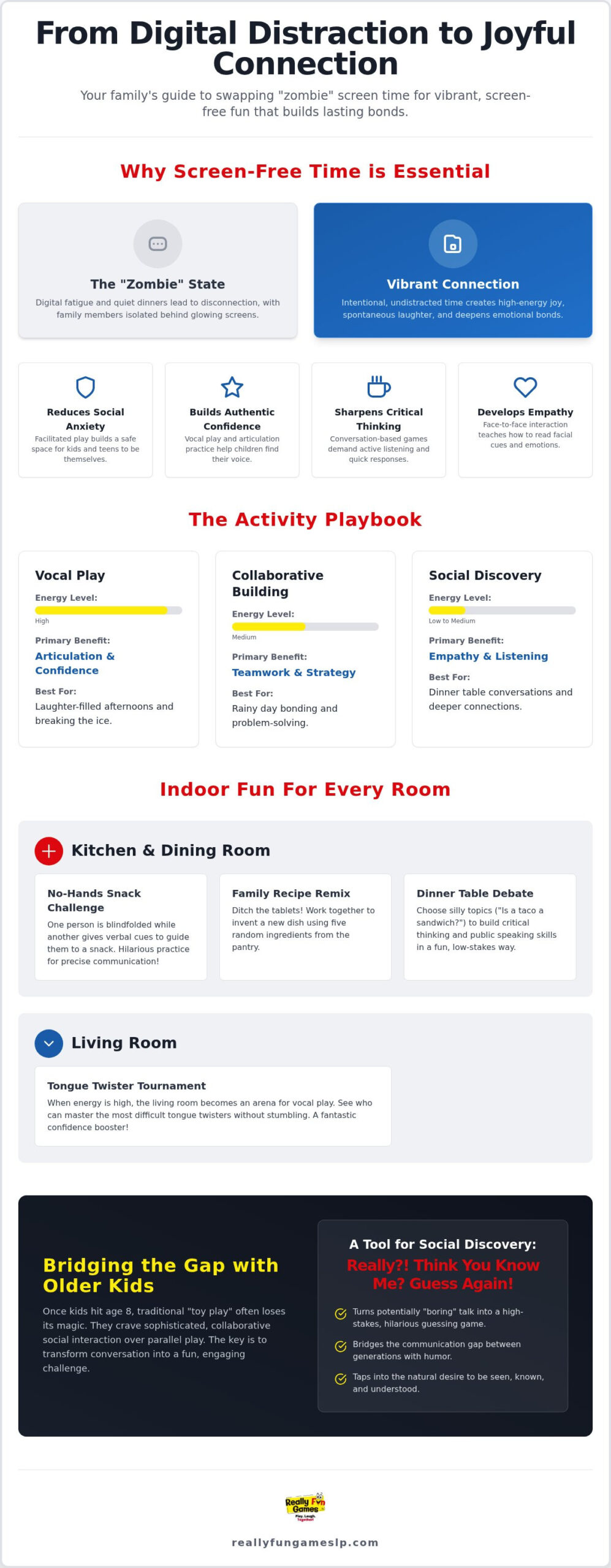
Connection isn’t just about being in the same room. It’s about removing the digital intermediaries that buffer our interactions. When we talk about screen free family fun, we’re describing intentional, undistracted time where the only “interface” is a smile or a shared joke. To understand the baseline of these habits, it’s helpful to look at What is Screen Time? and how it shapes our daily routines. Stepping away from the “glow” allows for high-energy joy, the kind that only comes from face-to-face vocal play and spontaneous laughter. This isn’t just a break for your eyes; it’s a reset for your heart.
Reducing digital noise directly lowers social anxiety in children and teens. Screens often act as a shield, but they can also become a barrier to authentic confidence. By engaging in facilitated play, parents act as joyful guides who build harmony and trust. This structured approach helps everyone feel safe enough to be silly, creative, and completely present. It’s about moving from “zombie” time to a vibrant atmosphere of social harmony.
The Impact on Child Development and Social Skills
Conversation-based games do more than pass the time. They sharpen critical thinking and demand active listening, skills that are often bypassed during passive media consumption. Screen-free interaction builds empathy by allowing players to read facial cues and interpret subtle emotional shifts in real time. For school-aged kids, the focus on articulation and vocal play is a massive confidence booster. It turns speech into a playground, helping them find their voice in a supportive, low-pressure environment.
Breaking the “Boredom” Barrier for Older Kids
Traditional “toy play” usually loses its magic once a child hits age 8. At this stage, kids crave something more sophisticated than building blocks but less isolating than a video game. The solution is a transition from parallel play, where everyone does their own thing, to collaborative social interaction. This is where the challenge of a shared goal or a competitive spark keeps them hooked.
Instead of battling the “I’m bored” refrain, introduce activities that prioritize social discovery. For example, Really?! Think You Know Me? Guess Again! turns what could be a “boring” talk into a high-stakes, hilarious challenge. It bridges the gap between generations, proving that screen free family fun can be just as engaging as any app when it taps into our natural desire to be seen, known, and heard.
The Ultimate Indoor Screen-Free Checklist: Fun for Every Room
Transforming your home into a dynamic social hub requires more than just hiding the remotes. For families with children aged 8 and up, screen free family fun needs to be energetic, slightly competitive, and deeply interactive. Research suggests that these moments of undivided attention are essential for connection, helping kids navigate social anxiety while building authentic confidence. The following checklist helps you match your family’s current mood to the perfect activity, ensuring everyone stays engaged from the kitchen to the couch.
| Activity Type | Energy Level | Primary Benefit | Best For… |
|---|---|---|---|
| Vocal Play | High | Articulation & Confidence | Laughter-filled afternoons |
| Collaborative Building | Medium | Teamwork & Strategy | Rainy day bonding |
| Social Discovery | Low to Medium | Empathy & Listening | Dinner table conversations |
Kitchen and Dining Room Activities
The kitchen is the heart of the home, making it the perfect setting for high-energy collaboration. Try the “No-Hands Snack Challenge.” One family member is blindfolded while another acts as the navigator, using only verbal cues to guide them toward a healthy snack. It’s a hilarious way to practice precise communication. You can also try a “Family Recipe Remix.” Put away the tablet tutorials and work together to invent a new dish using five random pantry ingredients. If things feel a bit too quiet during dinner, start a “Dinner Table Debate.” Choose silly, non-confrontational topics like “Is a taco a sandwich?” to build critical thinking and public speaking skills in a low-stakes environment.
Living Room Social Challenges
When the energy is high, the living room becomes the ultimate arena for vocal play. Host a “Tongue Twister Tournament” to see who can master the most complex vocal hurdles without tripping over their words. Using award-winning tools like “Triple Tongue Twisters” adds a layer of fast-paced articulation that keeps everyone laughing. These games are highly replayable and quickly become a favorite weekly tradition because they don’t require any prep time. If you want to understand what makes a game worth returning to week after week, our guide to replayable family card games breaks down exactly what to look for when building a collection that never gets old.
For a more reflective vibe, try a session of Really?! Think You Know Me? Guess Again!. Instead of guessing fictional characters, players share surprising facts from their childhood or hidden talents. It’s a beautiful way for kids to discover who their parents really are beyond their everyday roles. For ages 8 to 12, don’t underestimate the power of a “Living Room Fort.” Use every cushion and blanket in the house to build a collaborative base. It’s a classic team-building exercise that fosters spatial reasoning and cooperation. If you’re ready to move beyond blankets and pillows, LIMIKIDS provides inspiration for creating dedicated indoor play areas that keep kids active year-round. If you’re looking for more ways to spark these moments, check out our collection of conversation starter cards to find your next family favorite.
The great outdoors isn’t just a place to stretch your legs; it’s a vibrant arena for high-energy joy. When you step outside, the distractions of the digital world fade, replaced by the immediate rhythm of play and the crisp sound of laughter. This is where screen free family fun truly shines, bridging the gap between kids, parents, and even grandparents through shared physical challenges. Moving beyond simple walks, these activities provide a “game-like” structure that keeps older kids motivated and eager to participate.
Whether you’re in your own backyard or heading to a local park, the goal is to foster social harmony through movement. These challenges require minimal equipment but offer maximum engagement, ensuring that everyone from age 8 to 80 feels like a vital part of the team. It’s about creating a celebratory atmosphere where the focus remains on the people around you rather than a glowing device.
Active Team Building in the Backyard
Transform your lawn into a hub of connection with the “Human Knot” challenge. This classic icebreaker requires players to stand in a circle, grab random hands across from them, and then work together to untangle the mess without letting go. It’s a fantastic way to build trust and physical coordination while sparking plenty of giggles. For an evening twist, try a Flashlight Scavenger Hunt. Adding the element of darkness and a beam of light turns a standard search into a high-stakes adventure that older kids find irresistible.
If your family has a competitive streak, set up a Backyard Olympics. Instead of focusing on pure athleticism, create silly stations like “The Spoon Balance Walk” or “The Three-Legged Dash.” These stations require teamwork and communication to succeed, making them perfect for building family bonds. The emphasis is always on the shared experience and the funny memories made along the way.
Portable Fun for Travel and Outings
To see how these principles are applied in a professionally facilitated setting, you can visit TeamLabs to explore their range of interactive team games designed to build trust and joy through shared physical play.
Adventure often takes us away from home, making “portable fun” an essential part of your family toolkit. Long car rides don’t have to mean everyone retreats into their own tablet. Try a “Road Trip Interview” using conversation cards to pass the time. It turns a boring drive into a journey of discovery as you learn new things about each other. For more ideas on keeping the peace during transit, check out our best travel games for kids guide.
When you arrive at a park or picnic, compact card games are your best friend. They’re much easier to manage than bulky board games and can be played on a blanket or a picnic table. Specifically, look for card games for 4 players that offer a mix of strategy and social interaction. These games are easy to pack and provide a quick way to restart the screen free family fun wherever your journey leads. They ensure the conversation keeps flowing and the laughter never stops, no matter the setting.
Fostering Communication: Screen-Free Activities That Build Social Skills
The most common roadblock to screen free family fun isn’t a lack of interest; it’s that nagging question: “What do we actually talk about?” When the screens go dark, the pressure to have a “meaningful conversation” can feel heavy and forced. This is where the “warm guide” approach changes the game. You aren’t there to act as a therapist or a principal. You’re a facilitator of joy, using play as a bridge to reach those harder-to-start discussions. By introducing structured games, you remove the spotlight from the individual and place it on the activity, allowing connection to happen naturally through laughter and shared discovery.
Using a tool like Really?! Think You Know Me? Guess Again! acts as a catalyst for these moments. It provides the framework so you don’t have to invent topics from scratch. This type of play turns “boring” talk into a competitive, hilarious challenge that even the most skeptical teenager can’t resist, making it the gold standard for screen free family fun. It’s about creating an environment where everyone feels safe to share, laugh, and simply be themselves without the buffer of a digital device.
Building Empathy Through “Get to Know You” Play
Guessing games do more than just spark giggles; they teach children to step into someone else’s shoes. When a child has to guess how a parent or sibling would react to a specific scenario, they’re practicing the essential skill of perspective-taking. Really?! helps families discover hidden stories about each other, turning a standard evening into a voyage of discovery. These interactions build a foundation of empathy that carries over into school, friendships, and future careers. To get started tonight, try these three simple icebreakers:
- If you could have any animal as a personal butler, which one would it be and why?
- What’s the bravest thing you’ve ever done that nobody else saw?
- If our family had to live in a world made entirely of one food, which food would you pick?
Articulation and Confidence Boosters
Silly play is a powerful tool for breaking down emotional walls. Award-winning games like “Triple Tongue Twisters” are favorites in speech therapy and classroom settings because they turn vocal play into a celebratory event. There is a unique kind of bond that forms when a family attempts to master a difficult tongue twister together. It reduces the fear of “messing up” in front of others. When everyone is tripping over their words and laughing, the pressure to be perfect vanishes. This boost in confidence helps kids feel more comfortable speaking up in class and navigating social situations with ease. Ready to bring this energy to your next gathering? Explore our full collection of conversation starter cards and find the perfect fit for your family.
Planning Your Next Screen-Free Family Game Night
Consistency is the secret ingredient to a tradition that sticks. To turn screen free family fun from a “one-off” event into a weekly highlight, you need a plan that prioritizes ease and excitement. As a parent, you aren’t just the host; you’re the joyful facilitator. Your mission is to create a space where everyone feels invited to play, laugh, and connect without the friction of complicated manuals or digital interruptions. By choosing games that are easy to learn and highly replayable, you ensure that the focus remains on the people around the table rather than the rules on a page.
Step-by-Step: The Perfect Game Night Setup
- Set the Vibe: Dim the overhead lights, grab the favorite snacks, and create a cozy atmosphere that feels different from a typical school night.
- The Digital Parking Lot: Establish a designated basket for all phones and tablets. This physical act of “parking” devices signals to everyone that their undivided attention is the most valuable thing in the room.
- Match the Energy: Read the room before you start. If the kids are restless, start with high-energy vocal play. If it’s a quiet evening, opt for more reflective conversation.
- Keep it Low Pressure: Don’t get bogged down by strict rule-following. If a house rule makes the game funnier or more inclusive, go with it. Laughter is always the primary goal.
- End on a High Note: Stop while everyone is still having a blast. This leaves them wanting more and makes it much easier to get everyone excited for the next session.
Selecting Your Screen-Free Toolkit
A successful night starts with the right tools to ensure screen free family fun remains the priority. Really Fun Games are specifically designed for immediate engagement, meaning you can start playing within minutes of opening the box. If you want a fast-paced, hilarious challenge that gets everyone’s heart racing, reach for “Triple Tongue Twisters.” It’s an award-winning way to spark spontaneous joy through vocal play.
For nights when you want to dig a little deeper, “Really?! Think You Know Me? Guess Again!” offers a perfect blend of surprises and bonding. It turns social discovery into a game, helping you learn things about your kids that you never would have thought to ask. These activities are designed to bridge the gap between ages, ensuring that an 8-year-old and a grandparent are equally engaged. If you’re building out your game night collection, our best family card games for ages 8+ buying guide is an excellent resource for finding options that spark genuine conversation and hold everyone’s attention. For deeper insight into what separates a forgettable game from one your family returns to again and again, explore our dedicated guide to replayable family card games that never get old before you make your next purchase. Ready to build your own ritual of connection? Browse the Really Fun Games collection to find the perfect addition to your family’s toolkit.
Reclaim Your Family Connection Today
The journey from digital distraction to joyful connection starts with a single intentional choice. You’ve explored how screen free family fun can transform quiet rooms into hubs of laughter and discovery. By using simple checklists for indoor play and outdoor adventures, you’ve seen that meaningful interaction doesn’t require complex preparation. It just requires presence. You’re now equipped to move beyond the glow of the screen and into a world of shared experience.
Whether you’re mastering the vocal hurdles of “Triple Tongue Twisters” or uncovering hidden family stories with “Really?! Think You Know Me? Guess Again!”, these moments build lasting social harmony. Our award-winning game designs are created by experts for ages 8+ and are trusted by families, teachers, and speech therapists nationwide. They provide the perfect bridge to connect with older kids and teens in a way that feels natural, celebratory, and genuinely exciting.
Don’t let another evening fade into the digital glow. Discover the award-winning Really Fun Games collection and start your screen-free journey today! You have all the tools to turn your next family gathering into a memory-making masterpiece. Embrace the spontaneity, share the laughter, and watch your family bonds grow stronger with every game played.
Frequently Asked Questions
How do I get my teenager to participate in screen-free fun?
Focus on low-pressure, high-engagement activities that don’t feel like a lecture. Start by asking for their input on game selection or snack choices to give them a sense of agency. Using games like “Really?! Think You Know Me? Guess Again!” works because it taps into their natural interest in social dynamics and identity. Keep sessions short and energetic so they leave wanting more, rather than feeling trapped in a forced family meeting.
What are the best screen-free games for a family with a wide age gap?
Look for games with simple mechanics that scale in difficulty, such as conversation starter cards or vocal challenges. These activities allow an 8-year-old to participate fully while still providing a genuine challenge for adults. “Triple Tongue Twisters” is a fantastic choice here because the physical act of speaking fast is equally difficult and hilarious for everyone. It levels the playing field and ensures no one feels left behind or bored.
Can screen-free games actually help with my child’s social anxiety?
Yes, structured play provides a safe framework for social interaction without the pressure of open-ended conversation. By focusing on a specific task or game goal, children can practice eye contact and turn-taking in a low-stakes environment. This type of screen free family fun helps build confidence by celebrating small wins and shared laughter. Over time, these positive social experiences reduce the fear of “saying the wrong thing” in other settings.
How much time should we realistically set aside for screen-free family fun?
Even 15 to 20 minutes of focused, device-free play can make a significant difference in family harmony. You don’t need a four-hour marathon to see the benefits of connection. Start with a single round of a card game after dinner or a quick tongue twister challenge before bed. Consistency is more important than duration, so aim for short, high-energy sessions that fit into your existing daily routine without causing unnecessary stress.
What if my kids say they are bored during screen-free time?
Acknowledge the boredom as a natural transition away from high-stimulation digital environments. Instead of rushing to fix it, introduce a game that offers immediate engagement and a bit of a “hook.” Fast-paced challenges or competitive guessing games usually break the boredom barrier quickly. Remind them that some of the best screen free family fun happens after the initial “reset” period when their creativity and sense of humor finally kick in.
Are these games suitable for classroom or speech therapy settings?
Absolutely, many of our games are used by teachers and speech-language pathologists nationwide. “Triple Tongue Twisters” is particularly effective for articulation practice and building vocal confidence in a classroom setting. These tools turn educational goals into a celebratory game, making it easier for students to engage with difficult speech sounds. They foster a supportive atmosphere where students feel comfortable taking risks and learning from their mistakes through play.
How do conversation games improve children’s literacy and communication?
Conversation games require kids to listen actively, process information, and articulate their thoughts clearly. These skills are foundational for literacy and successful social interaction. By playing games like “Really?! Think You Know Me? Guess Again!”, children learn to expand their vocabulary and use more descriptive language. They also practice the art of storytelling and persuasive speaking, which are critical components of both written and verbal communication in school and beyond.
What is the best “first game” to start our screen-free collection?
We recommend starting with “Really?! Think You Know Me? Guess Again!” because of its universal appeal and ease of use. It’s the perfect entry point for families because it requires zero setup and works for any group of two or more players. This game immediately fosters discovery and laughter, setting a positive tone for your future screen-free journey. It’s a reliable “go-to” that ensures your very first game night is a resounding success. For a broader look at what’s available, our guide to family card games for ages 8+ can help you find the perfect next addition to your collection.