

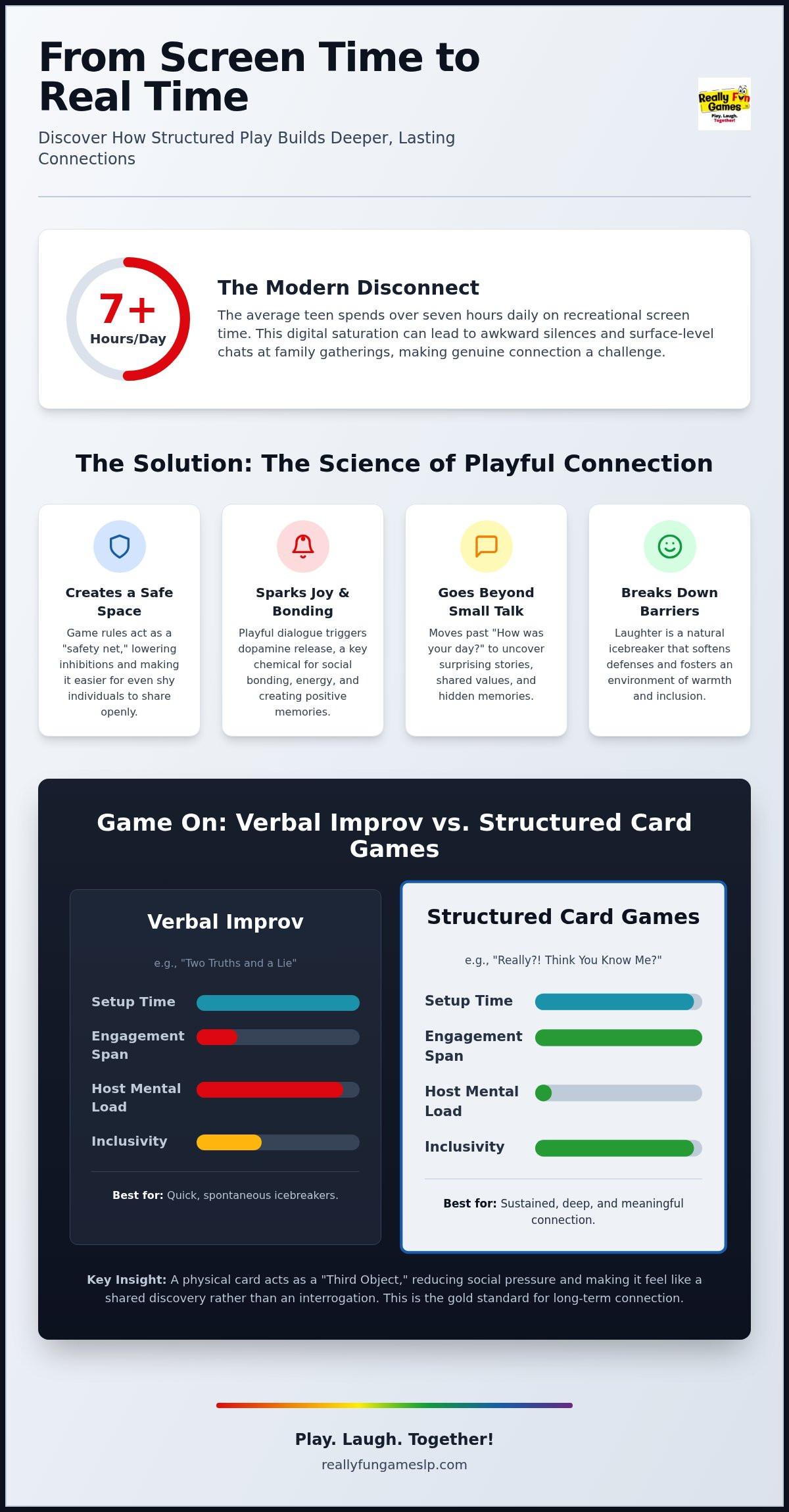
Did you know that the average teenager now spends over seven hours every single day on recreational screen time? That is nearly a full work day of digital noise, leaving very little room for the simple magic of a face-to-face chat. It is no wonder that sitting down for a family dinner or a holiday gathering can sometimes feel a bit stiff. We have all been there. The long silences, the one-word answers, and the struggle to find creative conversation games that actually work can make any host feel like they are performing for a tough crowd.
You deserve more than polite small talk or forced questions that lead nowhere. You deserve a room filled with belly laughs and those delightful “I never knew that!” moments. This guide will help you discover the best tools to bridge those digital gaps, spark genuine laughter, and build lasting bonds in any social setting. We are diving into the best screen-free activities and award-winning tools that turn awkward pauses into meaningful connections for everyone from toddlers to grandparents. From hilarious vocal play to surprising personal discoveries, get ready to transform your next gathering into a memory-making masterpiece.
Key Takeaways
- Discover how screen-free play helps your family trade digital distractions for genuine, face-to-face laughter and connection.
- Learn why structured creative conversation games offer the visual and tactile engagement needed to make sharing feel natural instead of forced.
- Find the perfect activities to bridge generation gaps at home or foster deep empathy and communication skills in a classroom setting.
- Uncover facilitator secrets for creating a warm, inclusive environment where even the quietest players feel confident enough to join in.
- See how award-winning game designs can turn a standard evening into a memorable experience with simple rules that anyone can learn in seconds.
Why Creative Conversation Games are Essential for Modern Connection
Imagine a room where the usual hum of scrolling phones is replaced by the vibrant sound of genuine laughter. Creative conversation games are far more than just a way to pass the time; they are intentional tools designed for structured social-emotional discovery. In a world where digital saturation has become a daily challenge, the physical interaction offered by a card deck provides an essential screen-free advantage. While digital chats often feel performative or shallow, holding a physical card and looking someone in the eye creates a grounded sense of presence that 2026 technology still cannot replicate.
Stepping into a game lowers the invisible walls we often build around ourselves. When we play, the fear of saying the wrong thing evaporates because the rules act as a safety net. This structure actually invites more creative freedom than an open-ended question ever could. Laughter plays a starring role here, too. It acts as a natural icebreaker, softening our defenses and creating a safe, joyous space where vulnerable sharing feels like a natural extension of the fun rather than a daunting task.
The Science of Connection Through Play
There is a fascinating chemical reaction happening when we gamify our interactions. Engaging in playful dialogue triggers a release of dopamine, which naturally fosters social bonding and keeps everyone at the table energized. This concept draws deep inspiration from Theatre games, which use specific structures to unlock spontaneity and group cohesion. For families, these moments are especially vital. Regular game nights have been shown to boost child literacy and build the kind of social confidence that lasts a lifetime. It turns out that when children feel safe enough to be silly, they also feel brave enough to be themselves.
From Small Talk to Deep Discovery
We’ve all fallen into the trap of the standard “How was your day?” inquiry, only to be met with a lackluster “Fine.” The best creative conversation games flip this script by inviting us to explore shared values and hidden memories instead of surface-level facts. Instead of reciting a schedule, players might find themselves debating hilarious “what if” scenarios or uncovering a surprising story from a grandparent’s youth. Social harmony is the ultimate goal of these games, where every voice is heard and every story is celebrated. By moving beyond the mundane, we create a rich tapestry of connection that lingers long after the cards are put away. You can explore our full collection of award-winning card games to find the perfect match for your next gathering.
Verbal Improv vs. Structured Card Games: Which is Right for You?
Choosing how to spark a conversation shouldn’t feel like a chore. You might wonder if you really need a physical tool or if you can just wing it with classic verbal improv. While no-prop games have their place, they often lack the staying power needed for a full evening of engagement. There is a distinct difference between a quick icebreaker and creative conversation games that can sustain an entire family game night.
The Verbal-Only Approach: Pros and Cons
Games like “Two Truths and a Lie” or “Would You Rather” are fantastic for quick transitions or unexpected wait times. They require zero setup and can be played anywhere, from the car to the doctor’s office. However, they carry a heavy “mental load.” For a parent or teacher, constantly inventing fresh, exciting prompts is exhausting. These games often work best as short icebreakers. Without a physical guide, the energy can fizzle out once the obvious questions are exhausted, often leading right back to the screens we’re trying to avoid.
Why Structured Card Decks Win for Long-Term Connection
This is where creative conversation games in a physical format truly shine. Psychologists often refer to the “Third Object” theory. When you hold a physical card, it acts as a neutral focal point for everyone in the group. It reduces the intense pressure of direct eye contact, which can feel intimidating for kids, teens, or shy adults. Instead of feeling interrogated, players feel like they are exploring a shared discovery together. The card is the prompt; you are just the storyteller.
| Feature | Verbal Improv (e.g., Two Truths and a Lie) | Structured Card Games (e.g., Really?! Think You Know Me?) |
|---|---|---|
| Setup Time | Zero setup required | 30 seconds to learn |
| Mental Effort | High (facilitator must invent prompts) | Low (cards provide all the prompts) |
| Social Pressure | High (direct eye-contact focus) | Low (physical card acts as a “Third Object”) |
| Replayability | Medium (can become repetitive) | High (hundreds of unique, expert-vetted prompts) |
Physical decks offer a tactile engagement that digital or verbal-only games simply cannot match. You can touch them, pass them around, and feel the quality of the cards. This sensory experience helps ground everyone in the present moment. Plus, a well-designed deck ensures the conversation never gets stale or repetitive. Our Really Fun Games collection is built on this principle, offering hundreds of unique prompts that prevent the “we already talked about this” slump. When comparing “Really?! Think You Know Me? Guess Again!” to simple verbal improv, the difference in replayability is staggering. It’s an investment in your social-emotional toolkit. If you’re ready to upgrade your next gathering, you can browse our award-winning games to find your perfect fit.
A Curated List: Creative Games for Every Social Setting
Finding the right spark for a conversation depends entirely on the room you’re in. Whether you’re at a bustling family reunion or a quiet therapy session, creative conversation games offer a tailored way to break the ice and build trust. The goal is always social harmony, but the path there looks different when you’re sitting with a toddler versus a corporate executive. Let’s look at how to choose the right tool for your specific group.
Family and Home: Building Brighter Bonds
Family gatherings are the heart of connection, yet they often suffer from the widest generation gaps. Our award-winning game, Really?! Think You Know Me? Guess Again!, is specifically designed to bridge these distances. It encourages grandkids to guess their grandparents’ favorite memories and parents to see their teens in a whole new light. It turns a standard evening into a vibrant discovery session where everyone feels seen and valued.
Don’t wait for a special occasion to start talking. You can easily integrate these prompts into your daily rhythm. Try these ideas:
- Dinner Table Talk: Keep a deck nearby to replace the standard “how was school” talk with hilarious “what if” scenarios.
- Road Trip Revelations: Use travel time to uncover surprising stories that make the miles fly by.
- Holiday Traditions: Make games a central part of your celebrations to ensure every guest feels included.
For more inspiration on hosting larger gatherings, check out our guide on Icebreaker Games for Groups. It is the perfect resource for anyone looking to turn a quiet room into a celebratory social experience.
Educational and SLP Settings: Learning Through Laughter
In the classroom or a speech therapy session, play is a serious business. Educators and Speech-Language Pathologists (SLPs) nationwide use vocal play to build confidence and articulation skills. Tongue twisters are a classic for a reason; they turn the hard work of speech practice into a joyful challenge. Our Triple Tongue Twisters collection is a favorite in these settings because it offers a fun, low-pressure way to improve communication.
When students laugh together at a silly phrase, they aren’t just practicing sounds. They’re building empathy and social-emotional resilience. These games help quiet students find their voice and help high-energy groups focus their attention. If you’re an educator looking to transform your classroom environment, dive into our tips for Mastering Classroom Games for Communication. It is about creating a space where every student feels brave enough to speak up.
Professional Teams and Corporate Retreats
Even in a professional setting, the need for human connection is vital. Icebreakers for corporate retreats shouldn’t feel like a chore or a performance. High-quality creative conversation games help teams move past professional titles to find common ground. This builds the kind of psychological safety that drives innovation and effective teamwork. When colleagues laugh together, they collaborate better, creating a more cohesive and optimistic workplace culture. For a comprehensive look at how to plan your next office event, our corporate team building games buyer’s guide offers expert-vetted strategies to make every retreat feel like a genuine celebration.
Facilitator Secrets: How to Make Conversation Games Joyful
Being a facilitator doesn’t mean being a teacher at a blackboard. It means being a joyful guide to discovery. Your energy sets the pace for the entire group. When you approach creative conversation games with a spirit of exuberant play, others will naturally follow your lead. It’s about creating a celebratory atmosphere where the goal is simply to enjoy each other’s company.
One of the biggest momentum killers is the dreaded “I don’t know” answer. Instead of letting the silence linger, pivot quickly. Ask a “What if?” question or invite the player to guess what someone else might say. This keeps the energy flowing without making anyone feel like they are on the spot. You’re not looking for a correct answer; you’re looking for a spark of connection.
Trust is the foundation of any meaningful interaction. Implementing a “Pass” rule gives participants agency. If they aren’t ready to share a specific memory, they can simply pass. Ironically, when people know they don’t have to talk, they often feel much more comfortable doing so. This simple rule builds a safe environment where sharing is a choice, not a chore.
Timing is everything. You want to start the game when the initial energy of the gathering is high, but before everyone gets too tired. Most importantly, end the session while the laughter is still loud. It is better to leave them wanting more than to play until the energy drags. This ensures that the lasting memory of the experience is one of pure joy and harmony.
The Warm-Up: Preparing the Group
Think of conversation like a physical workout. You need to warm up those conversational muscles before diving into deep topics. Start with low-stakes, silly questions that require very little emotional heavy lifting. As the facilitator, you must participate as an equal player. Share your own silly stories first. Use high-energy, celebratory language to show the group that this is a safe space for spontaneity. When you’re willing to be a bit ridiculous, it gives everyone else permission to do the same.
Navigating Reluctance and Building Empathy
Engaging skeptical teens or shy children requires a gentle touch. This is where vocal play becomes your best friend. Breaking the ice with something lighthearted, like a round of tongue twisters, can dissolve tension instantly. It is hard to stay skeptical when you’re tripping over our “Triple Tongue Twisters” and everyone is giggling. Create a no-judgment zone by reacting to every answer with genuine interest and celebratory energy. Your goal is social harmony, making sure every person feels like their contribution is a win for the group. If you’re ready to lead your next gathering with confidence, explore our collection of connection-building games today.
Why Really Fun Games is the Gold Standard for Connection
Choosing the right tools for connection shouldn’t be a guessing game. While there are plenty of options out there, Really Fun Games stands apart because our products are built with a deep understanding of social dynamics. We don’t just make card games; we create catalysts for joy. Our creative conversation games are vetted by experts and have earned prestigious honors, including the Creative Child Magazine 2022 Game of the Year Award and Tillywig Toy Awards for Best Family Fun. These aren’t just accolades; they’re proof that our designs actually work to bring people together in meaningful ways.
Accessibility is at the heart of what we do. We believe that great play should be easy to start and impossible to put down. Most of our games fit right in your pocket, making them the perfect companion for a hike, a flight, or a busy classroom. You can learn the rules in less than 30 seconds, which means you spend less time reading a manual and more time sharing a laugh. It’s this combination of portability and simplicity that makes our collection a staple for families and professionals alike.
Designed for Real People, by Real Play Experts
The story behind “Really?! Think You Know Me? Guess Again!” began with a simple desire to see families truly talk again. We wanted to move past the screen and back to the stories that make us who we are. This commitment to human connection is why our games are now used by speech-language pathologists and educators nationwide. They trust our formats to help students build articulation, confidence, and empathy through vocal play. Because our prompts are diverse and our mechanics are engaging, these games are highly replayable. You’ll find that every group brings a new perspective, ensuring the experience stays fresh for years to come.
Ready to Start the Conversation?
Deciding which game to start with is a fun journey in itself. If you’re looking for deep insights and surprising reveals with family or friends, the “Really?!” series is your gold standard. If you want high-energy laughter and a way to build vocal confidence, our Tongue Twisters collections like Triple Tongue Twisters or Blooming Tongue Twisters are the perfect choice. You can even grab the Really Fun Custom Games Bundle to get the best of both worlds. We invite you to Explore the Really Fun Games Collection and join our community of joyful facilitators. Let’s make 2026 the year of deeper bonds and unforced laughter.
Bring the Joy of Connection Home Today
You now have the secrets to turning any quiet room into a hub of laughter and shared discovery. By choosing high-quality creative conversation games, you are doing more than just picking a pastime. You’re investing in your family’s social-emotional health and creating a screen-free sanctuary where every voice is celebrated. Whether you’re a parent looking to reconnect with a teen or an educator building confidence in a classroom, these award-winning tools make the journey easy and incredibly fun.
Our designs are loved by SLPs and educators nationwide because they’re simple to learn and offer immediate engagement. From hilarious vocal play to deep personal insights, the right deck can transform your entire social landscape. It’s time to trade the scrolling for stories and the silence for smiles. Discover the “Really Fun Games” collection and find your perfect match today!
Let’s make every gathering a memory worth keeping. Your next great conversation is just one card away. We can’t wait to see the bonds you’ll build and the joy you’ll share with those who matter most.
Frequently Asked Questions
What are creative conversation games?
These are structured tools designed to facilitate meaningful dialogue and social-emotional discovery through play. Unlike open-ended questions that can feel forced, these games provide rules and prompts that lower social barriers. They help groups move past surface-level talk into deep discovery, fostering social harmony and laughter. By using physical components like cards, they offer a screen-free way to connect and build lasting bonds in any social setting.
Are these games suitable for kids under 8?
Our core collection, including “Really?! Think You Know Me? Guess Again!”, is specifically designed for ages 8 to adult. While younger children might enjoy the vibrant colors or the silly sounds of tongue twisters, the reading level and social concepts are optimized for those eight and up. This ensures that every player can fully engage with the prompts and contribute to the conversation with confidence and clarity.
How do conversation games help with social anxiety?
These creative conversation games reduce the pressure of direct interrogation by introducing a physical focal point, often called the “Third Object.” Instead of feeling like they are on the spot, players focus on the card or the game mechanic. This structure provides a safety net that makes sharing feel natural. Laughter acts as a celebratory icebreaker, softening defenses and helping quiet participants feel safe enough to join the fun.
Can these games be used in a professional corporate setting?
Yes, these tools are excellent for corporate retreats and team-building events. They help professionals move beyond titles and hierarchies to find common ground through shared laughter. By facilitating unforced interaction, they build the psychological safety necessary for innovation and better teamwork. It is a polished, joyful way to improve workplace communication and foster a more inclusive, optimistic culture among colleagues who might otherwise only discuss work tasks. You can find even more strategies in our dedicated guide to corporate team building games for 2026.
How do speech therapists use tongue twisters in their sessions?
Speech-Language Pathologists (SLPs) use our tongue twisters as a tool for vocal play to improve articulation and confidence. Collections like Triple Tongue Twisters turn repetitive speech practice into a high-energy challenge. By focusing on specific sounds in a silly, low-pressure environment, clients can work on their communication skills without feeling judged. It makes the hard work of therapy feel like a celebration of discovery and social harmony.
What makes “Really?! Think You Know Me? Guess Again!” different from other card games?
This award-winning game is unique because it focuses on the “why” behind the play, challenging you to guess what others think rather than just reciting facts. It has won the Creative Child Magazine 2022 Game of the Year Award for its ability to bridge generation gaps. The mechanics encourage deep family insight and surprising reveals, ensuring that every session feels fresh and highly replayable for groups of all ages.
How many players do I need for these games?
Most of our games are designed for small to medium groups of two or more people. They are exceptionally versatile, working just as well for a cozy dinner for two as they do for a larger family game night or classroom activity. The goal is always to bring people together, so the rules are flexible enough to accommodate different group sizes while maintaining high energy and ensuring everyone stays involved. If you’re specifically planning for an intimate gathering, our guide to the best games for small groups can help you find the perfect fit for your crew.
Are these games portable for travel or road trips?
Portability is a core feature of the Really Fun Games collection. Most of our card decks are compact enough to fit in a pocket or a small travel bag, making them perfect for road trips and flights. Because they are easy to learn in 30 seconds, they provide instant screen-free entertainment during long waits. They turn travel time into a vibrant opportunity for connection and memory-making without needing any digital devices.