
The secret to mastering clear speech isn’t found in a quiet room with a mirror; it’s found in the middle of a massive laughing fit on your living room floor. We’ve all seen the look of boredom when a child faces repetitive drills or the way they reach for a screen during a long car ride. You want an activity that feels like a party but works like a classroom. You’re looking for a way to spark their imagination, build their confidence, and keep everyone engaged without a single Wi-Fi connection.
In this guide, you’ll discover how to transform simple phrases into high-energy tongue twister challenges for kids that foster social harmony and vocal play. We’ll show you how to turn these classic linguistic puzzles into competitive games that even the most reluctant talkers will love. From travel-friendly tips to classroom-ready activities, you’re about to learn how award-winning tools like Triple Tongue Twisters can make articulation the most exciting part of your day. Let’s dive into the world of vocal gymnastics and see who can keep their cool when the words start to tumble.
Key Takeaways
- Discover how shared laughter over vocal stumbles builds empathy and lowers social anxiety for children during play.
- Learn to structure progressive tongue twister challenges for kids that move from simple warm-ups to complex alliteration patterns.
- Find out how to host high-energy competitions that balance the difficulty level for every age group in the room.
- Explore the educational benefits of vocal play, including improved phoneme awareness and stronger speech muscles.
- See why physical card collections like Triple Tongue Twisters offer a more engaging, portable experience than digital lists.
The Joy of Vocal Play: Why Kids Love Tongue Twister Challenges
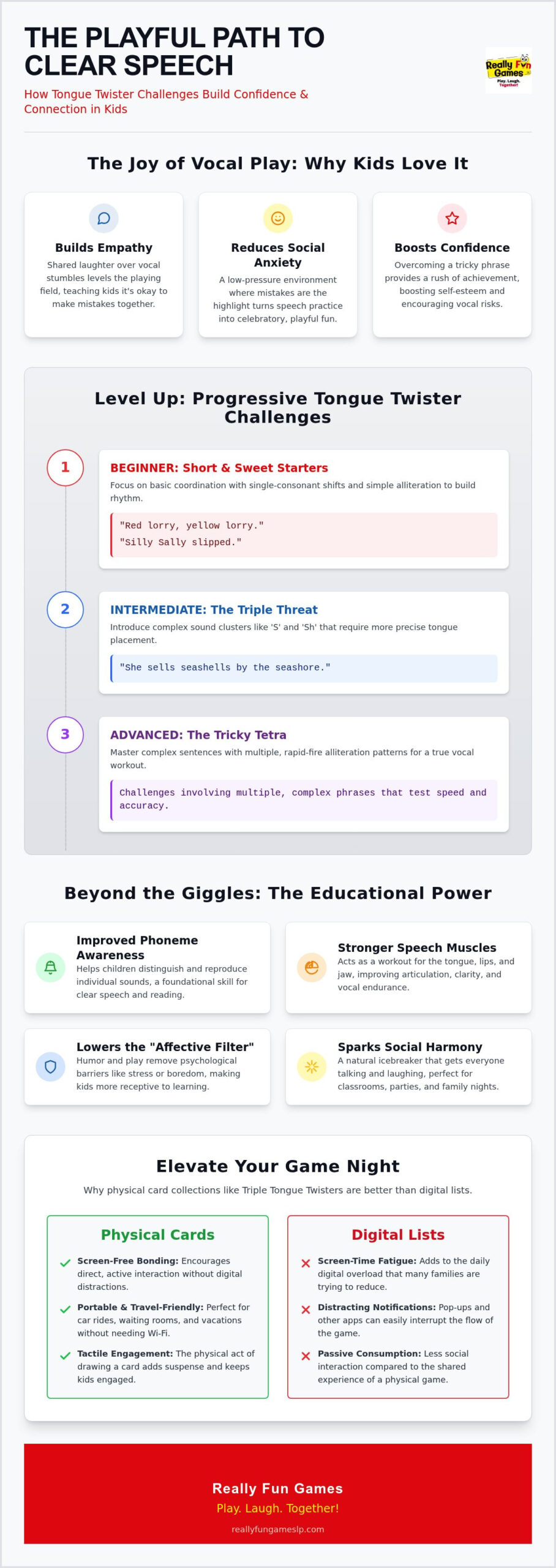
Laughter is the ultimate equalizer. When a child attempts a tricky phrase and their tongue ties into a knot, the resulting giggle isn’t just noise. It’s a signal that the pressure is off. Traditional speech practice often feels like a chore, but tongue twister challenges for kids turn that dynamic on its head. By focusing on the “jumble” rather than perfection, these games create a low-pressure environment where mistakes are the highlight of the show. It’s a celebratory space where the goal isn’t to be perfect, but to be present and playful.
Shared laughter over vocal stumbles does more than just lighten the mood; it builds deep empathy. When everyone in the room, from the youngest sibling to the oldest grandparent, struggles to say a complex phrase, it levels the playing field. This shared vulnerability reduces social anxiety and teaches kids that it’s okay to stumble. They learn to embrace the messiness of communication, viewing each slip-up as a funny moment rather than a failure. This mindset shift is powerful, as it encourages them to take risks in other areas of their social lives without the fear of being judged.
Vocal play also acts as a natural icebreaker for groups of all sizes. Whether it’s a classroom of new students or a birthday party full of cousins who haven’t seen each other in months, a quick round of verbal gymnastics gets everyone talking. It’s an immediate way to spark social harmony through shared effort and rhythmic fun.
Building Confidence Through Silly Sounds
Success feels sweet, especially when it’s hard-won. Overcoming a particularly gnarly phrase provides a rush of immediate achievement that boosts a child’s self-esteem. In educational settings, using humor helps lower the “affective filter.” This is the psychological barrier of stress or boredom that can block learning. When kids are laughing, that barrier disappears, making them more receptive to improving their articulation. Encouraging a child to lead the challenge even builds leadership skills. Letting them pick the cards from a deck like Triple Tongue Twisters gives them a sense of agency and authority over the group’s entertainment.
The Social Magic of Family Game Night
Modern life is loud and digital, making screen-free bonding more precious than ever. A family game night centered on tongue twister challenges for kids creates the kind of memories that stick around for years. You won’t remember a high score on a tablet, but you’ll definitely remember the time Dad turned bright red trying to get through a “Tricky Tetra” challenge. These games bridge the generation gap effortlessly. Whether you’re playing with classic phrases or modern variations, the goal remains the same: connection through conversation and play. It’s about moving away from passive consumption and toward active, rhythmic interaction that brings everyone closer together. If you’re searching for the perfect deck to spark those moments, exploring funny tongue twister cards for hilarious family game nights can help you find the right fit for every age group in your home.
Level Up: Progressive Tongue Twister Challenges for Kids
Think of vocal training like a workout for your brain and mouth. You wouldn’t lift the heaviest weight on your first day at the gym, and the same logic applies here. Creating structured tongue twister challenges for kids helps prevent frustration by building a path from simple sounds to complex sentences. This progression ensures that every child feels a sense of mastery before they move on to the next verbal hurdle. By starting small and scaling up, you keep the energy high and the discouragement low.
Beginner: Short and Sweet Starters
Every great challenge starts with a warm-up. For beginners, the goal is to build basic coordination without getting overwhelmed. Use short, punchy phrases that focus on single-consonant shifts. “Red lorry, yellow lorry” is a classic for a reason; it forces the tongue to flip-flop between the ‘R’ and ‘L’ sounds quickly. Alliteration is a key tool here, which is the repetition of the same initial sound in a group of words, like “Silly Sally slipped on slimy seaweed.” By mastering these bite-sized phrases, kids build the rhythm and momentum needed for longer sentences.
Intermediate: The Triple Threat
Once they’ve got the basics down, it’s time to introduce more complex clusters. This is where the real fun begins. Intermediate challenges often focus on the classic “S” and “Sh” sounds, which require precise tongue placement. “She sells seashells by the seashore” is a perfect example of a phrase that trips up even the most confident talkers. To keep things fresh, you can use the Triple Tongue Twisters card deck. Drawing a card at random adds an element of surprise that keeps kids on their toes. It turns a simple drill into a game of chance where anyone could end up with a “triple threat” phrase that requires extra focus.
Expert: Tricky Tetra and Beyond
The expert tier is reserved for those who have truly mastered their articulation. These challenges involve longer narrative twisters that require excellent breath control and focus. At this level, phrases include rapid vowel shifts and alternating consonants that seem designed to confuse the brain. The “Ultimate Challenge” involves drawing multiple cards and saying them all in one breath without a single stumble. It’s a high-energy way to push their limits and celebrate how far they’ve come. If you’re looking for more ways to bring your family together through play, you can explore our award-winning card games designed to spark laughter and connection.
Creative Ways to Host a Tongue Twister Challenge
Reading a list of words is a lesson. Turning those words into a high-stakes showdown is a memory. To truly engage a room full of energetic learners, you need to move beyond simple repetition and embrace the spirit of competition. Hosting tongue twister challenges for kids isn’t just about who speaks the clearest; it’s about creating a spectacle of sound where everyone feels like a star. By adding structure and stakes, you transform a quiet activity into a vibrant social event that builds bonds through shared effort.
One of the biggest hurdles in any group setting is balancing the difficulty for different ages. You don’t want a ten year old breeze through a phrase while a six year old feels defeated. To keep things fair, use a tiered system where younger participants tackle shorter, punchy phrases while the older “pros” take on narrative-length twisters. You can even incorporate physical movement to burn off extra energy. Try having participants hop on one foot or clap to the beat while they speak. This adds a layer of coordination that makes the challenge even more rewarding. To keep track of points or rounds without the mess of paper and pencils, tools like Extra Number Dials from the Really Fun Games collection provide a tactile, satisfying way for kids to visualize their progress.
The Beat the Clock Sprint
Speed is the name of the game in this high-energy format. Set a timer for exactly 30 seconds and see how many times a player can repeat a specific phrase. However, there’s a catch: you must use the “clean rep” rule. If a word is slurred or skipped, that repetition doesn’t count. This encourages kids to find the perfect balance between velocity and clarity. Instead of just competing against others, encourage them to track their personal bests. Watching their own score climb from three reps to six over a single afternoon provides a massive boost to their vocal confidence.
The Elimination Round (Last Speaker Standing)
For larger groups, an elimination format creates an electric atmosphere. Have everyone stand in a circle and pass the challenge around like a hot potato. As the round continues, the speed must increase. If a player stumbles, they aren’t just “out.” They transition into the role of a judge or a cheerleader. This keeps the social harmony alive and ensures that everyone stays engaged until the final two speakers face off in a “sudden death” round of the most complex phrases you can find.
The “Telephone” Twister Twist
Combine two classics by playing Telephone with a complex tongue twister. Watching a phrase morph from “Six slippery snails” into something completely unrecognizable by the time it reaches the end of the line is a guaranteed laugh-inducer. This is one of the most effective classroom games for communication because it highlights how easily messages can change when we don’t speak clearly. It’s a perfect way to wrap up tongue twister challenges for kids with a focus on the joy of the “jumble.”
Beyond the Giggles: The Educational Power of Articulation Play
While the room erupts in laughter, something remarkable happens beneath the surface. Each stumble and restart is actually a mini-workout for the developing brain. Speech-Language Pathologists (SLPs) frequently integrate tongue twister challenges for kids into their sessions because these phrases are precision tools for phoneme awareness. By isolating specific sounds, children learn to distinguish between subtle phonetic differences that might otherwise blend together. This repetitive play strengthens the intricate muscles of the tongue, lips, and jaw, building the physical foundation for clear speech. It’s about more than just pronunciation; it’s about developing the motor control necessary for complex communication.
Vocal agility isn’t just for actors or performers; it’s a vital skill for classroom participation and future public speaking. When a child masters a tricky sequence, they’re training their mouth to move with more precision and speed. This physical confidence often carries over into other areas of life, making them more likely to raise their hand in class or lead a group project. They learn that their voice is a powerful tool they can control. Interestingly, these same principles of vocal gymnastics can be scaled up, serving as high-energy articulation exercises for adults who want to maintain their own clarity and presence in professional settings.
Targeting Specific Speech Sounds
Not all twisters are created equal. Some focus heavily on the “R” sound, while others might target “L” or the tricky “TH” phoneme. Identifying these targets allows parents and educators to customize the play to a child’s specific needs. For a seasonal twist, using collections like Blooming Tongue Twisters keeps the engagement fresh throughout the school year. Phonemic awareness is one of the strongest predictors of future reading success because it allows children to manipulate the individual sounds that make up words. By playing with these sounds orally, they’re laying the groundwork for literacy before they even pick up a book.
Boosting Literacy and Vocabulary
Alliteration does more than just sound silly. It helps kids recognize word patterns and structures, making it easier to decode new language. You can even introduce “SAT words” or complex vocabulary by weaving them into ridiculous phrases. This removes the intimidation factor from big words and makes them feel like part of the fun. By turning these into tongue twister challenges for kids, you’re making vocabulary lessons feel like a game. To take it a step further, encourage kids to write their own twisters. This creative writing exercise forces them to think critically about word choice and phonetic rhythm. If you want to see how these tools can transform your home or classroom, explore our award-winning tongue twister collections today.
Elevate Your Game Night with Award-Winning Collections
A screen-free evening isn’t complete without a variety of ways to connect. Once the laughter from tongue twister challenges for kids has broken the ice, you can keep the momentum going with award-winning card games like “Really?! Think You Know Me? Guess Again!”. While tongue twisters challenge the mouth, this flagship game challenges the heart and mind, asking players to guess each other’s hilarious answers to surprising questions. Together, these collections from Really Fun Games form the ultimate toolkit for building social harmony and lasting memories.
Choosing the right deck depends on your setting, whether you’re in a quiet classroom or a bustling holiday party. To help you decide which tool fits your needs, here is a quick look at how our primary collections compare:
| Collection | Best For | Key Benefit |
|---|---|---|
| Triple Tongue Twisters | Families & SLPs | High replayability for articulation practice |
| Tricky Tetra Tongue Twisters | Travel & Road Trips | Compact, rapid-fire phrases for on-the-go fun |
| Seasonal Collections | Holiday Gatherings | Themed icebreakers for Christmas or Halloween |
The Triple Tongue Twisters Advantage
What makes this collection a staple for speech therapists and families alike is its incredible ease of use. You don’t have to spend twenty minutes reading a rulebook; you simply draw a card and start the vocal play. It’s truly a game for everyone, bridging the gap between eight year old siblings and their grandparents. Because the focus is on humor rather than a formal lesson, kids don’t even realize they’re practicing their articulation. They’re too busy trying to out-twist their relatives in a high-energy environment.
Seasonal Fun: From Santa to Spooky Twisters
The fun doesn’t stop when the seasons change, and our themed decks ensure your gatherings always have a festive spark. “Santa’s Tongue Twisters” makes for a hilarious holiday conversation starter, while “Trick-or-Treat Tongue Twisters” adds a rhythmic layer to any Halloween party. For larger organizations or schools, the “Really Fun Custom Games Bundle” provides a versatile set of tools for team-building. Whether you’re looking for a birthday gift or a new classroom activity, you can discover the full Really Fun Games collection here to find your perfect match.
Bring the Joy of Vocal Play to Your Next Game Night
Transforming speech practice into a high-energy social event is the most effective way to build lasting confidence and social harmony. By moving through progressive levels and hosting structured competitions, you turn what could be a repetitive drill into a laughter-filled family tradition. These tongue twister challenges for kids do more than just improve articulation; they create screen-free memories that bridge the generation gap and foster deep human connection.
Whether you’re a parent looking for travel-friendly fun or an educator seeking professional-grade tools, our award-winning collections are designed to spark meaningful conversations. Trusted by speech therapists and educators, our games provide portable, screen-free engagement for ages 8 and up. Find Your Perfect Family Game at Really Fun Games and discover how simple social interactions can be truly transformative.
It’s time to embrace the stumbles, enjoy the giggles, and watch your family’s vocal confidence soar.
Frequently Asked Questions
What age are tongue twister challenges best for?
Eight years old is typically the sweet spot for these family card games. While younger children can certainly join in the fun, these games for families are specifically designed for the cognitive focus and reading levels of elementary-aged kids. At this stage, they can handle the strategic element of tracking points or drawing from a deck, ensuring everyone stays engaged during a long weekend or a quiet afternoon at home.
Can tongue twisters actually help with speech therapy?
Yes, these rhythmic phrases are highly effective for improving articulation and phonemic awareness. Speech-Language Pathologists (SLPs) often utilize our award-winning card games because they transform repetitive speech drills into a celebratory social experience. By turning these exercises into tongue twister challenges for kids, you lower the pressure and help them build the muscle memory needed for clear speech without the stress of a formal lesson.
How do I make a tongue twister challenge fair for different ages?
You can balance the difficulty by assigning shorter phrases to younger kids and narrative-length twisters to adults. This tiered approach is perfect for a family game night where you want to maintain social harmony across different generations. It ensures that a six year old feels as much like a winner as a grandparent, keeping the energy high and the competition friendly for every participant in the room.
What are the best short tongue twisters for beginners?
Beginners should start with punchy, two-word repetitions like “Red lorry, yellow lorry” or “Toy boat.” These work perfectly as icebreaker card games because they build immediate vocal momentum without overwhelming the speaker. Once they’ve mastered these quick shifts, they’ll have the confidence to tackle the longer, more complex alliteration patterns found in our expert-level decks, making the progression feel natural and rewarding.
How can I use tongue twisters in a classroom setting?
In a classroom, you can set up rotation stations or use them as a “brain break” between subjects. Many teachers use these phrases as conversation starter cards to help students practice active listening and clear communication. It’s a screen-free way to build teamwork and literacy skills, especially when you use tiered challenges that cater to the diverse reading levels and social needs present in your room.
What if my child gets frustrated with difficult phrases?
If frustration sets in, immediately shift the focus back to the giggles rather than perfect delivery. Using family conversation games is about building connection, so remind them that even the adults are going to stumble. Slowing down the tempo or clapping to the beat can help them regain their rhythm while keeping the atmosphere lighthearted, encouraging, and focused on the joy of shared play.
Are there holiday-themed tongue twister games?
Yes, we offer several specialized decks for different times of the year, including Santa and Halloween themes. These are some of our most popular party card games because they provide a quick, rhythmic way to get guests laughing and interacting. Whether it’s a holiday dinner or a spooky celebration, these themed challenges ensure the tongue twister challenges for kids remain a highlight of the event for every guest.
Where can I buy a physical deck of tongue twister cards?
You can find our full collection of physical decks on the Really Fun Games website. We believe the best family card games are the ones you can hold in your hand, as they encourage eye contact and spontaneous bonding. Our conversation card games and tongue twister decks are designed for portability, making them the ideal choice for road trips, classrooms, or your next family gathering. For a curated look at the top options available, our guide to the best funny tongue twister cards for family game nights can help you choose the perfect deck with confidence.