

What if the secret to a game that never gets old isn’t found in a thick rulebook, but in the unpredictable laughter of the people sitting around your table? It is a common frustration to spend your hard-earned money on a game only to have the kids lose interest before the first round even ends. We have all experienced that sinking feeling when a “fun” family night turns into forty-five minutes of explaining complex instructions while everyone stares at their phones. Finding truly replayable family card games shouldn’t feel like a chore, yet many of us own closets full of dusty boxes that lost their spark after a single afternoon.
You deserve a collection that grows with your family instead of being outgrown. In this guide, you will discover the secrets to choosing games that offer endless variety and foster deep, meaningful connection. We are going to show you how to identify titles that stay exciting play after play by leveraging the infinite quirks of human personality. From building vital communication skills to finding the perfect portable companion for your next holiday, you will learn exactly what makes a game worth keeping on the shelf for years. Let’s dive into how you can transform your next game night into a vibrant celebration of shared stories and spontaneous joy.
Key Takeaways
- Learn how to spot the “Return to Play” factor that keeps a game fresh for years instead of just one afternoon.
- Discover why player-driven mechanics make for the best replayable family card games by letting the unique personalities at your table create a new experience every time.
- Explore why small-box, portable games offer better long-term value than bulky board games, especially for travel and holiday gatherings.
- Master a simple selection framework to pick the right game based on whether you’re aiming for classroom learning, speech therapy goals, or pure family laughter.
- Find out how you can build a screen-free library that prioritizes communication and deep connection so your games won’t just sit on the shelf.
What Defines Truly Replayable Family Card Games?
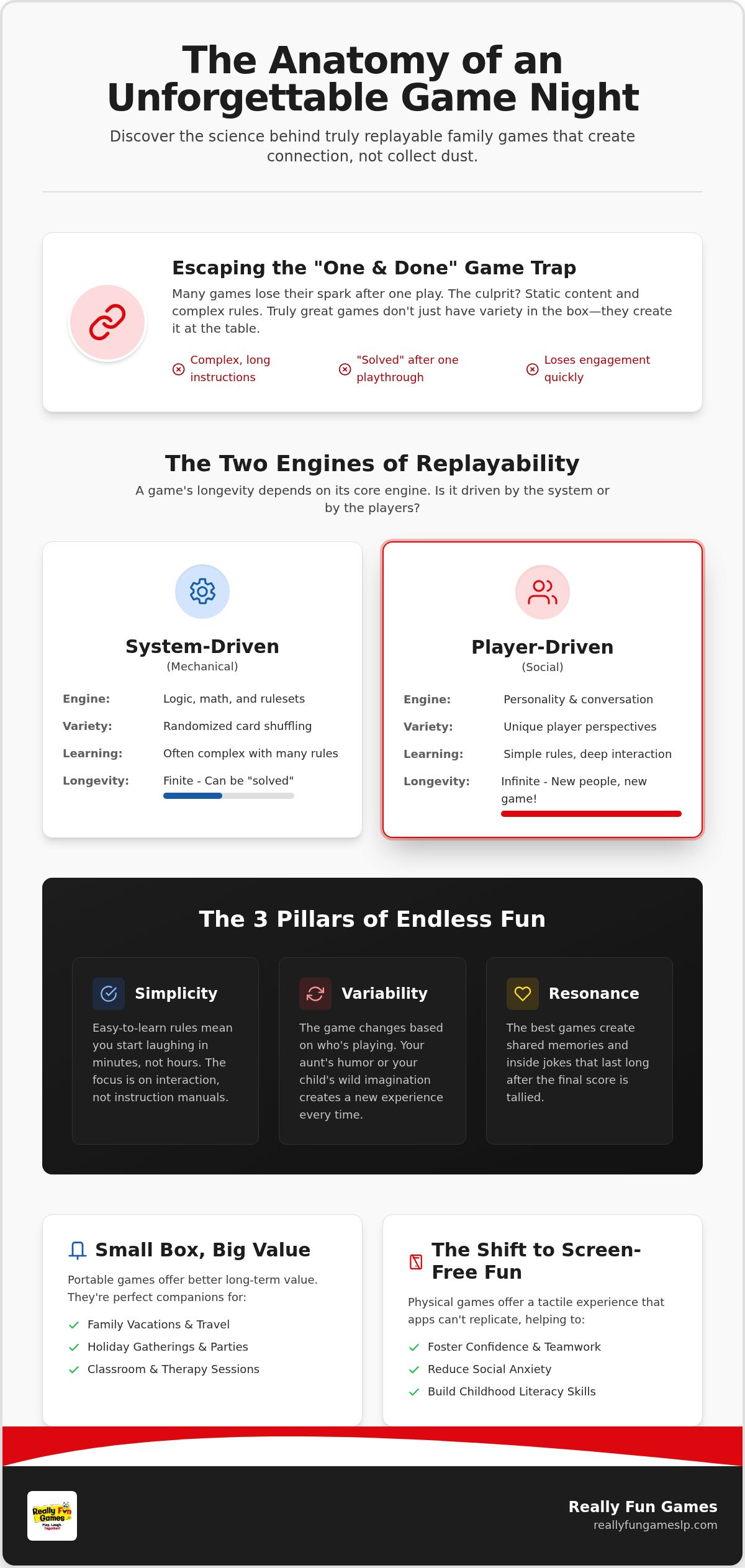
Replayability is the heartbeat of any successful game night. It’s the “Return to Play” factor that determines whether a box stays on the shelf or ends up at the back of a dusty closet. While many people think variety comes from having hundreds of different cards, the most successful replayable family card games actually rely on the people playing them. When a game ends and your kids immediately shout, “Again!”, you’ve found the sweet spot of engagement.
There’s a massive difference between mechanical variety and social variety. Mechanical variety refers to different card combinations or random setups. While this is common in many traditional card games, it can eventually feel repetitive once you’ve seen every card. Social variety, however, focuses on different outcomes based on who is at the table. This is why games like “Really?! Think You Know Me? Guess Again!” feel fresh every single time; the “answers” change depending on your fellow players’ personalities and experiences. When the game adapts to your aunt’s sense of humor or your toddler’s unique perspective, you’ve found gold.
Don’t fall into the “One-and-Done” trap often found in trivia or static puzzle games. Once you know the answer to a specific question, the mystery is gone and the card loses its value. A great game needs a low barrier to entry so kids can jump in immediately, but a high ceiling for fun so adults stay engaged round after round. It shouldn’t take forty-five minutes to explain the rules; it should take two minutes to start the laughter.
The Core Pillars of Endless Fun
Simplicity is your best friend. Easy-to-learn rules allow your family to focus on the actual interaction rather than flipping through a manual. Variability also matters. Changing the starting conditions or the “goal of the round” keeps the brain engaged and prevents a “solved” strategy from ruining the fun. Finally, look for emotional resonance. The best games create inside jokes and shared memories that outlast the final score. Laughter is the ultimate engine for replayability.
Why 2026 Families are Choosing Screen-Free Replayability
There’s a surging demand for screen-free family fun as parents look to combat digital fatigue. Physical card games offer a tactile experience that apps simply can’t replicate. Touching the cards and making eye contact reduces social anxiety and builds childhood literacy. In 2026, the focus has shifted toward games that foster confidence and teamwork through vocal play and joyful social harmony.
Mechanical vs. Social Replayability: Which Matters More?
The engine of a game isn’t just the cardboard; it’s the brain of the person holding it. While mechanical variety offers a changing puzzle, social variety offers a changing experience. Understanding this distinction is the key to stocking a closet that never goes stale. When you choose replayable family card games that rely on human personality, you’re tapping into an infinite resource that no algorithm can match.
To help you evaluate your next purchase, here is a quick look at how these two styles of play compare in the long run:
| Feature | System-Driven (Mechanical) | Player-Driven (Social) |
|---|---|---|
| Primary Engine | Logic, math, and rulesets | Personality and conversation |
| Source of Variety | Randomized card shuffling | Unique player perspectives |
| Learning Curve | Often complex with many rules | Simple rules, deep interaction |
| Longevity | Can be “solved” over time | Infinite (new people = new game) |
Games that lean into the human element possess “Dynamic Difficulty.” This means the challenge scales automatically based on who is playing. A round with your eight-year-old will feel completely different from a round with grandparents, even if you’re using the exact same deck. This leads to “Emergent Gameplay,” where the funniest moments aren’t written in the rulebook but are created by the players. It’s about the stories you tell and the connections you make, which is why these titles foster social connection so effectively.
System-Driven Games: The Logic of the Deck
System-driven games are built like logic puzzles. They focus on set collection, drafting, or complex resource management. While these are satisfying for strategy lovers, they often have a “solved” state. Once you figure out the most efficient way to win, the magic starts to fade because the “correct” move is always the same. These games can feel repetitive because the system doesn’t change, only the order of the cards. To find a system-driven game that lasts, look for those designed specifically as card games for 4 players, as the extra participants add enough chaos to keep the logic from becoming predictable.
Player-Driven Games: The Infinite Human Element
Player-driven games, like “Really?! Think You Know Me? Guess Again!”, offer a totally different vibe. Because the “answers” come from the players’ lives and opinions, the game state is never the same twice. You aren’t just playing the cards; you’re playing the people. This creates a vibrant atmosphere where conversation starters lead to unexpected discoveries and deep belly laughs. Similarly, our “Triple Tongue Twisters” collection uses vocal play to create replayable challenges. The difficulty isn’t just in the words, but in the joyful struggle of trying to articulate them while your family cheers you on. If you’re ready to build a library that never gets old, you can explore our full collection of player-driven games to find your next favorite.
Small Box Value: Why Portable Games Win in the Long Run
Big, flashy board games look impressive on a shelf, but they often collect more dust than memories. The real heroes of a family collection are the compact boxes that actually leave the house. Truly replayable family card games offer a much better return on investment because they remove the friction of setup and storage. When a game fits easily into a pocket or a backpack, it transforms from a “special occasion” activity into a constant companion for everyday life.
Smart families evaluate their purchases using the “Cost-Per-Play” metric. A heavy board game might cost sixty dollars and only hit the table twice a year, resulting in a high cost per session. In contrast, a portable card game that costs a fraction of that and gets played fifty times over three years is a massive win for your budget. Compact designs allow you to build a “Bundle of Fun” where several different titles fit into a single small bag, giving you a variety of ways to connect without the bulk. This flexibility ensures that the excitement never fades because you always have a fresh option ready to go.
The “Travel Game” Advantage
The best travel games for kids must be durable and incredibly easy to set up in tight spaces. You don’t want a hundred tiny plastic pieces that could disappear into the abyss of a car seat or under a restaurant booth. Really Fun Games designs products specifically for these on-the-go moments. Our portable family card games for ages 8+ don’t require a massive dining table or complex boards. You can spark a meaningful conversation on an airplane tray or share a laugh while waiting for your food to arrive, making every transition an opportunity for joy.
Durability and Longevity
Material quality is the secret ingredient for a game that lasts through hundreds of rounds. High-quality card stock and a smooth finish prevent fraying and peeling, even when handled by enthusiastic young players. There is also a significant psychological benefit to a “quick setup” game. In a busy family schedule, the knowledge that you can start playing in thirty seconds makes it far more likely that you will actually reach for the box. To keep your library in top shape, store your decks in their original tuck boxes or a dedicated travel pouch to protect them from moisture and wear during your adventures.
Choosing the Right Game for Your Specific Audience
Selecting replayable family card games requires a quick shift in perspective. Instead of just looking at the theme on the box, look at the “Goal of the Gathering.” Are you trying to break the ice at a classroom party, or are you hoping to spark a deep conversation during a holiday dinner? When you match the game to the emotional outcome you want, you ensure the cards stay in rotation for years. The best games are those that adapt to the energy in the room, whether it’s a high-energy tongue twister battle or a quiet night of discovery.
For Families and Social Gatherings
Family reunions often face the “generation gap.” Teens might be glued to phones while grandparents feel left out of the conversation. “Really?! Think You Know Me? Guess Again!” bridges this divide by focusing on empathy and shared stories. It isn’t about who knows the most facts; it’s about who knows the people in the room. To win over skeptical teens, start with the most lighthearted cards and let the laughter do the heavy lifting. These moments of genuine connection turn a simple game night into a cherished memory that family members will want to recreate every time they get together.
For Educators and Speech Therapists
For professionals, the challenge is finding tools that don’t feel like “work.” We believe speech therapy games for articulation should be fun first and educational second. If a student is laughing, they’re engaged. “Triple Tongue Twisters” offers incredible replayability in a classroom because the challenge is both physical and vocal. It builds confidence and teamwork as students cheer each other on through tricky phrases. These games serve as perfect icebreakers, creating a safe space for vocal play while naturally developing critical social skills and phonological awareness. Because the difficulty scales with the player’s speed and clarity, the same deck remains useful across multiple grade levels.
The beauty of these games is how they grow with the child. A tongue twister that is a struggle at age eight becomes a high-speed articulation challenge at age twelve. This versatility is why our products remain staples in family libraries, homeschool classrooms, and therapy offices alike. If you’re ready to find the perfect match for your specific group, browse our full collection of award-winning games to discover your next family favorite.
Building Your Replayable Library with Really Fun Games
At Really Fun Games, our philosophy is simple: play should be easy to learn and hard to put down. We design every deck to be a vibrant catalyst for joy, ensuring that the most replayable family card games focus on human connection rather than complex rulebooks. It is about creating a steady, inviting pulse of laughter that keeps everyone engaged from the first card to the last. We believe that when you strip away the barrier of difficult instructions, you leave more room for spontaneous discovery and shared memories.
We love adding seasonal sparks to your collection to keep the excitement high all year long. Themed titles like “Santa’s Tongue Twisters” or “Trick-or-Treat Tongue Twisters” provide a fresh, festive way to celebrate the holidays with a burst of energy. These specialized decks ensure that your game nights stay relevant to the calendar, offering unique challenges that match the spirit of the season. For families who want to ensure their shelf is always stocked with endless variety, the Really Fun Custom Games Bundle offers the best possible value for building a diverse home library.
The “Guess Again” Difference
“Really?! Think You Know Me? Guess Again!” is a massive hit for ages 8 to 108 because it relies on the infinite variety of human personality. By encouraging critical thinking and empathy through simple, thought-provoking questions, it helps players see each other in a completely new light. Award-winning games like Really?! leverage thousands of potential player combinations to ensure no two rounds are ever the same. You aren’t just playing a game; you’re building a bridge between generations and discovering hidden stories about the people you love most.
Mastering Articulation with Triple Tongue Twisters
Vocal play is a high-replay activity that challenges developing minds in a supportive, screen-free environment. It’s high-energy. It’s joyful. Starting with our “Triple Tongue Twisters” collection allows players to build confidence and phonological awareness through laughter. As your family masters those initial phrases, you can progress to the “Tricky Tetra Tongue Twisters” for even more advanced articulation challenges. We encourage you to start a new tradition of “vocal acrobatics” at home, where the goal is to embrace the silliness of a tangled tongue while strengthening communication skills. This progression ensures the game grows alongside your children, staying a favorite for years to come.
Start Your Next Tradition of Shared Laughter
Choosing the right replayable family card games is about more than just shuffling a deck; it is about choosing to invest in the people around your table. You now know that the most enduring fun comes from player-driven experiences that adapt to every personality, age, and mood. By prioritizing social variety and portable, high-quality designs, you ensure your game nights remain a vibrant source of connection rather than a chore. Whether you are a parent looking for screen-free entertainment or a teacher seeking to build confidence in the classroom, the right game acts as a catalyst for harmony and joy.
Our award-winning game designs are trusted by parents, teachers, and SLPs nationwide to provide 100% screen-free entertainment that never gets old. Every round of “Really?! Think You Know Me? Guess Again!” or a “Triple Tongue Twisters” battle offers a fresh opportunity for discovery and vocal play. Don’t let your next gathering be just another evening. Discover the full collection of Really Fun Games and start your next tradition! Embrace the spontaneity, share the laughter, and watch as your family builds bonds that last a lifetime.
Common Questions About Replayable Family Card Games
What makes a card game replayable for families?
Replayability comes from the “Return to Play” factor, which is strongest in games that rely on human interaction rather than static rules. Truly replayable family card games feel fresh because the “answers” change based on who is sitting at the table. Instead of memorizing a deck, you are constantly discovering new things about your friends and family. This social variety ensures that the game evolves with your group, making every round a unique celebration of connection.
Are conversation games actually fun for kids and teens?
Absolutely! The key is to choose games that feel like a party rather than a school assignment. “Really?! Think You Know Me? Guess Again!” succeeds because it taps into the natural curiosity of teens and the playful energy of younger kids. It turns empathy and critical thinking into a hilarious challenge. When kids realize they can surprise their parents with what they know, the engagement levels skyrocket, turning a simple conversation into an addictive social experience.
How do I choose a card game for kids with different ages?
You should prioritize games with a low “barrier to entry” but a high “ceiling for fun.” Look for titles designed for ages 8 and up, as these typically have simple enough rules for younger children while offering enough depth to keep adults entertained. A great game scales its difficulty naturally. For example, a tongue twister is a simple vocal challenge for a child but becomes a high-speed test of articulation and wit for a competitive teenager.
Can card games really help with speech therapy and articulation?
Yes, physical games are incredible tools for speech therapy and articulation. Our “Triple Tongue Twisters” collection turns vocal practice into a joyful game of “vocal acrobatics.” Speech-language pathologists (SLPs) love these because they encourage repetitive practice without feeling like a drill. By focusing on laughter and social harmony, kids build confidence in their communication skills and phonological awareness. It is the perfect way to make articulation practice the highlight of their day.
How many players do I need for Really Fun Games?
Most of our award-winning titles are designed to be flexible for various group sizes. While “Really?! Think You Know Me? Guess Again!” is a blast with a small family group of two or three, it also shines as an icebreaker for larger parties or classroom settings. The goal is always to foster connection, so whether you have a cozy trio or a full house, the mechanics ensure everyone feels included in the laughter and conversation.
What is the best way to introduce a new family card game?
The best way to start is by jumping straight into the action. Avoid long rulebook readings and instead explain the basics in under two minutes. You might even play a “practice round” where the points don’t count to help everyone get comfortable with the rhythm. Focus on the fun and the interaction rather than the technicalities. When the room is filled with laughter, the rules will naturally fall into place for everyone involved.
Are these card games suitable for travel and road trips?
Yes, these games are specifically designed for on-the-go fun. Because they come in compact, durable boxes and don’t require a massive table or hundreds of tiny pieces, they are the perfect companion for airplanes, cars, or restaurant booths. You can easily slip a deck into a backpack or glove compartment. This portability ensures you always have a screen-free way to connect and share a laugh, no matter where your family adventures take you.
Why should I choose physical card games over digital apps?
Physical games offer a tactile experience and genuine eye contact that digital apps simply cannot replicate. Choosing a screen-free option helps reduce digital fatigue and creates a shared space for meaningful social interaction. It is about being present in the moment with the people you love. Physical cards encourage better communication, build social confidence, and foster a sense of teamwork that feels much more rewarding than staring at a glowing screen during a road trip.