
What if the most dreaded part of your next gathering became the absolute highlight of everyone’s week? We’ve all felt that collective cringe when a facilitator mentions “icebreakers,” yet the right icebreaker games for groups can turn a room of quiet strangers into a synchronized, laughing team in mere minutes. It’s time to stop settling for generic prompts that leave people checking their watches and start creating moments that actually matter.
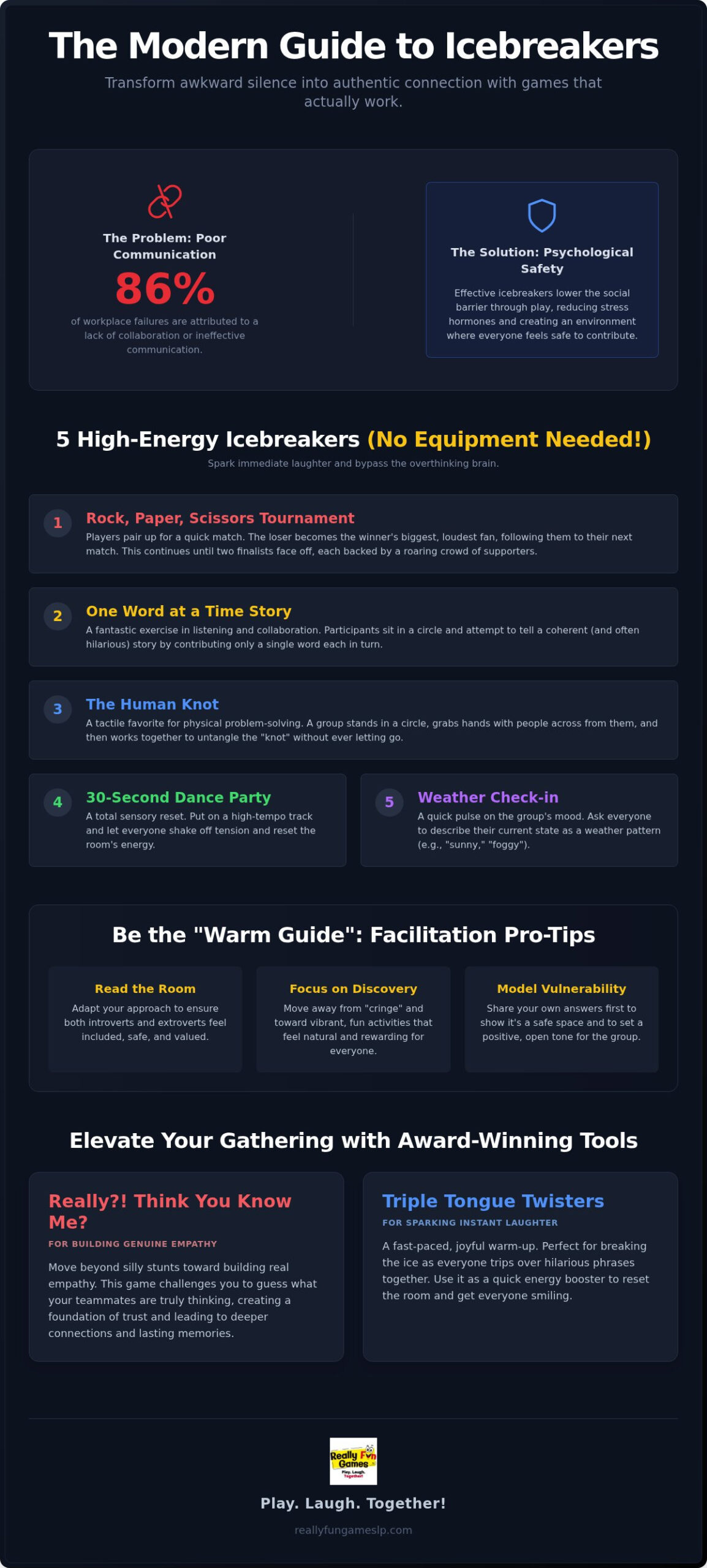
You probably agree that social anxiety is a real buzzkill. With 86% of employees attributing workplace failures to poor communication, the stakes for connection are high. Forcing introverts into loud, chaotic scenarios often backfires. It’s tough to find that perfect balance where everyone feels seen, heard, and energized. This article promises to help you transform those awkward introductions into meaningful bonds using our curated list of high-energy activities. We’ll explore how to spark vibrant communication through award-winning Really Fun Games tools like “Really?! Think You Know Me? Guess Again!” and the fast-paced joy of “Triple Tongue Twisters.” Whether you are a teacher, a manager, or a grandparent, you’re about to discover how simple play creates shared harmony for every personality type.
Key Takeaways
- Learn how to replace social anxiety with psychological safety by using play to lower the social barrier for everyone; it’s the secret to a successful start.
- Master the art of leading icebreaker games for groups with high-energy activities that require zero equipment and spark immediate laughter.
- Move beyond silly stunts toward building genuine empathy through games that challenge you to guess what your teammates are really thinking.
- Adopt the “warm guide” facilitation style to read the room effectively and ensure both introverts and extroverts feel included and valued.
- Discover why award-winning card games like “Really?! Think You Know Me? Guess Again!” create more lasting memories and deeper connections than generic digital lists.
Beyond the Cringe: Why Icebreaker Games for Groups Actually Matter
Walking into a room full of strangers often triggers a primitive “fight or flight” response. We call this the social barrier to entry. Effective icebreaker games for groups serve as a bridge over this gap, transforming a collection of individuals into a cohesive unit. To understand the basics, we can look at What is an icebreaker? and how it functions as a facilitation tool. It isn’t just about killing time; it’s about establishing an environment where everyone feels safe to contribute. When you lower this barrier through play, you open the door to genuine discovery and social harmony.
The Science of Connection and Psychological Safety
Psychological safety is the secret sauce of high-performing teams. When we engage in low-stakes play, our brains release dopamine and oxytocin while cortisol levels drop. This chemical shift reduces social anxiety almost instantly. Laughter acts as a universal language that creates immediate group harmony. By sharing a lighthearted challenge, you aren’t just playing a game. You are building a foundation of trust that makes future communication and empathy much easier to achieve. Over time, these sessions translate into improved teamwork and a more supportive culture. These shared experiences are the fastest way to build lasting memories.
Breaking the “Cheesy” Barrier in 2026
Let’s be honest: traditional icebreakers often feel forced or even infantilizing. The common pitfalls usually involve putting people on the spot or demanding deep vulnerability before trust is earned. In 2026, the shift is toward high-energy, inclusive facilitation that respects different personality types. We focus on games that people actually enjoy. This means moving away from the “cringe” and toward vibrant discovery.
By using portable, physical tools like those found in the Really Fun Games collection, you ensure that the interaction feels natural and rewarding for everyone involved. Whether you are leading a corporate retreat or a family reunion, the goal is to foster real connection. These activities provide a structured way for people to show their personalities without the pressure of a formal introduction. It’s about creating a space where spontaneity and laughter can thrive.
10 High-Energy Icebreakers for Large and Small Groups
High energy doesn’t require a high budget or a trunk full of props. When you lead icebreaker games for groups, your goal is to spark movement that bypasses the overthinking brain and heads straight for the heart. Movement resets the room. Whether you are corralling a classroom of energetic students or looking to wake up a corporate board meeting after lunch, these activities provide the spark you need. While many team-building games focus on complex rules, these classics prioritize movement and immediate connection.
The Rock Paper Scissors Tournament is a legendary way to ignite a crowd. Everyone starts by finding a partner for a quick match. The person who loses immediately becomes the winner’s biggest, loudest fan, following them to their next match to cheer them on. This continues until only two players remain, each backed by a massive, roaring crowd of supporters. For groups seeking collaborative flow, “One Word at a Time” is a fantastic exercise in listening. Participants sit in a circle and attempt to tell a coherent story by only contributing a single word each. If the energy feels heavy, a “Weather Check-in” offers a quick pulse on the group’s emotional state. Ask everyone to describe their current mood as a weather pattern, such as “sunny with a light breeze” or “a bit foggy but clearing.”
5-Minute Energy Boosters for Immediate Engagement
The Human Knot is a tactile favorite for physical problem-solving. Have your group stand in a tight circle. Everyone reaches in with their right hand to grab the hand of someone across from them, then does the same with their left hand. The challenge is to untangle the knot into a perfect circle without ever letting go. If you need a total sensory reset, try a 30-Second Dance Party. Put on a high-tempo track and let everyone shake off the tension. To add a layer of vocal play, use “Triple Tongue Twisters” as a warm-up. This award-winning game from Really Fun Games is perfect for sparking laughter as people trip over hilarious phrases together. You can explore our full range of connection tools at Really Fun Games to find the perfect fit for your next event.
Low-Movement Games for Quiet or Formal Spaces
Not every space allows for a dance party. In formal settings, try “Two Truths and a Dream.” It’s a modern twist where participants share two true facts and one thing they wish to achieve. This shifts the focus from “spotting the lie” to sharing aspirations. Another great option is “Common Ground,” where small groups must find three unexpected things they all have in common, such as a shared fear of spiders or a love for pineapple pizza. These activities build confidence by validating shared experiences. For more tips on this, check out How Tongue Twister Games Improve Confidence. These quiet moments of discovery often lead to the most lasting bonds.
Building Empathy and Trust: Deep Connection Games
While high-energy movement is a fantastic way to reset the room, the real magic of icebreaker games for groups often happens in the quiet moments of discovery. Meaningful interaction doesn’t have to feel like a heavy therapy session. By shifting the focus from silly stunts to structured sharing, you create a space where empathy grows naturally. This “vulnerability lite” approach allows participants to peel back layers at their own pace, ensuring that everyone from the loudest extrovert to the quietest introvert feels safe and valued.
The secret lies in the power of the guessing mechanic. When you try to predict a friend or colleague’s response, you aren’t just playing a game; you’re actively trying to see the world through their eyes. This process validates the person being guessed. It signals that their opinions and experiences matter enough to be known. Using play to bridge gaps is incredibly effective in diverse settings. It helps teenagers find common ground with grandparents and allows interns to connect with executives without the usual pressure of hierarchy. These shared insights become the building blocks of lasting group harmony.
The Power of Discovery: “Really?! Think You Know Me?”
Enter “Really?! Think You Know Me? Guess Again!”—an award-winning card game designed to spark these exact moments. Unlike generic lists of deep questions that can sometimes feel intrusive or awkward, this game uses a structured format to reveal personality. Participants don’t just answer a question. They guess how others will respond first. This small shift makes the experience much more engaging and celebratory. It challenges our assumptions in a lighthearted way, often leading to hilarious revelations and “I never knew that about you!” moments. You can explore this and other connection tools in the Really Fun Games collection.
Using Conversation Starters to Build Social Skills
For parents, teachers, and therapists, facilitating deep conversation is an art form that builds vital social-emotional skills. Here are a few ways to ensure success:
- The No-Wrong-Answer Rule: Remind everyone that there are no incorrect responses. This removes the fear of judgment and encourages shy participants to speak up.
- Lead with Curiosity: As a facilitator, show genuine interest in the “why” behind an answer. This encourages others to do the same.
- Keep it Portable: Use games that can travel from the dinner table to the classroom or even on a long car ride.
Conversation games act as a vibrant bridge for connection, turning potential social anxiety into a shared memory-making experience that resonates long after the game ends. By focusing on discovery rather than performance, you create an environment where trust flourishes and communication becomes second nature.
Facilitation Pro-Tips: How to Lead Games Everyone Enjoys
Facilitating icebreaker games for groups isn’t about being the loudest person in the room. It’s about being a “Warm Guide” who leads with genuine joy and inclusivity. Instead of acting like a rigid authority figure, position yourself as a catalyst for connection. This approach transforms a potentially awkward session into a vibrant social experience. Start by setting the stage. Warm lighting, comfortable circular seating, and enthusiastic encouragement go a long way in making people feel at ease. Most importantly, embrace an “Opt-Out” culture. When you respect personal boundaries and allow people to participate at their own comfort level, you actually build more trust than by forcing compliance.
A great facilitator always keeps a pulse on the group’s energy. If you notice shoulders slumping or eyes glazing over, it’s time to pivot. Move from a sedentary conversation game to a high-energy movement activity like a quick vocal warm-up. This flexibility keeps the atmosphere vibrant and prevents boredom from setting in. Keep the momentum going by knowing exactly when to stop. It’s always better to end a game while everyone is still laughing and wanting more than to let it drag on until the fun evaporates. Ending on a high note ensures the memory of the session is one of joy and success.
Adapting for Introverts and Social Anxiety
Introverts often dread the spotlight. You can make icebreaker games for groups much more inclusive by using “pair-shares.” Instead of asking someone to speak in front of forty people, let them chat with just one partner first. This builds confidence and provides “thinking time” to process their thoughts before they share with the larger group. This is especially vital for speech-language pathologists working on articulation and social-emotional skills. For more specialized advice, check out our Educational Games for Speech Therapists. These small adjustments ensure that every personality type feels successful and heard.
Choosing the Right Game for Your Audience
Your choice of game should match your audience perfectly. A group of eight-year-olds has different needs than a corporate executive team, yet the goal of shared joy remains the same. Our games are designed for ages 8 to 108, making them incredibly versatile for any setting. You can easily scale these activities from a small group of 4 players to a large gathering of 40 by splitting them into smaller teams that rotate. The trick is to keep instructions simple and transitions fast to maintain that high-energy pulse. If you’re ready to elevate your next gathering with award-winning tools that foster communication and laughter, explore our collection of connection-building games today.
Elevating Your Next Gathering with Really Fun Games
Physical games offer something digital lists never can: a tangible center of gravity for the room. While some platforms suggest using AI to generate icebreaker games for groups, these often feel sterile and lack the human touch that sparks real joy. Our award-winning card games act as “Icebreakers in a Box,” removing the stress of facilitation so you can focus on the fun. We believe play should be easy to learn and highly replayable, ensuring your next gathering is remembered for its vibrant energy rather than its awkward silences.
The Really Fun Games Collection
Our curated selection is designed to meet the needs of every social setting. For those seeking deep connection, “Really?! Think You Know Me? Guess Again!” is the ultimate tool. It turns the simple act of guessing into a celebratory experience that builds empathy across generations. If you need to inject immediate laughter and high energy, our “Tongue Twisters” collection is your go-to solution. From the classic “Triple Tongue Twisters” to the fast-paced “Tricky Tetra Tongue Twisters” and “Blooming Tongue Twisters,” these games challenge your articulation while creating shared moments of hilarity. These products aren’t just cards; they are invitations to vocal play and social discovery. You can explore the full range of options to find your perfect match when you Discover Our Games.
Why Our Games Are a Facilitator’s Secret Weapon
Portable, screen-free, and designed to foster social harmony, these games are a facilitator’s dream for leading icebreaker games for groups. Unlike complex board games that require an hour of rule-reading, our collection is intuitive and ready to play in seconds. This simplicity is why educators and speech therapists consider them a secret weapon for group impact. They provide a structured way to practice vocal play and social-emotional skills without it ever feeling like “work.” Parents and grandparents love them because they bridge the digital divide, bringing teenagers back to the table for a shared experience. By choosing a physical deck, you’re investing in a catalyst for harmony. Embrace the spontaneity. Lean into the laughter. Whether you are a teacher looking for a morning meeting spark or a parent planning a holiday party games for kids solution, these games ensure your group leaves with a sense of shared joy and lasting memories.
Start Building Vibrant Connections Today
Transform your next gathering from a room of quiet strangers into a joyful community of shared laughter. We’ve explored how psychological safety is the bedrock of any successful interaction and how the right mix of movement and discovery can lower social barriers for everyone. Whether you’re using high-energy boosters to reset the room or deep connection tools to bridge generation gaps, the goal is always to foster genuine empathy and social harmony.
Choosing the right icebreaker games for groups shouldn’t feel like a chore for facilitators. Our award-winning card games are designed for ages 8 to 108 and are already trusted by SLPs and educators nationwide to spark confidence and communication. It’s time to swap generic digital prompts for screen-free, portable fun that actually works for every personality type. Explore the Really Fun Games Collection for your next group event! and discover how simple play can create lasting memories. You’ve got the tools and the tips; now it’s time to lead with heart and watch your group thrive.
Frequently Asked Questions
What are the best icebreaker games for small groups of 4-6 people?
For intimate groups of 4-6, conversation card games like “Really?! Think You Know Me? Guess Again!” are the gold standard. These games thrive in smaller circles where players can dive deep into each other’s personalities without feeling overwhelmed. This setting creates a high-trust environment where every voice is heard. Because these tools are portable and screen-free, they’re perfect for a cozy dinner party or a focused small team huddle during a retreat.
How can I lead icebreakers for groups that are very shy or introverted?
The secret to engaging introverts is using structured guessing mechanics that remove the pressure to perform. Instead of asking someone to stand and share a fact, have the group guess their answer to a fun prompt. This shifts the spotlight from the individual to the group’s collective interaction. You can also start with “pair-shares,” where shy participants chat with just one partner before joining the larger circle to build their confidence gradually.
Are there icebreaker games for groups that don’t require any props or equipment?
You don’t need a single prop to run high-energy icebreaker games for groups. Classics like the Rock Paper Scissors Tournament or “One Word at a Time” storytelling require nothing but enthusiasm. These movement-based activities are fantastic for resetting the room’s energy and breaking down social barriers instantly. They prove that spontaneity and laughter are the only tools you truly need to create a vibrant, inclusive atmosphere during any social gathering or professional event.
How do icebreaker games improve team building in a professional setting?
Icebreakers improve team building by establishing psychological safety, which is a vital driver of workplace success. By engaging in low-stakes play, employees reduce social anxiety and cortisol levels, making them more open to collaboration. Research shows that companies with highly engaged teams see 21% greater profitability. Using award-winning tools from Really Fun Games helps coworkers find common ground and build the empathy necessary for effective, long-term communication and problem-solving in modern offices.
What are some fun icebreakers for kids and teens that aren’t embarrassing?
To keep teens engaged without the “cringe” factor, focus on high-energy vocal challenges like “Triple Tongue Twisters.” These games turn articulation into a hilarious competition where everyone trips over their words together. It levels the playing field and removes the fear of judgment. Since these games are designed for ages 8 and up, they feel like genuine entertainment rather than a forced classroom exercise, helping youth build social skills through shared laughter and spontaneity. If you’re planning a seasonal celebration, exploring holiday party games for kids can give you even more age-appropriate ideas that keep the energy high and the screens off.
How long should an icebreaker last to be effective without taking too much time?
An effective icebreaker should generally last between 5 and 15 minutes to maximize engagement without draining your main agenda. The goal is to provide a “warm-up” pulse rather than a full-day event. If the energy is high, you can keep it toward the longer end, but it’s always better to stop while people are still laughing. This ensures the group transitions into their next task feeling energized, synchronized, and ready for deeper collaboration.