What if the most effective way to master a tricky speech sound or navigate a complex social cue wasn’t a repetitive drill, but a fit of uncontrollable laughter? You’ve likely felt that familiar sinking feeling when a student’s eyes glaze over the moment the flashcards come out. It’s a constant challenge to find high-quality educational games for speech therapists that actually resonate with older elementary kids and teens who have outgrown “kiddy” activities. We believe that therapy should feel like a celebration of connection, not a chore to be endured.
In this 2026 guide, you’ll discover how to transform your sessions into high-engagement learning experiences using award-winning tools. We’ll show you how to target articulation, pragmatics, and social-emotional growth through play that feels authentic and spontaneous. You can expect to see increased student buy-in and natural conversation as we preview versatile games designed to make every session a vibrant success. Get ready to spark joy and foster deep communication skills with activities that students will beg to play again and again.
Key Takeaways
- Discover how naturalistic intervention transforms therapy into a joyful connection while melting away performance anxiety.
- Learn to use rhythmic tongue twisters and alliteration to sharpen oral motor skills and target specific phonemes.
- Explore the best educational games for speech therapists to help students practice reading the room and mastering social cues.
- Master the art of scaffolding to adapt game rules, ensuring every session is perfectly tailored to your client’s abilities.
- Find out why durable card games are the ultimate essential for busy, traveling clinicians working with teens and tweens.
The Power of Play: Why Educational Games are Essential for Speech Therapy
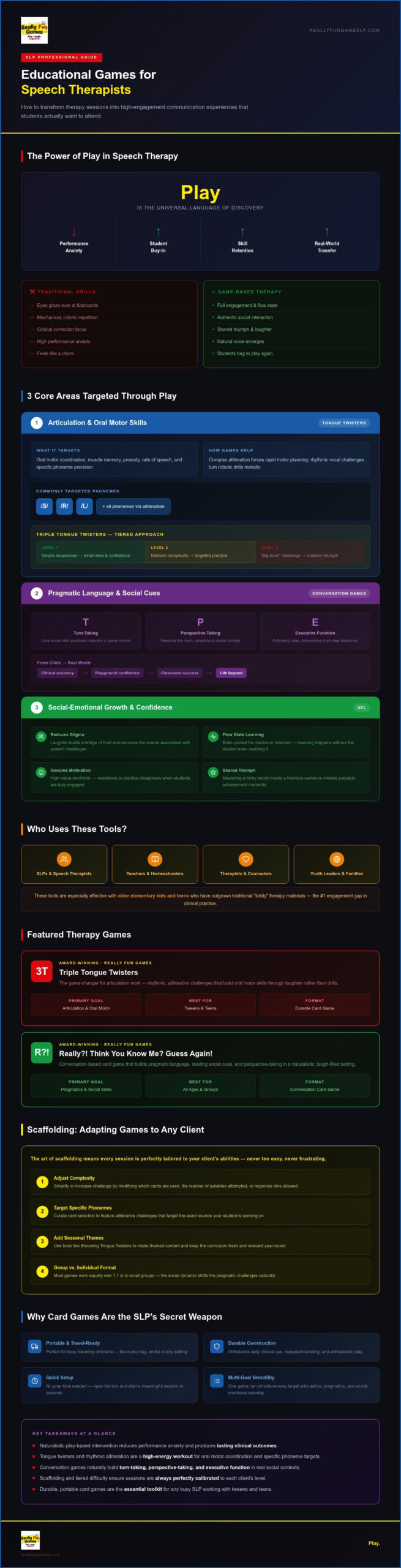
Play is the universal language of discovery. For a speech-language pathologist, integrating intentional play isn’t just about having fun; it’s about creating a safe harbor where communication can flourish without the weight of perfectionism. High-quality educational games for speech therapists serve as a powerful catalyst for naturalistic intervention, which remains the gold standard for achieving lasting clinical outcomes. By shifting the focus from the mechanics of speech to the excitement of the game, we effectively lower a student’s performance anxiety. This allows their natural voice to emerge in a way that traditional, rigid drills simply cannot replicate.
When a student enters a flow state during a game, their brain is primed for maximum retention and learning. They aren’t just practicing a specific phoneme or a sentence structure; they are navigating a complex social landscape in real time. This transition from mechanical repetition to authentic social interaction is where the real growth happens. It transforms the clinical setting into a vibrant space of social harmony and vocal play, making the hard work of therapy feel like a shared adventure rather than a clinical requirement.
Building Student Buy-In and Engagement
Let’s be honest: students know when they’re being “drilled,” and older kids are especially quick to check out. Games act as a high-value reinforcer that makes the difficult work of speech therapy feel like a genuine reward. Laughter is a serious clinical tool because it reduces the stigma often associated with speech challenges and builds a bridge of trust. While classic preschool games have their place, older elementary and teen clients crave variety and sophistication. Moving beyond simple cause-and-effect toys ensures that your toolkit stays as dynamic and respectful as the students you serve. When they’re truly engaged, the “buy-in” happens naturally, and the resistance to practice disappears.
Generalizing Skills to Real-World Settings
The ultimate goal of every session is functional communication that lasts long after the student leaves your room. Games provide a controlled, low-stakes environment where students can practice essential social-emotional learning skills like turn-taking and perspective-taking. Following game rules naturally targets executive function and the ability to process multi-step directions. This practice allows students to move from clinical accuracy in a quiet room to confident, real-world interaction. It’s about giving them the tools to read the room, adapt to social cues, and respond with ease. By practicing in a game, they’re preparing for the spontaneity of the playground, the classroom, and beyond.
Mastering Articulation with Creative Tongue Twister Challenges
Tongue twisters are far more than just a playground pastime; they are a high-energy workout for the articulators. For students working on precision, these rhythmic challenges provide the necessary resistance to build oral motor coordination and muscle memory. Unlike static flashcards, educational games for speech therapists that feature complex alliteration require the brain to plan and execute rapid motor movements with pinpoint accuracy. This vocal play naturally improves a student’s prosody and rate of speech, turning what used to be a robotic drill into a melodic, expressive experience. It’s about finding the rhythm in the language and feeling the physical joy of clear communication.
The Triple Tongue Twisters method is a game-changer for building confidence. By starting with simpler sequences and gradually increasing the complexity, you allow students to experience small wins before tackling the “big boss” level of speech. This tiered approach ensures that the challenge is always just right, keeping the atmosphere lighthearted and celebratory. When students master a tricky “S” or “R” sound within a hilarious sentence, the sense of achievement is palpable. It moves the session from a place of clinical correction to a space of shared triumph and laughter. You’re no longer just practicing sounds; you’re conquering a linguistic mountain together.
Targeting Specific Sound Errors
Every student has a unique mountain to climb, whether it’s the tricky “L” or the elusive “S” sound. Selecting the right alliterative challenge allows you to target these specific phonemes with surgical precision while keeping the engagement high. Using seasonal tools like Blooming Tongue Twisters adds a layer of thematic excitement that keeps the curriculum feeling fresh and relevant throughout the year. Rhythmic vocal challenges serve as a vibrant bridge that connects phonological awareness with motor execution in one seamless activity. If you are looking for ways to keep your students motivated, consider adding these award-winning articulation tools to your clinical kit.
Gamifying the Articulation Drill
Repetition is the soul of articulation therapy, but it doesn’t have to be boring. You can easily transform a standard drill into a high-stakes “speed challenge” or a “clarity contest” where the goal is to be both fast and perfectly understood. For your advanced students or teens who need a higher cognitive load, Tricky Tetra Tongue Twisters provide the perfect level of complexity to keep them on their toes. These games also naturally facilitate peer-feedback and self-monitoring within group sessions. Students learn to listen to their own output and support their peers, fostering a deeply inclusive environment where everyone is rooting for each other’s success. This collaborative spirit makes the hard work of speech practice feel like a team sport. To understand the full developmental impact of this approach, explore how tongue twisters for kids improve speech, confidence, and family fun beyond the therapy room.
Building Pragmatic Language Through Conversation Games
Pragmatic language is the invisible thread that holds our social world together. It’s about mastering turn-taking, active listening, and the delicate art of perspective-taking. For many students, these skills feel like a foreign code they can’t quite crack. Using educational games for speech therapists designed specifically for older kids and teens changes the entire energy of the room. It moves the focus from “getting it right” to simply getting to know one another. These games provide a structured yet spontaneous way to practice “reading the room” and interpreting subtle social cues without the crushing pressure of a real-world social mistake.
One of the most effective tools for this transformation is Really?! Think You Know Me? Guess Again!. It’s far more than a simple card game; it’s a vibrant empathy engine. By shifting the goal from individual performance to mutual discovery, it naturally decreases the social anxiety that often plagues teens and young adults. When students are laughing and debating over a surprising “guess,” they are actually practicing high-level communication skills in a low-stakes, joyful environment. It turns the therapy room into a sanctuary of connection and discovery.
Perspective-Taking and Empathy
The core “guessing” mechanic in these games is a brilliant way to build Theory of Mind. When a student has to predict how a peer would answer a prompt, they are forced to step outside their own bubble and consider another person’s unique viewpoint. This isn’t just about social niceties. It’s about bridging the gap between different social backgrounds and life experiences. We encourage therapists to ask students to explain their reasoning. “Why did you think Sarah would choose that?” This simple question sparks deep reflection and helps students articulate the social observations they are making in real time, fostering a deeper sense of social harmony.
Advanced Social Skills for Teens
Teens are often bored by basic “icebreaker” questions that feel like an interrogation. They want depth. Moving past “What’s your favorite color?” allows for a much richer practice of conversational repair and staying on topic. If a guess goes wrong, it’s a perfect opportunity to practice clarifying questions and active listening. These educational games for speech therapists facilitate a natural flow of dialogue that mimics real-world hanging out. You’re helping them build the confidence to navigate complex interactions with ease and joy. For group sessions where you want to ease students into conversation, pairing these tools with icebreaker games for groups can help even the most reluctant communicators warm up and engage authentically. Check out our full collection of games to find the perfect match for your next group session.
Practical Tips for Adapting Card Games to Your SLP Session Goals
Flexibility is the clinician’s superpower. It turns a simple deck of cards into a precision-guided therapeutic tool. Finding the right educational games for speech therapists is only the first step; the real magic happens when you adapt those tools to meet the specific needs of the person sitting across from you. Scaffolding allows you to dial the complexity up or down in an instant. For a student struggling with focus, you might simplify the rules to a single objective. For a high-achiever, you can layer on extra challenges that require deeper executive function. Integrating visual schedules or “First/Then” boards alongside card play creates a clear, predictable structure that helps students feel safe and ready to engage.
Data collection doesn’t have to kill the vibe. You can track progress by assigning specific target cards or using a simple tally system while the laughter is still echoing in the room. If you’re working in a classroom or a large group, Extra Number Dials are a lifesaver for keeping everyone involved and organized. It’s about maintaining that steady, inviting pulse of play while still hitting your clinical marks. You’re the expert on your students; these games are just the vibrant canvas for your expertise.
Adapting for Different Age Groups
While our games are crafted for ages 8 and up, high-functioning younger learners often thrive with a little extra support. You can modify Triple Tongue Twisters for students with emerging literacy by using picture cues or modeling the rhythm first. This ensures every child feels the triumph of a successful vocal play. If you’re looking for more portable options that work in any setting, The Best Travel Games for Kids: 2026 Guide offers fantastic ideas for screen-free engagement on the go. It’s all about making the content accessible and celebratory for every developmental stage.
Group vs. Individual Therapy Session Dynamics
In a small group, these educational games for speech therapists act as a bridge for peer-to-peer communication. You can step back and act as a fun-loving facilitator while students navigate turn-taking and social problem-solving. When you’re 1-on-1, Really?! Think You Know Me? Guess Again! serves as the perfect icebreaker to build a warm, nurturing connection with a new client. Focus on the social win. The game win is secondary. This emphasis on harmony ensures that every session feels like a victory for everyone involved. Ready to transform your therapy cart? Explore our full bundle of high-engagement games today.
The Really Fun Games Collection: Professional Tools for Communication
Your therapy cart is more than just a storage space; it’s a mobile command center for connection and growth. For the modern clinician, having a reliable set of educational games for speech therapists is essential for turning those “glazed-over” moments into breakthroughs. Our collection is built on the belief that professional tools should be as durable as they are delightful. These card games are designed to be tossed into a bag, carried between schools, and played on any surface. This makes them a perfect fit for the traveling therapist who needs high-impact results without the bulk of traditional board games. It’s about bringing the party to the therapy room while keeping your clinical goals front and center.
The Really?! series has become a beloved staple for targeting social-emotional learning and pragmatic language. It moves the needle from simple interaction to deep, empathetic understanding. For those focusing on articulation, our Tongue Twisters collections, including Triple, Tetra, and Blooming, provide a vibrant framework for repetitive practice that never feels like a chore. If you’re looking to outfit an entire clinic or school district, the Really Fun Custom Games Bundle offers a comprehensive solution. This ensures every therapist on your team has the tools they need to foster social harmony and vocal play.
Why Clinicians Trust Our Award-Winning Designs
Time is your most precious resource. We’ve designed our games so you can get straight to the therapy in under 60 seconds. There’s no complex board to assemble or tiny pieces to lose. The content is deeply inclusive, ensuring that every student feels seen and invited into the circle of play. Therapists across the country report that these games act as a catalyst for moments of genuine discovery. When a student finally masters a sound or makes a meaningful social connection through a game, it’s a win for everyone. These award-winning designs aren’t just games; they’re bridges to better communication.
Choosing the Right Tool for Your Practice
Selecting the right activity shouldn’t be a guessing game. When looking for educational games for speech therapists, it’s helpful to match the tool to the specific sound or social skill you’re targeting. Use this quick guide to find your perfect match:
- Articulation & Oral Motor: Triple, Tetra, or Blooming Tongue Twisters.
- Pragmatics & Empathy: Really?! Think You Know Me? Guess Again!
- Holiday & Thematic Sessions: Santa’s or Trick-or-Treat Tongue Twisters.
- Large Groups: Integrate Extra Number Dials to keep the energy high.
Every session is an opportunity to build a bridge of communication. Discover the perfect educational game for your next session at Really Fun Games LP and see the difference that joyful play can make in your clinical practice.
Spark Joy and Connection in Every Session
You’ve seen how the right tools can turn a routine drill into a celebration of vocal play and social harmony. By choosing award-winning educational games for speech therapists, you are inviting your students into a space where laughter drives learning and connection happens naturally. We’ve explored how rhythmic tongue twisters sharpen articulation and how guessing games build deep empathy in teens. These easy-to-learn card games, specifically designed for ages 8 and up, ensure that every student feels seen and every session feels like a win. They are simple to set up and perfect for the busy clinician on the move.
With national shipping across the United States, your next clinical breakthrough is just a few clicks away. It’s time to trade the repetitive flashcards for lasting memories and the mechanical drills for genuine discovery. Your students are ready for a new way to connect, and you have the expertise to lead them there with confidence and joy. Let’s make communication the highlight of their day and foster bonds that last long after the session ends.
Explore the full Really Fun Games collection for your clinic or classroom and start transforming your sessions into high-engagement learning experiences today.
Frequently Asked Questions
What are the best games for speech therapy targeting articulation?
The best educational games for speech therapists targeting articulation focus on high-repetition alliteration and oral motor agility. Our Triple Tongue Twisters and Blooming Tongue Twisters are specifically designed to target tricky phonemes like S, R, and L. These games turn repetitive drills into a vibrant speed challenge. By using these award-winning card sets, you can build a student’s confidence through tiered difficulty levels while keeping the atmosphere joyful and lighthearted.
Can conversation games be used for children with autism?
Yes, conversation games are fantastic tools for children with autism because they provide a clear, structured framework for social interaction. Really?! Think You Know Me? Guess Again! helps students practice perspective-taking and Theory of Mind in a low-stakes environment. It replaces the ambiguity of open-ended conversation with a fun, predictable guessing mechanic. This structure allows students to explore social cues and peer preferences while fostering a deep sense of social harmony.
Are Really Fun Games suitable for teenagers in speech therapy?
Absolutely, our games are specifically designed for ages 8 and up to fill the teen gap in therapy materials. Many teenagers feel patronized by toddler-focused toys, but Really Fun Games offer a more sophisticated and inclusive aesthetic. Whether you are using Tricky Tetra Tongue Twisters for advanced articulation or Really?! for pragmatic language, these tools respect the student’s maturity. They facilitate authentic conversation and buy-in that is essential for successful teen therapy.
How do I adapt card games for non-verbal students?
You can easily adapt card games for non-verbal students by using them alongside AAC devices or visual choice boards. For a game like Really?!, a student can point to their chosen answer or use their device to explain their reasoning. This ensures they are fully included in the social experience of the group. Focus on the connection and the social win rather than the spoken output to maintain an inclusive, celebratory environment for everyone.
What is a good gift for a speech-language pathologist?
A high-quality, portable card game is an excellent gift for a speech-language pathologist, especially those who travel between multiple schools. The Really Fun Custom Games Bundle is a thoughtful choice because it provides a versatile toolkit for articulation and social skills. These games are durable and easy to clean, which is a major plus for busy clinicians. It’s a practical way to help a professional spark joy and connection in their daily sessions.
How do tongue twisters help with speech sound disorders?
Tongue twisters help with speech sound disorders by requiring the brain to plan and execute rapid motor movements with precision. This builds muscle memory in the articulators and improves oral motor coordination. By practicing alliterative phrases in a game format, students work on their rate of speech and prosody without the anxiety of a traditional drill. It turns the physical effort of speech into a rhythmic, melodic exercise that feels like vocal play. For a deeper look at the research and real-world results behind this method, see how tongue twisters for kids build measurable speaking confidence in just a few weeks of consistent practice.
Can these games be used in a teletherapy or virtual setting?
Yes, these educational games for speech therapists work beautifully in teletherapy or virtual settings. You can simply hold the cards up to your camera or read the prompts aloud to engage your student. The vibrant, sensory-focused content translates well to the screen and keeps students focused during remote sessions. It’s a simple way to bring a sense of spontaneity and laughter to a digital platform, ensuring the therapy remains high-energy and effective.
Why should I choose card games over digital apps for speech therapy?
Card games offer a level of tactile interaction and human connection that digital apps often lack. While apps can be engaging, they sometimes isolate the student behind a screen. Card games encourage eye contact, turn-taking, and the reading of real-world social cues. They foster a sense of shared experience and community that is vital for social-emotional growth. Plus, you never have to worry about a dead battery or a glitchy Wi-Fi connection during therapy! If you’re looking to expand your repertoire even further, explore these fun speech therapy activities that transform communication skills and bring even more variety to your sessions. For students who also need support building their word knowledge, pairing these activities with vocabulary building games for kids can create a well-rounded communication toolkit that addresses both expressive language and lexical growth.