
What if the secret to a child’s expanding lexicon wasn’t found in a dusty dictionary or a repetitive app, but in the middle of a belly-aching laugh? We’ve all been there, watching a student or child glaze over during traditional word drills. It’s exhausting to battle screen fatigue while searching for vocabulary building games for kids that actually work in both home and classroom settings. You want more than just rote memorization; you want to see them speak with confidence and connect deeply with the people around them.
This guide is your roadmap to transforming word learning from a silent chore into a vibrant, social celebration. We promise to equip you with a toolkit of five high-energy, easy-to-learn games that focus on human connection rather than digital distractions. You’ll learn how to use vocal play, social guessing, and rhythmic challenges to improve literacy and strengthen family or classroom bonds. We are going to explore how these simple, sensory-rich interactions can spark a lifelong love for language and foster genuine social harmony through the power of play.
Key Takeaways
- Learn why laughter and emotional connection create a “sticky factor” that helps new words stay in a child’s memory longer than traditional drills.
- Discover how to select the best vocabulary building games for kids by focusing on high-frequency word use and emotional resonance.
- Identify whether your child will benefit more from social conversation games that build empathy or articulation games that improve pronunciation and speed.
- Master a simple two-step strategy to turn any evening into a vocabulary powerhouse using low-barrier games and the “Word of the Night” technique.
- Explore how screen-free tools like “Triple Tongue Twisters” transform speech therapy and classroom activities into high-energy social celebrations.
Why Vocabulary Building Games for Kids Outperform Traditional Memorization
Memorizing a list of definitions feels like a chore because, for most kids, it is. Traditional drills treat words like isolated data points rather than living tools for connection. Effective vocabulary building games for kids flip this script by turning language into an interactive experience fueled by context, emotion, and repetition. When a child uses a new word to win a round or land a punchline, that word gains immediate value. It isn’t just a string of letters anymore; it’s a key that unlocks a social win.
This shift from passive to active learning is vital for the process of language acquisition. In passive learning, a student might read a list and forget it by lunch. In active learning, they must retrieve and apply the word in real-time. As children move from elementary “naming” of objects to middle-grade “describing” of complex feelings, they need a safe space to test out nuance. Games provide that playground where they can explore the difference between being “annoyed” and being “exasperated” without the fear of a red pen on a test paper.
The Cognitive Science of Playful Learning
Fun isn’t just a bonus; it’s a biological catalyst. When kids engage in high-energy play, their brains release dopamine, which significantly enhances neuroplasticity. This makes it easier for the brain to forge new pathways for language. Unlike digital interfaces that often lead to overstimulation or “turn-off tantrums,” physical card games from Really Fun Games reduce the cognitive load. There are no flashing lights or addictive reward loops to distract from the core goal: vocal play and social interaction. Social feedback happens in an instant, helping kids correct their pronunciation and usage through the natural flow of conversation and laughter.
Moving Beyond the Classroom: Vocabulary in the Real World
The true power of vocabulary building games for kids lies in the development of “Social Vocabulary.” These are the words that help adolescents express their opinions, set boundaries, and share their unique perspectives. By practicing these skills in a low-stakes environment, kids build the articulation and confidence needed for high-pressure scenarios like school presentations or making new friends. Whether they are navigating the rhythmic challenges of “Triple Tongue Twisters” or guessing a friend’s reaction, they are learning that language is the ultimate bridge to human connection. Play builds the confidence that allows a child to step into any room and speak their truth with clarity and joy.
The 3 Pillars of Effective Vocabulary Acquisition Through Play
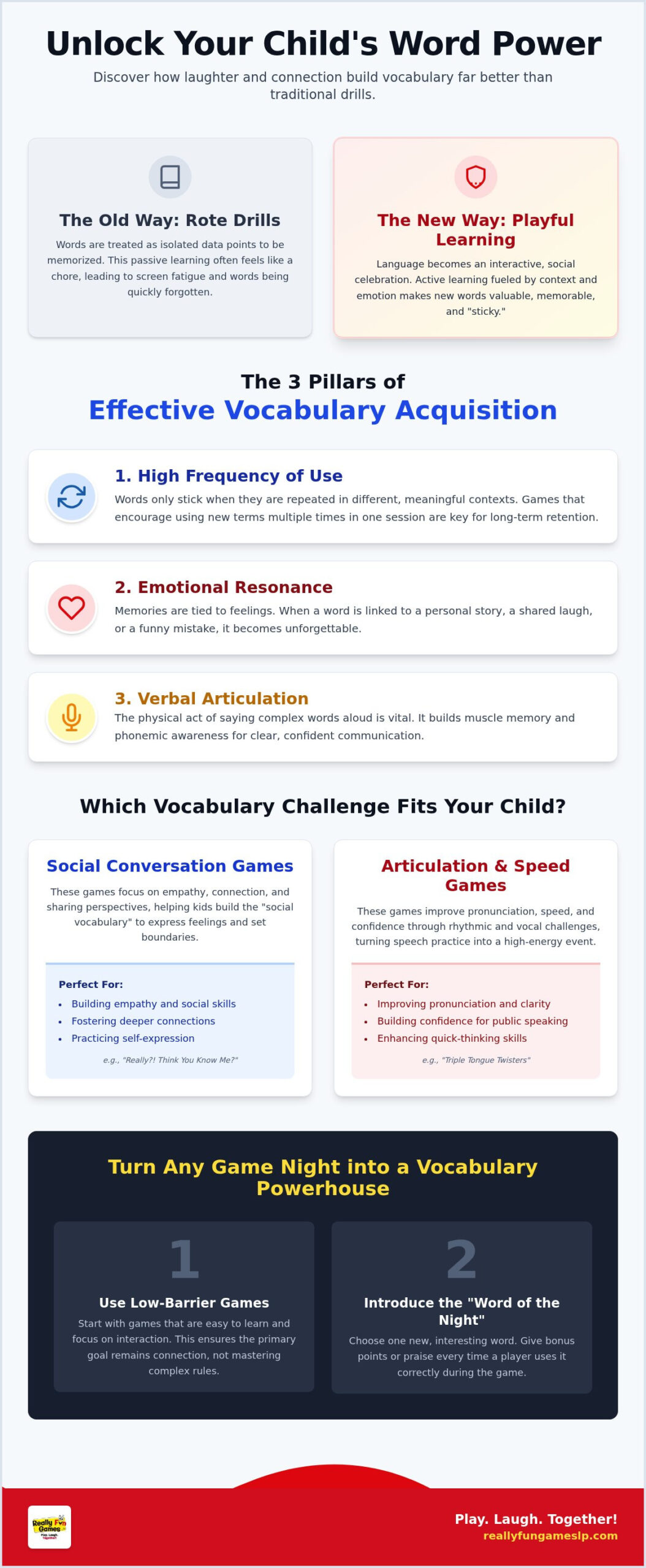
To move beyond digital “point and click” apps that lack social context, we need a framework that prioritizes active usage over simple recognition. Vocabulary isn’t just a collection of definitions to be filed away; it is a set of tools used to navigate the world. By focusing on three specific pillars, you can transform a standard family night into a fun speech therapy activity that feels like a high-energy celebration. These pillars ensure that vocabulary building games for kids provide more than just entertainment; they provide lasting cognitive growth.
- Pillar 1: High Frequency of Use. Words only stick when they are repeated in different contexts. Choosing games that require players to use specific terms multiple times in a single round is essential for retention.
- Pillar 2: Emotional Resonance. Memories are deeply tied to feelings. When a word is connected to a personal story, a hilarious mistake, or a shared secret, it becomes “sticky” in the long-term memory.
- Pillar 3: Verbal Articulation. The physical act of saying complex words out loud is a vital step. It builds the muscle memory and phonemic awareness required for clear communication.
Pillar 1: Creating a Word-Rich Environment
You don’t need to stop the fun to teach a lesson. Instead, introduce “challenge words” into your existing game rules. For example, if you’re playing a guessing game, give bonus points for using a specific adjective correctly. Modeling is another powerful tool; when parents use “exquisite” instead of just “good,” kids naturally begin to mimic that advanced language. This approach aligns with expert advice on Building Your Child’s Vocabulary through everyday interactions. The goal is to create a no-judgment zone where mistakes lead to laughter rather than correction. When children feel safe to stumble, they become much more willing to experiment with new, vibrant language.
Pillar 2 & 3: The Power of Vocal Play
Vocal play is where the magic of articulation happens. Tongue twisters are the gold standard for this, as they force the brain and mouth to coordinate at high speeds. This builds “Articulation Confidence,” which is the ability to speak clearly even when a sentence is tricky. As kids progress, encourage a transition from simple nouns to evocative adjectives. Instead of describing a “blue car,” challenge them to describe a “cobalt coupe.” Rapid-fire verbal challenges, like those found in our Triple Tongue Twisters collection, turn this practice into an exuberant social event. If you’re looking for ways to foster these skills at home, explore our award-winning card games designed to spark connection and curiosity. These vocabulary building games for kids help them find their voice while strengthening the bonds that matter most.
Comparing Game Types: Which Vocabulary Challenge Fits Your Child?
Every child learns differently. The most effective vocabulary building games for kids are the ones that meet them where they are. Some kids thrive on the adrenaline of a countdown; others prefer the warmth of a shared story. Understanding these categories helps you tailor the experience to your child’s specific developmental needs. By choosing the right format, you ensure that language development feels like a reward rather than a requirement. Use the table below to identify the best fit for your next session.
| Game Type | Primary Benefit | Best Setting |
|---|---|---|
| Social & Conversation | Builds descriptive language and social empathy. | Dinner table, road trips, or family reunions. |
| Articulation & Speech | Improves pronunciation, speed, and phonics. | Speech therapy, classroom warm-ups, or 1-on-1 play. |
| Competitive Recall | Sharpens quick retrieval of synonyms and antonyms. | Game nights with siblings or school competitions. |
| Collaborative Storytelling | Develops narrative structure and sentence complexity. | Homeschooling language arts or group icebreakers. |
When to Choose Conversation-Based Play
These games are ideal for the dinner table or long road trips where space is limited but curiosity is high. A game like “Really?! Think You Know Me? Guess Again!” transforms a simple car ride into a deep dive into social-emotional vocabulary. As players guess how their friends or family would react to specific scenarios, they’re forced to use evidence-based language. They aren’t just saying a word; they’re providing a reason why that word fits a person’s personality. This type of play builds the descriptive muscles needed for real-world social harmony and deepens human connection through laughter.
The Role of Articulation Games in Literacy
Speech-Language Pathologists (SLPs) often prioritize games that focus on the physical delivery of words. When a child masters a difficult sound, their willingness to use bigger, more complex words skyrockets. Games like “Triple Tongue Twisters” turn this practice into an exuberant challenge rather than a clinical exercise. By navigating rhythmic challenges, kids develop the phonemic awareness that is a cornerstone of early literacy. If you’re looking for professional-grade tools, check out our Best Educational Games for Speech Therapists. For a comprehensive overview of techniques and high-engagement tools, the 2026 speech therapy articulation reference guide offers an excellent resource for both clinicians and parents seeking effective speech therapy materials for articulation. These vocabulary building games for kids provide a joyful bridge between speech development and confident self-expression.
Step-by-Step: How to Turn Any Game Night Into a Vocabulary Powerhouse
You don’t need a formal lesson plan to spark a love for language. Transforming a standard evening into a linguistic adventure is about intentionality and high-energy engagement. By following a few simple steps, you can ensure that your vocabulary building games for kids deliver maximum educational value while keeping the atmosphere lighthearted and joyful. It’s about creating a space where words are celebrated as tools for connection and laughter.
- Step 1: Select a Game with a ‘Low Barrier to Entry.’ Pick something that takes less than five minutes to learn but offers high replayability. Starting with a game like “Really?! Think You Know Me? Guess Again!” ensures everyone feels included from the very first round.
- Step 2: Introduce the ‘Word of the Night.’ Choose one vibrant, advanced word before you start. Offer a bonus point or a small celebratory cheer whenever someone uses that specific word correctly during the game.
- Step 3: Practice ‘Vocal Warm-ups.’ Get the energy moving by using tongue twisters for kids. These quick, rhythmic challenges prime the brain for clear articulation and help shake off any social hesitation.
- Step 4: Encourage ‘Descriptive Guessing.’ Forbid one-word answers. If a child is trying to describe a concept, challenge them to use at least three evocative adjectives. This simple rule promotes rapid sentence expansion and critical thinking.
- Step 5: Reflect and Replay. End the session by asking, “What was the funniest word we used tonight?” This solidifies the memory and keeps the focus on the joy of shared experience.
Facilitation Tips for Parents and Teachers
Your role is to be a “fun-loving facilitator” rather than a traditional instructor. Use the “Sandwich Method” when offering feedback: start with a positive observation, provide a gentle correction on usage or pronunciation, and finish with more enthusiastic encouragement. If a child struggles to find the “right” word, don’t rush to provide it. Instead, use a timer for “lightning rounds” to keep the energy high and encourage them to describe the word’s meaning through context. This reduces frustration and turns the search for language into a collaborative puzzle.
Adapting Games for Different Age Groups (8-12+)
While our games are designed for ages 8 and up, you can easily scale the complexity. For younger players, simplify the rules to focus on basic nouns and verbs. For teens, add “Complexity Layers” by requiring them to use new words while speaking in a specific persona or tone. If you are hosting a larger classroom or a birthday party, use our “Extra Number Dials” to expand the group size without losing the intimate feel of the interaction. If you are ready to start your journey, explore our collection of award-winning games to find the perfect fit for your next gathering. These vocabulary building games for kids ensure that learning is always a social celebration.
Elevating Word Play with Really Fun Games: Articulation and Connection
At Really Fun Games, our philosophy is simple: we believe that language should be a source of exuberant excitement rather than a classroom chore. We design our vocabulary building games for kids to foster joy-first learning that truly sticks. By centering our mechanics around human connection and laughter, we ensure that every word learned is tied to a positive social memory. This isn’t just about passing a test; it’s about giving kids the tools to express their unique personalities with confidence.
Our “Triple Tongue Twisters” collection serves as a vibrant tool for vocal play. These games challenge children to master difficult sounds while exploring evocative adjectives and rhythmic sentence structures. It turns the physical act of speaking into a high-energy challenge that builds phonemic awareness and articulation. When kids conquer a tricky phrase, they don’t just learn new words; they gain the “Articulation Confidence” to use them in their everyday lives.
For those looking to build deep emotional connections, “Really?! Think You Know Me? Guess Again!” is the ultimate catalyst. This game encourages players to use social-emotional vocabulary to guess how their friends or family members would react to specific scenarios. It moves beyond simple nouns and verbs, requiring kids to describe complex feelings and opinions. It is a powerful way to bridge the gap between people through the transformative power of simple, meaningful conversation.
The beauty of our award-winning card games lies in their portable, screen-free nature. They are designed to be played anywhere, from a busy classroom to a quiet family dinner. There are no digital distractions or addictive reward loops here. Instead, we focus on the sensory-rich experience of physical cards and the immediate, joyful feedback of shared laughter.
Why Our Games Are Different
We build our games for the real world. They are designed for durability and high replayability, ensuring they can withstand the energy of any environment. Our inclusive design welcomes families, educators, and therapists alike, providing a versatile toolkit for any social setting. We prioritize the “Contextual Sticky Factor,” where the feel of the cards and the sound of a friend’s giggle make new language impossible to forget. This human-centric approach is why speech-language pathologists and teachers consistently choose our tools for their professional toolkits. Therapists seeking to maximize trial counts and engagement can also find valuable strategies in our speech therapy materials for articulation reference guide, which outlines how to turn monotonous drills into joyful vocal play.
Choosing Your Next Adventure
Selecting the right title depends on your specific goals. If you want to focus on vocal clarity and speed, start with our tongue twister collections. If you want to foster teamwork and critical thinking, our conversation-based games are the perfect fit. For classrooms or large family gatherings, the “Really Fun Custom Games Bundle” offers the ultimate variety for any group size. We invite you to embrace your role as a fun-loving facilitator and discover how vocabulary building games for kids can bring your community closer together through the simple magic of play.
Ready to Spark a Lifelong Love for Language?
Transforming word learning into a social celebration is the most effective way to ensure new concepts truly stick. You’ve discovered that the best vocabulary building games for kids prioritize emotional resonance and vocal play over silent, repetitive drills. By choosing screen-free activities that encourage descriptive guessing and rhythmic challenges, you are building more than just a lexicon. You’re fostering the confidence, empathy, and articulation skills that your child will carry into every school presentation and social gathering. These simple, joyful interactions create a “sticky factor” that no digital app can replicate.
Our award-winning game designs are 100% screen-free and highly rated by SLPs and educators for their ability to foster genuine human connection. Whether you are in a classroom or around the dinner table, these portable tools make it easy to be a fun-loving facilitator of growth and laughter. Discover the perfect vocabulary building game for your family or classroom! Embrace the spontaneity, celebrate the stumbles, and watch as your child finds their voice through the transformative power of play. It’s time to turn every game night into a vibrant linguistic adventure.
Frequently Asked Questions
What are the best vocabulary building games for kids who hate reading?
Auditory and social games are the perfect solution for reluctant readers because they focus on vocal play rather than text-heavy instructions. Games like “Really?! Think You Know Me? Guess Again!” rely on conversation and guessing, making them excellent vocabulary building games for kids who prefer speaking over reading. “Triple Tongue Twisters” also uses rhythmic challenges to introduce complex words through sound, allowing kids to expand their lexicon without ever feeling like they are doing schoolwork.
How do games help with speech therapy and articulation?
Games facilitate speech therapy by creating a low-stakes, joyful environment where children feel safe to practice difficult sounds. By engaging in vocal play, kids build the muscle memory required for clear articulation. Tongue twister challenges specifically target phonemic awareness, helping children coordinate their breath and mouth movements at high speeds. This active usage transforms clinical exercises into a social celebration, which significantly boosts a child’s confidence and willingness to experiment with more complex language.
Can vocabulary games be played without a screen or computer?
Absolutely, all Really Fun Games products are 100% screen-free and portable, designed to foster real human connection. In a world filled with digital worksheets, physical card games offer a sensory-rich experience that reduces cognitive load and prevents “turn-off tantrums.” You can play them at the dinner table, in the car, or at a park. This tactile approach encourages eye contact and active listening, which are essential components for developing a robust and meaningful vocabulary.
Are these games suitable for kids with social anxiety?
Yes, these games are specifically designed to be inclusive and nurturing, making them ideal for children who struggle with social anxiety. Because the focus is on laughter and shared experience rather than “right” or “wrong” answers, the pressure to perform is removed. Games like “Really?!” encourage gentle discovery of others’ thoughts, helping kids build social-emotional vocabulary in a safe, predictable format. This supportive environment allows them to find their voice and connect with others at their own pace.
How many players do I need for Really Fun Games?
Most of our games are designed for 2 to 6 players, making them perfect for small family groups or therapy sessions. However, you can easily expand the fun for larger gatherings. By using our “Extra Number Dials,” you can accommodate more players, which is perfect for classroom settings or holiday parties. This flexibility ensures that no one is left out of the social celebration, whether you’re playing a quick round at home or hosting a large event.
What age is best to start using vocabulary building games?
Our games are specifically crafted for ages 8 and up, which is a critical time for developing descriptive language and nuance. At this age, children transition from simply naming objects to expressing complex opinions and feelings. Using vocabulary building games for kids during this stage helps them navigate the social-emotional challenges of early adolescence. While the mechanics are simple enough for younger children with adult guidance, the depth of conversation truly shines as kids approach the middle-grade years.
How often should we play to see an improvement in a child’s vocabulary?
Consistency is much more important than the length of each session. Playing for just 20 minutes two or three times a week can lead to noticeable improvements in a child’s articulation and confidence. Because our games are highly replayable and easy to learn, they fit naturally into a busy family schedule. The goal is to keep the experience joyful and high-energy, ensuring that the “Word of the Night” becomes a permanent part of their daily conversation.
Can these games be used in a classroom or homeschool setting?
Teachers and homeschoolers frequently use our award-winning games to break up the monotony of traditional lessons. They are perfect for small group rotations, “brain breaks,” or as a reward for finishing work early. For larger groups, the “Really Fun Custom Games Bundle” provides a versatile toolkit that can be adapted for various curriculum goals. These games help educators create a vibrant, inclusive classroom culture where students feel empowered to speak up and share their unique perspectives.