What if the loudest sound in your classroom wasn’t the hum of a charging cart or the constant tapping of screens, but the genuine roar of laughter and connection? We’ve all seen it. Students are often more comfortable texting a peer two feet away than looking them in the eye. It is frustrating to watch social anxiety or “cringey” icebreakers stall the very peer-to-peer bonds you are trying to build. You know that deep down, your students crave real interaction, yet the digital divide feels wider than ever. You can break that spell and turn your room into a vibrant hub of empathy and articulation. By mastering the right classroom games for communication, you will help your students find their voices and truly listen to one another.
This article dives into high-energy activities that students actually love. We will explore how to swap forced small talk for meaningful discovery and vocal play. You will learn how to use award-winning tools like “Really?! Think You Know Me? Guess Again!” and “Triple Tongue Twisters” to build a culture of mutual respect and unstoppable confidence. Get ready to transform your lessons into a joyful space where every student feels seen, heard, and excited to participate.
Key Takeaways
- Turn classroom silence into vibrant connection by using play to bridge the digital gap and foster deep empathy.
- Master a simple five-step framework to pick the best classroom games for communication based on your students’ unique needs and your available space.
- Discover how structured tools like “Really?! Think You Know Me? Guess Again!” create more meaningful, repeatable bonds than typical icebreakers.
- Unlock student confidence and clearer articulation with fast-paced vocal challenges like “Triple Tongue Twisters” that take under two minutes to learn.
- Learn how to tailor your approach for every grade level, ensuring play feels natural and inclusive for every student in your room.
What Are Communication Games and Why Do They Matter in 2026?
Classroom games for communication are vibrant, interactive tools that facilitate both verbal and non-verbal exchange between students. As we move through 2026, the need for these tools has never been greater. We are currently facing a communication crisis where digital devices often act as a barrier to real-world connection. When students spend more time looking at screens than at each other, they lose out on the subtle cues of face-to-face interaction. By stepping into the role of a fun-loving facilitator, you can use these games to build a social safety net, ensuring every student feels included and valued.
Play-based learning offers unique benefits that a standard lecture simply cannot match. It teaches students the power of the pause, helping them understand that communication is a two-way street that requires patience and timing. Through these activities, students master the art of turn-taking and learn to celebrate the successes of their peers. When you prioritize classroom games for communication, you aren’t just taking a break from the curriculum; you’re teaching the most important life skills your students will ever own.
The Core Fundamentals of Effective Communication
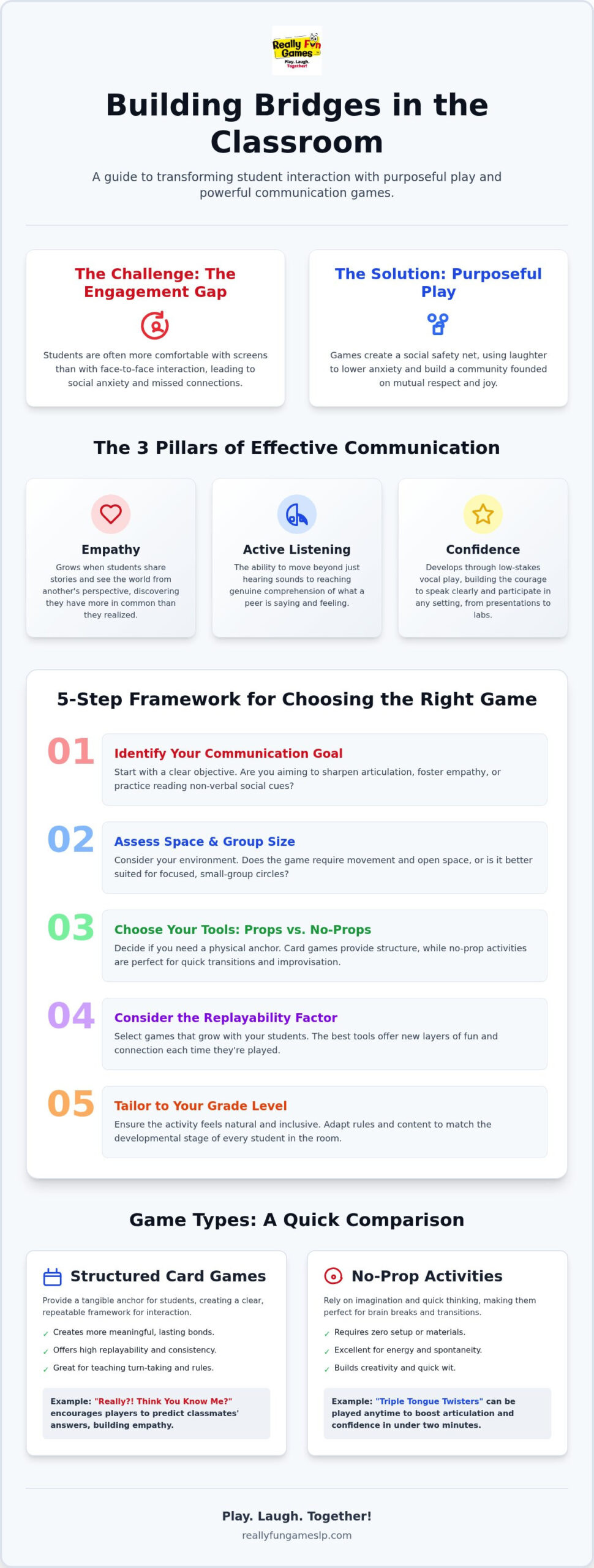
To build a truly connected classroom, we must focus on three pillars: empathy, active listening, and confidence. Empathy grows when students share stories and discover they have more in common than they realized. Award-winning tools like Really?! Think You Know Me? Guess Again! are perfect for this. They encourage players to predict their classmates’ answers and see the world through a different lens, turning every round into a moment of discovery.
Active listening is the next step. It is the ability to move beyond just hearing sounds to reaching genuine comprehension of what a peer is saying. Finally, there is confidence. When students play games like Triple Tongue Twisters, they practice vocal play in a way that builds the courage to speak clearly in front of others. This confidence carries over into every other subject they study, from history presentations to science labs.
How Games Solve the “Engagement Gap”
We’ve all seen traditional icebreakers fail. They often feel forced or cringey because they demand vulnerability before a foundation of trust is built. The psychology of play changes that dynamic entirely. Laughter is a powerful tool that naturally lowers social anxiety and builds immediate trust between students. It turns a room of quiet individuals into a synchronized team.
This approach is the heartbeat of Social-Emotional Learning (SEL), which is the process of developing the self-awareness and interpersonal skills necessary for healthy social interactions. By integrating conversation games and structured play into your daily routine, you bridge the engagement gap. You move from a room of isolated individuals to a community built on mutual respect and shared joy.
The 5-Step Framework for Choosing the Right Classroom Game
Choosing the perfect activity is a joyful art form that balances energy with educational intent. To help you master this, we’ve developed a simple 5-step framework to ensure your classroom games for communication hit the mark every single time. It’s about more than just filling a 10-minute gap. It’s about choosing the right tool to spark a breakthrough in how your students connect. You want to move from “just playing” to “intentional discovery” that resonates long after the school bell rings.
Start by assessing your physical space and group size. Are you working with a full class or small clusters? Some games thrive on movement and require cleared floors, while others rely on the focused intimacy of a small circle. You also need to weigh the “Prop vs. No-Prop” options. While no-prop games are excellent for transitions, physical tools like card sets provide a tangible anchor for students who might otherwise feel self-conscious. Don’t forget the “Replayability Factor.” The best games are those that grow with your students, offering new layers of humor and connection every time they hit the table. This ensures the investment you make in your classroom resources pays off for years to come.
Step 1: Identify Your Communication Goal
Every successful session begins with a clear objective. To sharpen articulation, lean into vocal play and rhythmic challenges. If fostering empathy is the goal, prioritize conversation starters that invite students to share unique perspectives. For classrooms struggling with social cues, use movement-based games to highlight non-verbal communication. Many fun classroom games can be adapted to these goals, ensuring students build specific, valuable skills.
Step 2: Match the Game to Student Maturity
Student maturity dictates how you frame the fun. Elementary students thrive on simple turn-taking, while middle schoolers need games that build peer trust without feeling “childish.” By high school, students are ready for deep conversational skills and assertiveness training. Matching the challenge to their development keeps engagement high with your classroom games for communication. To see how different tools bridge these gaps, you might explore our award-winning collection and find the perfect match for your room.
Structured Card Games vs. No-Prop Activities: A Comparison
Choosing between a zero-prep activity and a professional card set is often the difference between a five-minute distraction and a classroom transformation. No-prop activities, like the classic game “Broken Telephone,” are fantastic for quick transitions or filling unexpected gaps in the day. They require nothing but a willing group of students and a bit of imagination. However, these games can sometimes lose their spark quickly. Without a clear structure, the engagement level often depends entirely on the group’s mood that specific afternoon.
Structured classroom games for communication offer a significant advantage: they provide a psychological “buffer.” For a student navigating social anxiety, being the center of attention is terrifying. A physical tool, like a card or a dial, shifts the focus away from the individual and onto the game itself. This simple focal point makes it much easier for students to open up and participate without feeling exposed. Professional designs ensure that the fun is repeatable, keeping the energy high every time the box is opened.
| Feature | No-Prop Activities | Structured Card Games |
|---|---|---|
| Prep Time | Zero | Minimal (Under 2 mins) |
| Engagement Level | High (Short bursts) | Very High (Sustained) |
| Skill Depth | Surface-level play | Deep Emotional Connection |
The Power of Structured Conversation Tools
When you use a tool like Really?! Think You Know Me? Guess Again!, you are providing a framework for empathy. The game uses physical dials and cards to turn simple questions into a winning challenge. Students don’t just answer questions; they predict how their peers will respond, which requires genuine perspective-taking. This structured approach is far more effective than open-ended prompts. If you are looking for more ways to spark these connections, check out our guide on icebreaker games for groups and social gatherings.
Vocal Play and Articulation Challenges
Vocal play is a secret weapon for building confidence. Many speech therapists and SLPs rely on “Triple Tongue Twisters” because they turn pronunciation practice into a hilarious group activity. By using vocal comedy, students lose their fear of making a mistake while speaking. It turns a potentially stressful lesson into a shared moment of laughter. For educators focused on specialized support, we have curated a list of the best educational games for speech therapists to help your students find their voices with ease.
How to Implement Communication Games by Grade Level
Every grade level has a different social pulse. You wouldn’t use the same approach for an eight-year-old as you would for a seventeen-year-old. Mastering classroom games for communication means understanding these developmental milestones and adjusting the play to match. Use these activities as a high-energy warm-up before a literature discussion or a science lab to prime the brain for participation. It’s a simple way to transition students from the hallway’s chaos into a focused, collaborative mindset.
Watch the rhythm of your room carefully. If energy is peaking too high, use a calm conversation game to ground the group. As students get comfortable with the rules, move from teacher-led sessions to student-facilitated “game stations.” This hands over the facilitator role to the students themselves, which builds leadership and independence. It’s a joy to watch them take ownership of their social environment while practicing the very skills you’ve modeled for them.
Elementary (Ages 8-11): Building the Basics
For ages 8-11, the focus is on building a solid foundation of vocal confidence and empathy. Triple Tongue Twisters are a fantastic way to practice articulation while keeping everyone in the room laughing. It’s about building confidence through vocal play rather than dry drills. You can also use simple “get to know you” questions to spark basic social empathy between peers who might not usually interact. Teach the “Power of the Pause” early. It helps kids learn that waiting for a peer to finish speaking is just as important as the message they want to deliver.
Middle & High School: Deepening the Connection
Older students need a more sophisticated challenge. They are navigating complex social hierarchies and peer trust, so the games must feel authentic and mature. This is where Really?! Think You Know Me? Guess Again! shines. It pushes them to challenge their assumptions about one another in a safe, structured way. For those who love a vocal challenge, Tricky Tetra Tongue Twisters offer the high-stakes fun that teens enjoy. Encourage them to justify their guesses during play. This builds critical thinking and deeper conversational skills as they explain the logic behind their “read” on a friend. If you want to extend these skills beyond the classroom, explore our guide to creative conversation games for meaningful connection that work beautifully in any social setting.
Ready to bring these skills to your classroom? Shop our full collection of communication games and find the perfect fit for your grade level today.
Transforming Your Classroom with Really Fun Games
Becoming a fun-loving facilitator doesn’t require a master’s degree in improv comedy. It just takes the right tools to spark that first bit of laughter. Really Fun Games is your ultimate resource for turning quiet desks into vibrant hubs of connection. One of the best parts? Every game in the collection is designed to be learned and played in under 2 minutes. You don’t have to spend your precious prep period reading a 20-page manual. You simply open the box, read a few lines, and start the discovery immediately. It is a fast-paced, energetic way to ensure your students leave your room with stronger social bonds than when they entered.
By choosing these tools, you are inviting your students into a community of play that fosters lifelong social skills. These aren’t just temporary distractions. They are foundational experiences that teach empathy, patience, and the joy of shared humor. Whether you are looking for a quick warm-up or a deep-dive SEL session, these classroom games for communication provide a versatile solution that fits into any schedule. You are building a culture of mutual respect, one round at a time.
The Really Fun Games Classroom Bundle
The Really Fun Custom Games Bundle is a powerhouse solution for school-wide team building. It provides a diverse set of classroom games for communication that scale beautifully from small groups to full classrooms. This bundle allows you to keep the variety high so the engagement never dips. You can also bring seasonal flair to your lessons by integrating holiday-themed challenges. Whether it is the playful rhymes of Santa’s Tongue Twisters or the spooky fun of Trick-or-Treat Tongue Twisters, these games keep the energy fresh throughout the school year. If you are planning a class celebration and need more ideas, our guide on Holiday Party Games for Kids is packed with joyful inspiration.
Next Steps for the Connected Classroom
Consistency is what turns a simple activity into a lasting classroom tradition. Consider starting a “Game Friday” routine that your students will look forward to all week long. It is a fantastic reward for a week of hard work and a great way to end on a high note. These tools are also surprisingly effective during parent-teacher conferences or open houses. Using a quick conversation game with parents is a brilliant way to break the ice and showcase the social-emotional growth their children are experiencing in your care. When parents see the laughter and empathy firsthand, they become your strongest partners in building a supportive community. Take the first step toward a more connected room and discover the full Really Fun Games collection today.
Ready to Spark Real Connection in Your Classroom?
Bringing joy back into the learning environment is easier than you think. You have the power to bridge the digital gap and replace screen-time silence with the vibrant sound of students truly talking to one another. By choosing the right classroom games for communication, you create a space where empathy and articulation flourish naturally. Whether you’re helping a student find their voice through vocal play or challenging a group to see the world through a peer’s eyes, these moments of play build skills that last a lifetime.
Our award-winning designs for ages 8 and up are trusted by SLPs and educators nationwide to deliver results without the “cringe” factor. These games are easy to learn in under two minutes, offering immediate, screen-free fun for any setting. It’s time to turn your lessons into a celebratory hub of laughter and mutual respect. Explore the Award-Winning Really Fun Games Collection today and choose the perfect tools for your students. We’re excited to see the incredible connections you’ll build together!
Frequently Asked Questions
What are the best classroom games for improving active listening?
Active listening thrives when students must focus on their peers’ unique perspectives. “Really?! Think You Know Me? Guess Again!” is a standout choice because it asks players to predict how their classmates will respond to specific prompts. This requires students to pay close attention to past conversations and personality traits. By turning listening into a winning strategy, these classroom games for communication ensure that every student is fully engaged and focused on genuine understanding during the activity.
How can I use communication games for students with social anxiety?
For students with social anxiety, structured play acts as a vital psychological buffer. Physical tools like the dials in “Really?! Think You Know Me? Guess Again!” shift the spotlight from the individual student to the game mechanics. This reduces the pressure of being watched and makes participation feel much safer. Using low-stakes, humorous activities helps lower social barriers, allowing anxious students to connect with their peers at a pace that feels comfortable and encouraging.
Are there specific games that help with articulation and speech therapy?
Speech-Language Pathologists (SLPs) frequently use the “Tongue Twisters” collection to help students with articulation and confidence. Titles like “Triple Tongue Twisters” and “Tricky Tetra Tongue Twisters” turn difficult pronunciation practice into a joyful, high-energy challenge. Because these games focus on vocal play and laughter, they remove the fear of making a mistake while speaking. This supportive environment is perfect for speech therapy sessions where students need to practice clear enunciation in a stress-free setting.
How much time should I dedicate to classroom communication games?
You don’t need to overhaul your entire schedule to see results. Dedicating just 10 to 15 minutes once or twice a week can make a massive difference in your classroom culture. Since our games are designed to be learned in under 2 minutes, you can jump straight into the fun without wasting time on complex rules. Many teachers find success with a “Game Friday” tradition that rewards students for their hard work throughout the week.
Can these games be used for remote or hybrid learning environments?
While these are physical, screen-free card games, they adapt beautifully to hybrid settings. A teacher can use a document camera to show cards or dials to remote students while those in the room participate in person. This keeps everyone connected through shared laughter and conversation, even when they aren’t in the same physical space. These classroom games for communication provide a rare opportunity for students to interact face-to-face without the distraction of digital apps.
How do I handle students who are reluctant to participate in games?
The best way to engage reluctant students is to lead with humor and keep the pressure low. Start with group-based activities where the focus is on a shared challenge, such as “Triple Tongue Twisters,” rather than individual performance. As the room fills with laughter, even the most hesitant students usually find themselves drawn into the fun. Act as a warm guide to ensure the atmosphere remains inclusive and celebratory rather than competitive or forced.
What is the best way to introduce a new card game to a large class?
Introducing a new game to a large class is simple when the rules are intuitive. Start by modeling a single round with a small group of volunteers at the front of the room. Since Really Fun Games are designed for quick starts, the rest of the class will understand the mechanics almost instantly. Once the demonstration is over, you can break the class into smaller groups of 4 to 6 students to ensure maximum participation.
Do communication games align with Social-Emotional Learning (SEL) standards?
Communication games are a perfect match for Social-Emotional Learning (SEL) standards. They directly address core competencies like relationship skills, social awareness, and responsible decision-making. By practicing empathy through perspective-taking or building confidence through vocal play, students develop the emotional intelligence they need for success. These activities turn abstract SEL concepts into practical, hands-on experiences that help students build meaningful bonds and navigate social dynamics with much greater ease and respect.