

The fastest way to turn a quiet car ride into a riot of exuberant laughter isn’t a glowing movie screen, it’s a vocal gym where tripping over your words is the ultimate victory. You’ve probably felt the frustration of watching your kids grow bored with traditional learning or seen them disappear into tablets during family gatherings. It’s a common struggle to find age-appropriate challenges that spark genuine connection without feeling like a chore. We believe that the best way to build confidence and communication skills is through the pure, silly magic of play.
This 2026 collection of fun tongue twisters offers a massive variety of rhythmic challenges designed to boost speech skills and bring your family closer together. According to 2026 research from the University of Crete, regular practice with these vocal puzzles strengthens oral muscles and improves reading fluency. In this guide, we’ll dive into a list ranging from simple warm-ups to the legendary challenges found in our award-winning Triple Tongue Twisters. You’ll discover how to transform a dull afternoon into a high-energy celebration of social harmony, rhythmic discovery, and hilarious mistakes.
Key Takeaways
- Understand how the hilarious brain-to-mouth disconnect makes vocal play an instant hit for building deep family bonds through laughter.
- Explore our curated 2026 list of fun tongue twisters categorized by difficulty to ensure every child finds the right level of challenge.
- Discover how these rhythmic puzzles act as a vocal gym to sharpen articulation while teaching kids that making mistakes is just part of the joy.
- Learn five innovative ways to play at home, including high-energy Speed Rounds and group Pass the Phrase games that naturally reduce screen time.
- Find out why upgrading to award-winning card games like Triple Tongue Twisters provides a more durable and portable experience for travel and family game nights.
What is a Tongue Twister and Why are They So Fun?
Imagine your brain is a world-class sprinter, but your tongue is still lacing up its sneakers. That is the hilarious reality of vocal play. At its core, What is a Tongue Twister? It is a specific sequence of words crafted to be nearly impossible to pronounce correctly when spoken at high speed. The joy of fun tongue twisters isn’t found in the perfection. It’s found in the inevitable, side-splitting disconnect between what you want to say and what actually comes out of your mouth. For kids ages 8 and up, these challenges are perfect. They’re at a developmental stage where they can appreciate complex word patterns and phonological tricks. It’s fast; it’s funny; it’s a total tongue-tangler that builds social harmony through shared mistakes.
The Anatomy of a Great Twister
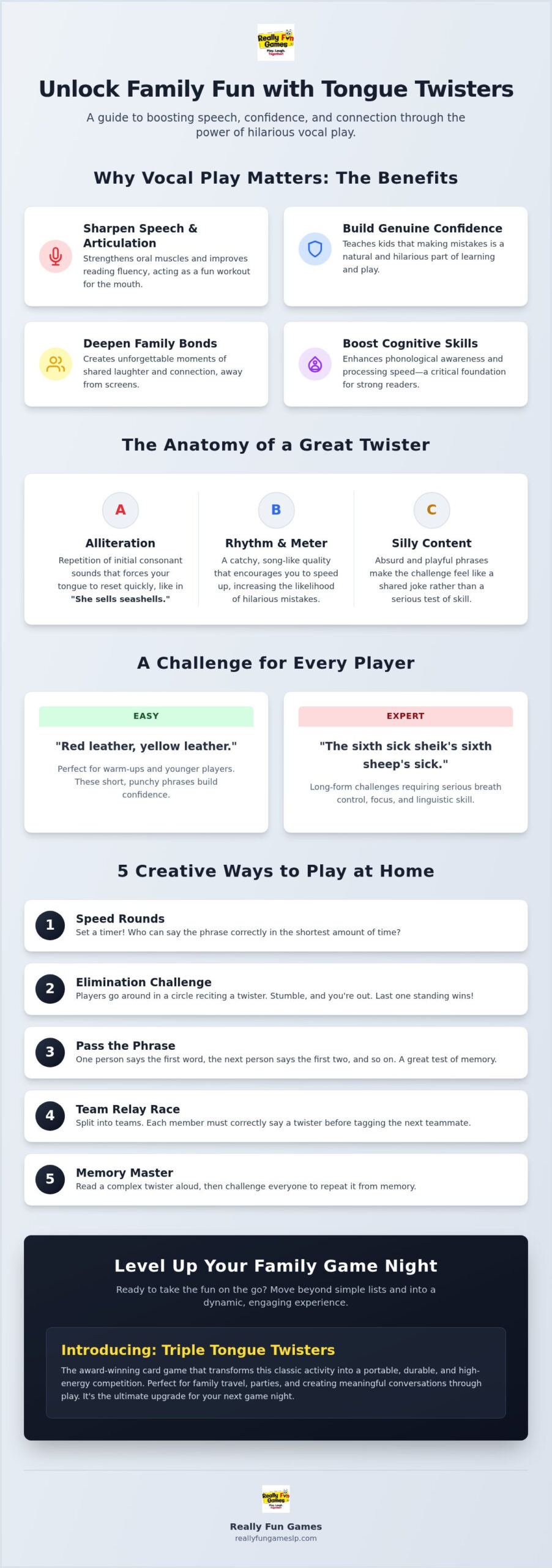
Why does “She sells seashells” make us stumble? It is all about the architecture of the phrase. Great fun tongue twisters rely on three main pillars. First is alliteration. This is the repetition of initial consonant sounds. When your tongue has to reset for the same sound over and over, it eventually misses its mark. We also see consonance, which is the repetition of similar consonant sounds in short succession. Next is rhythm and meter. A catchy twister feels like a song. The musicality makes you want to go faster, which is exactly when the mispronunciations start. Finally, there’s silly content. We’ve found that kids engage more deeply when the phrases are absurd. Saying something ridiculous makes the struggle feel like a shared joke rather than a test.
A Brief History of Vocal Play
Vocal puzzles aren’t a new fad. For centuries, these phrases were serious tools for elocution. Teachers used classics like “Peter Piper” to help students master clear diction and public speaking. This was often a rigid, high-pressure environment. Over time, the stiff, formal classroom vibe shifted into something much warmer and more connected. Today, we’ve moved from dusty textbooks to vibrant family game nights. We designed our Triple Tongue Twisters game to capture this evolution. It turns a historical speech exercise into an award-winning celebration of laughter. It is about moving away from proper training and toward a high-energy experience that builds confidence through pure, exuberant play. This shift allows families to focus on the joy of the attempt rather than the accuracy of the result.
The Ultimate List of Fun Tongue Twisters by Difficulty
Welcome to the ultimate vocal playground! Finding the right level of challenge is the secret to keeping the momentum alive during any group activity. If a phrase is too easy, the game loses its spark; if it’s too hard, frustration might set in. This is why we categorize our fun tongue twisters by difficulty. It allows every player, from ages 8 to 80, to find their groove while slowly leveling up their skills. You can explore a wide variety of starting phrases in The Ultimate List of Fun Tongue Twisters to get your group moving.
Short and Sweet: Easy Twisters for Starters
For those just beginning their vocal journey, short and punchy phrases are the way to go. These help build initial confidence and get the mouth moving without overwhelming the speaker. They’re excellent for younger kids or as a quick icebreaker. Try these classics to get started:
- Red leather, yellow leather.
- Unique New York.
- Toy boat, toy boat, toy boat.
These simple repetitions are perfect for a quick warm-up before diving into a full family game night. They focus on simple repetitive sounds that are just tricky enough to cause a giggle without causing a total tongue meltdown.
The Heavy Hitters: Challenging Phrases for Experts
Once you’ve mastered the basics, it’s time for the heavy hitters. These long-form phrases require serious breath control and unwavering focus. Many of these mix “s” and “sh” sounds, which are notoriously difficult for the brain to process at high speeds. Our expert-level challenges, like those in the Tricky Tetra Tongue Twisters collection, provide the ultimate competitive fun. A Tetra twister is a four-part vocal challenge that tests both memory and articulation in a single sequence. These are the phrases that turn a casual gathering into an exuberant celebration of linguistic skill.
Thematic Fun: Animals, Food, and More
Keeping interest high often means switching up the theme to match the mood of the room. Silly animal-themed phrases like “Six slippery snails slid slowly seaward” are always a hit with kids who love nature. Food-focused twisters add a layer of absurdity that makes everyone hungry for more laughter. During the holidays, you can even try seasonal favorites like those found in Santa’s Tongue Twisters or Trick-or-Treat Tongue Twisters. If you’re ready to take these challenges on the road, consider grabbing a portable card game to keep the fun tongue twisters going anywhere you travel.
Why Vocal Play Matters: Benefits for Speech and Confidence
Vocal play is the ultimate high-energy workout for the brain and the mouth. While we often view fun tongue twisters as simple entertainment, they serve as a vital “vocal gym” that sharpens articulation and builds lasting confidence. By engaging in these rhythmic challenges, kids learn to navigate complex phonological patterns while discovering that the journey is just as important as the destination. It is a celebratory process where the goal isn’t just to get the words right, but to enjoy the exuberant struggle of trying.
Articulation and the SLP Connection
Speech-language pathologists (SLPs) and educators have long recognized that repetition is the secret to mastering clear speech. When kids practice these phrases, they’re actively strengthening the muscles of the tongue, lips, and jaw. This repeated movement builds the muscle memory required for precise pronunciation and better diction. For professionals looking to integrate these tools into their practice, check out our guide on the Best Educational Games for Speech Therapists. By making articulation feel like a celebration rather than a chore, we can help children overcome speech hurdles with a smile and a sense of discovery.
Confidence and Public Speaking
One of the biggest barriers to effective communication is the fear of making a mistake in front of others. Fun tongue twisters provide a safe, low-stakes environment where stumbling is actually the highlight of the game. When a child sees an adult or a peer trip over a tricky phrase, it removes the pressure to be perfect. This shifts the focus from “getting it right” to “having a blast.” Over time, this comfort with vocal experimentation translates into greater confidence during public speaking and classroom participation. Mastering a particularly difficult sequence, like the ones found in our award-winning Triple Tongue Twisters, gives kids a tangible sense of accomplishment that boosts their self-esteem.
Beyond the physical benefits, vocal play fosters deep social harmony and improved focus. It requires active listening and concentration, as players must wait for their turn and pay attention to the nuances of each sound. It also builds empathy; laughing together at a shared mistake creates a bond that few other activities can match. It teaches kids that teamwork and social skills are built through vulnerability and joy. At Really Fun Games, we believe these simple social interactions have the power to transform how families and classrooms connect, turning every challenge into a shared memory.
5 Creative Ways to Play with Tongue Twisters at Home
Static lists are a great starting point, but the real magic happens when you turn those words into a social event. To keep kids engaged for more than five minutes, you need structure, stakes, and a healthy dose of silliness. Using fun tongue twisters as a foundation for interactive games transforms a simple reading exercise into an exuberant competition that everyone wants to join. It is about moving beyond the page and into a space of shared laughter and vocal discovery.
Try these five creative methods to spark social harmony during your next gathering:
- The Speed Round: Challenge players to repeat a phrase three times as fast as possible. Use a stopwatch to see who can claim the title of “Vocal Champion.”
- Pass the Phrase: This is a vocal version of telephone. One person whispers a complex twister to the next, and you see how much it has mutated by the time it reaches the end of the circle.
- Twister Theater: Assign an emotion or an accent to the challenge. Can you say “She sells seashells” like a grumpy pirate or a confused robot?
- Classroom Competitions: Teachers can use these as high-energy brain breaks. Split the room into teams and have them “relay” a phrase from one student to the next.
- The Elimination Game: Players take turns saying the same phrase, increasing the speed with each round. If you stumble, you’re out until the next game begins.
These activities are perfect for breaking the ice in new groups. If you’re looking for more ways to build teamwork through play, explore our guide on Icebreaker Games for Groups.
Screen-Free Travel Fun
Long road trips often lead to “digital zombies” as kids disappear into their tablets. You can reclaim the cabin by declaring a no-screens zone and launching a tongue twister marathon. These games require zero equipment and provide endless entertainment that keeps the whole family engaged. It turns boring highway miles into a rhythmic discovery session where the only goal is to avoid a total tongue meltdown. For more tips on keeping the peace during long hauls, check out The Best Travel Games for Kids.
The ‘Triple’ Challenge: Adding Complexity
We love the “Triple” method for adding a layer of professional-grade difficulty. Instead of saying a phrase once, you must say it in perfect sets of three. This requires intense focus and breath control, especially when you’re using a timer to track your progress. You can easily adapt the difficulty for different age groups in the same family. Give the younger kids a short, punchy phrase while the experts tackle our award-winning Triple Tongue Twisters. This ensures everyone feels included while still being pushed to their linguistic limits.
Ready to level up your next family game night with a challenge that brings everyone together? Discover the Really Fun Games collection and find the perfect deck to spark your next riot of laughter.
Level Up Your Game Night with Triple Tongue Twisters
A static list of phrases is a fine start, but a dedicated deck of cards is where the real party begins. While free resources offer a glimpse into the world of vocal play, they often lack the durability, portability, and professional flow required for a truly high-energy event. We designed our award-winning collection of fun tongue twisters to bridge that gap. By moving from a messy printed sheet to a polished card game, you transform a simple activity into a tactile, engaging experience that captures the attention of everyone in the room. It is the difference between a school assignment and a celebratory social gathering.
Our collection includes Triple Tongue Twisters, Tricky Tetra Tongue Twisters, and Blooming Tongue Twisters, each offering a unique spin on rhythmic discovery. These games solve the “what should we play?” dilemma by providing a structured, easy-to-learn format that sparks immediate laughter. Engaging with fun tongue twisters through a physical deck allows for better game flow, as players can draw cards, pass them around, and enjoy the vibrant artwork that accompanies each challenge. It is all part of our “Really?!” philosophy: fostering genuine human connection through the transformative power of simple, joyful interactions.
Portable Play for Every Occasion
One of the greatest advantages of a card-based game is its ability to travel anywhere life takes you. Whether you are moving from the living room to a classroom or packing for a cross-country road trip, these decks fit perfectly into a bag or glove compartment. Speech-language pathologists and youth leaders frequently choose our games because they are built to last through hundreds of high-energy sessions. They provide a reliable way to keep kids focused and entertained without ever needing a charging cable. To learn more about the science behind the smiles, explore our article on How Tongue Twister Games Improve Speech and Confidence.
Finding the Perfect Game for Your Group
Choosing the right deck depends on the vibe of your gathering and the age of your players. You might opt for seasonal favorites like Santa’s Tongue Twisters to add some festive spirit to a holiday party, or stick with our year-round classics for a standard family game night. These games are uniquely designed to bring generations together; it is a rare joy to see grandkids and grandparents laughing at the same silly mistakes. The low-stakes nature of the play ensures that everyone feels welcome to join the fun, regardless of their skill level. If you are ready to turn your next gathering into a riot of exuberant laughter, discover the full Really Fun Games collection here!
Ready to Spark a Riot of Laughter?
You’ve seen how vocal play transforms a boring car ride into a celebratory social gathering. By using fun tongue twisters as a vocal gym, you aren’t just improving articulation; you’re building a foundation of confidence and social harmony. These rhythmic puzzles teach kids that making mistakes is simply part of the joy, reducing the fear of stumbling during public speaking. It’s a powerful way to reclaim family time from digital distractions and foster deep connections through shared, silly mistakes.
Our collection offers something for every age and skill level, from easy starters to the legendary challenges found in our Tetra and Blooming decks. These award-winning family card games are trusted by SLPs and educators nationwide because they’re easy-to-learn and highly replayable. They move beyond simple text lists to create a tactile, durable experience that brings generations together around the table. It is time to put down the screens and embrace the exuberant spirit of play. Shop the Award-Winning Triple Tongue Twisters Collection today and turn your next game night into a memory your family will cherish forever. Let the laughter begin!
Frequently Asked Questions
What is the hardest tongue twister in the world?
MIT researchers identified “pad kid poured curd pulled cold” as one of the most difficult challenges ever created. It is designed to trigger specific phonological errors that confuse even the most articulate speakers. While we love a classic challenge, our Tricky Tetra collection offers a similar level of exuberant difficulty. These four-part vocal puzzles push your focus to the limit, ensuring that every victory feels like a hard-earned celebration of linguistic skill.
Are tongue twisters good for speech therapy?
Speech-language pathologists frequently use fun tongue twisters to target specific phonemes and strengthen the muscles required for clear articulation. By repeating these rhythmic phrases, kids build muscle memory and improve their enunciation in a high-energy environment. This makes therapy feel like a joyful game rather than a chore. Our award-winning games, including Triple Tongue Twisters, are trusted tools for educators and SLPs nationwide who want to foster communication skills through play.
At what age can kids start practicing tongue twisters?
Children can begin exploring simple vocal puzzles as early as 2 or 3 years old according to ASHA milestones. These early attempts focus on basic sound repetition and phonemic awareness. However, we design our Really Fun Games collection specifically for ages 8 and up. At this stage, kids have the cognitive development to handle more complex word patterns and the social maturity to enjoy the hilarious mistakes that happen during group play.
How do tongue twisters help with public speaking confidence?
Vocal play reduces the fear of stumbling over words by turning mistakes into a source of shared laughter. When kids learn that it is okay to trip up in a low-stakes game, they become more comfortable speaking in front of others. This builds a foundation of confidence that carries over into classroom presentations and social interactions. Mastering a difficult phrase provides a tangible sense of accomplishment that encourages kids to find their voice.
Can tongue twisters help adults improve their articulation?
Adults absolutely benefit from practicing these phrases to sharpen their diction and vocal clarity. Many professional speakers and actors use them as warm-up exercises to ensure their articulation remains crisp. It is a fantastic way for parents and grandparents to stay mentally sharp while engaging in social harmony with the younger generation. Our games are designed to be inclusive, making them perfect for adults who want to join the exuberant fun of game night.
What are some short tongue twisters for beginners?
Beginners should start with punchy, repetitive phrases that build confidence without being overwhelming. These short challenges are perfect for a quick warm-up before diving into a longer game. Some great examples include:
- Red leather, yellow leather.
- Toy boat, toy boat, toy boat.
- Unique New York.
These phrases focus on simple consonant shifts that are just tricky enough to spark a giggle and get the mouth moving.
How can I make tongue twisters into a competitive family game?
You can transform fun tongue twisters into a high-energy competition by introducing speed rounds or elimination challenges. Use a timer to see who can repeat a phrase three times the fastest without a single stumble. For a more structured experience, our Triple Tongue Twisters card game provides everything you need for a portable, highly replayable family game night. It turns vocal play into a tactile event where players compete for the title of ultimate tongue-tangler.
Why does my tongue get ‘tied’ when I say these phrases?
Your tongue gets tied because of a disconnect between your brain’s processing speed and your mouth’s physical movements. When you encounter similar sounds in quick succession, your neural pathways can overlap, leading to hilarious mispronunciations. This brain-to-mouth disconnect is exactly what makes vocal play so much fun. It creates a spirit of lightheartedness where everyone can laugh at the absurdity of their own speech, strengthening bonds through shared, exuberant mistakes.
