
Classroom games only succeed when they ditch complicated rulebooks in favor of instant social connection. As an educator, you already know the frustration when group work stalls, short attention spans take over, or an activity feels like a disguised worksheet. Worse yet, nobody wants to lose half an instructional period just deciphering instructions. Finding dynamic, durable card games for classrooms solves this dilemma by turning routine transitions and stations into lively hubs of vocal play and genuine peer interaction.
Whether you need to spark speech practice, support shy learners, or breathe fresh life into morning meetings, the right tabletop deck makes all the difference. You will discover how simple tabletop card games enhance student communication, collaboration, and learning engagement across diverse grade levels and reading abilities. Here is your roadmap to zero-prep, high-energy activities that build an inclusive classroom culture where every single student participates enthusiastically.
Key Takeaways
- Discover why tactile, screen-free tabletop play outperforms digital tools for student focus, memory retention, and collaboration.
- Learn practical rubrics to choose card games for classrooms that feature two-minute rule explanations and flexible group scaling.
- Explore dynamic categories ranging from empathy-building icebreakers to fast-paced phonics and articulation challenges.
- Master seamless lesson integration techniques to turn card activities into five-minute bell ringers, center rotations, or rainy-day recess wins.
- Find out how award-winning titles from Really Fun Games deliver durable, low-stress connection across diverse reading levels.
Why Card Games for Classrooms Transform Modern Student Learning
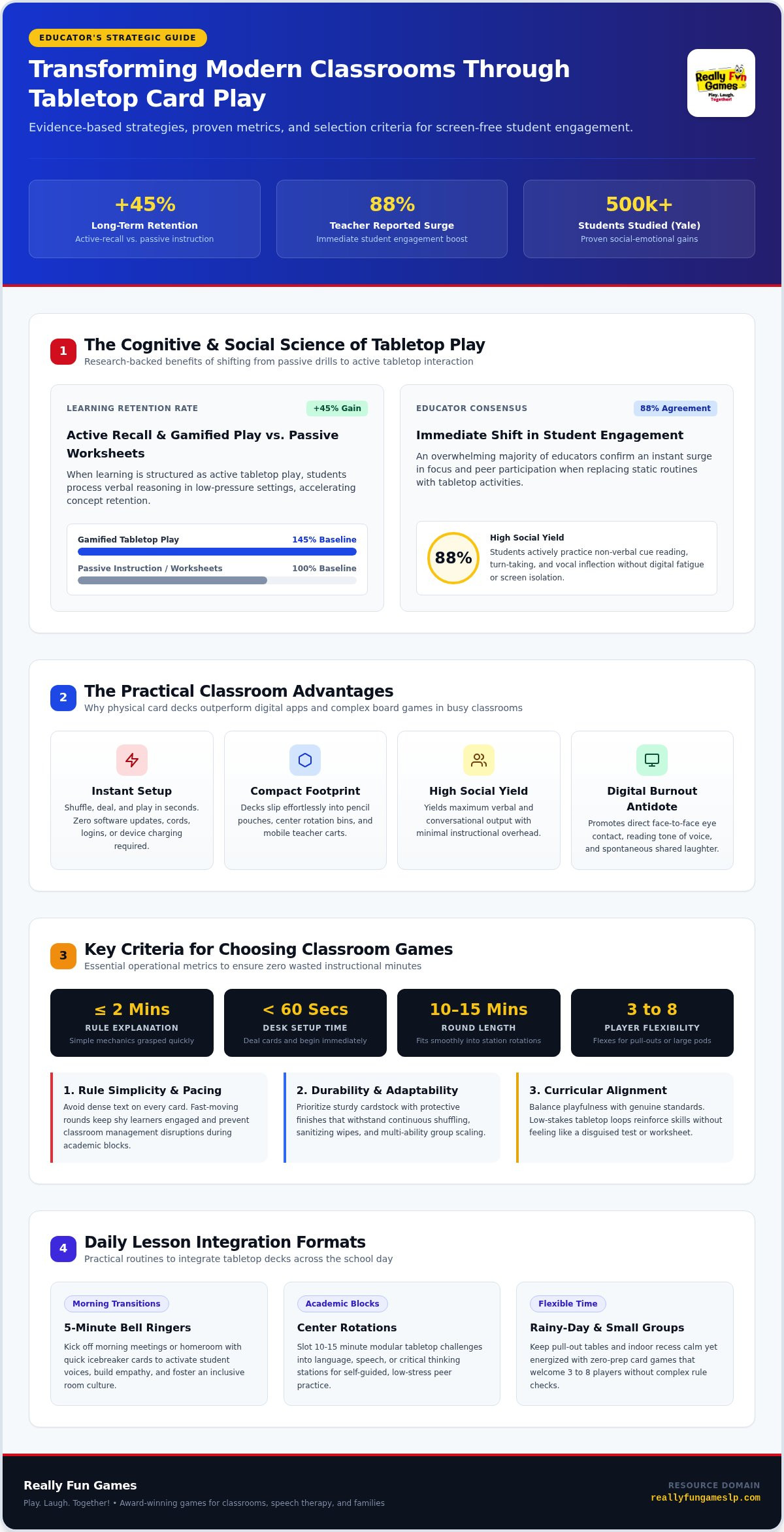
Classroom card games are structured tabletop tools designed to teach communication, teamwork, and critical thinking. Rather than relying on rigid worksheets or solitary drills, these games build organic social interactions right at student desks. According to educational research, active-recall and gamified learning methods improve long-term retention by 45% compared to passive instruction. When learning feels like play, students absorb concepts faster and retain them longer.
Tactile, screen-free play creates an immediate shift in focus. An overwhelming 88% of educators report a direct surge in student engagement when using interactive tabletop activities. By shifting away from static routines, dynamic educational games invite students to share laughs, navigate challenges, and build empathy in real time.
For educators managing packed supply closets and tight transitions, tabletop decks provide distinct practical advantages:
- Instant setup: Shuffle, deal, and play within seconds without software updates, cords, or log-in screens.
- Compact footprint: Decks slip easily into pencil pouches, center bins, or mobile teacher carts.
- High social yield: Maximum conversational output with minimal instructional overhead.
The Cognitive and Social Benefits of Tabletop Play
Tabletop card games promote quick verbal reasoning in a low-pressure environment. A Yale Child Study Center review covering more than 500,000 students showed that structured social-emotional learning boosts peer relationships, self-esteem, and classroom safety. When children participate in fast-moving conversational rounds, they practice active listening and turn-taking naturally. Shy learners who stay quiet during whole-group discussions find their voices inside small, supportive gaming circles.
Screen-Free Interaction in a Digital School Environment
Classroom devices have their place, but excessive screen exposure leads to fatigue and social isolation. Purposefully introducing card games for classrooms counters digital burnout by requiring direct, face-to-face peer connection. Students learn to read non-verbal cues, interpret vocal inflection, and react to spontaneous moments of humor. By gathering around a physical deck, your room transforms into a collaborative space where genuine human connection takes center stage.
Key Criteria for Choosing the Best Classroom Card Games
Bringing games into your room shouldn’t feel like a gamble with your instructional minutes. Selecting the right card games for classrooms requires a sharp filter. If a deck requires ten minutes of reading rules, it belongs on a family game shelf, not in a fast-moving academic block. Teachers need reliable tools that spark immediate participation without sparking classroom management headaches. When evaluating options for your curriculum, focus on games that deliver high social returns with minimal overhead.
Pacing, Rule Simplicity, and Setup Speed
Look for titles with rules students can grasp in two minutes or less. Physical desk setup should take under sixty seconds: simply deal the cards and start. To keep station rotations running smoothly, prioritize formats where a complete round finishes within ten to fifteen minutes. Avoid titles with dense text instructions on every single card unless direct reading comprehension is your lesson objective. The quicker kids understand the core mechanics, the faster they jump into active play.
Adaptability Across Group Sizes and Skill Levels
Classroom seating arrangements rarely match strict player-count limits. The best card games for classrooms flex effortlessly, functioning just as well for three students at a pull-out table as they do for six to eight learners at a pod. Look for modular formats where you can easily adjust challenges for mixed-ability learners without making anyone feel singled out.
Card durability is another non-negotiable factor. Flimsy paper stock quickly bends, tears, or stains under heavy daily handling. Prioritize sturdy cardstock with protective finishes that withstand continuous shuffling, sanitizing wipes, and months of energetic group use.
Curricular Alignment and Skill Reinforcement
Every classroom activity should balance genuine playfulness with clear learning standards. When an activity feels like a disguised test, kids disengage immediately. University research on game-based learning strategies demonstrates that low-stakes play dramatically boosts collaborative focus and student memory. The central loop of the game should naturally reinforce competencies like verbal reasoning, phonics, or active listening. Introducing proven educational communication games helps you spark authentic peer dialogue while reinforcing essential speaking and listening milestones.
Essential Categories of Card Games for Elementary and Middle Schools
Every classroom dynamic is unique, which means a single game format cannot solve every instructional need. Some days require quiet collaboration to settle restless energy after lunch. Other times demand high-spirited vocal drills to wake up tired brains. Building a versatile game library gives you the right tool for any moment. When curating card games for classrooms, categorizing decks by their core social function ensures your students get the exact support they need.
Here are the four foundational categories that belong in any elementary or middle school classroom:
- Empathy and icebreaker games: Build rapport and dissolve social cliques.
- Speech and phonics decks: Accelerate diction, rhythm, and phonological awareness.
- Deduction and strategy sets: Sharpen logic, working memory, and hypothesis testing.
- Fast-action reaction games: Reset physical energy and banish mid-afternoon slumps.
Conversation and Social-Emotional Learning Card Games
Morning meetings often struggle when the same three vocal students dominate every discussion. Conversation card games level the playing field by creating structured, low-stakes opportunities for self-expression. Decks like Really?! Think You Know Me? Guess Again! give kids pre-built prompts to guess each other’s favorite memories, hypothetical choices, and quirky preferences. These shared discoveries dissolve artificial social barriers. Classmates quickly realize how much they share in common, establishing psychological safety and mutual respect across the entire room.
Speech, Phonics, and Articulation Card Games
Repetitive oral drills often feel dry, intimidating, or tedious for developing readers. Speech-centered card games flip that dynamic entirely by transforming targeted sound repetition into contagious laughter. Games like Triple Tongue Twisters use alliteration, meter, and rapid-fire play mechanics to challenge oral motor planning. Students race to gather matching sets while reading complex twisters aloud. By integrating proven tongue twister speech activities, educators and speech-language pathologists help students celebrate mispronunciations without embarrassment, building resilient verbal confidence.
Deduction, Memory, and Critical Thinking Games
Strategic card games challenge kids to eliminate false hypotheses, retain revealed information, and think two steps ahead. Whether decoding mystery clues or sequencing complex patterns, players must justify their choices out loud to their peers. These problem-solving sessions strengthen executive function and verbal reasoning without adding a single grading pile to your desk. Integrating varied card games for classrooms turns everyday skill development into joyful group discovery.
How to Seamlessly Integrate Card Games into Daily Lesson Plans
Great tabletop tools fall flat if they turn your room into chaotic free play. Integrating card games for classrooms requires purposeful structural guardrails. With 74% to 81% of K-8 educators regularly tapping into game-based pedagogy, the secret lies in modular time blocks. Rather than saving cards for a rare Friday reward, build them directly into your daily instructional rhythms.
Smart ways to schedule tabletop play across your day include:
- Morning bell ringers: Ten-minute conversational openers that prime focus and wake up sleepy minds.
- Center rotations: Dedicated station stops where small groups play during targeted reading or math blocks.
- Early-finisher incentives: Turnkey activities that reward focused independent work without disturbing others.
- Indoor recess resets: Screen-free social play that channels indoor energy productively on rainy afternoons.
Setting Up Efficient Classroom Learning Stations
Station success depends on friction-free logistics. Designate specific table zones where card boxes and score markers remain pre-positioned before the bell rings. To minimize interruptions while you pull intervention groups, assign a rotating student facilitator at each table to clarify card prompts and keep turns moving. Set a clear visual timer for 12 to 15 minutes, which gives groups ample time to shuffle, play a full cycle, and pack up without dragging down academic momentum. When equipping early learning spaces and station rotations with engaging group activities, specialized educational outfitters such as Kigata offer a variety of play and movement resources designed for group settings.
Establishing Expectations and Noise Control
Joyful vocal play gets loud fast if you skip upfront boundary-setting. Model what enthusiastic yet considerate dialogue looks like before opening the decks. Practice hand signals or point to a visual sound meter so students can monitor their own volume when laughter peaks. Borrowing strategies from group icebreaker team activities helps you cultivate a culture of cheering on peers, taking turns gracefully, and celebrating creative answers.
Post-Game Reflection and Assessment Prompts
Lock in the educational value by capping every session with a quick two-minute reflection. Ask students to share one surprising fact they discovered about a teammate, or prompt them to jot down an unfamiliar vocabulary term in their learning journals. Connecting tabletop discoveries back to larger conversational and academic standards ensures students recognize the real growth behind the fun.
Ready to upgrade your instructional tool kit? Discover how our collection of screen-free tabletop favorites can energize your daily rotations when you explore educational communication games from Really Fun Games.
Award-Winning Card Games from Really Fun Games for Your Classroom
Teachers rarely have spare hours to laminate DIY printables or replace flimsy paper flashcards that tear by mid-semester. Really Fun Games designs award-winning, screen-free card games specifically crafted for genuine human connection. Engineered for ages eight and up, each title delivers instant replay value that keeps students eager for future rotations. Built with durable components and protective coatings, these boxed games endure years of active classroom handling while eliminating prep work entirely.
Here is why these tabletop tools stand out as premier card games for classrooms:
- Ready out of the box: Zero cutting, sorting, or laminating required before your first round.
- Built for busy hands: Thick, durable cardstock resists bending and stands up to daily cleaning.
- High replayability: Hundreds of unique combinations keep stations feeling fresh every week.
Really?! Think You Know Me? Guess Again! for Social Connection
Transforming classroom culture starts with breaking down social walls. Really?! Think You Know Me? Guess Again! serves as an extraordinary icebreaker card game that cultivates empathy and mutual understanding across diverse grade levels. Students use number dials to guess their peers’ preferences, memories, and quirky opinions, sparking uncontrollable laughter and thoughtful dialogue. It dismantles cliques effortlessly by showing classmates just how much they truly share in common.
The Tongue Twisters Collection for Speech, Language, and Literacy
Targeting phonetic awareness and reading fluency becomes pure fun with our fast-paced speech titles. Triple Tongue Twisters challenges students to collect matching sets and articulate tricky phrases at top speed. For seasonal variety and progressive difficulty, titles like Tricky Tetra Tongue Twisters and Blooming Tongue Twisters expand phonemic coordination even further. These versatile decks are frequently paired with dedicated speech therapy learning games to normalize articulation practice inside inclusive classrooms.
Equipping Your School with Really Fun Custom Games Bundles
Outfitting an entire grade band, advisory wing, or speech resource room requires scalable solutions. The Really Fun Custom Games Bundle lets educators combine multiple titles to meet their specific curricular goals. For larger desk clusters, adding sets of Extra Number Dials allows you to seamlessly expand student groups without buying separate games. Explore the complete Really Fun Games classroom collection to energize your lesson plans with playful, lasting connection.
Transform Your Classroom Community Through Meaningful Tabletop Play
Meaningful learning happens when students feel connected, heard, and excited to participate. Integrating thoughtful card games for classrooms turns everyday routines into powerful moments of peer collaboration and verbal growth. By choosing decks with rapid setups, durable components, and engaging conversational loops, you swap out digital fatigue for genuine human connection.
Whether you need an empathy-building icebreaker to dissolve social cliques or an energetic speech challenge that gets students laughing through phonics practice, tabletop games provide the spark. They invite every learner, from the quietest observer to the most energetic speaker, to step into the circle with confidence.
Give your students tools that encourage real conversations and lasting friendships. Zero-prep mechanics keep your lesson plans streamlined, while durable cards stand up to daily use. Take the first step toward a more joyful, collaborative learning space today: Bring joyful connection to your students with Really Fun Games!
Frequently Asked Questions
How do card games support social-emotional learning in the classroom?
Card games build social-emotional skills by giving students structured, low-stakes opportunities to practice perspective-taking, active listening, and self-awareness. When players take turns asking questions or guessing peer responses, they practice patience and mutual empathy. These shared moments help children recognize unexpected commonalities across backgrounds, creating a kinder and more inclusive classroom climate where everyone feels secure expressing their thoughts.
Can card games help students who struggle with speech articulation or reading fluency?
Yes, rhythm and alliteration games transform repetitive vocal drills into motivating play. Games like Triple Tongue Twisters target oral motor planning, phonemic awareness, and diction by having students repeat playful phrases aloud. Because the atmosphere stays lighthearted, students who feel self-conscious during traditional reading aloud can stumble, laugh, and try again without anxiety, steadily improving both vocal clarity and reading confidence.
What is the ideal group size for playing card games during classroom stations?
The optimal group size for card games for classrooms is three to six students per station. This range keeps individual downtime short, ensuring every child stays engaged without waiting too long for their turn. For larger clusters, games featuring expandable mechanics or accessories like Extra Number Dials let you comfortably include up to twelve players without compromising communication or pacing.
How do teachers manage classroom noise levels when students play card games?
Teachers manage game volume by establishing clear hand signals, visual sound meters, and assigned table facilitators before opening the cards. Designating one student at each table to monitor conversational turns keeps peer interaction focused. Emphasize that excitement is welcome, but remind groups to use inside table voices so nearby stations can concentrate on their own tasks without distraction.
Are card games suitable for students with diverse learning abilities and attention spans?
Card games excel in mixed-ability classrooms because their mechanics rely on visual prompts, verbal sharing, and short turn cycles. Children who lose focus during long lectures stay alert during brisk two-minute rounds. Educators can easily scaffold gameplay by pairing reluctant readers with supportive buddies or adjusting round goals, ensuring every child participates successfully regardless of their individual learning style.
How long does a typical educational card game take to set up and play?
Most classroom card decks require under sixty seconds of physical setup and between ten to twenty minutes of active play. Simply distribute the decks to student tables, give a quick prompt, and start immediately. This brief duration makes card games for classrooms ideal for morning warm-ups, small-group center rotations, or productive brain breaks between heavier academic blocks.
What makes conversation card games better than traditional get-to-know-you worksheets?
Conversation card games surpass worksheets by turning personal sharing into dynamic, live peer dialogue rather than a solitary writing assignment. Prompt cards spark spontaneous laughter, follow-up questions, and active listening in real time. Instead of handing in a paper that only the teacher reads, students actually talk, listen, and build genuine friendships face to face.
