What if the highlight of your child’s day wasn’t a screen or a snack, but their speech practice? It sounds like a dream, yet it’s entirely possible when you swap repetitive drills for fun speech therapy activities that spark genuine excitement. We’ve all felt that sinking feeling when a child’s interest fades during traditional exercises, making it nearly impossible to hit those crucial articulation goals. It’s frustrating for parents, exhausting for SLPs, and, frankly, a bit boring for the kids involved.
You’re in the right place to change that dynamic forever. This article promises to help you discover creative, play-based strategies that turn quiet sessions into vibrant, high-energy games. We believe that communication is the heartbeat of human connection, and there’s no better way to foster it than through shared laughter and spontaneous discovery. By shifting the focus from clinical repetition to joyful engagement, you can unlock progress you never thought possible.
We’ll walk you through fifteen innovative ideas that work for social skills and sound production alike. You’ll learn how to use sensory-rich tools and award-winning games like Triple Tongue Twisters to build confidence while making every session feel like a celebration. Get ready to explore how you can create meaningful family bonding and lasting communication progress through the transformative power of play.
Key Takeaways
- Understand how child-led play melts away performance anxiety, creating a safe space where communication flourishes through genuine joy.
- Learn how to turn dull articulation drills into high-energy games with fun speech therapy activities like Triple Tongue Twisters to target specific sounds.
- Shift your focus from how words are said to the magic of social connection using Really?! Think You Know Me? Guess Again! to build narrative skills.
- Master the art of the low-pressure game night, ensuring your child feels like a champion while working on their unique speech goals.
- Discover simple ways to weave vocal play into daily routines, making progress possible during car rides or festive holiday gatherings.
Why Play-Based Speech Therapy Activities Are More Effective
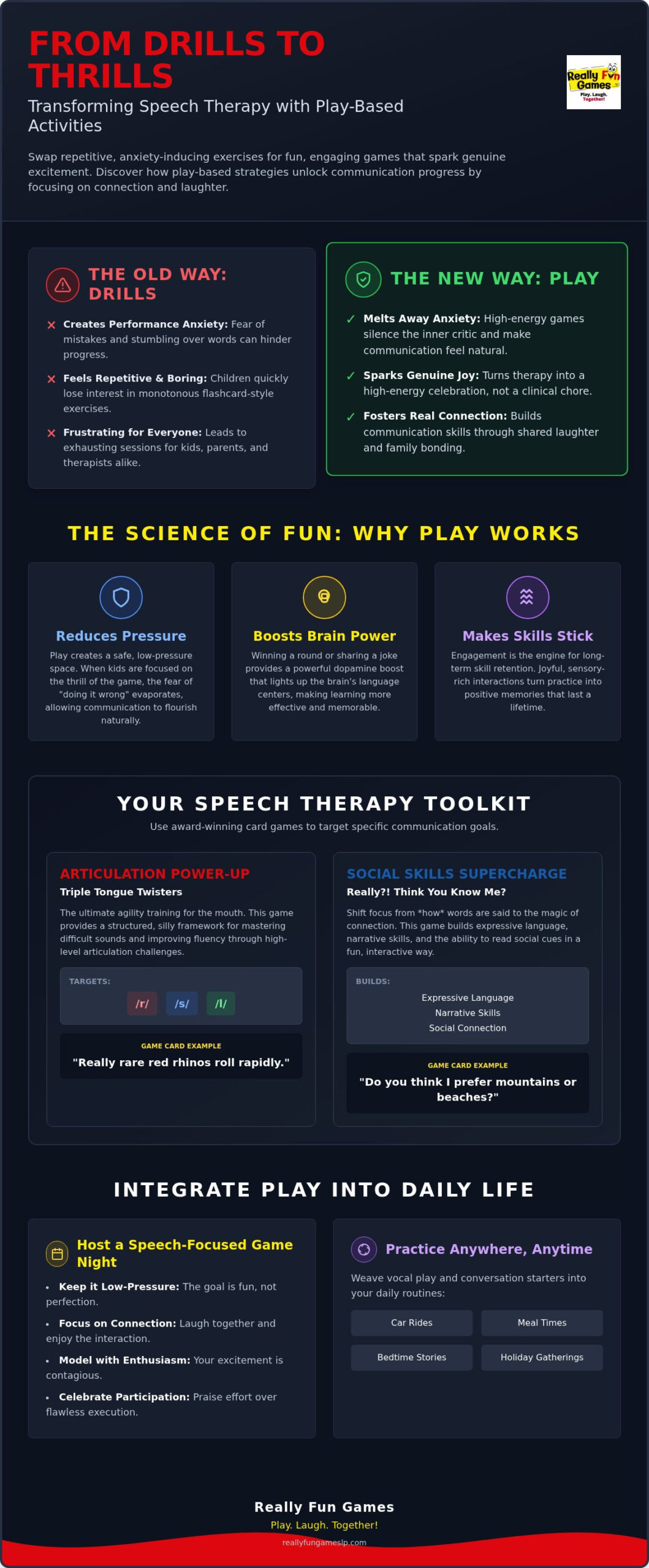
Communication is a celebration, not a chore. When we embrace fun speech therapy activities, we transform the learning environment from a clinical space into a playground of possibility. Play-based therapy is a child-led, naturalistic approach to language development that prioritizes the child’s interests and spontaneous curiosity. Instead of forcing a child to follow a rigid script, we follow their lead. This method is gaining massive traction within the professional field of Speech-language pathology because it treats the child as an active participant rather than a passive recipient of instruction.
High-energy play does something magical: it silences the inner critic. Children with speech delays often carry a heavy load of performance anxiety, fearing the moment they’ll stumble over a syllable. When the game gets exciting, that anxiety evaporates. The brain’s focus shifts to the thrill of the interaction, which is where true neuroplasticity happens. Engagement isn’t just a bonus; it’s the engine of long-term skill retention. Play-based therapy is the intentional use of joyful interaction to achieve clinical communication goals.
The Psychology of Game-Based Learning
Winning a round or sharing a joke provides a powerful dopamine boost that lights up the brain’s language centers. Social rewards are the ultimate motivator. This “invisible therapy” allows a child to practice complex sounds or sentence structures without the crushing weight of “doing it wrong.” While digital apps offer quick distractions, they lack the sensory-rich experience of a physical card game. Real-world social cues, like noticing a teammate’s grin or waiting for a turn, are skills that only happen when you’re face-to-face. Physical games foster a sense of harmony that screens simply cannot replicate.
Moving from Drills to Thrills
For children aged 8 and up, flashcard drills can feel babyish or repetitive. They want games with depth and personality. Moving from drills to thrills means using competitive or cooperative mechanics to sustain attention. These fun speech therapy activities keep a child engaged for much longer than a standard worksheet ever could. By integrating award-winning card games into your routine, you move the practice from the therapy room to the living room. Using a game like Really?! Think You Know Me? Guess Again! turns a speech session into a family memory that sticks, making the hard work of communication feel like pure joy.
Articulation Power-Ups: Using Tongue Twisters for Speech Sounds
Tongue twisters are the ultimate agility training for the mouth. While basic drills focus on single sounds, these fun speech therapy activities challenge a child’s phonology and fluency by stringing complex patterns together. It’s high-level articulation that feels like a high-energy game rather than a clinical lesson. The Triple Tongue Twisters collection provides a structured yet silly framework for mastering difficult phonemes. By using physical game cards, you can help a child visualize the pacing of their speech. This physical anchor is incredibly helpful for preventing cluttering or stuttering, as it encourages the speaker to touch each card or word as they navigate the sentence. It’s about building a rhythm that feels natural and joyful.
Once a child feels comfortable with the rhythm, you can introduce the “Speed Challenge.” This method involves gradually increasing the rate of speech while maintaining crystal-clear clarity. It’s a fantastic way to track progress toward developmental milestones without the pressure of a formal evaluation. If you want to see how these challenges can transform your next session, explore our award-winning card games designed for vocal play. You’ll find that when the focus is on the challenge, the speech sounds follow naturally.
Mastering Specific Phonemes through Vocal Play
Focusing on the /r/, /s/, and /l/ sounds becomes an adventure with alliterative card prompts. These sounds are often the trickiest for school-aged children, but they become manageable when wrapped in a humorous phrase. For advanced learners who need a greater challenge, Tricky Tetra Tongue Twisters up the ante with even more complex consonant clusters. You can easily gamify repetitions by setting a simple rule: “Say it three times fast without a stumble to win the card.” This turns a standard repetition drill into a high-stakes victory that rewards persistence and precision. SLPs looking to maximize trial counts while keeping sessions engaging will find our speech therapy materials for articulation a valuable resource for planning high-energy, game-based sessions. It’s a great way to keep energy levels high while hitting those specific articulation targets.
Building Confidence with Silly Speech
The best part about tongue twisters is that they are designed to be difficult. This makes it easy to normalize speech “mistakes” because everyone, including parents and therapists, will inevitably trip over their words. Laughter becomes a tool to reduce the frustration often associated with speech therapy. When a child laughs at a slip-up, they are building the resilience needed for long-term success. For a deeper look at this, read How Tongue Twister Games Improve Speech, Confidence, and Family Fun. By embracing the silliness, you’re helping them find their voice in a supportive and fun-loving environment.
Expressive Language and Pragmatics: The Power of Conversation
Speech is more than just making the right sounds; it’s about the magic of being understood. While we’ve already explored articulation power-ups, it’s time to shift our focus from the mechanics of speech to the depth of human connection. This is where expressive language and social pragmatics take center stage. By using fun speech therapy activities that prioritize “what we say” over “how we say it,” we invite children to become confident storytellers. Family conversation games are incredible tools for this journey. They turn the act of speaking into a vibrant social exchange where every word builds a bridge between people.
Our award-winning game, Really?! Think You Know Me? Guess Again!, is a perfect example of this shift. It uses a unique “Guessing Mechanic” that requires players to predict a family member’s answer. This isn’t just about winning a point; it’s about social inference. It forces the child to step into someone else’s shoes, practicing perspective-taking and empathy in a high-energy environment. When a child tries to figure out what Grandma would pick as her favorite superpower, they’re doing deep cognitive work disguised as a hilarious family game night. It’s a celebratory way to learn how others think and feel.
Building Narrative and Descriptive Skills
To help a child move beyond one-word answers, we need to provide a playground for their imagination. Using open-ended questions naturally encourages multi-sentence responses, which is essential for building narrative skills. You’ll find that practicing “Wh-” questions in a natural, high-stakes game context feels much less like an exam and more like an adventure. Many parent resources emphasize the importance of this naturalistic approach to language. Encourage your child to elaborate on their answers. Ask them “Why?” or “Tell me more!” to help them build vocabulary and sentence complexity. Conversation card games provide the perfect prompts to keep the dialogue flowing without the pressure of a formal lesson. Pairing these conversation tools with vocabulary building games for kids gives children an even richer foundation for expressive language growth.
Social Pragmatics and Perspective Taking
Social skills are best learned through doing, not through reading a list of rules. Family card games teach turn-taking and active listening through the natural flow of play. There’s no need for a formal lecture when the game itself rewards you for paying attention to your teammates. Another vital skill is conversational repair. This happens when someone doesn’t understand an answer, and the child has to find a new way to explain their thought. It’s a real-world skill that builds immense confidence and resilience. Check out the Really Fun Games collection to find tools that make these social connections easy and joyful for the whole family.
Step-by-Step: How to Host a Speech-Focused Game Night
Imagine a night where the air is filled with laughter and the “therapy” is completely invisible. Hosting a speech-focused game night is about creating a sanctuary where communication flourishes without the weight of expectation. These fun speech therapy activities work best when they feel like a celebration of connection rather than a clinical session. You aren’t just a parent or therapist during these sessions; you’re a fun-loving facilitator guiding a journey of discovery. By selecting the right game, you can target specific goals without ever making it feel like work.
Choosing the right tool is the first step toward success. If you’re focusing on clear sounds and vocal agility, you’ll want a game that emphasizes rhythm and phonology. For those working on social cues and storytelling, a conversation-heavy game is the way to go. To help you choose the best fit for your family or classroom, here’s a quick look at how different goals match our award-winning designs:
| Feature | Articulation Focus | Pragmatics Focus |
|---|---|---|
| Recommended Game | Triple Tongue Twisters | Really?! Think You Know Me? Guess Again! |
| Primary Goal | Mastering Speech Sounds | Building Social Connections |
| Key Skill | Phonology and Fluency | Social Inference and Empathy |
| Core Mechanic | Rhythmic Repetition | Prediction and Perspective-Taking |
To include the whole family, don’t forget to use Extra Number Dials. This increases the social circle in a safe, supportive way, allowing your child to practice their skills with siblings and grandparents alike. It creates a celebratory atmosphere where every player feels like they belong.
Setting the Stage for Success
A successful game night starts with a clear space and a clear mind. Turn the screens off to ensure everyone can focus on vocal clarity and meaningful eye contact. This simple act tells your child that their voice is the most important thing in the room. Start with easy challenges to build momentum before moving into more complex cards. Rewards should be built into the game mechanics themselves, as winning a card or earning points creates a sense of achievement that external treats can’t match. It makes the progress feel earned and authentic.
Modeling and Recasting Techniques
Your role as a facilitator is to guide the conversation without interrupting the flow of play. Use “recasting” to naturally repeat a child’s incorrect sentence with the correct sounds. If they say, “The wed bwoon,” you might reply, “Yes, the red balloon is so bright!” It’s subtle, nurturing, and highly effective. It’s also vital that you participate fully. Show them that even adults struggle with the hilarious complexity of Triple Tongue Twisters. When you stumble and laugh, you show them that mistakes are just part of the fun. Ready to start your own tradition? Choose the perfect game for your family today and watch the communication magic happen.
Integrating Speech Practice into Daily Routines
Consistency is the secret sauce of communication success. You don’t need a clinical setting or a designated “therapy hour” to see massive progress in your child’s confidence and clarity. In fact, the most effective fun speech therapy activities are the ones that slip seamlessly into your family’s existing rhythm. Think about the dinner table. By establishing a “One Card a Day” habit, you turn a standard meal into a celebratory moment of connection. It’s a simple, low-stakes way to ensure that daily practice never feels like a burden. Whether you’re pulling a card from Really?! Think You Know Me? Guess Again! or challenging everyone to a quick rhyme, you’re building skills in the most natural environment possible.
Really Fun Games offers portable, easy-to-learn solutions for on-the-go therapy that fit perfectly into a busy lifestyle. These games are designed to be grabbed as you head out the door, ensuring that practice happens wherever life takes you. When speech practice feels like a natural extension of your day, the resistance vanishes, replaced by a spirit of spontaneous discovery and laughter. It’s about making the most of the small gaps in your schedule to foster big improvements.
Screen-Free Travel and On-the-Go Practice
A ten-minute car ride can easily become a high-energy articulation session. While it’s tempting to hand over a tablet, physical cards beat digital apps for speech development every single time. Real cards require vocalization, eye contact, and social interaction, which are the building blocks of communication. During the school commute, try quick-fire tongue twister challenges to wake up those articulators before the first bell rings. For longer journeys, check out The Best Travel Games for Kids: Screen-Free Road Trip Fun to keep the whole family engaged. These moments turn “dead time” into a vibrant playground for vocal play and shared laughter.
Seasonal and Holiday Themed Motivation
Holiday breaks often lead to a “summer slide” in speech skills, but seasonal themes can keep motivation sky-high. Use Trick-or-Treat Tongue Twisters to keep kids engaged during the spooky excitement of Halloween. When spring arrives, Blooming Tongue Twisters serve as perfect classroom icebreakers or garden-party games. Even winter becomes a time for growth with Santa’s Tongue Twisters, keeping skills sharp while the cocoa is brewing. The right tools make speech therapy a journey of joy rather than a series of tasks. When we prioritize play, we aren’t just teaching a child how to speak; we’re showing them how much fun it is to be heard and understood by the people they love most.
Transform Every Conversation into a Celebration
The journey toward clear speech and deep social connection doesn’t have to be a struggle. By embracing fun speech therapy activities, you’re choosing to replace repetitive drills with moments of pure, high-energy joy. We’ve explored how play-based strategies melt away performance anxiety, how tongue twisters build articulation agility, and how conversation games foster true empathy through social inference. These aren’t just exercises; they’re opportunities for your child to feel heard, understood, and celebrated by the people who matter most. When communication feels like a game, everyone wins.
Our award-winning designs for ages 8+ are already trusted by SLPs and educators nationwide because they’re highly replayable and intentionally simple to learn. Whether you’re mastering difficult phonemes or building complex narrative skills, the right tools turn every session into a win for the whole family. It’s time to swap the worksheets for something that sparks a genuine smile. Explore the Really Fun Games collection for speech and social skills and discover the perfect fit for your next game night. Your child’s voice is a gift, and we’re here to help you unwrap it with laughter and harmony.
Frequently Asked Questions
What are the best speech therapy activities for articulation?
The most effective articulation activities involve high-repetition vocal play that feels like a game. Using Triple Tongue Twisters allows a child to target specific phonemes like /r/, /s/, or /l/ while laughing through silly phrases. You can also try “Sound Scavenger Hunts” where players find objects starting with their target sound. These fun speech therapy activities turn the repetition needed for muscle memory into a celebratory challenge rather than a boring drill.
How can I make speech therapy fun for an 8-year-old?
Eight-year-olds crave social connection and a bit of friendly competition. Swap babyish flashcards for games with deep social mechanics like Really?! Think You Know Me? Guess Again! This age group loves proving how well they know their family members. By focusing on the “win,” the speech practice becomes an invisible part of the excitement. Incorporating points, rewards, or speed challenges keeps the energy high and ensures they stay engaged for much longer.
Can card games really help with speech delays?
Card games are powerful tools because they provide a structured framework for natural interaction. Unlike digital apps, physical cards require eye contact, turn-taking, and active listening. They create a low-pressure environment where a child can practice expressive language without feeling like they’re being tested. The tactile nature of cards helps with pacing and provides a visual anchor for speech sounds, making them a preferred choice for many educators and therapists nationwide.
How often should we practice speech therapy activities at home?
Consistency beats intensity every single time. Aim for 10 to 15 minutes of practice each day rather than one long session per week. You can easily integrate fun speech therapy activities into existing routines like the school commute or dinner time. Using a “One Card a Day” habit keeps the skills sharp without causing burnout. Frequent, joyful practice helps the brain retain new patterns more effectively, leading to faster progress and increased child confidence.
What is the difference between expressive and receptive language games?
Expressive language games focus on the child’s ability to produce speech and share ideas, like describing a card or telling a story. Receptive language games focus on their ability to understand and process information, such as following multi-step directions or identifying a specific character based on clues. Both are essential for communication. A well-rounded game night should include activities that challenge both skills, ensuring the child can both understand and be understood clearly.
Are there specific speech therapy games for social skills?
Yes, conversation starter games are specifically designed to foster social pragmatics and empathy. Really?! Think You Know Me? Guess Again! is a fantastic example because it requires players to use social inference to guess a teammate’s answer. This teaches perspective-taking and active listening in a high-energy setting. Other great options include cooperative games where players must communicate clearly to achieve a shared goal, building teamwork and conversational repair skills naturally through laughter.
How do I encourage a child who is frustrated with speech practice?
If a child feels frustrated, shift the focus entirely to the fun of the game. Normalize mistakes by making them yourself. When you stumble over a “Triple Tongue Twister” and laugh about it, you show them that speech is a journey, not a test. Use high-energy encouragement and celebrate small victories like a clear sound or a funny description. Laughter is the ultimate tool for reducing the performance anxiety that often leads to frustration.
Can tongue twisters improve clear speech in adults too?
Absolutely! Tongue twisters are excellent for adults who want to improve their diction, public speaking, or overall vocal clarity. They serve as a high-level workout for the articulators, helping anyone speak more precisely under pressure. Many professionals use them as a warm-up before presentations or meetings. Beyond the clinical benefits, they’re simply a joyful way to keep the mind sharp and bring a spirit of lightheartedness to any social gathering or corporate icebreaker.